

Magento is rarely the default answer for every retail brand. It is the right answer when the business has reached a level of operational, catalog or integration complexity that a lighter platform cannot handle cleanly.
That is why choosing a Magento development agency should not start with the platform. It should start with the constraints around your business model: how you merchandise products, how orders move through your stack, how often pricing changes, how many regions you serve and how much control your team needs over the customer experience.
For some brands, Magento (now commonly discussed alongside Adobe Commerce) gives the flexibility needed to support serious growth. For others, it adds cost and complexity before the business has earned it. The goal is not to choose the most powerful platform. The goal is to choose the platform and agency model that match the way your retail operation actually works.
Magento today: what are you really choosing?
Magento can mean two related but different things. Magento Open Source is the open source ecommerce platform. Adobe Commerce is the enterprise product built from the Magento foundation, with additional capabilities, commercial support and cloud options.
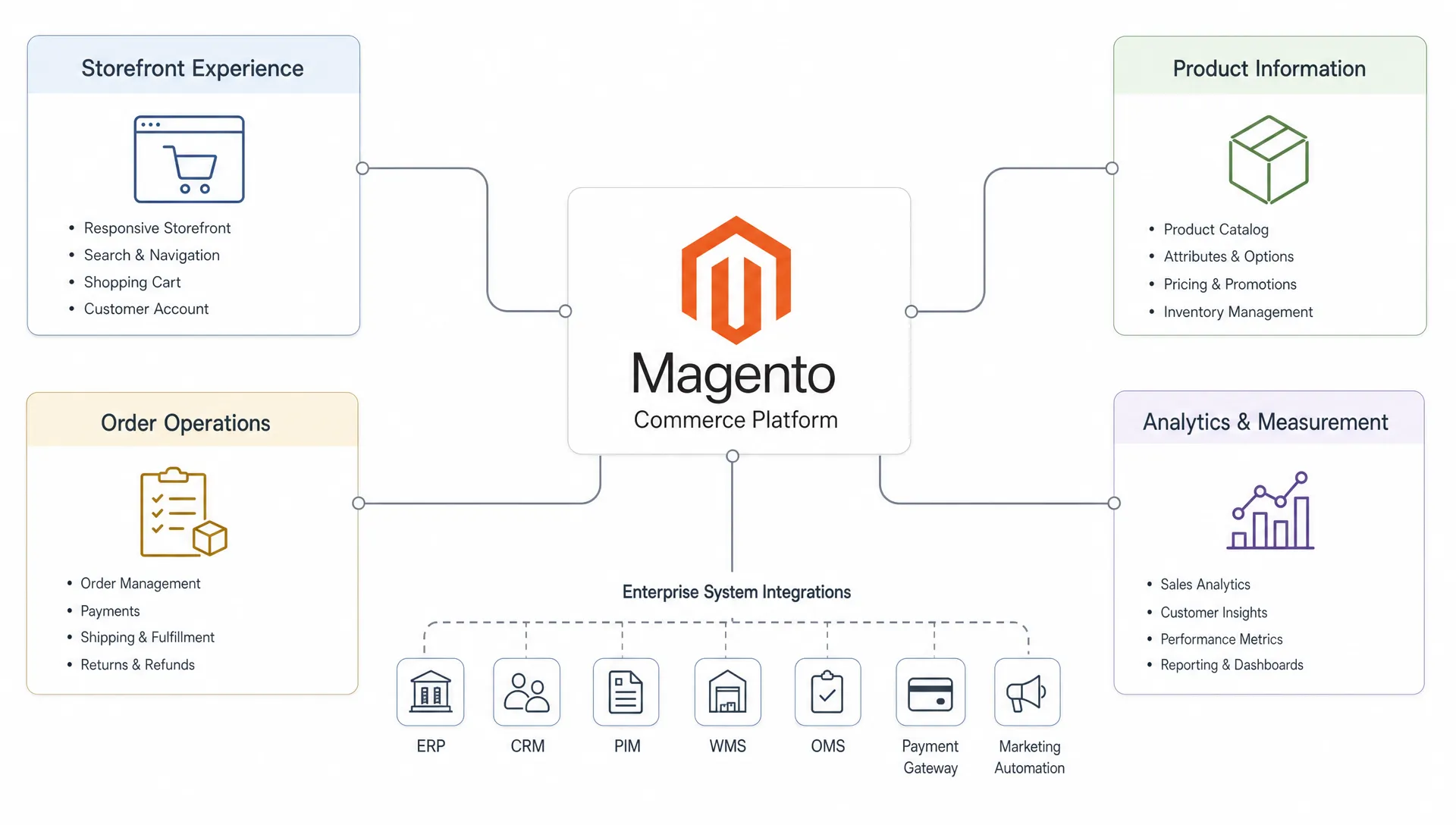
A Magento development agency typically works across the architecture, implementation, customization, maintenance and optimization of these environments. That can include custom modules, backend workflows, integrations with retail systems, theme development, checkout improvements, performance engineering and long-term platform governance.
This is very different from hiring a team to launch a simple storefront. Magento work usually involves decisions that affect operational stability, total cost of ownership and revenue performance. The agency is not only changing what customers see on the front end. It is shaping how product data, inventory, pricing, promotions, payments and fulfillment behave behind the scenes.
That depth is exactly why Magento can be valuable. It is also why it can be the wrong fit if the business does not need that level of control.
When a Magento development agency makes sense
A Magento development agency is most useful when ecommerce is deeply connected to the rest of the business. If the storefront is only a simple sales channel, Magento may be more than you need. If the storefront is a complex commercial system, Magento can be a strong foundation.
Your catalog is complex enough to need custom structure
Magento often fits brands with large catalogs, layered product attributes, configurable products, bundles, multiple price rules or region-specific availability. These are not just cosmetic requirements. They affect search, filtering, product detail pages, merchandising, inventory logic and conversion.
A retailer with a few dozen products can often work within a standard theme and app ecosystem. A retailer with thousands of SKUs across categories, fit rules, compatibility requirements, bundles or multi-brand merchandising may need deeper data modeling.
Deep catalog problems also show up in adjacent digital marketplaces. A property discovery platform such as Best Property in Dubai depends on accurate filters, detailed listing data and comparison-friendly discovery. Retailers with similar catalog depth face the same underlying challenge: customers need to narrow a large data set quickly without losing confidence in what they are buying.
A Magento agency can help define product attributes, category architecture, search behavior and admin workflows so the catalog stays manageable as it grows.
You sell B2B, B2C or both
Magento and Adobe Commerce are often considered when a brand needs more than a standard direct-to-consumer checkout. B2B or hybrid businesses may need account-specific catalogs, negotiated pricing, quote workflows, purchase approvals, tax handling, bulk ordering or customer groups.
These requirements can become messy when they are patched together through disconnected apps. A Magento development agency can help determine which workflows belong inside the commerce platform, which should stay in ERP or CRM systems and where integration boundaries should be drawn.
The benefit is not just functionality. It is operational clarity. Sales teams, customer service teams and ecommerce teams need a shared view of how accounts, pricing and orders are supposed to behave.
Your integrations are a major part of the business
Retail ecommerce rarely operates in isolation. A growing brand may rely on an ERP, PIM, OMS, WMS, payment provider, fraud tool, tax engine, loyalty platform, analytics stack and customer service system.
Magento can support complex integrations, but the quality of the implementation matters. Poorly designed integrations create slow admin screens, inaccurate stock, failed order syncs, duplicate customer records and release anxiety.
A strong Magento agency will think in terms of data contracts, queues, error handling, observability and recovery. That means asking practical questions before development starts: Which system owns each field? What happens when an API fails? How quickly does inventory need to update? Who gets alerted when an order does not sync?
If those questions matter to revenue or operations, Magento specialist support may be justified.
You need multi-store, multi-brand or international control
Magento is often attractive to retailers managing multiple storefronts, brands, languages, currencies or regional catalogs. Its architecture can support shared infrastructure with localized experiences, although the implementation needs careful planning.
A Magento development agency can help decide when to use store views, separate websites, shared catalogs, localized content structures or separate operational workflows. These decisions affect SEO, analytics, merchandising, translation, promotions, fulfillment and governance.
The platform can support a lot, but flexibility without rules becomes technical debt. The agency should help define which teams can change what, how content is localized and how shared components are maintained across markets.
You want ownership over experience and architecture
Some retail brands choose Magento because they want more control over the experience than a closed SaaS model allows. This can matter when checkout rules, pricing logic, product configuration or backend operations are central to differentiation.
That control comes with responsibility. Magento usually needs more active technical ownership than a simpler SaaS platform. You need maintenance, patching, monitoring, performance work and release discipline.
A Magento development agency is the right fit when the business values that control enough to fund the operating model behind it.
| Business signal | What it usually means | Why a Magento agency matters |
|---|---|---|
| Large or complex catalog | Product data affects search, filters and conversion | The agency can design scalable attributes, categories and merchandising logic |
| Hybrid B2B and B2C selling | Pricing, accounts and checkout rules vary by customer | The agency can map workflows across commerce, ERP and CRM systems |
| Heavy integrations | Order, inventory and customer data move across several tools | The agency can build resilient data flows and error handling |
| Multi-brand or international growth | Markets need shared systems with local control | The agency can design governance, localization and analytics structures |
| Custom operational rules | Standard apps cannot model the business cleanly | The agency can extend the platform without turning every request into technical debt |
When Magento may be the wrong fit
Magento is not automatically the more mature choice. It can be the wrong fit when a brand needs speed, simplicity or lower operational overhead more than customization.
If your catalog is straightforward, your checkout is standard, your integrations are light and your team does not want to manage a more technical environment, a SaaS platform may be more practical. In that case, the better question might be how to evaluate an agency that can scale a simpler platform well. Space Dinosaurs has covered that decision in more detail in its guide to choosing a Shopify agency that can actually scale.
Magento can also be a poor fit when the business problem is not yet clear. If a brand asks for a rebuild without knowing whether the real issue is site speed, product discovery, conversion rate, data quality or merchandising process, the platform choice may become a distraction. Starting with the business problem is usually the safer path, which is also central to choosing an ecommerce agency for long-term growth.
The warning sign is not Magento itself. The warning sign is choosing Magento because it sounds enterprise-grade, without proving that its flexibility solves a specific commercial problem.
What a strong Magento development agency should bring
A Magento specialist should bring more than platform familiarity. The best agencies understand how retail teams use the platform every day, from merchandising and marketing to customer service, warehouse operations and finance.
The work should connect technical choices to business outcomes. A custom module is not valuable because it is custom. It is valuable if it reduces manual work, improves conversion, supports a high-value customer journey or prevents operational errors.
Look for strength in these areas:
- Architecture planning: The agency should know what belongs in Magento, what belongs in external systems and how data should move between them.
- Extension governance: Magento ecosystems can become bloated when extensions are added without scrutiny. The agency should evaluate security, performance, maintainability and overlap before installing anything.
- Performance engineering: Core Web Vitals, caching, frontend weight, image handling, database performance and third-party scripts all affect revenue.
- Retail UX: Product discovery, product detail pages, cart flows and checkout should be shaped around customer behavior, not only platform defaults.
- Analytics and measurement: The agency should define what success looks like and make sure tracking supports those KPIs.
- Release discipline: Testing, deployment processes, rollback planning and monitoring matter when ecommerce revenue depends on site stability.
This is where ecommerce development becomes growth infrastructure rather than a one-time build. For a broader view of how technical work supports revenue, stability and customer experience, see Space Dinosaurs’ article on how ecommerce web development services support growth.
What the agency should evaluate before proposing work
A responsible Magento development agency should not jump straight to features. The discovery process should uncover where the current system is limiting the business and where Magento is genuinely the right tool.
| Evaluation area | Questions a good agency should ask |
|---|---|
| Commercial model | How do you sell today, and which customer segments are most profitable? |
| Catalog structure | Which product attributes drive search, filtering, compatibility and merchandising? |
| Operational workflows | Where do teams still rely on manual work, spreadsheets or duplicate entry? |
| Integrations | Which systems own product data, pricing, inventory, orders and customer records? |
| Performance | Where are speed, stability or Core Web Vitals limiting revenue? |
| Governance | Who will manage content, promotions, releases and platform decisions after launch? |
| Measurement | Which KPIs will prove that the work improved the business? |
The first engagement does not always need to be a rebuild
Many retailers assume that hiring a Magento development agency means committing to a full replatform or rebuild. Sometimes that is necessary. Often, the smarter first step is a focused audit or stabilization phase.
A Magento audit can uncover whether performance issues come from hosting, frontend code, unnecessary extensions, database problems, tracking scripts or inefficient integrations. It can also identify whether merchandising friction comes from product data, admin workflows, search configuration or UX decisions.
This matters because a rebuild is expensive and disruptive. If the existing platform has a strong foundation, optimization may deliver value faster. If the foundation is weak, an audit gives the business evidence to justify a larger investment.
A phased approach also reduces risk. The agency can start by improving site speed, cleaning up extensions, fixing analytics, stabilizing integrations or improving key journeys before proposing deeper architectural change.
Questions to ask before hiring a Magento development agency
The right agency will welcome specific questions because they reveal whether the team thinks strategically or only executes tickets.
- Which parts of our business make Magento a better fit than a simpler SaaS platform? The answer should reference your model, not generic platform advantages.
- What would you avoid customizing? Strong agencies know that unnecessary customization increases cost and risk.
- How do you evaluate Magento extensions? Listen for security, maintainability, performance and overlap with existing functionality.
- How will you protect performance during development? The agency should discuss budgets for scripts, media, frontend code, caching and measurement.
- How do you handle integrations that fail? Mature teams plan for retries, logs, alerts and operational ownership.
- Which KPIs will guide the roadmap? Conversion rate, revenue per visitor, search usage, checkout completion, page speed and operational efficiency may all matter.
- How will our internal teams manage the platform after launch? Admin usability, documentation and governance are part of the deliverable.
Vague answers are a concern. So are agencies that push a platform before understanding the business. Space Dinosaurs has also outlined common warning signs in its guide to ecommerce agency red flags retail brands should avoid.
Cost, speed and risk: the real tradeoff
Magento can be cost-effective when its flexibility prevents operational workarounds, duplicate systems or revenue-limiting compromises. It can become expensive when every department request becomes custom code, when extensions are installed without governance or when performance work is postponed until after launch.
A good Magento development agency should help the business manage total cost of ownership. That means looking beyond build cost and considering hosting, maintenance, upgrades, QA, monitoring, security, internal admin time and future change.
Speed is another tradeoff. Magento may take longer to design and implement well than a simpler storefront, especially when integrations are involved. But speed to launch is not the only speed that matters. Retailers also need speed to merchandise, speed to localize, speed to test improvements and speed to recover when something breaks.
The right fit depends on which kind of speed matters most to your business.
Magento, Shopify Plus or composable commerce?
Many retail teams compare Magento against Shopify Plus or a composable architecture. There is no universal winner. The decision depends on complexity, control, internal capability and commercial priorities.
| Option | Best fit | Watchout |
|---|---|---|
| Magento Open Source or Adobe Commerce | Complex catalogs, custom workflows, B2B needs, heavy integrations and multi-store control | Requires strong technical governance and ongoing maintenance |
| Shopify Plus | Brands that want SaaS simplicity, speed, reliability and a strong app ecosystem | Deep customization may be constrained by platform patterns |
| Composable commerce | Retailers with mature teams that need best-of-breed services and custom experience layers | Can become complex without clear ownership and architecture discipline |
A Magento development agency is the right fit when the platform’s flexibility maps directly to commercial advantage. If a business cannot explain that advantage, it should revisit the platform decision before committing.
Where Space Dinosaurs fits into the decision
For retail brands weighing Magento, Adobe Commerce, Shopify Plus or composable options, the most valuable partner is one that starts with the commercial system rather than the platform logo.
Space Dinosaurs helps retail brands modernize ecommerce experiences, improve performance, reduce operational friction and make better use of analytics and AI-enabled engineering. In a Magento context, that means the conversation should cover architecture, UX, Core Web Vitals, integrations, cost optimization and KPI tracking before any build plan is finalized.
That approach matters because the best ecommerce platform is not the one with the longest feature list. It is the one your team can operate confidently, improve continuously and connect to measurable growth.
Frequently Asked Questions
Is Magento still relevant for retail brands in 2026? Yes, Magento and Adobe Commerce remain relevant for retailers with complex catalogs, B2B requirements, custom workflows, multi-store operations or significant integration needs. They are less compelling for brands that mainly need a fast, simple storefront with standard ecommerce flows.
Do I need Adobe Commerce instead of Magento Open Source? It depends on your requirements, budget and support expectations. Adobe Commerce may fit enterprise teams that need its commercial feature set and support model. Magento Open Source can still be appropriate when the business has the right technical ownership and does not need Adobe Commerce features.
Can a Magento development agency improve performance without rebuilding the whole site? Often, yes. A focused audit may identify issues with frontend code, caching, images, extensions, hosting, database queries or third-party scripts. Some sites can see meaningful improvement through optimization before a rebuild is considered.
How do I know if Magento is overkill? Magento may be overkill if your catalog is simple, your integrations are limited, your workflows are standard and your team wants low technical maintenance. In that situation, a SaaS platform may support growth with less operational burden.
Should I hire a Magento specialist or a broader ecommerce agency? If the work involves deep Magento customization, integrations, performance or long-term maintenance, platform expertise matters. For strategic platform selection, UX, analytics and growth planning, a broader retail-focused ecommerce agency can be valuable, especially if it can compare Magento against other options objectively.
Make the platform decision around growth, not habit
A Magento development agency is the right fit when your ecommerce platform needs to reflect the complexity of your retail business, not when you simply want a more powerful tool.
If your brand is dealing with complex product data, B2B workflows, multi-store operations, integration pressure or performance issues, Magento may deserve serious consideration. If your needs are simpler, another platform may help you move faster with less overhead.
Space Dinosaurs helps retail teams make that distinction clearly, then design ecommerce systems that are faster, more stable and easier to optimize. If you are evaluating whether Magento is the right next step, start with the business case, the operational constraints and the KPIs that will prove the decision was worth it.