
Choosing an ecommerce agency is not a cosmetic vendor decision. For retail brands, it can affect conversion rate, site speed, merchandising agility, acquisition efficiency, operational cost, and the customer experience your team has to support every day.
The challenge is that many agencies sound similar during a pitch. They all talk about strategy, design, technology, growth, and innovation. Some will show polished case studies. Others will lead with a preferred platform, a flashy AI demo, or an aggressive timeline. The real question is not whether an agency can present well. It is whether they can build and improve a retail commerce operation without creating more complexity than they solve.
If you are comparing partners, the red flags below will help you spot risk early, before you sign a statement of work, commit to a replatform, or hand over a mission-critical roadmap.
Why ecommerce agency red flags matter more in retail
Retail ecommerce is unforgiving because every technical, UX, and operational decision shows up in revenue. Slow product pages hurt paid traffic efficiency. Poor filtering makes large catalogs feel smaller than they are. Weak checkout logic can increase abandonment. Messy analytics makes it hard to know whether growth came from a campaign, a UX fix, discounting, or seasonality.
A weak ecommerce agency does not only produce weak deliverables. It can lock your team into brittle architecture, create a backlog of avoidable maintenance, slow down merchandising teams, and leave executives with unclear reporting. In many cases, the damage appears months later, when launch excitement fades and the internal team has to live with the decisions.
A strong partner should be able to connect strategy, engineering, UX, analytics, and retail operations. If you want a broader framework for evaluating fit, Space Dinosaurs has also covered how to choose an ecommerce agency for long-term growth. The red flags below focus specifically on what should make retail leaders pause.
Red flag 1: They start with deliverables before understanding the business problem
If the first conversation is mostly about page templates, hourly rates, platform preferences, or a redesign timeline, be cautious. Deliverables matter, but they should come after diagnosis.
A retail-focused ecommerce agency should ask about your business model before recommending a solution. That includes questions about margin structure, product complexity, traffic mix, seasonal demand, promotional cadence, inventory constraints, store operations, customer segments, and where revenue is currently leaking.
For example, a brand with high traffic but low product detail page conversion needs a different plan than a brand with strong conversion but rising maintenance costs. A retailer with frequent drops and merchandising changes needs a different operating model than a catalog with stable evergreen products. A brand expanding internationally may have localization, tax, content, and fulfillment issues that a surface-level redesign will not solve.
A good sign is when the agency can clearly explain the commercial problem they believe they are solving. A bad sign is when they jump to a solution before they can describe the constraint.
Red flag 2: They recommend a platform before auditing your current stack
Platform bias is one of the most common agency red flags. Some agencies are excellent within a specific ecosystem, but a platform recommendation should still be grounded in your goals, current architecture, team capacity, and future operating needs.
Be wary if an agency says you should move to a platform before reviewing your catalog structure, integrations, ERP or OMS dependencies, PIM setup, personalization tools, payment requirements, tax logic, loyalty program, data flows, and internal technical skills. No platform is automatically right for every retail brand.
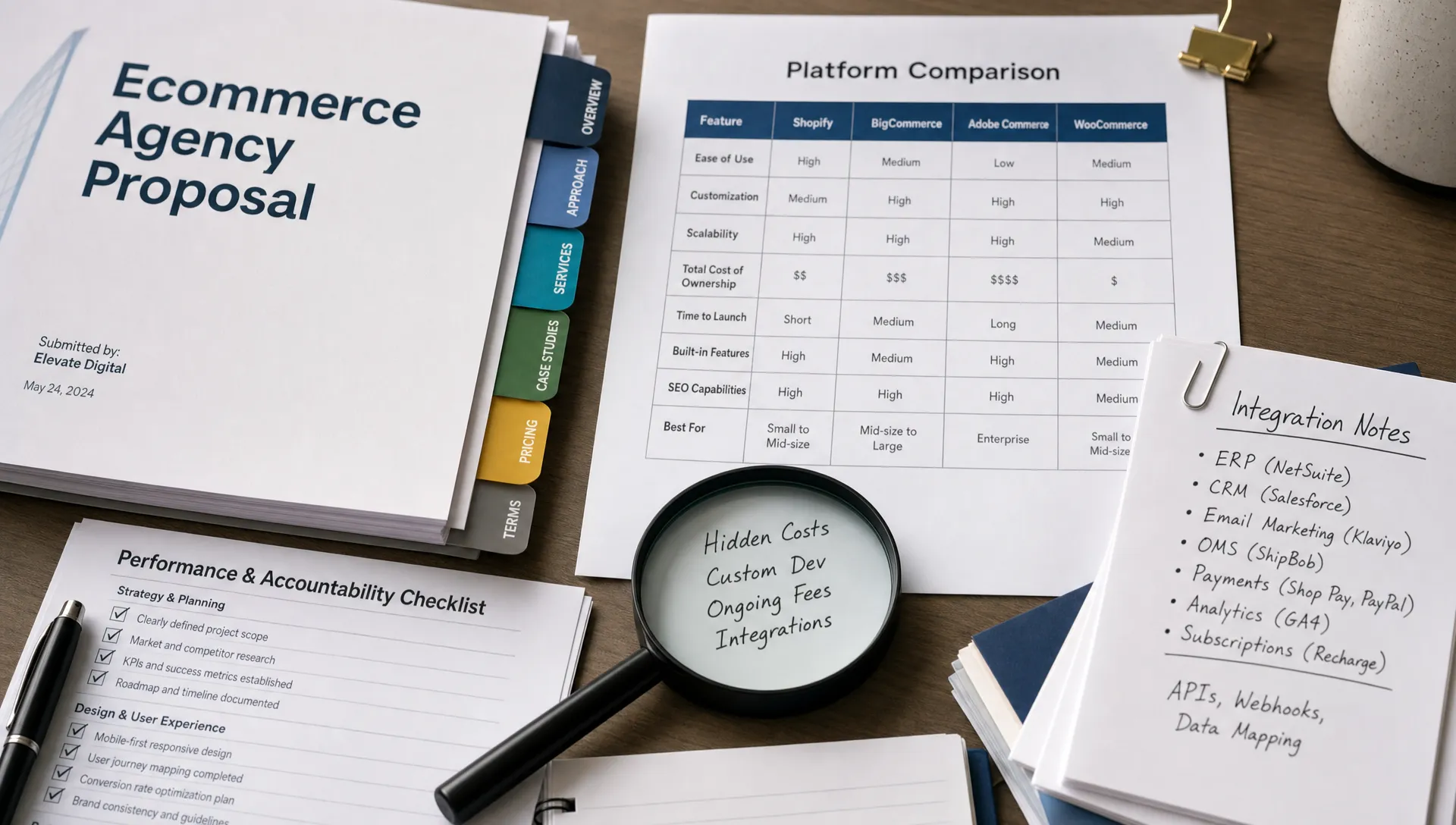
The issue is not whether the agency prefers Shopify, Salesforce Commerce Cloud, BigCommerce, Adobe Commerce, a composable stack, or another platform. The issue is whether they can explain the tradeoffs. That includes implementation cost, maintenance burden, app dependency, scalability, customization limits, integration complexity, and speed to market.
A strong agency should be comfortable saying, "This platform could work if these constraints are true, but it may become expensive or limiting if these other conditions apply." A weak agency sells the platform they know best, then makes your business fit the tool.
Red flag 3: Their AI claims are vague, trendy, or disconnected from operations
AI can improve ecommerce, but vague "AI-powered" language is not a strategy. Retail brands should be especially skeptical of agencies that use AI as a pitch shortcut without explaining governance, measurement, workflow impact, data quality, or risk.
Useful AI in ecommerce might support product discovery, search relevance, merchandising workflows, content operations, customer service, personalization, forecasting, or analytics interpretation. But each use case needs a clear business goal and guardrails. Otherwise, AI becomes a demo rather than an operating advantage.
Ask what data the AI depends on, how outputs are reviewed, how customer privacy is protected, how hallucinations or incorrect recommendations are handled, and how performance will be measured. If an agency cannot answer these questions in plain English, the risk is not that they lack buzzwords. The risk is that they may introduce tools your team cannot trust or maintain.
Space Dinosaurs has a deeper guide on how to choose a next-gen ecommerce agency without being distracted by surface-level AI branding.
Red flag 4: They treat performance as a technical cleanup task, not a revenue lever
Site speed is not just an engineering concern. For retail, it affects conversion, paid media efficiency, SEO, customer trust, and mobile shopping behavior. If an ecommerce agency only mentions performance near the end of the project, or frames it as a post-launch optimization, that is a warning sign.
Performance should influence architecture, design, third-party scripts, image strategy, analytics tagging, app selection, frontend implementation, and release processes. It should also be measured continuously, not only during a one-time launch QA pass.
Core Web Vitals such as Largest Contentful Paint, Interaction to Next Paint, and Cumulative Layout Shift are useful because they reflect parts of the real customer experience. But the goal is not simply to score well in a tool. The goal is to make shopping faster, easier, and less frustrating, especially on mobile and lower-quality connections.
If speed is already a known issue, this guide on why e-commerce retail teams need faster storefronts explains why performance should be treated as a growth priority, not a technical afterthought.
| Red flag | Why it hurts retail brands | What a stronger agency does instead |
|---|---|---|
| Leads with deliverables | Solves symptoms instead of revenue constraints | Diagnoses business, UX, technical, and operational issues first |
| Pushes one platform immediately | Creates architecture risk and future switching costs | Audits stack requirements before recommending options |
| Uses vague AI language | Adds tools without trust, governance, or measurable value | Defines AI use cases, data needs, risks, and success metrics |
| Delays performance work | Makes speed harder and more expensive to fix later | Builds performance budgets into design and engineering decisions |
| Reports only activity | Makes it hard to connect work to revenue | Measures commercial, technical, and customer experience outcomes |
Red flag 5: UX is separated from merchandising and retail operations
Beautiful screens do not automatically create a better shopping experience. In retail, UX has to work with the realities of product data, inventory, pricing, promotions, fulfillment, returns, and customer service.
A weak agency may design a polished homepage and product page without understanding how shoppers actually browse your catalog. They may ignore filtering logic, product comparison behavior, size and fit information, out-of-stock handling, bundles, subscriptions, pickup options, or the questions customers ask before purchase.
A strong agency treats UX as a commercial system. That means improving how customers discover products, evaluate options, understand value, trust the brand, and complete checkout. It also means designing experiences that your internal teams can manage without constant developer intervention.

The best UX conversations include both customer behavior and operational feasibility. If a proposed experience depends on perfect product data your team does not have, fragile manual workarounds, or custom logic that slows every release, the design may not be as effective as it looks in a presentation.
Red flag 6: Reporting focuses on traffic, hours, or tickets instead of business outcomes
Activity is not the same as progress. A retail ecommerce agency may ship many tickets, run many meetings, or increase traffic, but those facts alone do not prove the work is improving the business.
Ask how the agency defines success. If the answer is mostly based on deliverables completed, keyword rankings, generic engagement metrics, or hours used, you may end up with reporting that looks busy but does not help decisions.
A more mature measurement model connects work to outcomes at multiple levels. Executives need visibility into revenue, conversion, margin impact, customer acquisition efficiency, and operational cost. Ecommerce teams need funnel metrics, product discovery data, checkout performance, promotion impact, and merchandising insights. Engineering teams need site speed, error rates, release quality, technical debt, and stability indicators.
The agency does not need to own every metric directly, since retail performance depends on many variables. But they should be able to show how their work is expected to influence the metrics that matter, what assumptions are involved, and how results will be interpreted.
Red flag 7: They cannot explain the long-term cost of their recommendations
Some ecommerce decisions look affordable at the start and become expensive later. Custom features can increase maintenance. Too many apps can slow the storefront and create conflicting scripts. Poor documentation can make every future update harder. Unclear integration ownership can turn small changes into multi-team fire drills.
A responsible ecommerce agency should be able to discuss total cost of ownership. That includes build cost, licensing, hosting, maintenance, monitoring, QA, release management, team training, and future flexibility. They should also be honest about what happens after launch.
Retail leaders should listen for how the agency talks about tradeoffs. If every recommendation sounds easy, fast, and low risk, the agency may be overselling. Good partners do not create fear, but they do make risk visible. They can explain which choices are reversible, which are hard to unwind, and where shortcuts may create future costs.
This matters even more when your brand is growing. The solution that works for a small catalog, one region, or a limited content team may break down when you add more SKUs, markets, channels, or personalization requirements.
Red flag 8: They have no credible omnichannel point of view
Retail growth rarely happens on the ecommerce site alone. Customers may discover your brand through paid social, search, stores, email, SMS, marketplaces, affiliates, creators, catalogs, direct mail, or loyalty programs. Your agency does not need to run every channel, but it should understand how ecommerce connects to the wider customer journey.
A red flag is an agency that treats the site as an isolated destination. That mindset can lead to disconnected tracking, inconsistent messaging, weak landing pages, and channel strategies that compete rather than reinforce one another.
For example, if direct mail is part of your retention or acquisition mix, the agency should be able to discuss how offers, landing pages, customer segments, coupon codes, and attribution connect with tools for omni-channel direct mail automation and reporting. The same principle applies to email, SMS, paid media, store events, and loyalty campaigns.
A strong agency thinks in journeys. They ask where the shopper came from, what promise was made, what context the landing experience should reflect, and how the brand will know whether the journey worked.
Red flag 9: They sell CRO as a bag of tactics rather than a testing discipline
Conversion rate optimization is often reduced to button colors, urgency messages, badges, popups, and checkout tweaks. Some of those details can matter, but CRO without diagnosis is guesswork.
A retail-ready agency should understand experimentation. That means forming hypotheses, prioritizing tests by impact and effort, segmenting results, protecting test quality, and learning from inconclusive outcomes. It also means knowing when not to test. If a checkout bug, broken filter, or missing product information is clearly hurting customers, fixing it may be more urgent than running a formal experiment.
Be cautious if an agency guarantees conversion lifts without seeing your data. Be equally cautious if they recommend the same CRO checklist for every brand. Retail conversion depends on product category, price point, purchase frequency, customer intent, traffic source, device mix, inventory status, and trust signals.
The strongest CRO programs combine analytics, session behavior, customer research, merchandising knowledge, and technical execution. They improve the shopping system, not just individual page elements.
Red flag 10: The proposal hides who will actually do the work
Many agency pitches are led by senior strategists, founders, or polished sales teams. That is normal. The problem starts when the proposal does not clarify who will own strategy, design, engineering, QA, analytics, project management, and ongoing optimization after the deal is signed.
Retail brands should ask to meet the working team, not only the pitch team. You should understand their experience with similar commerce environments, how decisions are documented, how issues are escalated, and how the agency handles changes in scope or priority.
Pay attention to operating cadence. Weekly status calls are not enough if the agency lacks clear ownership, roadmap discipline, release processes, or decision logs. Good delivery feels structured without being rigid. Bad delivery feels reactive, even when individual people are talented.
The proposal should also explain what the agency needs from your team. If dependencies are missing, such as product data, brand assets, analytics access, legal review, or integration documentation, timelines can become unrealistic before work even begins.
Due diligence questions to ask before signing
The best way to uncover red flags is to ask specific questions and listen for concrete answers. You are not looking for perfection. You are looking for clarity, relevant experience, and intellectual honesty.
| Area to evaluate | Question to ask | Strong answer should include |
|---|---|---|
| Strategy | What business problem do you think we are solving first? | A clear view of revenue, cost, customer, or operational constraints |
| Technology | What would you audit before recommending a platform or architecture? | Integrations, data flows, team skills, performance, scalability, and maintenance |
| Performance | How do you prevent speed problems during design and build? | Performance budgets, script control, image strategy, frontend standards, and monitoring |
| AI | Which AI use cases are realistic for our business, and how would you govern them? | Data requirements, review workflows, privacy considerations, and measurable outcomes |
| Reporting | How will you connect agency work to commercial impact? | KPIs across revenue, funnel behavior, technical health, and operational efficiency |
| Delivery | Who will be on our account, and how will decisions be made? | Named roles, cadence, escalation paths, documentation, and ownership model |
Proposal warning signs retail teams should not ignore
Even before the work begins, the proposal can reveal how an agency thinks. Look for signs that the scope is built around your business rather than a recycled template.
Common proposal red flags include:
- Vague outcomes such as "improve engagement" without defining the metric or baseline.
- A timeline that assumes perfect client inputs, instant approvals, and no integration surprises.
- No mention of performance, analytics, QA, accessibility, or post-launch optimization.
- Heavy reliance on custom development without explaining maintenance implications.
- No clear ownership model for third-party vendors, apps, data feeds, or tracking.
- Case studies that show visuals but not constraints, decisions, tradeoffs, or measurable outcomes.
A strong proposal should make you feel more informed, not simply more impressed. It should clarify what will be done, why it matters, what risks exist, what assumptions are being made, and how success will be measured.
When a red flag is manageable and when it is a deal breaker
Not every red flag means you should walk away immediately. Sometimes an agency may be strong in one area and need support in another. For example, a technically excellent agency may need tighter commercial direction from your internal team. A design-led agency may be a good fit if paired with strong analytics and engineering governance.
A red flag becomes more manageable when the agency acknowledges it, explains how they will close the gap, and brings in the right expertise. It becomes a deal breaker when they dismiss the concern, hide behind jargon, or make promises without evidence.
Retail brands should also consider the importance of the project. A small landing page test may not require the same level of diligence as a replatform, checkout rebuild, headless implementation, or long-term optimization partnership. The higher the business risk, the more proof you should require.
The best agency relationships are built on transparency. You want a partner who can challenge assumptions, explain tradeoffs, and adapt as new information appears. If the sales process already feels evasive, the delivery process is unlikely to feel better.
Frequently Asked Questions
What is the biggest ecommerce agency red flag? The biggest red flag is a lack of diagnosis. If an agency recommends a platform, redesign, or roadmap before understanding your business model, stack, customer journey, and operational constraints, the work is more likely to solve the wrong problem.
Should retail brands avoid agencies that specialize in one platform? Not necessarily. Platform specialization can be valuable if your needs align with that ecosystem. The red flag is when the agency cannot explain platform tradeoffs or ignores evidence that another approach may be better for your business.
How can I tell if an agency is truly AI-capable? Ask for specific use cases, data requirements, governance practices, measurement plans, and examples of how AI changes workflows or outcomes. Real AI capability should sound practical and measurable, not just promotional.
What should an ecommerce agency report on after launch? Reporting should include business outcomes, customer behavior, technical health, and operational impact. Revenue, conversion rate, average order value, funnel drop-off, Core Web Vitals, error rates, and campaign performance may all matter depending on the project.
Is the cheapest ecommerce agency always the riskiest choice? No, but a low price can hide missing scope, junior staffing, weak QA, limited strategy, or future maintenance costs. The better question is whether the agency can explain what is included, what is not included, and what tradeoffs the budget creates.
Choose an agency that reduces complexity, not one that adds to it
The right ecommerce agency should help your retail brand move faster, make better decisions, and create a stronger customer experience. The wrong one can leave you with more technical debt, unclear reporting, slower pages, and a roadmap that is harder to execute.
Before you sign, look past the pitch deck. Ask how the agency diagnoses problems, evaluates platforms, manages performance, uses AI, measures outcomes, and supports your team after launch. If the answers are specific, honest, and connected to retail realities, you are likely having the right conversation.
If your brand needs a retail-focused partner for ecommerce modernization, performance optimization, AI-enabled commerce experiences, UX, analytics, or ongoing improvement, Space Dinosaurs can help you evaluate what to fix next and how to build for long-term growth.