
Choosing an ecommerce agency is not just a procurement decision. For a retail brand, it shapes how quickly your team can test ideas, improve the customer experience, reduce technical drag, and turn digital commerce into a compounding growth channel.
That is why the best partner is rarely the one with the flashiest pitch deck or the biggest list of platform badges. The right agency should help you make better commercial decisions over time. It should understand your operating model, your merchandising calendar, your technology constraints, and the profit levers behind every website change.
If you are evaluating an ecommerce agency for long-term growth, the goal is not to buy a website. The goal is to build a digital commerce engine that can keep adapting as customer expectations, AI capabilities, acquisition costs, and platform economics change.
Start With the Growth Problem, Not the Agency Shortlist
Many selection processes start too late in the decision journey. A team decides it needs a redesign, replatform, performance sprint, or support retainer, then starts comparing agencies against that presumed solution.
A better approach is to define the growth problem first. Are you trying to increase conversion rate? Improve mobile revenue? Reduce site maintenance costs? Launch into new markets? Stabilize a fragile stack? Improve merchandising agility? Reduce dependency on paid media? Each goal points to a different type of partner.
A brand with a slow, bloated storefront needs deep performance engineering. A brand struggling with retention may need UX, personalization, CRM, and analytics alignment. A brand locked into inefficient workflows may need architecture and process redesign more than a new homepage.
Before you ask agencies for a proposal, align internally on a few essentials:
- Commercial goals: Revenue growth, margin improvement, average order value, repeat purchase, international expansion, or customer lifetime value.
- Operational pain points: Slow releases, unstable integrations, poor analytics, high support costs, duplicate work, or merchandising bottlenecks.
- Technical realities: Current platform, third-party apps, custom code, data quality, deployment process, and team capacity.
- Customer experience gaps: Navigation issues, poor search, confusing PDPs, checkout friction, weak mobile journeys, or lack of trust signals.
This foundation prevents you from choosing an agency based on aesthetics alone. It also makes it easier to separate strategic partners from vendors that simply quote against a list of requested features.
Look for an Operating Partner, Not a Launch Vendor
A launch-focused agency can help you ship a project. A growth-focused ecommerce agency helps you make the right sequence of improvements before and after launch.
That difference matters because ecommerce growth is cumulative. Site speed, product discovery, content structure, checkout usability, analytics accuracy, and merchandising workflows all interact. When improvements are planned in isolation, results are harder to sustain.
A strong long-term partner should be able to answer questions like:
- Which website improvements are most likely to affect revenue first?
- Which technical issues are creating unnecessary cost or risk?
- Which parts of the stack should stay, change, or be simplified?
- Which metrics will prove whether the work is working?
- How will the roadmap evolve after the first release?
This is where ongoing optimization becomes important. A website is never really finished, especially in retail. Product assortments change, traffic sources shift, campaigns create demand spikes, and customer expectations keep rising. If you need structured support beyond a one-time project, Space Dinosaurs offers ecommerce website growth and optimization through Momentum, designed around continuous improvement rather than one-off delivery.
Evaluate Strategic Depth Before Creative Output
Portfolio reviews are useful, but they can be misleading. A polished case study may hide the constraints, tradeoffs, and internal team dynamics that actually determined success.
Instead of only asking what an agency designed or built, ask how they made decisions. You want to understand their thinking process.
A capable ecommerce agency should be able to explain how it connects customer behavior, platform constraints, technical performance, and business KPIs. It should not treat UX, development, SEO, analytics, and conversion optimization as disconnected workstreams.
Use the following table to evaluate strategic depth during the selection process:
| Evaluation area | What to look for | Warning sign |
|---|---|---|
| Commercial understanding | The agency asks about margin, inventory, acquisition costs, and repeat purchase | They focus only on visual design or feature delivery |
| Technical judgment | They can explain tradeoffs between simplicity, flexibility, cost, and scale | They recommend a stack before understanding your needs |
| UX thinking | They connect user research, merchandising, content, and conversion behavior | They rely on generic best practices without context |
| Analytics approach | They define KPIs before work begins and discuss measurement quality | They promise growth without explaining attribution or tracking |
| Roadmap discipline | They prioritize work based on impact, effort, risk, and dependencies | They treat every request as equally urgent |
| Retail experience | They understand promotions, seasonality, product data, and operational constraints | They discuss ecommerce as if every business model is the same |
The best agencies are comfortable saying, “This is not the first thing we would fix.” That honesty is valuable. Long-term growth depends on prioritization, not just production capacity.
Make Sure They Understand Your Category and Customer Journey
Retail is not one category. A beauty brand, apparel retailer, luxury marketplace, grocery operator, B2B distributor, and industrial commerce business all require different experiences.
This is especially important if your products are technical, regulated, operationally complex, or sold through multiple channels. The agency must understand how customers evaluate value, compare options, seek reassurance, and move from education to purchase or inquiry.
For example, a company offering sustainable cleaning and contamination-control solutions for production lines needs a digital experience that communicates technical credibility, application fit, process benefits, and sector-specific expertise. That journey looks very different from a trend-led fashion purchase, even though both businesses still need fast pages, clear navigation, and measurable conversion paths.
Ask prospective agencies how they would adapt UX, content, taxonomy, search, and analytics to your specific customer journey. If their answers sound identical across every category, they may not be thinking deeply enough.
Treat Platform Advice as a Test of Objectivity
Platform selection is one of the clearest ways to test whether an agency is acting as a strategic partner or a reseller of its preferred technology.
A good ecommerce agency should have opinions, but those opinions should be grounded in your business model. The right platform depends on factors such as catalog complexity, internationalization, content needs, checkout requirements, integration demands, internal team skills, and future roadmap.
For enterprise retailers, the decision often involves tradeoffs between speed, control, extensibility, and operational complexity. If your team is comparing major enterprise options, this breakdown of Salesforce Commerce Cloud, Shopify Plus, and SCAYLE can help frame the conversation before you commit to a direction.
Be cautious if an agency recommends a platform before understanding your order management, ERP, PIM, CRM, inventory, fulfillment, and content workflows. A storefront decision can create years of operational consequences.
The agency should also be able to discuss when composable architecture makes sense and when it adds avoidable complexity. Long-term growth does not always mean choosing the most flexible stack. Sometimes it means reducing moving parts so your team can execute faster.
Prioritize Performance as a Revenue Lever
Site performance is often framed as a technical issue, but for ecommerce it is a commercial issue. Slow pages affect discovery, engagement, conversion, paid media efficiency, and customer trust.
A growth-oriented ecommerce agency should be able to connect performance work to business outcomes. That means going beyond one-time page speed scores and building performance into the way the site is designed, developed, measured, and maintained.
Key questions to ask include:
- How do you diagnose performance issues across templates, third-party scripts, images, and front-end code?
- How do you protect speed as new features, apps, and campaigns are added?
- How do you prioritize Core Web Vitals work against other roadmap items?
- How do you connect performance changes to conversion, revenue, and user behavior?
Space Dinosaurs has written more about how ecommerce teams can connect technical performance to commercial outcomes in this guide to turning site speed into revenue.
Performance should not be treated as a cleanup project after a redesign. It should influence creative decisions, component architecture, tracking strategy, third-party governance, and release processes from the start.

Ask How They Use AI, but Listen for Practicality
AI can improve ecommerce work, but it is not a strategy by itself. In agency selection, the question is not whether a partner says it is AI-powered. The question is whether it uses AI in ways that improve speed, quality, decision-making, and customer experience without adding risk.
Practical AI use may support areas such as product enrichment, content workflows, customer service experiences, search relevance, personalization, testing analysis, development efficiency, or merchandising insights. But every use case should be tied to governance, data quality, brand standards, and measurable outcomes.
Be skeptical of agencies that present AI as a magic layer that solves unclear strategy, weak data, or poor UX. AI can accelerate a good operating model, but it rarely fixes a broken one on its own.
A useful selection question is: “Show us where AI changes your process, what humans still review, and how you measure whether it improves outcomes.”
If the answer is vague, the agency may be using AI as positioning rather than a practical capability. For a deeper view on this distinction, see Space Dinosaurs’ perspective on how to choose a next-gen ecommerce agency without falling for AI branding.
Demand a Clear Measurement Framework
Long-term growth requires measurement discipline. Without clean tracking and shared KPIs, agency relationships often drift into subjective debates about whether the work is valuable.
A strong agency should define success at multiple levels. Some metrics show commercial outcomes. Others show whether the system is becoming healthier and easier to improve.
| Measurement layer | Example metrics | Why it matters |
|---|---|---|
| Commercial outcomes | Revenue, conversion rate, average order value, repeat purchase, margin contribution | Shows whether digital work is affecting business growth |
| Customer behavior | Product views, search usage, add-to-cart rate, checkout completion, navigation paths | Reveals where shoppers engage or drop off |
| Technical health | Core Web Vitals, error rates, uptime, deployment stability, page weight | Protects scalability and user experience |
| Operational efficiency | Release frequency, bug volume, support hours, content publishing time | Shows whether the team can move faster with less friction |
| Experimentation | Test velocity, uplift, confidence, learning quality | Helps teams improve based on evidence rather than opinion |
The agency should also be honest about attribution. Ecommerce growth rarely comes from a single change. A better partner will help you interpret patterns across channels, site behavior, merchandising, and technical improvements.
During selection, ask what your first reporting dashboard or growth review would include. If the agency cannot explain what it would measure and why, it may struggle to prove long-term value.
Understand Their Approach to Governance and Communication
Even the most talented agency can underperform if governance is weak. Long-term ecommerce growth depends on clear ownership, decision rights, roadmap management, and communication rhythms.
Ask how the agency manages priorities when stakeholders disagree. Ask how it handles urgent fixes during planned work. Ask how it documents decisions so your internal team is not dependent on individual agency employees.
A mature engagement usually includes clear answers to these areas:
- Roadmap ownership: Who decides what gets worked on next, and what criteria guide prioritization?
- Release process: How are changes tested, approved, deployed, and monitored?
- Commercial reviews: How often do teams review performance data and adjust priorities?
- Documentation: Where are technical decisions, UX patterns, integrations, and tracking rules recorded?
- Risk management: How are security, privacy, accessibility, and third-party dependencies handled?
The goal is not bureaucracy. The goal is momentum with control. Retail teams need to move quickly, but they also need to avoid the chaos that creates regressions, duplicated effort, and surprise costs.
Compare Pricing Models by Value, Not Just Cost
Agency pricing can be difficult to compare because scopes vary widely. One proposal may look cheaper because it excludes strategy, QA, analytics, performance work, or post-launch support. Another may look more expensive because it includes the work required to create durable results.
Instead of asking, “Which agency is cheapest?” ask, “Which model gives us the best chance of profitable growth with the least avoidable risk?”
Common pricing models include fixed-scope projects, retainers, dedicated teams, and outcome-oriented optimization programs. None is automatically best. The right choice depends on how certain the scope is, how much ongoing change you expect, and how much internal capacity you have.
Fixed-scope work can be useful for well-defined builds or migrations. Retainers are often better for continuous improvement, performance maintenance, experimentation, and evolving roadmaps. Dedicated capacity can work when you need sustained execution across many workstreams.
Whatever the model, insist on clarity. You should understand what is included, what is excluded, how priorities are managed, how unused time is handled, and how the agency reports progress against outcomes.
Watch for Red Flags During the Sales Process
The way an agency sells often reflects the way it will work. If the sales process is rushed, generic, or overly polished without substance, take it seriously.
Common red flags include:
- The agency recommends a platform or architecture before discovery.
- The proposal focuses heavily on deliverables but lightly on outcomes.
- The team cannot explain how it will measure success.
- Every case study sounds like a redesign story, not a growth story.
- AI is mentioned often, but practical workflows and governance are unclear.
- Performance, analytics, accessibility, and QA are treated as optional extras.
- The agency avoids discussing tradeoffs, risks, or your internal constraints.
- You meet a senior team during sales but cannot confirm who will actually do the work.
You are not looking for a partner with no limitations. You are looking for one that is transparent about constraints and thoughtful about how to manage them.
Use a Scorecard to Make the Final Decision
A simple scorecard helps reduce bias in the final selection. It also forces stakeholders to compare agencies against the same criteria instead of choosing based on personal preference.
| Criteria | Weight | What a strong answer looks like |
|---|---|---|
| Retail and category understanding | High | The agency adapts its recommendations to your customer journey and operating model |
| Strategic roadmap quality | High | Work is prioritized by impact, effort, dependency, and business value |
| Technical capability | High | The team can explain architecture, integrations, performance, and maintainability |
| UX and conversion thinking | High | Design decisions are tied to shopper behavior and commercial outcomes |
| Measurement discipline | High | KPIs, analytics, and reporting are defined before execution begins |
| AI practicality | Medium | AI is used where it improves workflow or customer experience, with human oversight |
| Collaboration model | Medium | Governance, documentation, communication, and release processes are clear |
| Cost transparency | Medium | Pricing connects to scope, value, risk, and long-term support needs |
| Cultural fit | Medium | The agency challenges assumptions while respecting internal realities |
Have each stakeholder score independently, then discuss the gaps. If one agency wins on creative but loses on technical governance, that matters. If another is slightly more expensive but far stronger on performance, analytics, and roadmap discipline, it may be the better long-term choice.
Frequently Asked Questions
What should I look for in an ecommerce agency? Look for a partner that understands retail strategy, UX, engineering, analytics, performance, and ongoing optimization. The agency should connect its work to business outcomes, not just deliver pages, features, or designs.
How do I know if an agency is right for long-term growth? Ask how it prioritizes work after launch, measures performance, manages technical debt, and adapts the roadmap over time. A long-term partner should have a clear operating model for continuous improvement.
Should I choose an agency based on platform expertise? Platform expertise matters, but it should not be the only factor. The agency should understand your business model first, then recommend a platform or architecture that fits your catalog, operations, integrations, and growth plans.
Is an AI-powered ecommerce agency always better? Not necessarily. AI is valuable when it improves workflows, customer experiences, content operations, analytics, or development quality. It is not valuable when it is used as a vague marketing claim without governance or measurable impact.
How should ecommerce agency performance be measured? Measure both commercial outcomes and system health. Revenue, conversion rate, average order value, and repeat purchase are important, but so are site speed, release stability, tracking quality, experimentation velocity, and operational efficiency.
Choose the Partner That Can Keep Improving the System
The right ecommerce agency should help your retail business grow beyond the next launch. It should improve how your team makes decisions, ships work, measures impact, and adapts to change.
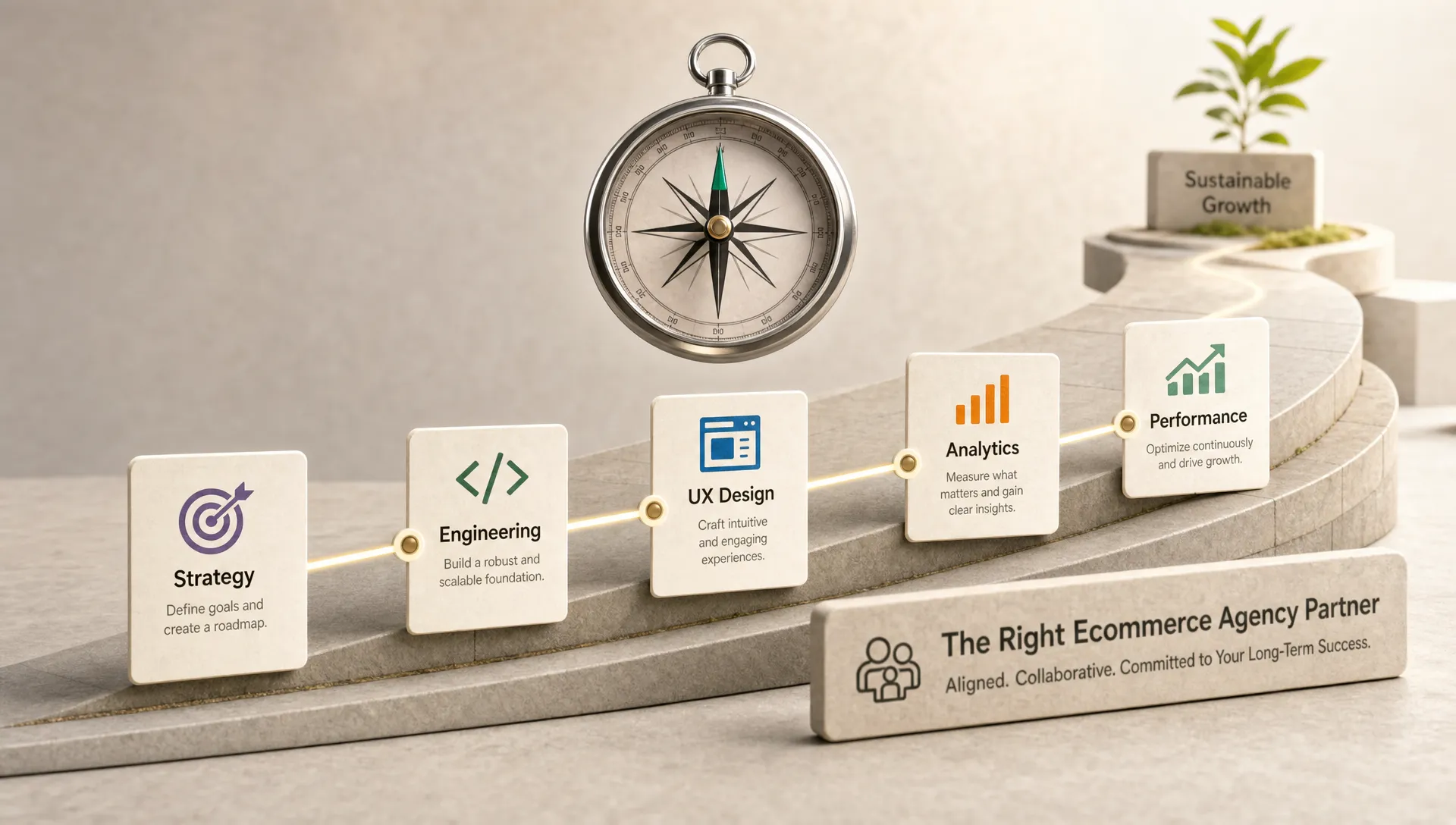
That requires a mix of strategy, engineering, UX, analytics, performance optimization, and practical AI adoption. More importantly, it requires a partner that understands ecommerce as an operating system for growth, not a set of isolated projects.
If your team is looking for a retail-focused digital partner to modernize your ecommerce experience, improve performance, and build a more effective growth roadmap, Space Dinosaurs can help you evaluate the next move with clarity.