

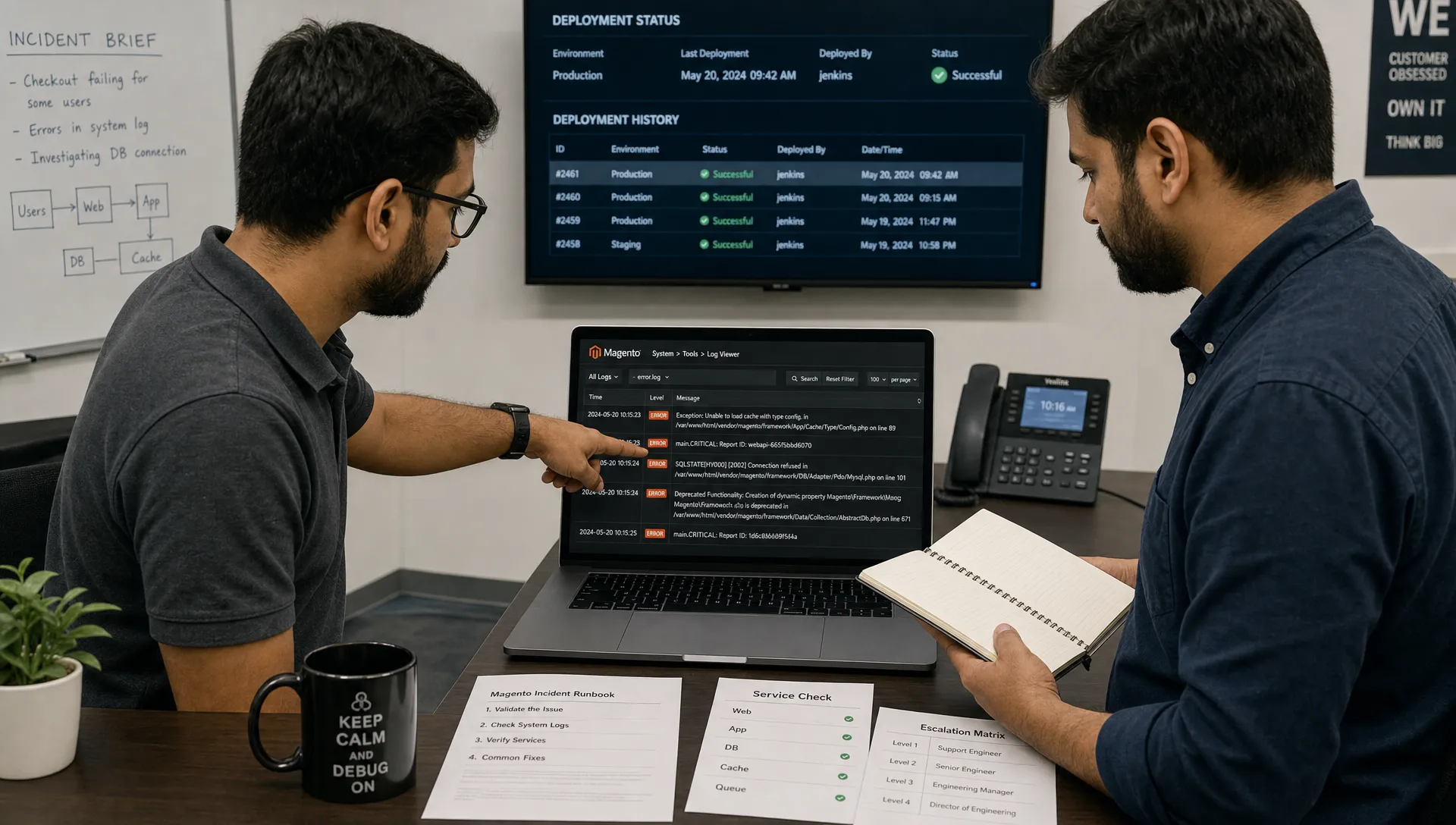
Retail storefronts do not become slow or unstable overnight. A Magento support agency keeps the small problems from compounding: outdated extensions, heavy scripts, brittle integrations, untested releases, database bloat, hosting misconfiguration and checkout edge cases that quietly damage revenue. For retail teams running Magento or Adobe Commerce, post-launch support is not a technical luxury. It is the operating system behind a store that shoppers, merchandisers and leadership can trust.
Magento is powerful because it can support complex catalogs, customer groups, B2B workflows, promotions, integrations and multi-store operations. That flexibility also means there are more places for performance and stability issues to appear. The real value of support is not simply fixing tickets after something breaks. It is creating the routines, visibility and engineering discipline that keep the store fast during normal trading, resilient during peak traffic and safe when the business needs to change.
What a Magento support agency protects after launch
Magento support work sits between engineering, commerce operations and revenue protection. The storefront is the visible layer, but the performance of that layer depends on everything behind it: theme quality, caching, search, product data, inventory feeds, payment services, analytics tags and hosting behavior.
A strong support partner treats the site as a living retail system rather than a finished build. That mindset matters because most instability comes from normal business activity. Merchants launch campaigns, add products, test promotions, install tools, adjust tracking, expand to new regions and change fulfillment rules. Each change may be reasonable on its own, but the combined effect can slow product listing pages, create checkout errors or overload integrations.
If your team is still deciding whether Magento is the right foundation for a complex retail model, Space Dinosaurs has also covered when a Magento development agency is the right fit. Once the platform is live, support shifts the focus from launch delivery to sustained operational health.
| Area of support | What it protects | Common warning signs |
|---|---|---|
| Frontend performance | Speed, Core Web Vitals, conversion paths | Slow category pages, layout shifts, delayed interactions |
| Release management | Stability after deployments | Bugs after updates, inconsistent environments, rollback panic |
| Integration health | Inventory, orders, payments, ERP and CRM flows | Stuck orders, delayed stock updates, failed webhooks |
| Security maintenance | Store trust and operational continuity | Unpatched modules, suspicious admin activity, outdated dependencies |
| Analytics quality | Better decisions and cleaner reporting | Missing events, duplicate tracking, unreliable funnel data |
Performance work starts with bottleneck diagnosis
A Magento support agency that understands retail performance does not begin by randomly compressing images or adding another plugin. It starts by finding the bottleneck that actually affects shoppers. In Magento, slowdowns can originate from the frontend, server response, database queries, cache misses, third-party scripts, product indexing, search configuration or a mix of these factors.
Core Web Vitals give teams a useful shared language for performance. Google defines these as user experience metrics focused on loading speed, interaction responsiveness and visual stability, currently Largest Contentful Paint, Interaction to Next Paint and Cumulative Layout Shift. Retail teams can use Google’s Core Web Vitals guidance to understand why these measures matter for search and page experience, but diagnostics still need platform-specific interpretation.
For example, a slow product detail page may look like an image problem in a generic audit. In practice, the delay might come from uncached personalization rules, a bloated theme, slow pricing logic or multiple tag managers competing for the main thread. Good support separates symptoms from root causes.
Caching, indexing and database hygiene
Magento performance depends heavily on cache behavior. Full-page cache, Varnish configuration, Redis usage, block caching and cache invalidation rules can all influence whether shoppers receive fast responses or force the application to rebuild pages repeatedly.
Indexing is another frequent source of friction. Catalog, price, search and stock indexes need to be configured and monitored so that merchandising changes remain accurate without overwhelming the store. When indexing jobs fail or run at the wrong time, retail teams may see stale product data, delayed pricing changes or admin slowdowns.
Database hygiene is less visible but equally important. Large quote tables, old logs, inefficient custom queries and poorly written extensions can increase load over time. The support job is to keep the system clean enough that growth does not automatically translate into drag.
Stable stores depend on disciplined release management
A fast store can still be fragile if releases are rushed. A Magento support agency keeps release work predictable by using version control, staging environments, deployment plans, QA routines and rollback paths. This is less glamorous than a redesign, but it is often what prevents lost revenue during campaign launches or seasonal peaks.
The release process should match the risk of the change. A small content update does not need the same governance as a checkout extension upgrade, but neither should happen blindly. The support team should understand which parts of the store are revenue-critical, which integrations are sensitive and which workflows need regression testing before deployment.
Retail teams should also separate emergency fixes from routine improvements. If every release is treated as urgent, quality drops. If every small request waits for a large release window, business teams lose momentum. Mature support creates a practical operating rhythm where urgent issues can move quickly without turning the whole roadmap into chaos.
| Release practice | Why it matters for Magento stability |
|---|---|
| Staging and production parity | Catches environment-specific bugs before shoppers see them |
| Regression testing | Protects checkout, search, account and merchandising workflows |
| Deployment checklists | Reduces human error during routine updates |
| Rollback planning | Limits damage when a release introduces unexpected behavior |
| Post-release monitoring | Confirms that performance and conversion paths remain healthy |
Monitoring turns stability into a measurable discipline
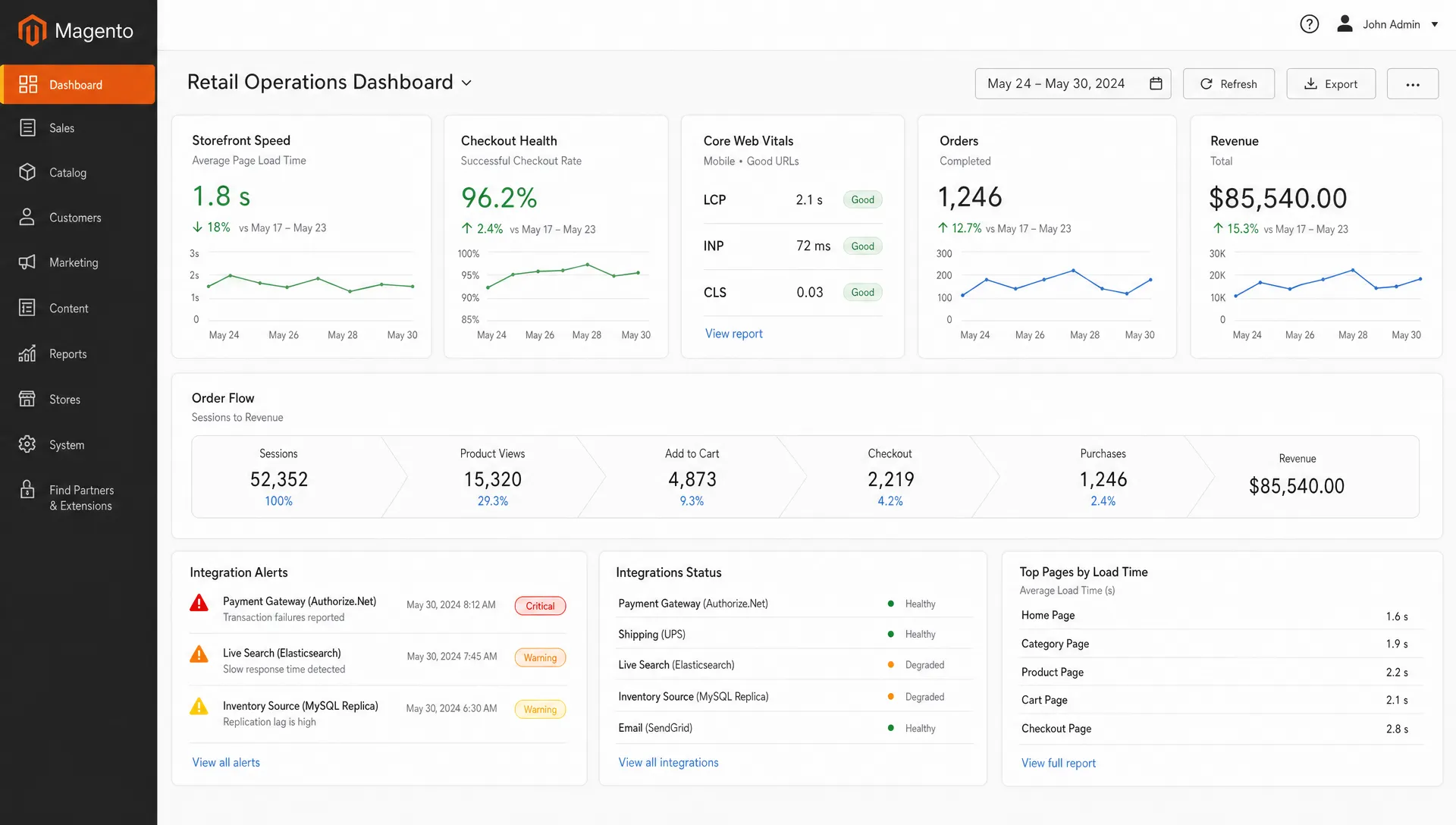
Support is weakest when it depends only on users reporting problems. By the time a shopper complains about checkout or a merchandiser notices a broken feed, the business may already have lost orders. A better model uses active monitoring across the storefront, infrastructure, integrations and business-critical journeys.
A Magento support agency should define what “healthy” means for the store, then monitor for deviations. Technical alerts are useful, but retail alerts should connect to commercial impact. A spike in server errors matters more if it happens on checkout. A slow API response matters more if it delays inventory availability during a sale.
Monitoring should cover uptime, response time, error rates, cron health, queue processing, search availability, payment errors, order flow and admin performance. It should also include analytics checks, because teams cannot optimize what they cannot measure reliably. If conversion tracking breaks after a tag update, the store may still accept orders, but decision-making becomes unstable.
Security maintenance supports both trust and uptime
Magento and Adobe Commerce stores handle sensitive customer, payment and operational data. Even when payment card details are tokenized or handled by payment providers, the store remains a high-value target because it touches checkout, customer accounts, admin access, integrations and order data.
The right Magento support agency builds security into the maintenance rhythm rather than treating it as a once-a-year audit. That includes applying platform security updates, reviewing extension versions, hardening admin access, checking user permissions, monitoring suspicious activity and removing unused modules that expand the attack surface.
Security also extends beyond the ecommerce application. Store stability can depend on employee devices, identity management, networks, backup policies and cloud operations. Retailers with broader IT needs often coordinate ecommerce support with dependable managed IT services so that platform work, cybersecurity practices and business continuity planning do not sit in separate silos.
Backups and recovery planning deserve special attention. A backup is only useful if it can be restored quickly and correctly. Support teams should understand what is backed up, how often it is backed up, where it is stored and how restoration would work during a real incident.
Frontend UX choices can make Magento feel faster
Performance is not only a server-side problem. Shoppers experience speed through interface behavior: how quickly content appears, whether buttons respond, whether filters feel smooth and whether checkout steps behave predictably. A Magento support agency can improve perceived performance by pairing technical optimization with UX decisions that reduce friction.
For example, a category page with dozens of heavy merchandising components may technically load within an acceptable window, but still feel sluggish if filters jump, images shift or promotional banners push products down the page. A cleaner frontend can improve both speed and usability.
This is where support overlaps with continuous optimization. Retail teams should review templates, navigation, search results, product cards and checkout flows through the lens of shopper intent. Fast pages that are confusing will not perform. Beautiful pages that are heavy will not scale. The goal is to create storefront experiences that are both efficient and commercially useful.
Space Dinosaurs has written more broadly about why e-commerce retail teams need faster storefronts, especially as paid media costs, mobile expectations and AI-driven shopping journeys put more pressure on speed.
Cost optimization is part of stability
Many Magento stores become expensive because complexity accumulates without governance. Every extension, integration, custom workflow and analytics script has a maintenance cost. Some costs are direct, such as license fees or hosting spend. Others are operational, such as slower releases, harder debugging and more fragile checkout behavior.
A support team should help decide which complexity is earning its place. That does not mean stripping the store down to something generic. It means making sure the architecture supports the business instead of quietly draining it.
Cost optimization may include retiring unused extensions, consolidating overlapping tools, improving cache hit rates, reviewing hosting configuration, simplifying custom modules and prioritizing fixes that reduce recurring support volume. Stability improves when there are fewer unnecessary moving parts and better visibility into the parts that remain.
How to evaluate Magento support before you need it
When choosing a Magento support agency, retail teams should look beyond hourly rates and ticket queues. The better question is whether the agency can protect the commercial systems that depend on the storefront. That includes engineering depth, retail context, performance discipline, analytics awareness and clear communication.
Ask how the agency handles incidents, releases and prioritization. A vague answer like “we fix issues as they come in” is not enough for a revenue-critical store. You want to hear how they triage severity, communicate during outages, document recurring problems and prevent the same issue from returning.
It is also worth asking how they balance maintenance with growth. A support relationship should not become a backlog of patches with no strategic direction. The agency should be able to identify patterns, recommend improvements and help your team decide which technical investments are most likely to support revenue, operational efficiency or customer experience.
| Evaluation question | What a strong answer should reveal |
|---|---|
| How do you diagnose performance issues? | A structured process using real user data, logs, profiling and platform knowledge |
| How do you manage releases? | Clear environments, QA steps, deployment ownership and rollback planning |
| How do you handle urgent incidents? | Severity levels, response expectations, communication routines and post-incident review |
| How do you approach extensions? | Governance, compatibility review, security awareness and avoidance of unnecessary app sprawl |
| How do you report progress? | Metrics tied to store health, not just a list of completed tickets |
If you are comparing broader partners, Space Dinosaurs also outlines how to choose an ecommerce agency for long-term growth. The same principle applies here: the partner should understand both the platform and the business outcomes the platform is supposed to support.
FAQ
What does a Magento support agency do? A Magento support agency maintains and improves Magento or Adobe Commerce stores after launch. Work commonly includes performance optimization, bug fixes, release management, extension updates, security maintenance, integration troubleshooting, monitoring and continuous UX improvements.
How often should a Magento store be maintained? Maintenance should be ongoing, not occasional. Security updates, monitoring and urgent fixes need continuous attention, while performance reviews, extension audits and technical cleanup usually work best on a planned monthly or quarterly rhythm.
Why do Magento stores slow down over time? Magento stores often slow down because of added extensions, heavier themes, unoptimized media, inefficient queries, database growth, poor cache behavior, third-party scripts and integration complexity. Growth increases load, but poor governance usually turns that growth into instability.
Is Magento support different from Magento development? Yes. Development often focuses on building new features or launching major projects. Support focuses on keeping the live store fast, secure and stable while making controlled improvements over time. In practice, a strong partner may provide both capabilities.
What should retailers track to know if support is working? Useful metrics include page speed, Core Web Vitals, uptime, checkout errors, server error rates, failed integrations, release defects, support ticket recurrence, conversion rate and analytics tracking health. The best reporting connects technical work to shopper experience and revenue risk.
Keep Magento fast, stable and ready for what comes next
Magento can be a strong foundation for complex retail, but only when the store is actively cared for after launch. Speed and stability come from disciplined maintenance, better monitoring, cleaner releases, thoughtful UX and technical decisions that reduce unnecessary complexity.
Space Dinosaurs helps retail brands modernize ecommerce experiences, improve performance, stabilize operations and use AI-enabled engineering where it creates practical value. If your Magento store is carrying too much technical drag or your team needs a clearer support model, Space Dinosaurs can help you turn maintenance into a growth advantage.