


Strong ecommerce ppc management is not just a way to buy more clicks. For retail brands, its real job is to identify which paid moments create revenue that would not have happened otherwise, then shift budget toward those moments with discipline.
That distinction matters because many ad accounts look healthy in-platform while the business sees flat growth. Branded search can take credit for shoppers who already knew the brand. Retargeting can overvalue people who were already close to buying. Platform ROAS can rise even when net new revenue stalls.
Incremental revenue asks a harder question: did the campaign change customer behavior, or did it simply capture demand the brand had already earned? Answering that question requires better measurement, cleaner product data, stronger landing pages and a media plan connected to margin rather than vanity metrics.
For ecommerce leaders in 2026, this is where PPC moves from acquisition channel to operating system. Paid media still needs strong creative and bidding, but it also needs fast pages, accurate tracking, conversion-focused UX and a clear view of profitability.
What ecommerce ppc management changes about revenue growth
The biggest change is the unit of optimization. A traffic-focused account optimizes for cheaper clicks or higher platform ROAS. An incremental revenue account optimizes for profitable customer actions that the business would not have captured through organic search, email, direct traffic or marketplace presence.
That changes how campaigns are structured. Brand, non-brand, Shopping, Performance Max, social prospecting and remarketing should not be judged by the same standard. Each campaign type has a different job, a different level of existing demand and a different risk of taking credit for sales that were already likely.
| PPC decision | Traffic-focused approach | Incremental revenue approach |
|---|---|---|
| Budget allocation | Move spend to the highest reported ROAS | Move spend to the highest marginal profit opportunity |
| Brand search | Maximize impression share by default | Test how much revenue disappears when spend is reduced |
| Remarketing | Count all returning shoppers as wins | Separate true recovery from natural return behavior |
| Product ads | Push top sellers hardest | Balance demand, margin, stock and new customer potential |
| Landing pages | Send traffic to existing pages | Match intent to the page most likely to convert profitably |
This is why PPC management cannot sit apart from merchandising, site performance or analytics. A campaign can only create incremental revenue when the offer, page experience and measurement model let it.
Incremental revenue starts with better measurement
The practical value of ecommerce ppc management shows up when measurement moves beyond platform dashboards. Google Ads, Meta and other platforms are useful for optimization, but each platform has an incentive to claim conversions touched by its ads. Business leaders need a second layer of measurement that looks across channels.
Start by separating reported revenue from incremental revenue. Reported revenue is what the ad platform attributes to campaigns. Incremental revenue is the additional revenue generated because paid media influenced the shopper in a way that would not have happened without the spend.
Useful inputs include blended marketing efficiency ratio, new customer revenue, contribution margin, customer acquisition cost, repeat purchase behavior and holdout tests. For larger retailers, geo experiments or audience exclusions can reveal whether a campaign is expanding demand or only harvesting it.
| Metric | What it tells you | Limitation |
|---|---|---|
| Platform ROAS | How a platform attributes revenue to spend | Can over-credit ads near the end of the journey |
| MER | Revenue generated per total marketing dollar | Can hide underperforming individual campaigns |
| New customer CAC | Cost to acquire first-time buyers | Needs reliable customer matching and order history |
| Contribution margin | Profit after variable costs | Requires clean product and fulfillment data |
| Holdout results | Lift versus an unexposed group | Needs enough volume to be meaningful |
This measurement discipline sits close to profitability-focused ecommerce strategy. Space Dinosaurs covers the broader operating logic in its guide to digital marketing for ecommerce that improves profitability.
Manage campaigns around margin, not blended ROAS
If ecommerce ppc management is measured only on blended ROAS, teams can accidentally scale revenue that contributes little profit. A product with a 7x ROAS can be less valuable than a product with a 3x ROAS if the first has thin margins, high return rates or expensive fulfillment.
The paid media plan should know which products deserve aggressive acquisition spend and which should be protected from overinvestment. This requires product-level economics, not just category-level assumptions. Margin, inventory position, average order value, return rate, discount depth and expected repeat purchase all affect the amount a retailer can spend to acquire demand.
A practical model groups products into paid media roles. Some products are acquisition doors because they bring in first-time customers efficiently. Some are profit engines because they have strong margin and low return risk. Others are retention or cross-sell products that should be promoted to existing customers rather than broad cold audiences.
Once campaigns reflect those roles, budget decisions become clearer. The question is no longer which campaign has the prettiest ROAS. The question is where the next dollar is most likely to create profitable revenue that would otherwise be missed.
Find demand you would not have captured anyway
Paid search and shopping ads are strongest when they meet specific intent. The challenge is knowing which intent is already owned by the brand and which intent needs paid support.
Good ecommerce ppc management separates demand capture from demand creation. Branded campaigns usually capture people who already have some awareness. Non-brand category campaigns can intercept shoppers comparing options. Shopping ads can win product-level intent at the moment of evaluation. Social and video can introduce new audiences before they start searching.
The level of incrementality depends heavily on the buying journey. A shopper buying a low-consideration replenishment item behaves differently from someone comparing a major purchase. For example, in jewelry, buyers may compare stone type, certification, custom design options, warranties and local service before choosing where to buy. A retailer studying this market could learn from how buyers evaluate where to buy an engagement ring in New Zealand, then build PPC journeys around the questions shoppers actually ask.
That kind of insight changes campaign architecture. Instead of pushing every shopper to the same product page, a retailer can align ads to comparison guides, curated category pages, custom design pages or high-trust product detail pages depending on intent.
Product feeds turn paid traffic into better revenue
Product data is often the quiet constraint in paid media performance. Bids and audiences matter, but shopping campaigns depend on titles, descriptions, product types, images, availability, pricing, promotions and variant logic. If the feed is inaccurate or thin, campaigns enter auctions with weak context.
For ecommerce ppc management to improve incremental revenue, the product feed should reflect how customers search and how the business earns money. That means using clear product titles, complete attributes, current inventory and promotional data that matches the site. It also means excluding products that are out of stock, unprofitable or likely to disappoint shoppers after the click.
A healthy feed helps automation make better decisions. It gives campaign systems stronger signals, reduces wasted spend and helps retailers promote the products that can actually absorb demand. Feed work is not glamorous, but it is one of the most direct ways to improve the quality of paid traffic without simply raising budgets.
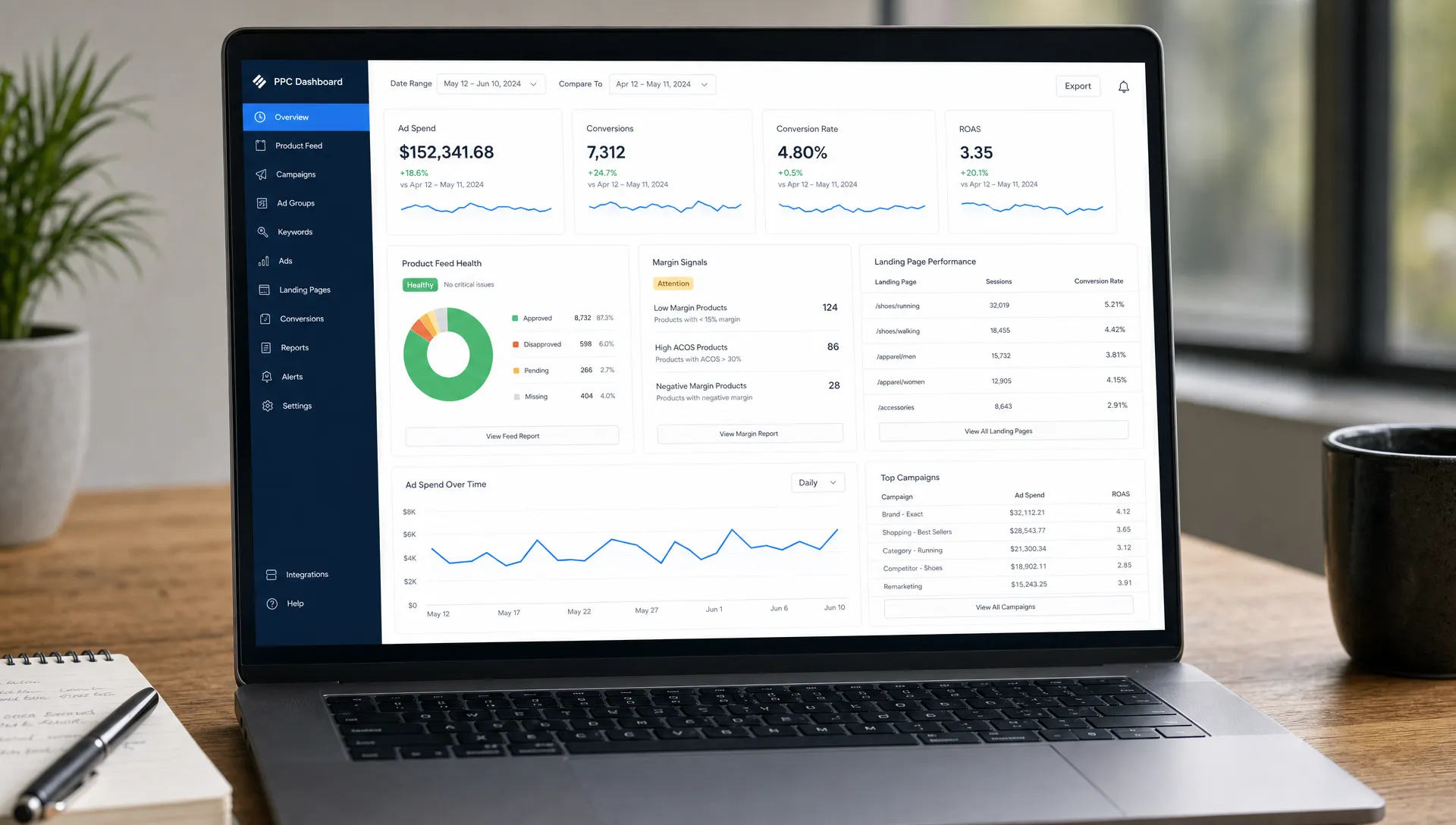
Landing pages protect the incrementality you already paid for
A paid click is not revenue. It is only the right to compete for a shopper’s attention after money has already been spent. Slow pages, unclear product information, weak mobile UX and checkout friction turn incremental demand into wasted acquisition cost.
This is why PPC performance should be reviewed with landing page performance. Search terms, ad copy and product feeds reveal what the shopper expected. The landing page either confirms that expectation or breaks it. Category pages may need stronger filters. Product pages may need clearer sizing, delivery, returns or trust signals. Checkout may need fewer distractions and fewer surprise costs.
Site speed matters here because paid traffic often arrives with low patience and high comparison behavior. If performance issues are reducing conversion, Space Dinosaurs explains how ecommerce teams can connect technical metrics to revenue in its article on turning site speed into revenue.
Conversion work also changes the economics of PPC. When more qualified clicks convert, the same budget produces more revenue without higher bids. For teams trying to diagnose where shoppers drop out, the guide to conversion optimization services that reduce revenue leaks covers the broader funnel view.
Budget allocation should follow marginal returns
Scaling paid media is not the same as increasing spend. In many ecommerce accounts, early budget captures the most efficient demand, then additional spend moves into more expensive auctions, broader audiences or lower-intent placements. Incremental revenue depends on knowing where that curve starts to flatten.
This is where ecommerce ppc management should use marginal analysis. Instead of asking whether a campaign is profitable overall, ask what happened when spend increased or decreased. Did revenue rise proportionally? Did new customer orders grow? Did contribution margin hold? Did organic or direct revenue fall at the same time?
These questions are especially useful for branded search and remarketing. Both can be valuable, but both can also overclaim revenue. A brand campaign may protect against competitors in some auctions, yet waste money in others. Remarketing may recover hesitant shoppers, yet overspend on people who would have returned through email or direct navigation.
Strong budget allocation usually creates a portfolio. Some spend protects demand. Some spend captures high-intent category searches. Some spend tests new audiences. Some spend supports seasonal pushes or inventory priorities. The portfolio should be judged by total business lift, not by isolated platform wins.
A practical operating model for paid growth
Retail PPC improves when teams treat it as a continuous operating loop rather than a monthly reporting exercise. The cadence should connect campaign data, product economics, site behavior and business priorities.
A useful weekly rhythm includes:
- Search term and query quality review across brand, non-brand and shopping campaigns
- Product feed checks for stock, price changes, title quality and disapproved items
- Budget movement based on margin, inventory and marginal return signals
- Landing page review for high-spend campaigns with weak conversion rates
- New customer and returning customer split analysis where data is available
Over a longer period, ecommerce ppc management should also include structured testing. That might mean brand holdouts, geo tests, audience exclusions, landing page tests or creative tests tied to a specific hypothesis. The goal is not to create more reports. The goal is to make better spending decisions with less guesswork.
A strong operating model also creates shared accountability. Paid media teams need access to merchandising changes. Ecommerce teams need to know which pages are receiving spend. Analytics teams need clean events and customer data. When those functions work together, incremental revenue becomes easier to find and easier to defend.
Where AI helps, and where human judgment still matters
AI can improve bidding, segmentation, creative variation and product recommendations, but automation does not remove the need for strategy. Automated systems optimize toward the goals and signals they are given. If the conversion setup rewards low-margin orders or overvalues returning customers, automation will scale the wrong outcomes faster.
In ecommerce ppc management, AI is most useful when the foundations are strong. Clean event tracking, reliable product data, strong site performance and clear business rules give automated systems better input. Human teams still need to decide which customers are worth acquiring, which products deserve spend and which tests will answer the most important business questions.
This is also where retail-focused engineering and UX work can unlock paid media performance. A faster storefront, better product discovery, cleaner analytics and more relevant customer journeys all improve the odds that PPC spend becomes real business lift.
How Space Dinosaurs supports the revenue foundation
Paid media rarely fails in isolation. It often exposes deeper issues in the ecommerce stack: slow templates, fragile tracking, unclear product pages, poor merchandising logic or a checkout experience that leaks qualified demand.
Space Dinosaurs helps retail brands modernize ecommerce experiences with AI-enabled engineering, performance optimization, human-centered UX, analytics and ongoing optimization. That foundation makes paid acquisition more accountable because teams can connect spend to the full customer journey, not just the ad click.
For brands investing heavily in paid media, the opportunity is often not only to manage bids better. It is to build a retail experience where every qualified click has a stronger chance of becoming profitable, incremental revenue.
Frequently Asked Questions
What is incremental revenue in PPC? Incremental revenue is the additional revenue generated because paid media changed shopper behavior. It excludes sales that likely would have happened anyway through organic search, direct traffic, email or existing brand demand.
Why can high ROAS still be misleading? High ROAS can include conversions from shoppers who were already close to buying. It can also hide low-margin products, heavy discounting, high return rates or budget cannibalization from other channels.
How often should ecommerce PPC performance be reviewed? Campaign quality, budget pacing, feed issues and landing page performance should be reviewed weekly. Incrementality tests and budget strategy should be reviewed over longer windows because lift patterns need enough data to be reliable.
Does ecommerce ppc management require conversion rate optimization? It does if the goal is profitable growth. Paid media can bring qualified traffic, but landing pages, product discovery, site speed and checkout determine how much of that demand becomes revenue.
Turn paid traffic into measurable business lift
If PPC spend is rising but profit is not keeping pace, the issue may not be media buying alone. Measurement, product economics, site performance and UX all shape whether campaigns create incremental revenue.
Space Dinosaurs works with retail brands on the ecommerce foundations that make growth more efficient: faster experiences, stronger analytics, AI-driven retail journeys and continuous optimization. For teams that want paid acquisition to drive real revenue instead of louder reporting, those foundations are often the place to start.