


For many retail brands, digital marketing e commerce work has become more expensive, more fragmented and harder to connect to profit. Traffic is not the goal; profitable orders are. The practical question is how each campaign, landing page, promotion and lifecycle message affects contribution margin after media costs, discounts, fulfillment pressure and returns.
That shift matters because ecommerce teams now operate with tighter budgets and more scrutiny. A channel can look strong in platform reporting and still weaken profitability if it attracts low-margin orders, increases returns or depends on constant promotions. The better approach is to connect marketing, UX, engineering, merchandising and analytics into one operating model.
Build a digital marketing e commerce model around margin
Profitability starts with the unit economics of the order, not with the channel dashboard. Before scaling campaigns, teams need to know which products, categories, customer segments and acquisition sources produce healthy contribution after variable costs.
A simple model should include gross margin, discounts, payment fees, pick and pack costs, shipping subsidies, return rates, media spend and customer service pressure. That level of detail prevents a common mistake: increasing revenue while quietly reducing profit per order.
| Metric | Why it matters | What to watch |
|---|---|---|
| Gross margin by category | Shows which products can support acquisition costs | Low-margin bestsellers that dominate spend |
| Contribution margin | Connects marketing to real profitability | Orders that only work before fulfillment and returns |
| Return rate | Reveals hidden cost in product and channel mix | Channels that attract poor-fit shoppers |
| Discount dependency | Measures how much demand relies on promotions | Campaigns that train customers to wait |
| Repeat purchase rate | Shows whether acquisition creates durable value | One-time buyers with high CAC |
A digital marketing e commerce plan built on margin gives every team a shared definition of growth. Marketing can still pursue scale, but not at the expense of economics that make the business harder to run.
Prioritize demand capture before demand creation
Not all revenue is equally efficient. In many retail categories, the most profitable marketing starts by capturing existing demand from shoppers who already know the problem, product type or brand they want. That usually means improving paid search structure, Shopping feeds, category SEO, email segmentation and onsite merchandising before pouring budget into broad awareness.
For a deeper breakdown of the revenue levers behind channel efficiency, Space Dinosaurs has covered marketing in ecommerce strategies that improve ROI. The profitability lens is slightly different: it asks which levers should receive funding first when cash, engineering capacity and attention are limited.
Paid media should follow product economics
Paid acquisition works best when campaign structure reflects business reality. A brand should not bid the same way on a high-margin replenishable product as it does on a low-margin seasonal item with high return risk.
In a digital marketing e commerce program, paid media should be grouped by margin profile, inventory depth, repeat purchase likelihood and conversion intent. That makes budget allocation more accurate than optimizing only for platform ROAS, which can over-credit channels that capture customers who were likely to buy anyway.
SEO should focus on commercial paths
SEO is often treated as a traffic channel, but ecommerce SEO improves profitability when it supports high-intent category, collection and product discovery pages. Blog content has a role, yet commercial pages usually have a clearer connection to revenue.
The best opportunities often sit in category architecture, faceted navigation, internal linking, page speed and product content quality. When SEO brings shoppers into pages that match buying intent, the business reduces its dependence on paid acquisition over time.
Fix conversion leaks before buying more traffic
If the site experience wastes demand, marketing spend becomes a tax on inefficiency. Retail teams should review the full journey from ad or search result to product discovery, product detail page, cart, checkout and post-purchase communication.
Common profit leaks include unclear pricing, slow product listing pages, weak filtering, missing delivery information, poor mobile usability and checkout steps that create uncertainty. These problems do not just reduce conversion rate. They also increase customer support contacts, returns and abandoned carts from shoppers who were otherwise qualified.
Every digital marketing e commerce budget becomes more profitable when conversion work happens before major spend increases. That is why CRO should be tied to known revenue leaks instead of random testing calendars. If your team is prioritizing fixes, this guide to ecommerce conversion rate optimization explains how to focus on issues that actually affect sales.
| Journey area | Profitability question | Example improvement |
|---|---|---|
| Product discovery | Can shoppers find the right item quickly? | Better filters, sorting and collection logic |
| Product pages | Does the page reduce purchase uncertainty? | Clear sizing, availability, delivery and return details |
| Cart | Does the order value still feel worthwhile? | Transparent shipping thresholds and promo logic |
| Checkout | Is completion fast and trustworthy? | Fewer distractions, better payment options and clear errors |
| Site speed | Are slow pages suppressing demand? | Core Web Vitals improvements on key templates |
Treat performance optimization as a marketing lever
Site speed is often owned by engineering, but its impact shows up in marketing efficiency. Slow pages reduce the value of every paid click, organic visit and email session. They can also affect crawling, user trust and the ability to launch new campaigns without breaking the shopping experience.
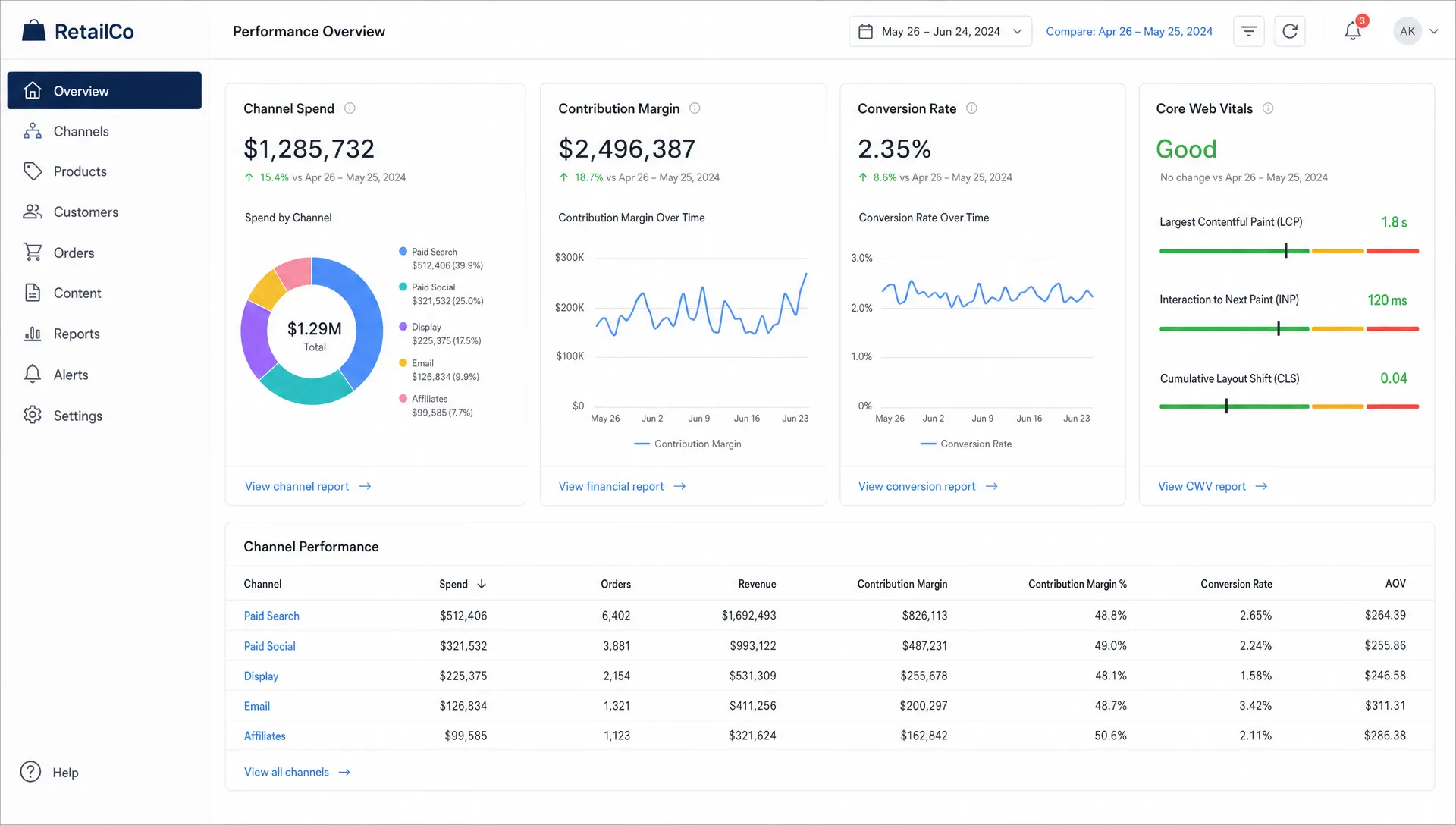
For retail teams, the most important performance work usually happens on templates that influence revenue at scale: homepage, product listing pages, product detail pages, cart and checkout. Core Web Vitals such as Largest Contentful Paint, Interaction to Next Paint and Cumulative Layout Shift give teams a practical way to connect technical health with shopper behavior.
A profitable digital marketing e commerce system treats speed improvements as part of the growth budget, not as a cleanup task. Space Dinosaurs has written more about how teams can turn site speed into revenue, especially when performance metrics are connected to conversion outcomes.
Use AI where it reduces friction
AI can improve ecommerce profitability, but only when it solves a specific shopper or operator problem. Useful applications include better product recommendations, faster product content workflows, improved search relevance, customer service triage, conversational commerce and analytics support.
The risk is adding AI because it looks innovative rather than because it improves a measurable behavior. A chatbot that creates confusion, a recommendation engine that pushes low-margin items or automated content that weakens product accuracy can hurt trust and revenue.
A digital marketing e commerce team should evaluate AI initiatives against adoption, usability and business impact. For teams building AI-powered customer or operator experiences, a structured resource like the AI Product Adoption Deck can help diagnose where trust, retention and usability break before those issues become expensive to fix.
Start with narrow AI use cases
Retail AI works best when the use case is specific. Instead of asking AI to transform the entire customer journey at once, teams can begin with high-friction moments such as product comparison, fit guidance, support deflection or merchandising analysis.
Each use case should have a measurable baseline. If AI improves conversion but increases returns, the business may not be better off. If it reduces support volume but lowers customer satisfaction, the implementation needs refinement. Profitability depends on the full outcome, not the headline feature.
Measure marketing by incremental profit
Attribution platforms are useful, but they do not always answer the most important question: what would have happened without this spend? Incrementality matters because platform dashboards often overstate impact, especially when campaigns retarget existing customers or capture branded demand.
The finance-friendly digital marketing e commerce scorecard should combine channel data with business metrics. Teams can compare blended media efficiency, contribution margin, new customer quality, repeat purchase behavior and cohort profitability. Where possible, holdout tests, geo tests or budget shifts can reveal whether spend is truly creating demand.
| Measurement layer | What it answers | Useful signal |
|---|---|---|
| Platform reporting | What happened inside the ad system? | Clicks, conversions and reported ROAS |
| Analytics | How did users behave onsite? | Sessions, funnel steps and conversion paths |
| Margin reporting | Was the order profitable? | Contribution margin and return-adjusted value |
| Cohort analysis | Did acquisition create durable customers? | Repeat purchase rate and lifetime value |
| Incrementality testing | Did spend create revenue that would not exist otherwise? | Lift versus control or baseline |
This approach also improves cross-functional decision-making. Marketing can defend investments more clearly, finance can see how spend turns into contribution and product teams can prioritize site improvements that make every channel more efficient.
A 90-day profitability roadmap
Retail teams do not need to rebuild everything at once. A focused 90-day plan can uncover the biggest leaks, improve the highest-value journeys and create a measurement system that keeps growth accountable.
In practice, a digital marketing e commerce roadmap should move from diagnosis to focused execution. The first month is for connecting channel data, margin data and site behavior. The second month is for fixing the most visible profit leaks, such as poor mobile conversion, feed errors, slow templates or checkout friction. The third month is for reallocating budget toward channels, categories and customer segments that show stronger economics.
A practical roadmap can include these priorities:
- Audit contribution margin by channel, category and customer type
- Identify top landing pages where paid or organic traffic underperforms
- Review product feed quality, campaign grouping and promotion logic
- Fix the highest-impact UX and performance issues on mobile journeys
- Build a dashboard that combines spend, revenue, margin and repeat behavior
- Test one AI or automation use case tied to a clear operational or shopper problem
The key is sequencing. If analytics are broken, fix measurement first. If conversion is weak, improve the journey before scaling spend. If margins vary widely by category, restructure campaigns around economics rather than average ROAS.
Frequently Asked Questions
What makes ecommerce marketing profitable instead of just revenue-generating? Profitable ecommerce marketing accounts for contribution margin, media cost, discounts, shipping, returns and customer lifetime value. Revenue alone can hide campaigns that look successful but weaken the business after costs are included.
How often should teams review profitability metrics? Digital marketing e commerce performance should be reviewed weekly at the channel and campaign level, then monthly at the cohort and margin level. Weekly reviews help with tactical adjustments, while monthly reviews reveal deeper patterns in customer quality and repeat behavior.
Should brands cut paid media if profitability is under pressure? Not always. The better move is to separate efficient demand capture from wasteful spend. Branded search, high-intent Shopping campaigns and profitable retargeting may still deserve funding, while broad campaigns with weak incrementality may need tighter controls.
Where does UX fit into marketing profitability? UX affects the return on every visit. Better product discovery, faster pages, clearer product information and smoother checkout can increase conversion without raising acquisition spend, which often makes UX one of the highest-leverage profit improvements.
Turn marketing spend into a stronger retail engine
The most profitable ecommerce teams do not treat marketing as a separate function from site experience, analytics or engineering. They connect the full system: how shoppers arrive, how quickly they find the right product, how confident they feel before checkout and whether the order creates lasting value.
Space Dinosaurs helps retail brands modernize ecommerce experiences, improve performance, strengthen UX and connect analytics to growth decisions. If your team is ready to make marketing more accountable to profitability, start by identifying the few technical, experience and measurement changes that can make every dollar work harder.