

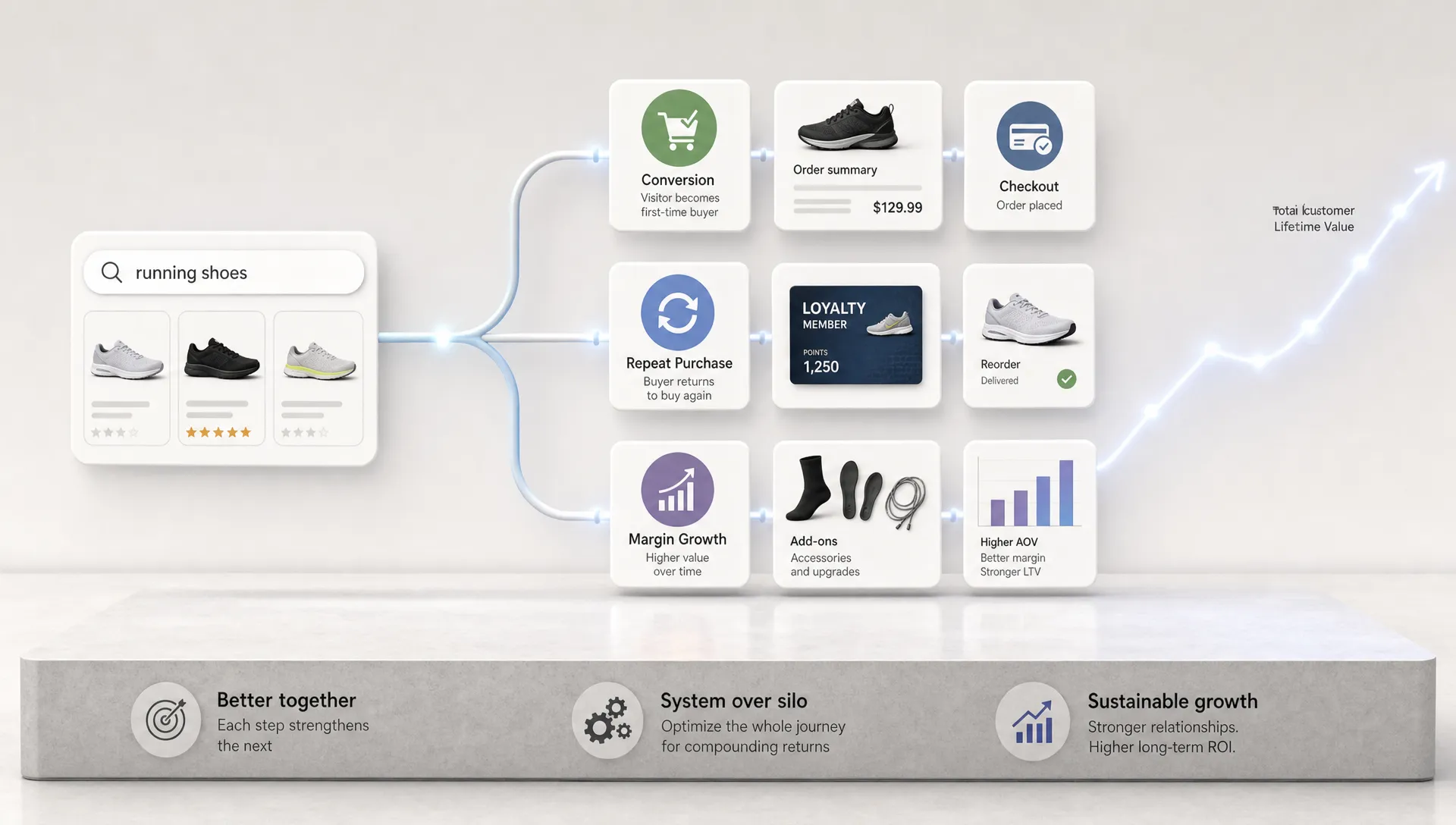
Marketing in ecommerce has become a margin discipline. Traffic costs are high, customer journeys are fragmented, and retail teams are under pressure to prove that every dollar spent creates measurable revenue, not just impressions, sessions, or assisted conversions.
That does not mean ecommerce marketing should become conservative. It means the best teams treat marketing as a connected system. Paid media, SEO, email, UX, performance, merchandising, analytics, and AI all influence the same outcome: profitable customer behavior.
If ROI is flat, the answer is rarely to add another campaign. More often, the highest return comes from finding the lever that is limiting the whole system. The seven levers below help ecommerce and retail brands focus investment where it compounds.
Why ecommerce marketing ROI is harder than it looks
Ecommerce ROI is often reduced to ROAS, but ROAS alone can be misleading. A campaign can look efficient while pushing low-margin products, over-discounting existing customers, or acquiring one-time buyers who never return.
A better view of ROI connects marketing activity to contribution margin, customer acquisition cost, lifetime value, conversion rate, return rate, and operating cost. This is especially important for retail brands with large catalogs, seasonal demand, multiple channels, and frequent promotions.
In practical terms, ecommerce marketing should answer three questions:
- Are we attracting shoppers with real purchase intent?
- Are we converting them efficiently once they arrive?
- Are we increasing the value of each customer over time?
The levers below are designed around those questions.
The 7 ecommerce marketing levers, at a glance
| Lever | Primary ROI impact | Key metric to watch |
|---|---|---|
| Profit-based measurement | Stops spend from optimizing toward vanity metrics | Contribution margin by channel |
| Site speed and UX | Converts more of the traffic you already have | Revenue per session |
| High-intent SEO and discovery | Captures demand without paying for every click | Non-paid revenue from category and PDP traffic |
| Paid acquisition discipline | Improves incrementality and reduces wasted spend | Incremental CAC and blended CAC |
| First-party retention | Raises customer lifetime value | Repeat purchase rate |
| AI-enabled execution | Improves speed, personalization, and decision quality | Time saved and lift from automated journeys |
| Experimentation rhythm | Turns learning into compounding gains | Win rate and annualized revenue lift |
1. Start with a profit-based measurement model
The first lever is not a channel. It is the measurement model that tells you which channels deserve investment.
Many ecommerce teams still manage marketing around platform-reported ROAS. The problem is that ad platforms are designed to claim credit, not to model your business economics. They rarely account for margin differences, discount depth, shipping costs, return rates, or whether the customer would have purchased anyway.
A stronger model starts with a simple hierarchy. At the top is profit, not traffic. Below that are the drivers of profit: qualified sessions, conversion rate, average order value, gross margin, repeat purchase rate, and cost to acquire or retain the customer.
This shifts the conversation from asking which campaign got the most revenue to asking which investment created the most profitable demand. It also helps teams make better tradeoffs. A channel with lower ROAS may still be valuable if it brings in new customers with high lifetime value. A channel with strong ROAS may be less attractive if it mostly captures branded demand from existing shoppers.
For retail teams, the measurement model should separate at least three layers: acquisition, conversion, and retention. Acquisition tells you whether marketing is bringing in the right shoppers. Conversion tells you whether the site experience is monetizing those shoppers. Retention tells you whether the customer relationship is growing after the first order.
2. Improve site speed and conversion friction before buying more traffic
The second lever is the one many marketing teams underestimate: the site itself.
A slow, confusing, or unstable ecommerce experience taxes every channel. Paid media becomes more expensive because fewer visitors convert. SEO underperforms because technical issues and weak user experience limit organic growth. Email and SMS drive traffic that leaks before checkout. Affiliate and influencer campaigns send shoppers into a funnel that cannot fully monetize demand.
This is why conversion infrastructure belongs in the marketing ROI conversation. Google defines Core Web Vitals around loading, responsiveness, and visual stability through metrics like Largest Contentful Paint, Interaction to Next Paint, and Cumulative Layout Shift, as explained in its Core Web Vitals guidance. These metrics matter because they reflect real shopper experience, especially on mobile.
Cart and checkout friction also carry a direct revenue cost. The Baymard Institute's long-running research on cart abandonment shows that abandonment remains a major ecommerce challenge across industries. While some abandonment is natural comparison behavior, much of it is caused by avoidable issues: unexpected costs, forced account creation, slow checkout, limited payment options, unclear delivery information, or trust concerns.
The ROI opportunity is straightforward. If you improve conversion rate, revenue per session, and checkout completion, every traffic source becomes more productive. Before increasing media spend, audit the experience that spend is funding.
Performance is especially powerful because it connects engineering work to commercial outcomes. For a deeper look at that connection, Space Dinosaurs has explained how ecommerce teams can turn site speed into revenue instead of treating performance as a purely technical score.
3. Capture high-intent demand with SEO and product discovery
SEO is one of the most durable levers in ecommerce marketing, but only when it is tied to commercial intent. Ranking for broad informational queries can support brand visibility, yet the highest ROI often comes from category pages, product listing pages, product detail pages, buying guides, comparison content, and internal search improvements.
A shopper searching for a specific product type, size, use case, material, brand, or compatibility requirement is often much closer to purchase than someone browsing a generic trend article. Ecommerce SEO should help those shoppers land on the right page, understand the assortment quickly, filter the catalog easily, and move toward purchase with confidence.
This makes SEO more than content production. It includes technical health, crawlability, site architecture, internal linking, structured data, faceted navigation governance, product data quality, and page templates that can scale across the catalog.
Product discovery is part of the same lever. If shoppers cannot filter effectively, compare products, understand availability, or find the right variant, marketing ROI suffers. Search demand may bring them to the site, but merchandising and UX determine whether they buy.
For ecommerce teams evaluating this channel, the useful question is not whether SEO increased traffic. The better question is whether organic visibility increased qualified sessions and revenue across high-intent pages. That is the lens Space Dinosaurs uses in its perspective on how SEO in e commerce should move revenue, not just rankings.
4. Make paid acquisition more incremental
Paid acquisition still matters, but the ROI ceiling depends on incrementality. In other words, how much revenue would not have happened without the spend?
This matters because ecommerce ad accounts often blend different types of demand. Some campaigns create new demand. Some capture demand created elsewhere. Some retarget shoppers who were already likely to convert. All can have a role, but they should not be valued the same way.
A healthier paid media strategy separates prospecting, retargeting, brand search, shopping ads, marketplace ads, affiliate, and creator campaigns by intent and incrementality. It also looks beyond last-click revenue to blended CAC, new customer rate, payback period, margin, and LTV.
Discounting is another paid media trap. Promotions can lift conversion rate while reducing profit. If the offer trains customers to wait for discounts, short-term ROAS can hide long-term margin damage. That does not mean brands should avoid promotions. It means promotions need clear goals: clearing inventory, acquiring a specific segment, increasing basket size, or reactivating dormant customers.
A practical approach is to set channel roles. Prospecting campaigns should be judged on qualified new customer acquisition and payback. Retargeting should be capped based on marginal lift. Brand search should be monitored for cannibalization. Shopping campaigns should be optimized by product margin and availability, not only revenue.

5. Use first-party data to lift retention and lifetime value
Acquiring a customer is only the first step. Better ecommerce ROI comes when marketing increases the value of that relationship after the initial order.
First-party data is the foundation. Purchase history, browsing behavior, product preferences, category affinity, size or fit data, location, loyalty status, and customer service interactions can all help create more relevant journeys. The goal is not personalization for its own sake. The goal is to reduce irrelevant communication and make the next best action easier for the customer.
Retention marketing typically has a strong ROI profile because it builds on an existing relationship. Email, SMS, loyalty programs, replenishment reminders, post-purchase education, back-in-stock alerts, personalized product recommendations, and winback campaigns can all increase repeat purchase rate and LTV.
The key is to map lifecycle journeys around customer intent. A first-time buyer may need reassurance, usage guidance, delivery clarity, or social proof. A repeat buyer may respond to early access, replenishment, bundles, or loyalty benefits. A dormant customer may need a reason to return, but not always a discount.
Segmentation also helps protect margin. High-value customers should not automatically receive the same discounts as price-sensitive one-time buyers. Customers who regularly purchase full price can often be nurtured through access, service, content, or better recommendations.
Retention should be measured by cohort behavior. Look at how often customers return, how long it takes them to make a second purchase, which first products lead to higher LTV, and which campaigns change behavior compared with a holdout group.
6. Apply AI where it removes work or improves decisions
AI is now part of marketing in ecommerce, but ROI depends on applying it to specific workflows rather than treating it as a novelty.
The strongest use cases usually fall into three categories: speed, relevance, and decision support. Speed includes tasks like product content generation, campaign variant creation, reporting summaries, and customer service triage. Relevance includes personalized recommendations, dynamic merchandising, search improvement, conversational commerce, and lifecycle segmentation. Decision support includes forecasting, anomaly detection, assortment insights, and performance diagnostics.
Retail brands should start with use cases where the business value is measurable. For example, AI-generated product descriptions may reduce content production time, but the ROI should also consider accuracy, brand consistency, conversion impact, and governance. AI-powered product recommendations may lift average order value, but the team should measure margin and customer satisfaction, not just clicks.
The best AI roadmap is grounded in operational reality. It should answer where the data lives, which systems need integration, who reviews outputs, how errors are handled, and what success metric proves value. Teams that need a broader adoption plan can work with specialists offering AI opportunity audits and custom AI platforms to identify practical automation opportunities before committing to large-scale implementation.
For ecommerce leaders, the principle is simple: use AI where it improves the customer experience, removes repetitive work, or helps teams make faster and better commercial decisions. Avoid AI projects that are impressive in demos but disconnected from revenue, margin, or operating efficiency.
7. Run experimentation as an operating system
The final lever is experimentation. Not occasional A/B testing, but a repeatable operating system for learning what actually improves performance.
Ecommerce teams have many opinions about what will increase conversion: shorter pages, longer pages, bigger product images, different copy, different filters, alternative shipping messages, new bundles, fewer form fields, more social proof, and countless other changes. Some will work. Some will do nothing. Some will hurt revenue.
Experimentation creates a disciplined way to decide. It also prevents teams from overvaluing best practices that may not apply to their customers, category, price point, or brand positioning.
A useful experimentation program includes a clear hypothesis, a primary business metric, guardrail metrics, clean implementation, and post-test documentation. The goal is not to win every test. The goal is to build a learning engine that compounds over time.
Conversion testing is especially valuable when combined with qualitative evidence. Heatmaps, session recordings, customer service logs, onsite search data, reviews, and survey responses can reveal why shoppers hesitate. Quantitative tests then show whether a proposed fix changes behavior at scale.
If your team is building a testing roadmap, start with the highest friction moments: product listing pages, product detail pages, cart, checkout, mobile navigation, search results, and delivery or returns messaging. Space Dinosaurs has outlined practical conversion rate optimization tactics for retail brands that fit this type of evidence-led approach.
How to prioritize the seven levers
Not every ecommerce brand should start in the same place. A retailer with fast traffic growth and flat revenue should likely audit conversion friction first. A brand with strong conversion but rising CAC may need paid acquisition discipline and retention. A site with a large catalog and weak organic revenue may need SEO, product discovery, and technical cleanup.
A simple prioritization model can help. Score each lever by potential impact, confidence, effort, and speed to value. Then look for initiatives that improve more than one lever at once.
| Initiative | Levers it can support | Why it often improves ROI |
|---|---|---|
| Improve mobile PDP performance | Site speed, UX, SEO, paid media | More traffic converts from every source |
| Restructure category pages around buying intent | SEO, product discovery, conversion | Shoppers find relevant products faster |
| Add post-purchase lifecycle flows | Retention, first-party data | More first-time buyers return |
| Segment paid campaigns by margin | Measurement, acquisition discipline | Spend shifts toward profitable demand |
| Build an experimentation backlog | CRO, analytics, customer insight | Learning compounds across the funnel |
The best ecommerce marketing roadmaps are not channel wish lists. They are revenue systems. They identify the biggest constraint, fix it, measure the impact, and move to the next constraint.
Common mistakes that weaken ecommerce marketing ROI
Even capable teams lose ROI when execution becomes fragmented. Paid media may be optimized separately from merchandising. SEO may be measured separately from revenue. Engineering may improve performance without a commercial hypothesis. Email may focus on send volume rather than customer progression.
The most common mistake is treating each channel as its own scoreboard. Customers do not experience your brand as channels. They experience a sequence: search, ad, landing page, product discovery, product detail page, cart, checkout, delivery, support, and re-engagement. ROI improves when that sequence feels coherent.
Another mistake is chasing new tools before fixing the basics. A personalization platform will not save unclear product pages. A bigger ad budget will not fix a slow checkout. An AI assistant will not compensate for poor product data. Technology creates leverage only when the underlying experience and measurement model are sound.
Finally, teams often underinvest in operational cadence. Weekly performance reviews, shared dashboards, test documentation, and cross-functional decision-making are not glamorous, but they make improvement repeatable.
Frequently Asked Questions
What is marketing in ecommerce? Marketing in ecommerce is the set of strategies used to attract, convert, retain, and grow online customers. It includes paid media, SEO, email, SMS, content, merchandising, site experience, analytics, and increasingly AI-enabled personalization and automation.
What is the best way to improve ecommerce marketing ROI? The best starting point is to identify the biggest constraint in the customer journey. If traffic is low, focus on acquisition and SEO. If traffic is strong but revenue is weak, focus on speed, UX, product discovery, and checkout. If acquisition costs are rising, focus on retention and LTV.
Is ROAS enough to measure ecommerce marketing performance? ROAS is useful, but it is not enough. Ecommerce teams should also measure contribution margin, CAC, repeat purchase rate, LTV, revenue per session, conversion rate, return rate, and incrementality.
How does AI improve ecommerce marketing ROI? AI can improve ROI by reducing manual work, personalizing customer journeys, improving product discovery, supporting better segmentation, and helping teams analyze performance faster. The highest-value AI use cases are tied to measurable business outcomes.
Which ecommerce marketing lever should retail brands prioritize first? Prioritize the lever with the largest revenue constraint and the fastest path to measurable impact. For many retail brands, that means improving site performance and conversion friction before increasing traffic spend.
Ready to improve ecommerce marketing ROI?
Better ecommerce ROI does not come from isolated campaigns. It comes from connecting marketing, UX, engineering, analytics, and AI around the same commercial goal.
Space Dinosaurs helps retail brands modernize ecommerce experiences, improve performance, optimize costs, and build smarter digital systems that support growth. If your site is ready to become a stronger revenue lever, start by identifying which of these seven levers is limiting your ROI today.