
If your conversion rate optimization program feels like a pile of button color tests, pop-ups and isolated landing page tweaks, it is probably not working hard enough.
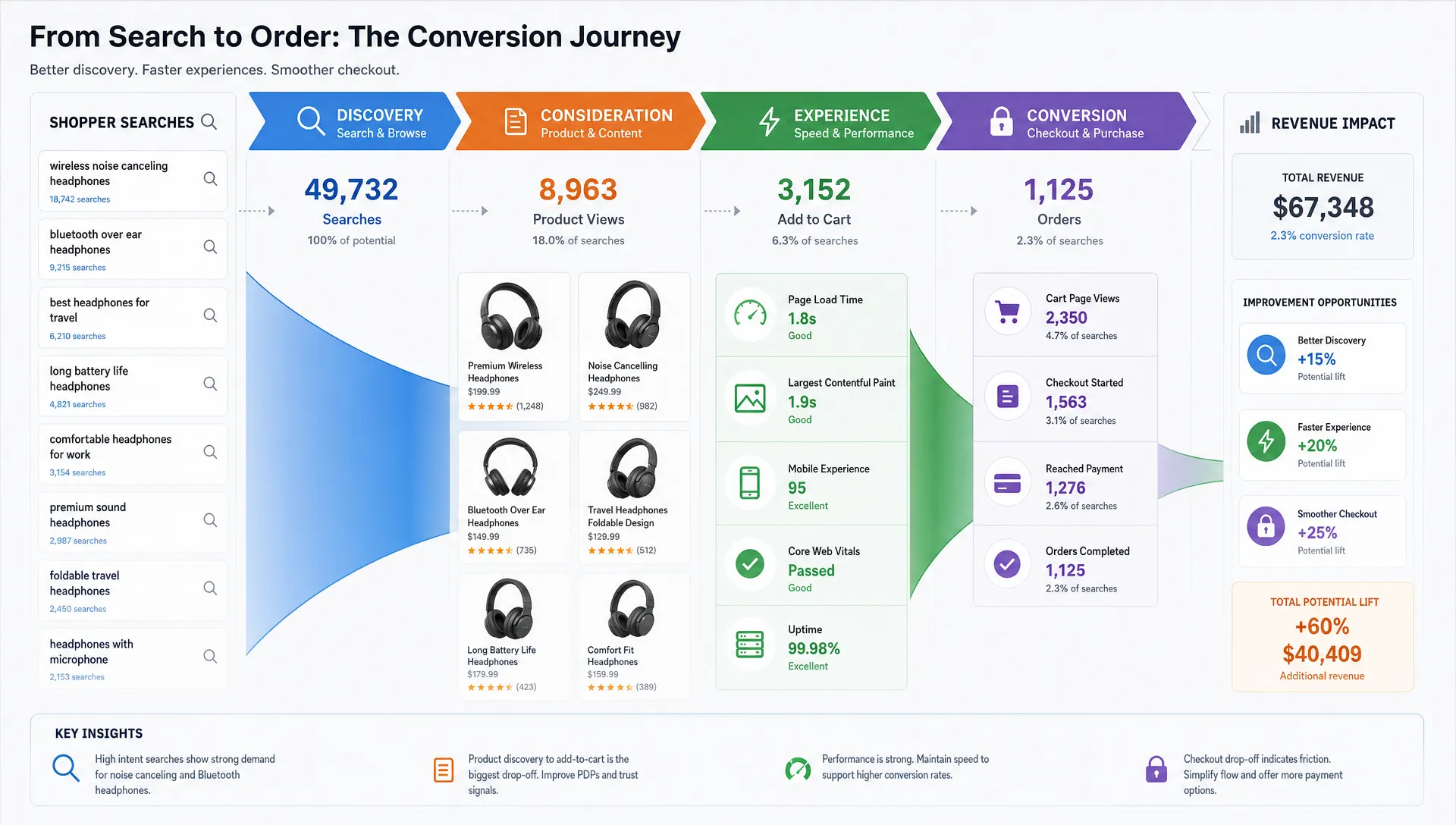
Real ecommerce conversion rate optimization is less about finding one clever trick and more about removing the reasons shoppers hesitate. They cannot find the right product. They do not understand the offer. The page loads slowly. The delivery promise arrives too late in the journey. The checkout asks for too much information. Each small point of friction leaks revenue from traffic you already paid to acquire.
For retail teams, the goal is not simply a higher sitewide conversion rate. A healthier goal is profitable revenue growth from the same demand. That means improving conversion while protecting average order value, margin, retention and brand trust.
Why Most Ecommerce CRO Programs Stall
Many CRO programs fail because they start with tactics instead of diagnosis. Someone sees a competitor using a sticky add-to-cart bar, a homepage quiz or a countdown timer, then asks the team to test the same thing. The test may produce a small lift, but it rarely builds durable advantage because it was not tied to a specific shopper problem.
Another common issue is over-reliance on the blended conversion rate. Sitewide conversion rate is useful as a health metric, but it hides the real story. A returning customer on a branded search query behaves differently from a first-time mobile visitor coming from paid social. A shopper comparing high-consideration products needs different reassurance than someone replenishing a product they already know.
CRO also stalls when it is treated as a marketing activity detached from engineering, merchandising and operations. A checkout test cannot fix a slow payment step if the underlying implementation is fragile. A product page redesign cannot overcome poor inventory data. A personalization experiment may harm performance if it adds heavy scripts to key templates.
The teams that win treat conversion as a system. They connect customer behavior, technical performance, UX, merchandising, analytics and experimentation into one operating model.
Start With Revenue Leaks, Not Random Tests
Before deciding what to test, map the buying journey from first landing page to completed order. The point is not to create a perfect diagram. The point is to identify where qualified intent drops off and why.
A practical ecommerce CRO audit should review at least these journey points:
- Landing pages by channel and audience segment
- Product listing pages, category pages and internal search
- Product detail pages for top sellers and high-margin products
- Cart behavior, promo code usage and shipping cost exposure
- Checkout steps, validation errors and payment failures
- Post-purchase paths that influence repeat buying
Look for patterns that combine quantitative and qualitative evidence. A high exit rate on a product page tells you where something is happening. Search queries, session recordings, reviews, support tickets and on-page survey responses help explain why.
| Revenue leak signal | Likely friction | Better CRO response |
|---|---|---|
| Strong category traffic with weak product clicks | Poor sorting, unclear filters or weak product cards | Improve product discovery and merchandising logic |
| High PDP views with low add-to-cart rate | Missing trust, unclear value or weak product content | Improve above-the-fold clarity, proof and buying guidance |
| High cart abandonment after shipping appears | Unexpected costs or weak delivery proposition | Show delivery, returns and thresholds earlier |
| Checkout drop-off on mobile | Form effort, payment friction or layout issues | Reduce fields, improve validation and prioritize express pay |
| Conversion drops on slower templates | Performance bottlenecks in revenue-critical paths | Optimize Core Web Vitals where buying decisions happen |
This approach keeps the CRO roadmap grounded in the customer journey rather than personal preference.
The Five CRO Levers That Actually Move Revenue
1. Product discovery that matches buying intent
Shoppers do not convert if they cannot get to the right product quickly. This is especially true for retailers with large catalogs, seasonal collections, complex sizing, technical specifications or compatibility requirements.
Good product discovery starts with the basics: category structure, search relevance, filters, sort logic and product cards. If shoppers search for common terms that return weak results, your site is asking motivated buyers to work too hard. If filters hide the attributes people care about, category pages become browsing dead ends.
Internal search data is one of the most underused CRO inputs. It reveals the language customers use, the attributes they care about and the gaps between demand and your catalog structure. A search for waterproof jacket, wide fit boots or iPhone 14 battery replacement carries clear intent. The experience should respond with relevant paths, not generic results.
For product cards, focus on the information needed to decide whether a click is worth it. Price, imagery, ratings, colors, size availability, delivery cues and promotions can all matter, depending on the category. The job of the product card is not to tell the whole story. It is to help shoppers choose the next best product to inspect.
2. Product pages that remove uncertainty
A product detail page has one job: help the shopper decide with confidence. That requires more than nice photography and a visible add-to-cart button.
High-converting PDPs make the value proposition clear, answer common objections and reduce the perceived risk of buying. For fashion, that might mean fit guidance, model details, fabric information, care instructions and returns clarity. For electronics, it might mean compatibility, warranty information, specifications and delivery timing. For replenishable products, subscription details, quantity options and savings should be easy to understand.
Trust signals matter most when the purchase requires confidence. Reviews, user-generated content, expert guidance, stock status and transparent policies all help shoppers feel they are making a safe decision. For service-heavy retail offers, clarity is just as important. An iPhone repair provider that clearly separates display, battery, charging port and backcover repairs reduces guesswork before a customer contacts the business or sends in a device.
The highest-value PDP improvements usually answer real shopper questions. Mine reviews, chat transcripts and support tickets to find repeated concerns. If customers keep asking whether an item runs small, ships next day or works with a specific model, the page is not doing enough.
For more retail-specific examples, Space Dinosaurs has a deeper guide to conversion rate optimization tactics for retail brands that covers product discovery, PDPs, mobile UX and checkout in more detail.
3. Site speed where it affects buying decisions
Performance is a conversion issue, not only a technical hygiene issue. Slow pages interrupt intent. Layout shifts reduce confidence. Delayed interactivity makes shoppers tap twice, abandon forms or assume the site is broken.
Google defines Core Web Vitals around loading performance, responsiveness and visual stability. For ecommerce teams, the practical question is not whether the homepage gets a passing score. The question is whether high-value templates perform well on real devices, real networks and real traffic sources.
Prioritize performance on templates that directly influence revenue:
- Product listing pages where shoppers compare options
- Product detail pages where they evaluate risk and value
- Cart pages where they review cost and delivery
- Checkout pages where any delay can stop the order
If performance work is competing with other roadmap items, frame it in commercial terms. A faster PDP can improve add-to-cart rate. A smoother checkout can reduce abandonment. A more stable product listing page can increase product engagement. Space Dinosaurs breaks down this connection further in its article on Core Web Vitals for ecommerce.
4. Cart and checkout that reduce effort
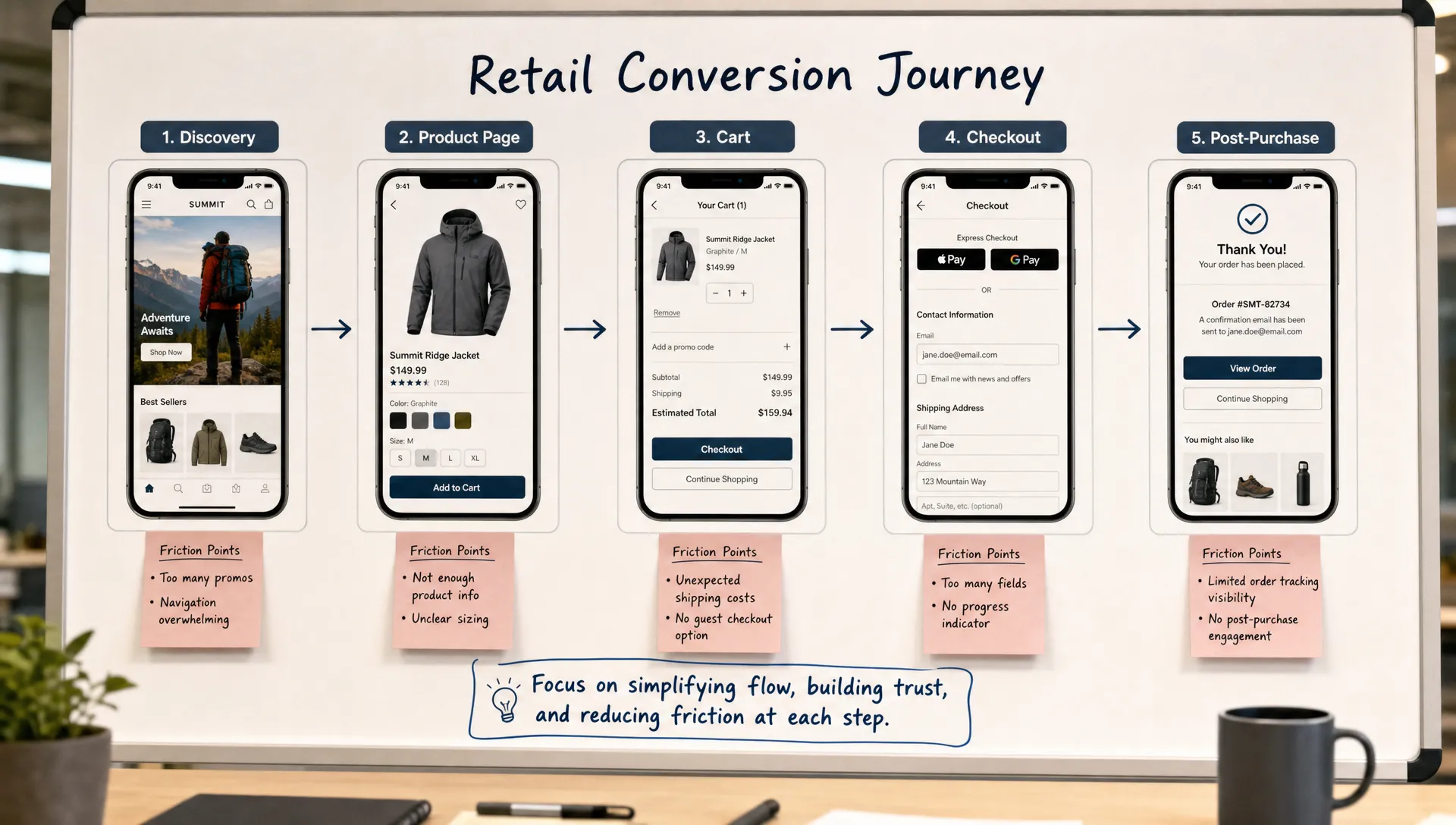
Checkout is where hidden friction becomes expensive. Shoppers have already shown intent, so every avoidable step, surprise or error message carries a direct revenue cost.
Baymard Institute has documented checkout usability issues across ecommerce for years, including friction from account creation, form complexity, unclear costs and weak error handling. Their checkout research is a useful benchmark, but the best starting point is your own funnel data. Where do people hesitate? Which fields trigger errors? Which payment methods fail? Where do mobile shoppers abandon disproportionately?
Strong checkout experiences share a few traits. They allow guest checkout. They expose shipping costs and delivery timing before the final step. They support preferred payment methods. They use clear inline validation. They avoid asking for information that is not necessary to complete the order.
Promo code fields deserve special attention. A visible empty code box can send shoppers away to hunt for discounts. If your brand relies on promotional selling, design the interaction carefully. If not, consider a less dominant placement or a link-style reveal that does not distract full-price buyers.
Checkout optimization should always include guardrail metrics. A test that increases conversion by over-discounting or encouraging low-margin orders may not be a win. Track revenue per visitor, margin impact, average order value, payment failure rate and customer service contacts alongside the primary conversion metric.
5. Offers, merchandising and messaging that align
CRO is not only UX. The offer itself must make sense.
A well-designed page cannot compensate for unclear pricing, confusing bundles or promotions that conflict with shopper intent. If a retailer is pushing free shipping at a threshold, product recommendations and cart messaging should help shoppers reach that threshold naturally. If a category relies on compatibility, merchandising should guide customers toward the correct model, size or variant.
Message consistency is also critical. If a paid ad promises fast delivery, the landing page should confirm delivery timing immediately. If an email promotes a limited collection, the category page should not force shoppers to filter through unrelated products. Every mismatch creates doubt.
This is where CRO and merchandising should work together. Conversion improvements often come from changing how products are grouped, compared and presented, not from changing the color of a call-to-action.
How to Prioritize CRO Work Without Guessing
A good CRO backlog balances impact, confidence and effort, but many teams score those dimensions too casually. The result is a list of tests that feel organized but still reflects internal bias.
A stronger prioritization process considers commercial upside, evidence strength, technical complexity and learning value.
| Prioritization factor | What to ask | Why it matters |
|---|---|---|
| Revenue exposure | How much traffic or revenue touches this issue? | High-traffic friction compounds quickly |
| Intent quality | Are affected visitors likely to buy? | Fixes for qualified shoppers usually pay back faster |
| Evidence strength | Do analytics, feedback and observation point to the same problem? | Multiple signals reduce guesswork |
| Implementation effort | Does the change require design, engineering, data or platform work? | Effort affects sequencing and payback |
| Learning value | Will the test teach something reusable across templates or segments? | CRO should create compounding insight |
Not every improvement needs a formal A/B test. If a checkout field is broken on a mobile browser, fix it. If product pages omit legally required or operationally necessary information, add it. If a template is visibly slow because of an oversized asset, optimize it.
Use experimentation when the outcome is uncertain and traffic is sufficient. Use controlled rollout, before-and-after analysis or segmented monitoring when an A/B test is impractical. The method should match the decision risk.
Build a CRO Operating Model, Not a Campaign
Ecommerce conversion rate optimization works best as an ongoing operating rhythm. One-off audits can uncover opportunities, but the bigger gains come when teams continuously observe, prioritize, ship, measure and learn.
A practical operating model includes a few repeatable habits.
First, create a shared view of performance. Marketing, product, design, engineering and merchandising should agree on the key funnel metrics. If each team works from a different dashboard, CRO turns into debate instead of execution.
Second, connect analytics to qualitative evidence. Numbers show where the leak is. Customer language explains what the leak feels like. Review mining, on-site surveys, customer service themes and usability sessions can all feed the roadmap.
Third, treat templates as products. Category pages, PDPs, carts and checkout flows are revenue assets that need maintenance. As campaigns change, scripts accumulate, product data shifts and customer expectations evolve, yesterday's optimized experience can become today's bottleneck.
Fourth, document what you learn. Failed tests are not wasted if they sharpen your understanding of customer behavior. Record the hypothesis, audience, change, result and next step. Over time, this becomes a decision library that prevents teams from repeating the same arguments.
For teams dealing with performance-related friction, this companion guide on website speed optimization fixes that improve conversions can help connect technical fixes to commercial outcomes.
Where AI Helps Ecommerce CRO
AI can make CRO faster, but it should not replace judgment. The strongest use cases are the ones that help teams process more evidence, personalize responsibly and reduce manual work without degrading the customer experience.
AI can cluster search queries, summarize review themes, identify repeated support questions and help generate test hypotheses from customer language. It can support product recommendations, conversational commerce and guided selling when the underlying product data is reliable. It can also help teams create content variants for testing, provided those variants are reviewed for accuracy, brand fit and compliance.
The risk is using AI to add complexity without solving a shopper problem. A chatbot that cannot answer delivery questions will not improve conversion. A recommendation engine that ignores stock status can frustrate customers. Auto-generated copy that exaggerates product claims can damage trust.
For retail brands, AI-enabled CRO should be grounded in the same principles as any other optimization work: clear intent, good data, fast performance, strong UX and measurable commercial impact.
Metrics That Matter More Than a Simple Conversion Rate
Conversion rate is useful, but it is not enough. A CRO program can increase order count while reducing profitability, increasing returns or attracting poorly matched customers.
Track conversion rate in context with metrics such as:
- Revenue per visitor
- Gross margin per visitor
- Average order value
- Add-to-cart rate by template and segment
- Checkout completion rate
- Payment failure rate
- Return rate and cancellation rate
- Customer acquisition cost payback
- Repeat purchase behavior
Segmentation is essential. A sitewide average can hide meaningful wins or losses. Measure by device, channel, customer type, geography, landing page type and product category. Mobile conversion issues may be masked by strong desktop performance. Paid social visitors may need more education than branded search visitors. Returning customers may respond differently to promotional messages than first-time shoppers.
Also watch for novelty effects. A test can show a short-term lift because the experience is new or more aggressive, then fade as customers adjust. Durable CRO improves the buying experience, not only immediate response.
A Practical 30-Day CRO Sprint
If your team needs momentum, start with a focused 30-day sprint instead of a huge transformation plan.
Week one should be diagnosis. Review funnel analytics, top landing pages, high-value templates, search data, checkout errors and performance metrics. Collect qualitative evidence from reviews, support tickets and session observations.
Week two should be prioritization. Choose a small number of issues with clear revenue exposure and strong evidence. Define the customer problem, hypothesis, expected outcome, primary metric and guardrails.
Week three should be implementation. Ship the simplest version of the improvement that can validate the idea. That might be a PDP content update, checkout form improvement, category filter change or performance fix.
Week four should be measurement and learning. Review results by segment, document what changed and decide whether to scale, iterate or stop. The output should be both a business result and a sharper backlog.
This rhythm keeps CRO close to revenue and reduces the risk of spending months on speculative redesigns.
Frequently Asked Questions
What is ecommerce conversion rate optimization? Ecommerce conversion rate optimization is the process of improving an online store so more qualified visitors complete valuable actions, such as adding products to cart, starting checkout or placing an order. The best programs focus on profitable revenue, not just a higher percentage.
What ecommerce CRO tactic usually has the biggest impact? There is no universal biggest tactic. For one retailer, checkout simplification may drive the largest lift. For another, product discovery, PDP clarity or site speed may matter more. The best tactic is the one tied to the largest proven revenue leak.
How long does it take to see CRO results? Some fixes, such as correcting checkout errors or improving slow templates, can show results quickly. Formal A/B tests need enough traffic and conversions to reach a reliable read. Many ecommerce teams work in two-week to four-week optimization cycles.
Should small ecommerce sites run A/B tests? Small sites can run A/B tests, but low traffic often makes results unreliable. In that case, use qualitative research, usability testing, controlled rollouts and careful before-and-after analysis. Fix obvious friction first.
How does site speed affect ecommerce conversion rate? Site speed affects how quickly shoppers can browse, evaluate and complete purchases. Slow loading, delayed interactivity and layout shifts create frustration, especially on mobile. Performance work is often one of the most practical CRO investments for retail teams.
Make CRO a Revenue System
Ecommerce conversion rate optimization that actually works is disciplined, cross-functional and customer-led. It starts with revenue leaks, uses evidence to prioritize work and connects every change to business outcomes.
If your retail team needs a clearer roadmap, Space Dinosaurs helps brands modernize ecommerce experiences through AI-enabled engineering, human-centered UX, analytics, performance optimization and ongoing improvement. Explore how Space Dinosaurs can help turn your ecommerce site into a faster, smarter conversion engine.