
Revenue leaks rarely look dramatic in a retail dashboard. They usually appear as small, explainable losses: a product detail page that gets plenty of traffic but low add-to-cart rates, a checkout step that performs worse on mobile, a promo code field that sends shoppers hunting for discounts, or a slow collection page that quietly pushes impatient buyers away.
That is why conversion optimization services are valuable for retail brands. They do not simply “increase conversion rate” in the abstract. They identify where qualified demand is already arriving, where it is losing momentum, and which fixes are most likely to recover revenue without requiring more ad spend.
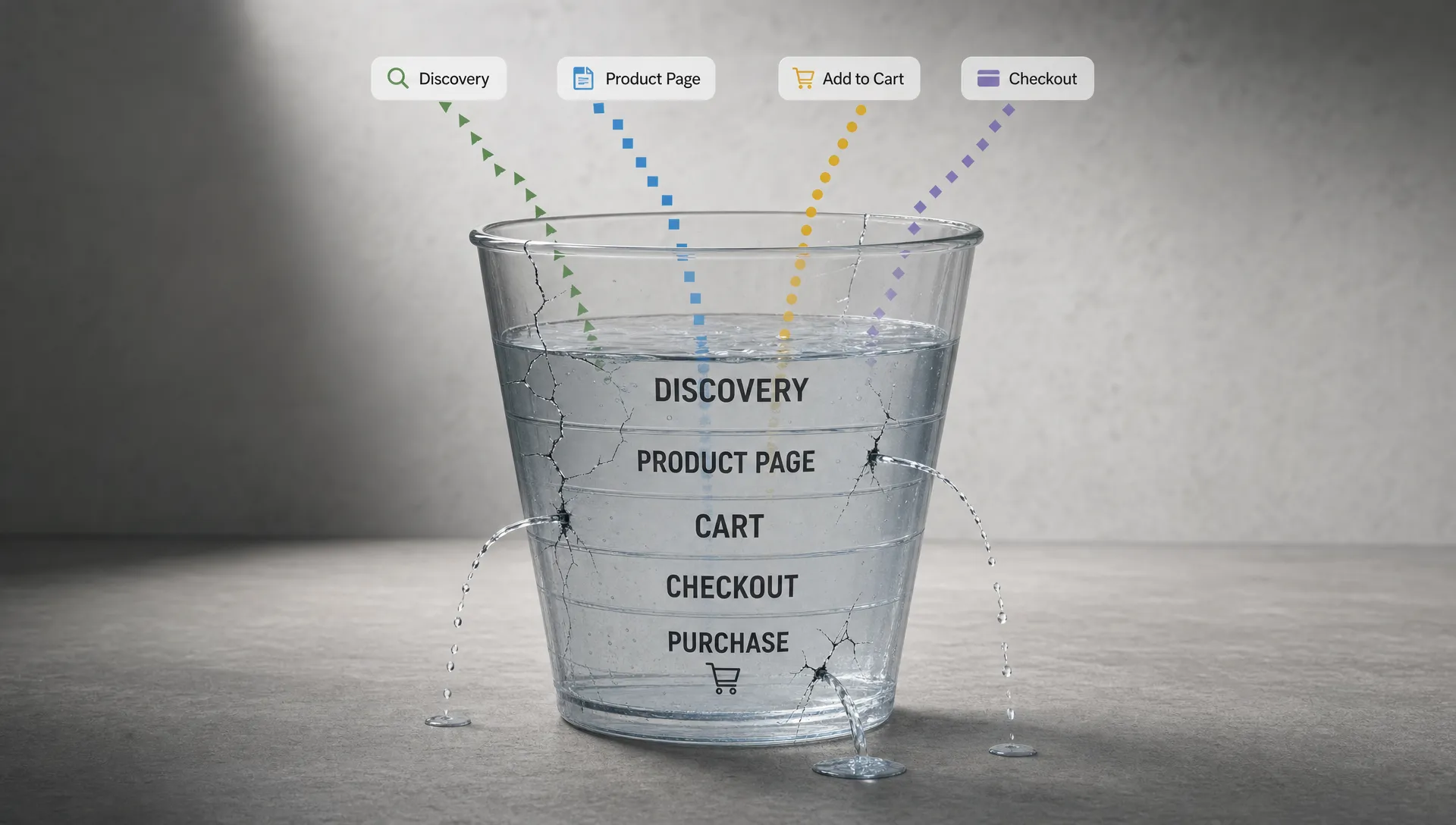
For ecommerce leaders, this matters because traffic is expensive. If paid media, SEO, email, and affiliate campaigns are doing their job, but the site lets buyers fall through avoidable gaps, the business is effectively paying to refill a leaky bucket.
What Is a Revenue Leak in Ecommerce?
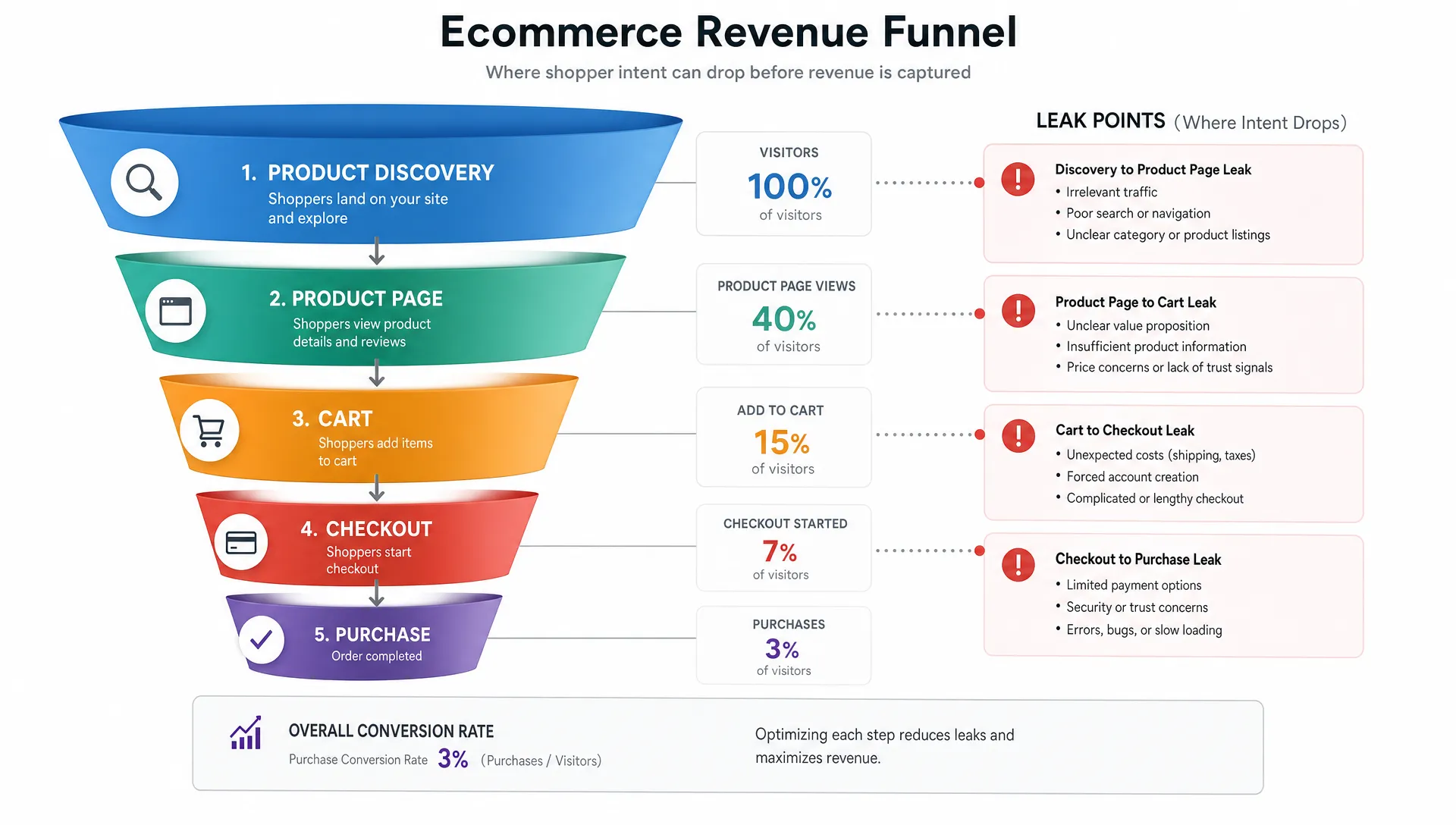
A revenue leak is any point in the customer journey where purchase intent exists but avoidable friction prevents that intent from becoming revenue. It can happen before a shopper sees a product, while they compare options, when they add to cart, or during checkout.
A leak is different from a broad performance issue. A low conversion rate tells you the outcome. A revenue leak tells you where and why the outcome is happening.
| Revenue leak type | What it looks like | Common cause | Metric to inspect |
|---|---|---|---|
| Discovery leak | Shoppers browse but do not find relevant products | Weak search, filters, navigation, or merchandising logic | Search exit rate, PLP click-through rate, zero-result searches |
| Product page leak | PDP traffic is strong but add-to-cart rate is weak | Missing value proof, unclear sizing, poor media, hidden shipping details | Add-to-cart rate, scroll depth, variant selection errors |
| Cart leak | Shoppers add items but do not progress to checkout | Surprise costs, unclear promotions, weak trust cues | Cart-to-checkout rate, promo code interactions |
| Checkout leak | Shoppers start checkout but abandon | Form friction, payment limitations, account creation pressure | Checkout completion rate, field errors, payment failures |
| Performance leak | Conversion drops on slower devices or pages | Heavy scripts, poor Core Web Vitals, bloated frontend | LCP, INP, CLS, conversion by device and speed cohort |
The key is that every leak has an economic value. If 10,000 shoppers reach a checkout step each month and 2 percent more of them could complete payment after a friction fix, the impact is not theoretical. It can be modeled directly against average order value and margin.
Why Revenue Leaks Are Easy to Miss
Most retail teams are not short on data. They are short on connected diagnosis. Analytics platforms show funnel movement, heatmaps show behavior, search tools show product discovery, customer service tools show complaints, and performance tools show technical bottlenecks. The challenge is connecting those signals into a ranked commercial roadmap.
Revenue leaks are especially easy to miss for four reasons.
First, averages hide the problem. A blended conversion rate may look stable while mobile checkout is declining, paid social traffic is underperforming, or one high-margin category is losing add-to-cart momentum.
Second, teams often optimize by department. Marketing owns traffic, product owns roadmap, engineering owns performance, and ecommerce owns conversion targets. Leaks sit between those ownership lines.
Third, growth can mask inefficiency. If traffic grows 20 percent while conversion quality declines, revenue may still rise, but the site is becoming less efficient. The leak only becomes obvious when acquisition costs increase or demand softens.
Fourth, many fixes look too small to prioritize. A confusing delivery message, a slow size selector, or an unclear returns policy may not feel like a major initiative. Yet these small frictions can compound across thousands or millions of sessions.
This is where an outside CRO partner can help. The role is not just to generate test ideas. It is to bring analytics, UX, engineering, and commercial prioritization into one operating model.
How Conversion Optimization Services Find the Leaks
Strong CRO work starts with diagnosis, not design opinions. The goal is to identify where money is escaping, quantify the likely impact, and separate symptoms from causes.
Funnel Data Shows Where Intent Drops
The first step is usually a funnel audit. A team reviews key journeys across landing pages, category pages, product pages, cart, checkout, and post-purchase paths. The important part is segmentation.
A useful funnel view does not only ask, “Where do users leave?” It asks:
- Which device, browser, channel, product category, or customer segment is affected?
- Is the issue consistent over time or tied to a campaign, season, release, or promotion?
- Does the leak affect all shoppers or only high-intent shoppers close to purchase?
- Is the lost revenue concentrated in high-margin categories or low-margin traffic?
This prevents teams from fixing the loudest issue instead of the most valuable one.
Behavioral Research Explains Why They Drop
Quantitative data identifies the leak. Qualitative research explains the cause. This can include session recordings, customer surveys, support tickets, on-site search terms, reviews, and sales chat transcripts.
Voice-of-customer research is particularly useful because shoppers often describe friction in plain language. They may say “I could not tell if this would arrive by Friday,” “the size guide did not match the product,” or “I did not trust the payment page.” Those statements are stronger CRO inputs than generic best practices.
Some teams also mine external communities for unmet needs, objections, and comparison language. For example, if your growth team already uses social listening to find buyer discussions, they may log in to Redditor AI as part of a broader workflow for reviewing high-intent questions that can inform landing page copy, FAQs, and product content.
Technical Audits Reveal Invisible Friction
Not every leak is visible in a screenshot. Site speed, JavaScript execution, layout shifts, third-party tags, and API delays can all reduce conversion without appearing as a broken experience.
This matters most on revenue pages. A slow product grid, delayed checkout validation, or unresponsive add-to-cart button can hurt buyers at the exact moment they are ready to act. If your team suspects performance is part of the issue, Space Dinosaurs has a deeper guide to website speed optimization fixes that improve conversions.
Commercial Prioritization Turns Findings Into a Roadmap
A long list of issues is not a strategy. Effective conversion optimization services translate findings into a prioritized roadmap based on revenue potential, confidence, effort, and risk.
A simple prioritization model might score each opportunity by:
- Impact: How much revenue could be recovered if the issue is fixed?
- Confidence: How strong is the evidence from data and research?
- Effort: How much design, engineering, QA, and stakeholder alignment is required?
- Risk: Could the change damage brand perception, margin, SEO, or operational stability?
The best roadmap usually mixes fast fixes with larger structural improvements. Retailers often need both.
The Main Funnel Areas Where CRO Services Recover Revenue
Revenue leaks can appear anywhere, but retail sites tend to see the biggest gains in a few recurring areas.
Product Discovery
If shoppers cannot find the right product quickly, they rarely continue patiently. Product discovery leaks often show up as high search exits, poor filter usage, high collection page bounce rates, or heavy reliance on internal search for basic navigation.
CRO services may analyze search queries, filter behavior, merchandising rules, and category page layouts. The goal is to reduce the distance between intent and product relevance. That might mean improving category hierarchy, exposing popular filters earlier, making sort options more useful, or reducing visual clutter on product listing pages.
For retail brands with large catalogs, discovery optimization can be one of the highest-value areas because it improves many journeys at once.
Product Detail Pages
The PDP is where shoppers decide whether a product is right for them. Many brands invest heavily in photography and brand storytelling, but still miss practical purchase questions.
Common PDP leaks include unclear sizing, hidden delivery information, weak review visibility, missing product comparison details, poor variant selection, or confusing inventory messages. These are not minor UX issues. They are risk signals that stop shoppers from acting.
A CRO partner will usually review PDP performance by product type, device, traffic source, and customer intent. A first-time shopper from paid social may need more trust and education. A returning customer from email may need speed, availability, and a clear path to checkout.
Cart and Checkout
Cart and checkout leaks are often the easiest to quantify because shoppers have already shown intent. According to Baymard Institute’s long-running cart abandonment research, the average documented online cart abandonment rate sits around 70 percent across studies, which is why checkout friction remains such a high-priority optimization area for ecommerce teams.
Not all abandonment is preventable. Some shoppers compare prices, save items, or browse casually. But many losses come from avoidable friction such as surprise shipping costs, forced account creation, confusing promo code behavior, slow payment steps, or unclear error messages.
The most effective fixes simplify decisions. Show costs earlier. Reduce form effort. Make guest checkout clear. Support expected payment methods. Keep error states specific and helpful. Reinforce trust at the moment payment information is requested.
Mobile Experience
Mobile is often where revenue leaks hide in plain sight. A page may look acceptable in a desktop review but feel slow, cramped, or unstable on a real phone. Small tap targets, sticky elements covering calls to action, delayed buttons, and hard-to-use filters can all suppress conversion.
This is why mobile CRO should be tested on real devices and realistic network conditions. The question is not whether the page is responsive. The question is whether a shopper can move from intent to purchase with minimal effort.
Site Performance
Performance optimization is not separate from conversion optimization. It is one of its most direct levers. Slow pages reduce patience, increase bounce, and make every downstream optimization work harder.
Retail teams should look beyond broad site-speed scores and connect performance to revenue behavior. Which templates are slowest? Which third-party scripts delay interaction? Which pages drive the most revenue but have weak Core Web Vitals? Which device segments lose conversion when load times increase?
This is also where engineering and CRO need to work together. A performance issue may require code splitting, image optimization, third-party governance, caching improvements, or composable architecture decisions. Treating the site as a commercial system, not just a technical asset, is a theme Space Dinosaurs explores in why your site is a revenue lever, not an engineering metric.
How CRO Services Turn Small Fixes Into Measurable Revenue
The commercial value of CRO becomes clear when you model small improvements across meaningful traffic.
Imagine a retail site with 500,000 monthly sessions, a 2.0 percent conversion rate, and an $85 average order value. That produces 10,000 orders and $850,000 in monthly revenue. If optimization raises conversion from 2.0 percent to 2.2 percent, orders increase to 11,000. At the same AOV, that is an additional $85,000 per month before considering margin, repeat purchase, or operational costs.
This is why CRO is often more efficient than simply buying more traffic. The same traffic works harder.
However, the goal should not be conversion rate at any cost. Retailers need to track the right commercial metrics, including revenue per visitor, average order value, margin, return rate, new versus returning customer behavior, and customer lifetime value where available. A change that increases low-quality orders but increases returns may not be a win.
Strong conversion optimization services create a measurement plan before changes go live. That plan should define the hypothesis, target audience, success metric, guardrail metrics, test duration, and decision rule. Without that discipline, teams risk mistaking noise for progress.
What a Good CRO Engagement Should Include
A useful CRO engagement is not a bundle of random A/B tests. It should operate like a revenue recovery system.
At minimum, a retail-focused program should include analytics validation, funnel analysis, UX review, technical performance assessment, customer research, opportunity sizing, test planning, and implementation support. The mix depends on the maturity of the brand and the complexity of the stack.
For some retailers, the biggest wins come from fast UX and content improvements. For others, the leaks are tied to site architecture, third-party bloat, unstable templates, or poor tracking. That is why conversion work benefits from a blend of strategy, design, analytics, and engineering.
Space Dinosaurs approaches this through retail-focused digital transformation, combining AI-enabled engineering, UX design, performance optimization, analytics, and ongoing improvement. For teams deciding whether now is the right time to invest, this breakdown of when conversion rate optimization services pay off can help frame the ROI conversation.
Signs Your Retail Site Is Leaking Revenue
You do not need a full audit to suspect a leak. Several signals suggest that existing demand is not being captured efficiently.
Your site may be leaking revenue if paid traffic is growing faster than revenue, mobile conversion lags far behind desktop, PDP views are increasing but add-to-cart rate is flat, checkout abandonment spikes after shipping or payment steps, high-traffic pages have weak Core Web Vitals, or customers repeatedly ask the same pre-purchase questions through support.
One signal on its own may not prove a major issue. Patterns matter. If multiple signals point to the same journey stage, the business case for CRO becomes stronger.
The practical next step is to estimate the size of the leak. Start with the affected sessions, the current conversion behavior, the average order value, and a realistic improvement range. Even a conservative recovery estimate can clarify whether the fix belongs in the next sprint, the next quarterly roadmap, or a larger transformation program.
Frequently Asked Questions
What are conversion optimization services? Conversion optimization services help improve the percentage and quality of visitors who take valuable actions on a site, such as adding products to cart, completing checkout, or submitting lead forms. For retail brands, this usually combines analytics, UX, experimentation, performance optimization, and implementation support.
How do CRO services reduce revenue leaks? They identify where high-intent shoppers drop off, diagnose the reason, prioritize fixes by commercial impact, and measure whether changes recover lost revenue. The focus is not just more conversions, but more efficient revenue from traffic the brand already has.
Are revenue leaks always caused by bad design? No. Design can be part of the problem, but leaks can also come from slow performance, poor tracking, unclear product data, technical errors, weak merchandising, limited payment options, or operational messages that create uncertainty.
How long does it take to see results from conversion optimization? Some fixes, such as clearer shipping messaging or checkout error improvements, can show impact quickly once deployed. Larger gains from experimentation, performance remediation, or product discovery improvements often require a structured roadmap over several weeks or months.
Should retailers focus on CRO before acquiring more traffic? If the site has meaningful traffic and visible funnel friction, CRO should usually run alongside acquisition. Improving conversion efficiency makes every marketing channel more productive and can reduce dependence on rising media spend.
Turn Leaks Into Revenue You Can Measure
Revenue leaks are not always obvious, but they are measurable. The retailers that recover them fastest are the ones that treat conversion optimization as an ongoing commercial discipline, not a one-off redesign exercise.
If your ecommerce site has traffic but revenue is not scaling efficiently, Space Dinosaurs can help connect the dots between performance, UX, analytics, AI-enabled engineering, and retail growth strategy. The result is a clearer path from diagnosis to prioritization to measurable revenue recovery.