
Conversion rate optimization services pay off when they turn existing demand into measurable revenue without requiring a proportional increase in media spend. For retail brands, that usually happens when traffic is already meaningful, friction is visible, margins can support experimentation, and the organization is ready to act on what the data reveals.
That last point matters. CRO is not a magic audit, a one-off A/B test, or a new button color. Done well, it is a disciplined system for finding revenue leaks, prioritizing fixes, testing high-impact ideas, and shipping improvements across product discovery, PDPs, cart, checkout, site speed, and post-purchase flows.
The question is not simply, “Should we improve conversion rate?” Every ecommerce brand should. The sharper question is, “When does it make financial sense to bring in dedicated conversion rate optimization services instead of handling improvements ad hoc?”
What “pay off” really means in CRO
CRO pays off when the incremental profit created by optimization exceeds the cost of the work, including strategy, design, analytics, engineering, QA, tools, and internal stakeholder time.
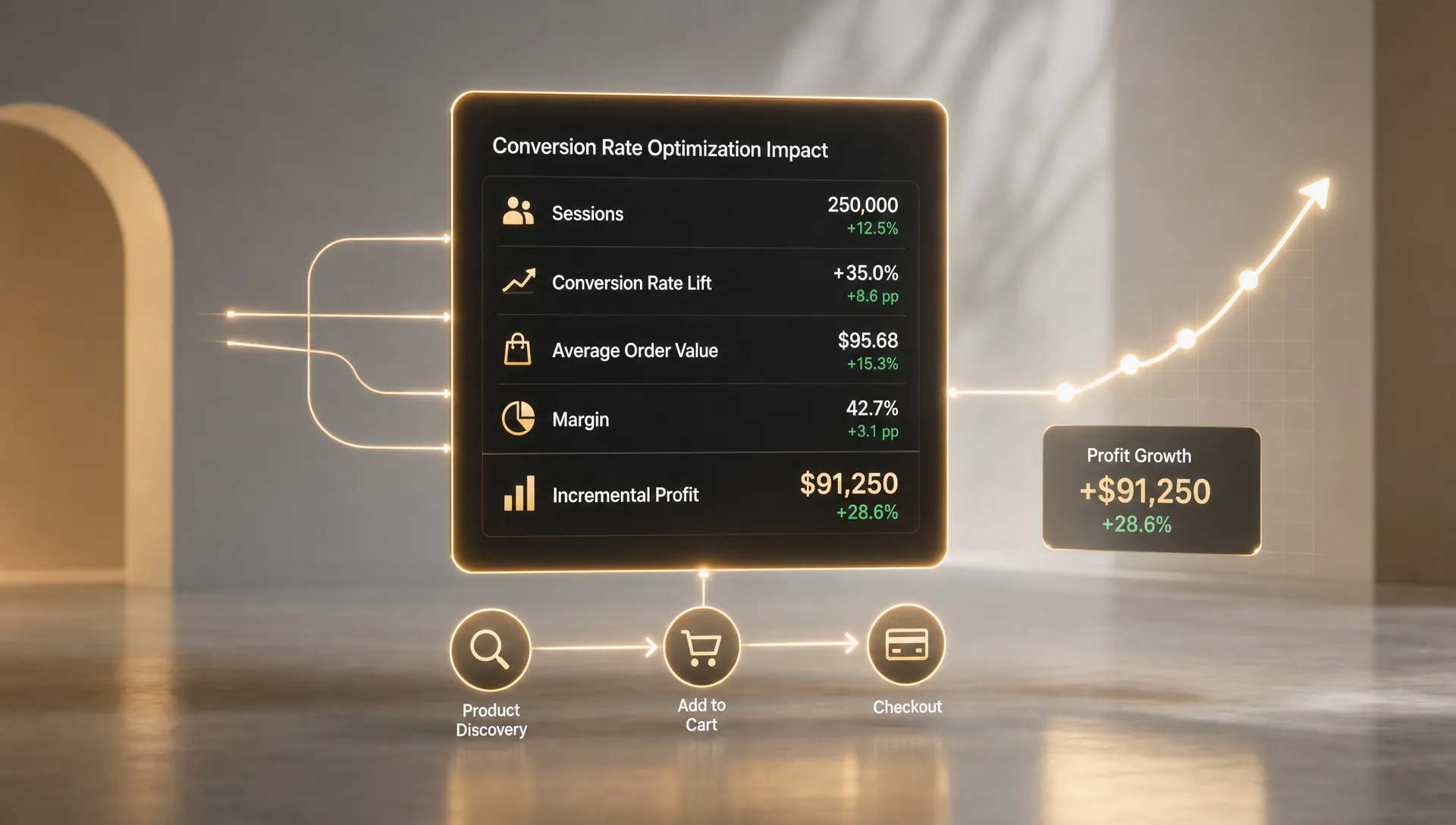
At a basic level, the business case looks like this:
| Metric | Why it matters |
|---|---|
| Sessions | Determines whether improvements have enough volume to create meaningful revenue impact |
| Conversion rate | Shows how efficiently traffic turns into orders, but should not be viewed alone |
| Average order value | Higher AOV increases the value of each incremental conversion |
| Gross margin | Determines how much of incremental revenue becomes contribution profit |
| Implementation cost | Includes agency fees, tools, developer time, QA, and operational overhead |
| Time to impact | Affects payback period, especially before peak trading periods |
A simple formula can help frame the conversation:
Incremental monthly revenue = monthly sessions × conversion rate lift × average order value
Then:
Incremental monthly contribution = incremental revenue × gross margin
If a retailer receives 500,000 monthly sessions, has a $110 AOV, and improves conversion rate by 0.2 percentage points, that creates 1,000 additional monthly orders. That is $110,000 in incremental monthly revenue before margin. If the gross margin is 45%, the contribution is $49,500 per month before accounting for optimization costs.
The same lift on a site with 15,000 monthly sessions may still matter, but the payback window will be longer unless AOV, margin, or customer lifetime value is unusually high.
When conversion rate optimization services are most likely to pay off
The strongest CRO opportunities tend to appear when a retail site has both traffic and friction. Traffic gives you leverage. Friction gives you upside.
You already have meaningful traffic, but revenue is not scaling with it
If paid media, SEO, email, or marketplace-adjacent campaigns are bringing shoppers to your site but revenue growth is lagging, CRO should move up the priority list. This is especially true when acquisition costs are rising. Sending more traffic into a leaky funnel often makes the problem more expensive.
A conversion specialist can identify whether the issue is landing page mismatch, weak product discovery, confusing merchandising, slow templates, unclear value propositions, mobile usability issues, checkout friction, or all of the above.
For retail teams looking at this from a funnel-leak perspective, Space Dinosaurs has also explored the broader idea of hidden revenue sitting in existing traffic, which is often where the fastest optimization wins are found.
Your mobile conversion rate trails desktop by a wide margin
Most retail traffic is mobile-heavy, but many ecommerce experiences are still designed, reviewed, and approved on desktop. A mobile gap is not automatically a problem, since browsing behavior differs by device. But when mobile users engage with products and abandon before cart or checkout, the issue is often practical friction.
Common mobile problems include cramped filters, slow product listing pages, oversized scripts, unclear CTAs, hard-to-edit cart contents, discount code distractions, and payment options that appear too late in the journey.
CRO services pay off here because small improvements at scale can compound. A faster PDP, clearer size guidance, better sticky add-to-cart behavior, or streamlined express checkout can influence thousands of sessions every day.
You have high traffic acquisition costs
When customer acquisition gets more expensive, conversion improvements become more valuable. A brand spending heavily on paid search, shopping ads, paid social, affiliates, or influencer traffic should know whether its website is converting that spend efficiently.
CRO does not replace acquisition. It makes acquisition more productive. If the same media budget generates more orders because the onsite experience improves, the effective cost per acquisition falls.
This is where performance, UX, and personalization should be treated as commercial levers rather than technical nice-to-haves. Space Dinosaurs has written more about how performance, UX, and personalization move the revenue needle, especially for brands operating at meaningful scale.
Your product catalog requires education, comparison, or confidence-building
Some purchases are simple. Others require context. CRO services are especially valuable for retail brands selling products where shoppers need to compare specifications, understand materials, visualize fit, evaluate customization, or trust delivery and returns.
For example, a shopper considering customizable designer lighting needs more than a product image and price. They may need room-based navigation, clear dimensions, ceiling-height guidance, customization details, delivery expectations, return reassurance, and strong visual merchandising. In categories like this, conversion depends on reducing uncertainty as much as increasing desire.
The more considered the purchase, the more important it becomes to align product content, UX, merchandising, and checkout around the customer’s decision process.
Your analytics show drop-offs, but the team cannot agree on what to fix
Most retail teams have plenty of opinions about the site. The problem is prioritization. Marketing wants campaign landing pages. Merchandising wants richer PDPs. Engineering wants to reduce tech debt. Leadership wants revenue impact now.
Good conversion rate optimization services create a shared operating system for decisions. Instead of debating preferences, the team evaluates opportunities using evidence, expected impact, effort, confidence, and risk.
This does not mean every idea needs a statistically perfect A/B test. Some fixes are obvious once observed, such as broken filters, layout shifts, confusing error messages, or slow checkout steps. The value comes from knowing what to test, what to fix immediately, and what to ignore.
When CRO services may not pay off yet
There are also moments when hiring a CRO partner too early can disappoint. Not because optimization is unimportant, but because the inputs are not ready.
CRO services may be premature if traffic is too low to evaluate changes in a reasonable time, analytics are unreliable, or the core offer has not been validated. If shoppers do not understand the product, pricing is misaligned with the market, inventory is inconsistent, or fulfillment creates poor reviews, CRO can diagnose some symptoms but cannot fully solve the business model.
The same is true if your team cannot implement changes. A CRO roadmap that sits in a backlog for six months does not create ROI. Before investing, retailers should confirm that they have access to design, development, QA, analytics, and decision-makers who can move quickly.

How to calculate whether conversion rate optimization services are worth it
A practical CRO business case does not need to be complicated. It should be realistic, conservative, and tied to the economics of your store.
Start with your current baseline. Use a representative period, usually the last 30 to 90 days, and separate unusual promotion periods from normal trading. Pull sessions, conversion rate, orders, AOV, revenue, gross margin, and paid media spend.
Then model a few lift scenarios. Avoid assuming dramatic improvements unless your funnel is clearly broken. For a mature retail site, even modest gains can be meaningful.
| Scenario | Monthly sessions | Current conversion rate | New conversion rate | AOV | Incremental monthly revenue |
|---|---|---|---|---|---|
| Conservative | 250,000 | 2.0% | 2.1% | $90 | $22,500 |
| Moderate | 250,000 | 2.0% | 2.25% | $90 | $56,250 |
| Strong | 250,000 | 2.0% | 2.5% | $90 | $112,500 |
This table is illustrative, but it shows why CRO often becomes compelling at scale. A change that looks small in percentage terms can become substantial when applied to large traffic volumes.
The next step is to apply margin. If gross margin is 50%, the moderate scenario above creates $28,125 in monthly contribution before CRO costs. If optimization costs $15,000 per month and the lift holds, payback is relatively fast. If gross margin is 20%, the same revenue lift produces a longer payback period.
Retailers should also consider secondary effects. Better conversion can improve paid media efficiency, email revenue, repeat purchase behavior, merchandising insights, and customer satisfaction. These should not be used to inflate projections carelessly, but they are real strategic benefits when the optimization program is well run.
Signs your site has CRO upside
You do not need to wait for a full audit to spot conversion potential. Several signals suggest that dedicated help could pay off:
- High product page traffic with low add-to-cart rate
- Strong add-to-cart rate but weak checkout completion
- Large mobile traffic share with poor mobile revenue contribution
- Slow PLP, PDP, cart, or checkout templates
- Search results pages with high exits or no-result queries
- Frequent customer service questions about shipping, returns, sizing, compatibility, or customization
- Heavy discounting needed to generate urgency
- Paid campaigns with good click-through rates but weak onsite performance
These signals become more valuable when connected to revenue. For example, “checkout completion dropped by 6% on mobile after a payment update” is a stronger CRO brief than “we think the checkout looks outdated.”
What good CRO services should include
The best conversion rate optimization services combine analytics, customer understanding, UX judgment, engineering awareness, and commercial prioritization. For retail brands, this usually means working across multiple templates and functions rather than optimizing isolated pages.
A strong engagement should include:
- Analytics validation so decisions are based on trustworthy data
- Funnel analysis across acquisition source, device, customer type, and product category
- Qualitative research such as session recordings, surveys, customer service themes, and user testing
- UX and heuristic review focused on retail purchase behavior
- Technical performance review for revenue-critical templates
- Prioritized roadmap with expected impact and implementation effort
- Experiment design where testing is appropriate
- Clear reporting tied to revenue, not just test activity
The key is that CRO should produce shipped improvements. A long deck of recommendations is not enough. Retail teams need a cadence for turning insights into production changes, measuring impact, and feeding the next round of decisions.
If you are looking for tactical examples, the Space Dinosaurs guide to conversion rate optimization tactics for retail brands covers practical areas like discovery, product detail pages, mobile UX, checkout, and personalization.
What to ask before hiring a CRO partner
Before investing in conversion rate optimization services, ask questions that reveal how the partner thinks about revenue, implementation, and retail complexity.
| Question | What a strong answer should reveal |
|---|---|
| How do you prioritize opportunities? | They should balance impact, confidence, effort, risk, and business goals |
| How do you handle low-traffic pages? | They should offer alternatives to classic A/B testing, such as research, segmented analysis, or best-practice fixes |
| Who implements recommendations? | They should clarify responsibilities for design, development, QA, analytics, and release management |
| How do you measure success? | They should connect results to revenue, margin, funnel movement, and customer behavior |
| How do you account for performance? | They should understand that speed, stability, and UX directly affect conversion |
| What happens after the first wins? | They should describe an ongoing optimization cadence, not a one-time audit |
Be cautious with partners who promise guaranteed conversion lifts without understanding your traffic, margins, analytics, platform, or customer journey. CRO is evidence-led work. Confidence is useful. Certainty before diagnosis is a red flag.
The biggest mistake: treating CRO as a testing program only
A/B testing is valuable, but it is not the whole discipline. Many ecommerce teams stall because they define CRO too narrowly. They run button-color tests while ignoring page speed, product data quality, navigation, search relevance, payment friction, and merchandising logic.
For retail brands, conversion is shaped by the entire shopping system. A shopper may start on a campaign landing page, browse a category, use filters, compare PDPs, check reviews, leave, return through email, add to cart, look for delivery information, and finally pay through a wallet. Every step can either build confidence or create doubt.
That is why CRO services often pay off most when they sit close to ecommerce strategy, UX, analytics, and engineering. The work should connect what shoppers experience with what the business needs to improve.
So, when should you invest?
Conversion rate optimization services are most likely to pay off when your brand has meaningful traffic, a clear commercial goal, visible funnel friction, reliable enough data, and the ability to ship improvements. They are especially valuable when acquisition costs are rising, mobile performance is under pressure, your product requires customer education, or your team needs an objective system for prioritizing revenue work.
They are less likely to pay off when the site lacks traffic, analytics cannot be trusted, implementation capacity is unavailable, or the core offer is not yet proven.
In other words, CRO is not just a design expense. At the right stage, it is a revenue efficiency investment.
Frequently Asked Questions
What are conversion rate optimization services? Conversion rate optimization services help ecommerce teams improve the percentage of visitors who take valuable actions, such as adding to cart, starting checkout, completing a purchase, signing up for email, or engaging with product recommendations. The work often includes analytics, UX research, testing, performance improvements, and implementation support.
How long does it take for CRO services to pay off? Payback depends on traffic, AOV, margin, implementation speed, and the size of the improvements. High-traffic retailers with clear friction can sometimes see impact within weeks of shipping fixes, while lower-traffic sites may need a longer research and iteration cycle.
Do you need A/B testing for CRO to work? Not always. A/B testing is useful when there is enough traffic and uncertainty to justify a controlled experiment. But many CRO wins come from fixing obvious friction, improving speed, clarifying product information, or simplifying checkout based on analytics and customer research.
What conversion rate is considered good for ecommerce? A “good” conversion rate varies by category, price point, traffic source, device, and customer intent. Instead of chasing a universal benchmark, retailers should compare performance by segment and focus on improving revenue per visitor, contribution margin, and funnel progression.
Should CRO come before or after a redesign? Ideally, CRO should inform a redesign rather than follow it. Research, analytics, and testing can help identify what should change, what should stay, and which parts of the journey have the highest revenue upside.
Turn optimization into a revenue system
If your retail site has traffic but too much revenue is leaking through slow pages, unclear product journeys, or checkout friction, Space Dinosaurs can help you prioritize and ship the improvements that matter. Our retail-focused approach combines AI-enabled engineering, UX design, analytics, performance optimization, and ongoing ecommerce improvement.
For brands that need a consistent optimization engine rather than a one-time project, Momentum by Space Dinosaurs is built to continuously discover opportunities, prioritize work, and improve ecommerce performance over time.