

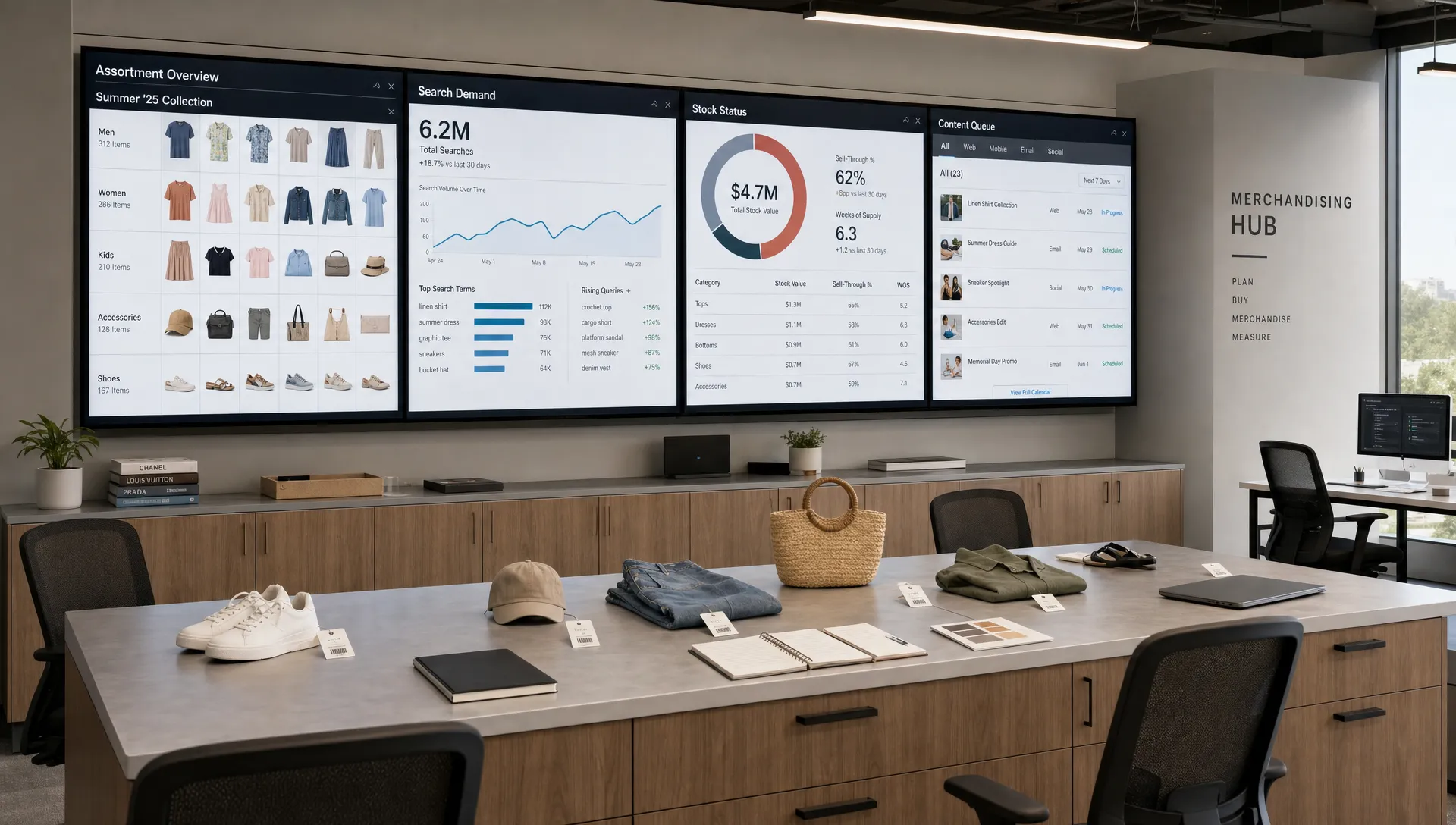
AI in merchandising helps retail teams move faster by turning fragmented product, customer and performance data into usable decisions. Instead of waiting for a weekly report, manually reviewing hundreds of SKUs or rewriting product copy one page at a time, merchandisers can use AI to surface what needs attention and act while demand is still moving.
For retail teams, speed is not only an operational preference. It affects conversion, margin, inventory productivity and campaign performance. A delayed product sort can bury best sellers. A slow content workflow can hold back a seasonal launch. A promotion that takes days to analyze may already be over by the time the team knows what worked.
The real promise is not that AI makes every merchandising call automatically. It is that it reduces the drag around the decision, so human teams spend more time judging tradeoffs and less time gathering evidence.
What AI in merchandising changes for retail teams
Traditional merchandising depends on a mix of taste, trading experience, spreadsheets, platform reports and category knowledge. That still matters. Used well, AI in merchandising does not replace commercial judgment, it gives that judgment a faster operating system.
The shift is most visible in three areas: how teams find signals, how they produce and maintain product experiences and how quickly they can test changes across the storefront.
From manual review to exception handling
Many retail merchandising workflows start with broad review. Teams scan category performance, check stock, compare search terms, inspect product pages and look for anomalies. This is necessary work, but much of it is repetitive.
AI changes the starting point. A model can flag products with rising search demand, identify high-traffic items with weak conversion, cluster products with missing attributes or highlight pages where content does not match customer intent. Merchandisers then review exceptions instead of boiling the ocean.
That difference matters during peak trading periods. If a team has to decide which 40 products deserve homepage visibility, AI can narrow the field by combining margin, stock, recent demand, conversion trend and audience fit. The final call still belongs to the team, but the first pass is faster.
From static rules to adaptive storefront decisions
Rule-based merchandising is useful, but rules age quickly. A category sort that made sense last Monday may be wrong after a stock change, influencer mention or weather shift. That is where AI in merchandising compresses the feedback loop between shopper behavior and storefront action.
Instead of relying only on fixed bestseller logic, retailers can blend rules with live signals. A product can move up a grid because it is gaining traction with a specific segment, not just because it has the highest historical sales. A search result can prioritize products that are available in the shopper's region, match the query intent and have healthy inventory.
This is also where merchandising, UX and performance intersect. If the storefront is slow or unstable, even the smartest product order will underperform. Space Dinosaurs has written about why e-commerce retail teams need faster storefronts, and the same principle applies here: AI-driven decisions need a fast experience to turn into revenue.
The speed problem: merchandising work has too many handoffs
Retail teams often move slowly because decisions pass through too many systems and people. Product data lives in a PIM or ERP. Performance data sits in analytics. Search data is in one tool, marketing campaigns in another and inventory in yet another platform. By the time insights are combined, the moment may have changed.
At the workflow level, AI in merchandising helps by connecting signals that teams already have but rarely analyze together. This does not require every retailer to rebuild the whole commerce stack at once. It does require a clear view of where decisions slow down.
| Merchandising task | Common bottleneck | How AI can speed it up | Human decision still needed |
|---|---|---|---|
| Category sorting | Manual review of sales, stock and margin | Suggests product ranking based on multiple signals | Balance margin, brand priorities and campaign goals |
| Product attribution | Missing or inconsistent product data | Detects gaps and recommends normalized attributes | Approve taxonomy rules and edge cases |
| Product copy | Slow creation and updates across many SKUs | Drafts descriptions, titles and metadata | Ensure accuracy, tone and compliance |
| Search tuning | Reactive fixes after poor search results | Flags zero-result queries and intent mismatches | Decide synonyms, boosts and exclusions |
| Promotion analysis | Reports arrive after campaign windows close | Summarizes performance patterns quickly | Choose future pricing and offer strategy |
The table shows why speed is not just about automating tasks. The biggest gains come from reducing handoffs, clarifying the next best action and keeping people focused on decisions with commercial consequence.
Where AI in merchandising speeds up the workflow
Retail leaders often ask where to start. The best starting point is usually a workflow that is frequent, measurable and painful enough that faster decisions would clearly matter. If the team cannot tell whether the AI helped, the use case is probably too vague.
Product data and attribution
Product attributes power filters, search relevance, recommendations and personalization. Yet many retailers still manage attributes inconsistently across categories, vendors and legacy systems.
AI can cluster similar products, suggest missing attributes and spot inconsistencies such as a product tagged as waterproof in one field but described as water resistant in another. Better attributes help shoppers find what they want and help merchandisers create cleaner rules.
This is a practical, low-drama use case because the team can review suggestions before publishing. It also creates better inputs for more advanced personalization later.
Product content at retail pace
Retailers do not need generic product copy. They need accurate, on-brand content that reflects customer intent and can be adapted across channels. The strongest use cases for AI in merchandising often start with content because the work is high volume and quality can be reviewed before it goes live.
A team can use AI to draft product descriptions, comparison copy, size guidance, care instructions or SEO metadata from approved source data. The gain is not only faster writing. It is faster iteration when products change, seasonal campaigns launch or new customer questions appear.
Search, discovery and product ranking
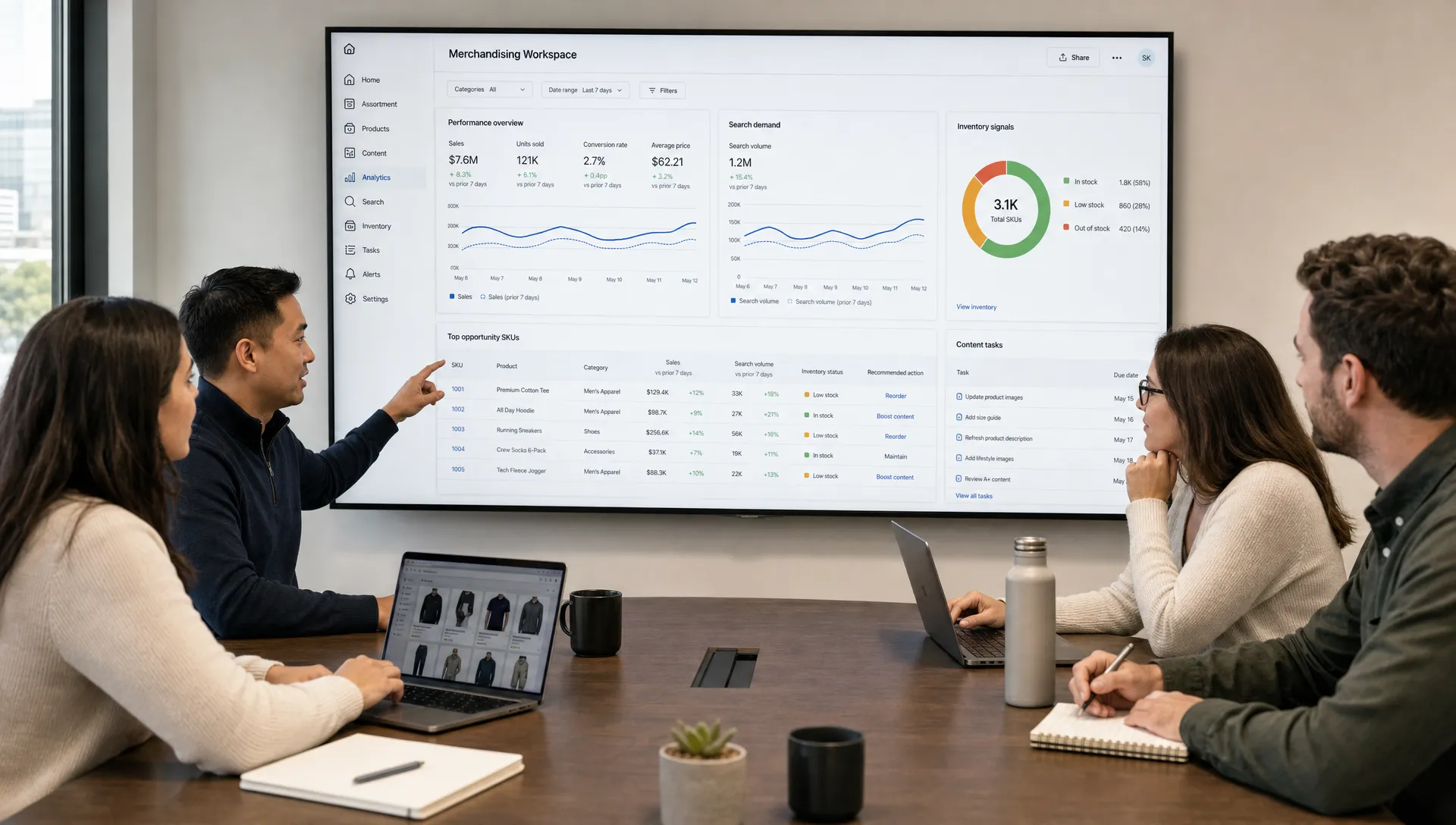
Search and product discovery are merchandising systems, not just technical features. When shoppers use internal search, they reveal intent in plain language. AI can help interpret that intent, map it to product attributes and detect where results disappoint.
For example, a spike in searches for “travel wedding guest dress” might signal a need for a curated landing page, new filters or a different category sort. AI can surface the pattern before the merchandising team would normally see it in a weekly report.
For a broader view of early opportunities, the Space Dinosaurs guide to where retailers tend to get their first practical wins with AI is a useful companion to this merchandising-specific lens.
Promotions and markdown decisions
Promotions move quickly, but many teams analyze them slowly. AI can help summarize which products responded to a discount, which customer segments changed behavior and where margin tradeoffs looked unhealthy.
This does not mean AI should set prices without guardrails. Pricing and promotions carry brand, margin and customer trust implications. But AI can make the analysis faster, especially when teams need to compare multiple campaigns, regions or product groups.
Agent-ready merchandising is becoming part of the job
AI-powered shopping agents are changing the way retailers think about product data and merchandising logic. If an agent is helping a shopper compare products or build a cart, the retailer's catalog needs to be legible to machines as well as humans.
That means product feeds, policies, inventory, structured attributes and checkout paths need to be clean and accessible. Some commerce teams are already exploring machine-readable store guidance, such as agent instructions for a Shopify store that describe shopping workflows, product search, cart creation and checkout endpoints.
For merchandisers, this expands the definition of shelf placement. Product visibility may happen on a website, inside a marketplace, through a chat interface or through an agent that retrieves product options on behalf of the customer. Clean product data and clear merchandising rules become even more valuable in that environment.
How to implement AI in merchandising without adding noise
The fastest teams do not start by asking, “Where can we use AI?” They ask, “Which merchandising decisions are currently too slow, too manual or too inconsistent?” A sensible rollout of AI in merchandising starts with bottlenecks, not tools.
Choose one workflow with a clear commercial outcome
Good candidates include improving site search relevance, speeding up product content production, reducing attribute gaps or identifying products that deserve more visibility. Each use case should connect to a metric the business already cares about, such as conversion rate, revenue per visitor, search exit rate, margin or time to publish.
Avoid starting with a use case that requires perfect data across the whole organization. Retail transformation works better when teams create momentum from focused wins. Space Dinosaurs outlines this outcome-first approach in its practical roadmap for digital transformation in retail.
Put guardrails around brand, compliance and margin
AI should accelerate merchandising work, not create new review chaos. Teams need clear rules for what AI can suggest, what it can publish and what requires approval.
For most retailers, human approval should remain in place for pricing, regulated product claims, brand-sensitive copy, legal language and major changes to customer-facing experiences. AI can draft, rank, classify and summarize, but accountability should stay with named owners.
Make measurement part of the workflow
AI projects often stall when they are treated as experiments outside normal trading rhythms. The better approach is to make measurement part of the merchandising process from day one.
Track before and after performance for the workflow being improved. If AI helps product content, measure time to publish and content-driven conversion changes. If it helps search, track zero-result rate, search conversion and refinement behavior. If it helps category sorting, monitor revenue per session, stock sell-through and margin impact.
Measured this way, AI in merchandising becomes less of a speculative innovation project and more of a practical operating improvement.
The operating model: humans stay accountable
Speed without accountability creates risk. Retailers need a model where AI handles scale and pattern detection while people keep control of strategy, ethics, brand and commercial tradeoffs.
That model usually has four parts: clean inputs, clear approval rules, measurable outputs and continuous optimization. It also requires cross-functional ownership. Merchandising cannot adopt AI in isolation if product data, engineering, analytics, UX and trading teams are all part of the same customer journey.
The most mature retail teams treat AI as a system capability. They connect it to existing planning cycles, trading meetings and performance reviews. Instead of waiting for a large transformation program to finish, they improve one decision loop at a time.
Frequently Asked Questions
What is the main benefit of AI in merchandising? The main benefit is faster, better-informed decision-making. AI can analyze product, inventory, search and customer behavior signals quickly, then help teams prioritize what to review or change.
Does AI replace retail merchandisers? No. It is most useful when it reduces repetitive analysis and production work so merchandisers can focus on judgment, strategy, brand fit and commercial tradeoffs.
Which merchandising workflow should retailers start with? Start with a high-volume workflow that has clear metrics, such as product attribution, product content creation, site search improvement or category ranking.
How do retailers keep AI-generated merchandising work accurate? Use approved source data, define review rules, limit automated publishing for sensitive areas and track performance after changes go live.
Move faster without rebuilding everything
Retail teams do not need a grand AI overhaul to improve merchandising speed. They need focused use cases, cleaner data flows, sensible guardrails and a storefront that can turn better decisions into better customer experiences.
If your merchandising team is spending too much time assembling reports, fixing product data or reacting late to shopper behavior, Space Dinosaurs can help you identify the workflows where AI, UX, analytics and performance improvements will have the clearest commercial impact.