

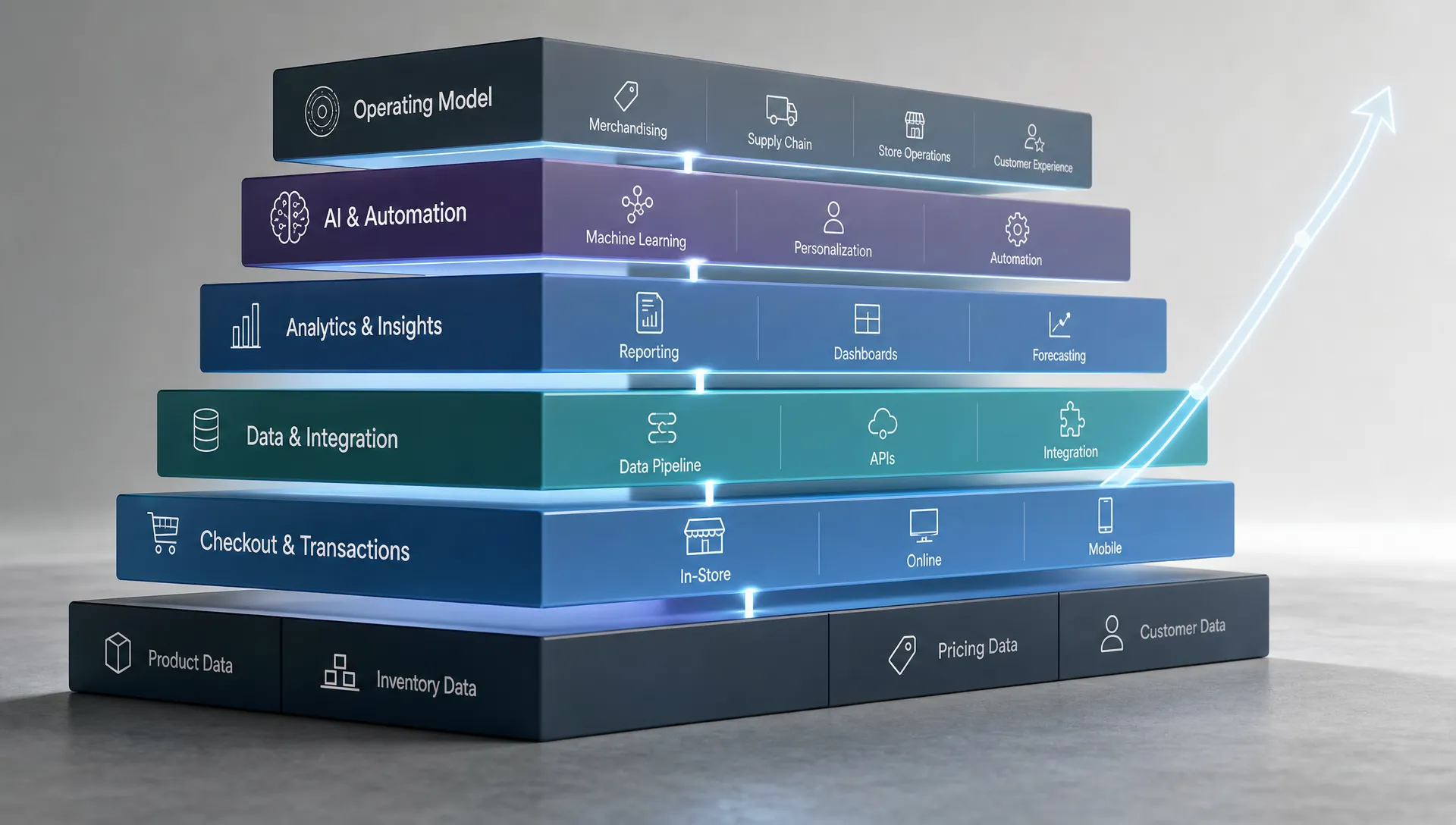
Digital transformation in retail is not a single platform migration, AI pilot or redesign. It is the disciplined redesign of how a retailer sells, serves, measures and improves across every digital touchpoint. The goal is simple to say and hard to execute: make shopping easier for customers while making the business faster, more profitable and more resilient.
For many retail teams, the challenge is not a lack of ideas. It is the opposite. There are too many tools, too many disconnected priorities and too many initiatives competing for budget. A practical roadmap helps separate the work that changes commercial performance from the work that only looks modern.
The best retail transformation programs start with outcomes, then move through data, experience, architecture, AI and operating model. This sequence reduces risk because each layer supports the next. A retailer with unreliable product data, slow pages and unclear KPIs will struggle to get value from advanced personalization or conversational commerce. A retailer with a stable foundation can move faster, test more and scale what works.
What digital transformation in retail should mean in 2026
Digital transformation in retail now means more than adding digital channels. Most retailers already sell online, run paid media, manage social commerce and use some form of automation. The next challenge is integration. Customers expect inventory, pricing, promotions, content, service and fulfillment to feel consistent no matter where they interact with the brand.
This is why transformation should be treated as a commerce operating system, not an IT project. The storefront, CMS, search, checkout, ERP, order management, analytics, marketing tools and customer service workflows all influence the shopper experience. When one part is slow or inaccurate, the whole system feels broken.
Retail is also changing alongside other industries. Kell Solutions' overview of digital transformation across fast-moving industries highlights how AI, cloud computing and connected data are moving from experimental projects into day-to-day operations in sectors such as healthcare, manufacturing and retail. For commerce leaders, the lesson is clear: digital maturity is becoming an operational requirement, not a brand differentiator by itself.
Start with business outcomes, not technology
A practical roadmap starts by choosing the commercial problems worth solving. Replatforming, AI, automation and UX redesign can all be useful, but only when they are tied to measurable outcomes. Without that discipline, transformation becomes a list of projects rather than a path to better performance.
Retail leaders should define three to five outcomes for the next 12 months. These outcomes need to be specific enough to guide tradeoffs. Improve customer experience is too broad. Reduce mobile checkout abandonment, increase organic revenue from category pages or shorten product launch cycles gives teams a clearer direction.
| Business objective | Transformation focus | Useful KPIs |
|---|---|---|
| Grow digital revenue | Improve discovery, merchandising, PDP quality and checkout | Conversion rate, average order value, revenue per session |
| Improve margin | Reduce rework, optimize promotions and prioritize profitable journeys | Gross margin, contribution margin, return rate |
| Increase customer loyalty | Connect customer data, service history and lifecycle marketing | Repeat purchase rate, customer lifetime value, retention rate |
| Lower operating cost | Simplify integrations, reduce incidents and retire redundant tools | Platform cost, incident volume, release cycle time |
| Improve speed to market | Modernize workflows for campaigns, content and product launches | Time to launch, backlog age, deployment frequency |
This table should not live in a strategy deck that nobody revisits. It should become the filter for roadmap decisions. If a proposed initiative cannot connect to one of the chosen outcomes, it may still be valuable, but it should not jump the queue.
Map the current retail system before changing it
Retail transformation often fails because teams start building before they understand the current system. A retailer may blame low conversion on design when the real issue is product availability. Another may blame paid media efficiency when landing pages are slow or category filters hide relevant items. A good audit connects symptoms to causes.
The audit should cover both customer experience and internal workflows. It should look at how shoppers move through the site, how teams launch campaigns, how product data is created, how analytics are collected and how technology changes are released. The aim is not to produce a long diagnostic document. It is to find the bottlenecks that block revenue, speed and reliability.
Key questions to answer include:
- Where do shoppers abandon the journey, and what evidence explains why?
- Which pages, templates or flows are slowest on mobile?
- How accurate and complete is product, pricing and inventory data?
- Which manual workarounds slow down merchandising, marketing or service teams?
- Which analytics events are trusted enough to support decisions?
- Where do incidents, bugs or integration failures happen most often?
The best audits combine quantitative data with hands-on review. Analytics may show that checkout conversion is falling, but session review, user testing and QA can reveal whether the cause is payment friction, form design, shipping surprises or performance. Retail transformation gets more practical when every recommendation is connected to observed behavior.
Stabilize the e-commerce foundation first
Before adding sophisticated new capabilities, retailers need a stable digital foundation. This is the part of transformation that customers rarely notice directly unless it fails. Pages load quickly. Search returns relevant products. Checkout works. Tracking is reliable. Releases do not break core flows. These basics compound because every marketing, UX and AI initiative depends on them.
Performance should be one of the first priorities. Slow storefronts hurt conversion, SEO, paid media efficiency and customer trust. Core Web Vitals, image optimization, third-party script control and front-end architecture all matter because retail traffic is often mobile, campaign-driven and impatient. For a deeper look at the commercial case for speed, Space Dinosaurs explains why e-commerce retail teams need faster storefronts.
Analytics is the second foundation layer. A transformation roadmap needs clean event tracking, consistent product identifiers, a clear KPI hierarchy and reporting that teams trust. If every department has a different version of conversion rate or revenue attribution, the roadmap will drift into opinion. Strong analytics does not mean measuring everything. It means measuring the few things that guide better decisions.
Operational stability is the third layer. Retail sites need release processes, monitoring, rollback plans and ownership models that match commercial reality. Peak trading periods, campaign launches and inventory events put pressure on the platform. A modern retail experience is not just visually polished. It is resilient under load and economical to maintain.
Remove buying friction before adding complexity
Once the foundation is stable, the next priority is the shopping journey. Many retailers lose revenue through small points of friction that feel minor in isolation but expensive at scale. Poor filters, weak product content, hidden delivery costs, clumsy checkout forms and confusing returns information all create hesitation.
The most effective transformation roadmaps treat UX as a commercial lever. Human-centered design is not only about visual quality. It is about reducing the effort required to find, evaluate and buy the right product. That requires collaboration between UX, merchandising, analytics, content, engineering and customer service.
| Journey moment | Common friction | Practical improvement |
|---|---|---|
| Product discovery | Search results are irrelevant or filters are hard to use | Improve search logic, attribute data and category navigation |
| Product detail pages | Shoppers lack confidence in fit, quality, delivery or returns | Strengthen content, reviews, imagery, availability and reassurance |
| Cart | Costs or delivery options appear too late | Show clearer pricing, promotions and fulfillment information earlier |
| Checkout | Forms are long, payment options are limited or errors are unclear | Reduce fields, support preferred payment methods and improve validation |
| Post-purchase | Customers cannot track, return or resolve issues easily | Improve order communications, self-service and service workflows |
Prioritization matters here. Retail teams should focus first on high-traffic, high-intent journeys where friction has direct commercial impact. For example, fixing mobile PDP content on best-selling categories may outperform a full homepage redesign. Transformation should favor changes that remove known blockers over changes that satisfy internal preferences.
Modernize architecture when it unlocks better execution
Architecture decisions should follow the roadmap, not lead it. A full replatform may be necessary when the current stack blocks performance, flexibility or growth, but many retailers can make meaningful progress through targeted modernization. The practical question is whether the architecture helps teams improve the customer experience at the pace the business needs.
Composable and headless commerce can be powerful when retailers need faster front-end experiences, flexible content, multiple storefronts or best-of-breed capabilities. They also require governance, integration discipline and the right engineering model. A poorly managed composable stack can become just as expensive and fragile as a legacy monolith.
| Architecture path | Best fit | Watch out for |
|---|---|---|
| Optimize the current stack | The platform is stable but under-tuned | Short-term fixes can accumulate into more debt |
| Replace selected components | Search, CMS, checkout or analytics is the main bottleneck | Integration quality and ownership must be clear |
| Move toward headless or composable commerce | Speed, flexibility and multi-channel delivery are strategic needs | Requires stronger technical governance and roadmap discipline |
| Full replatform | The current platform blocks growth, stability or cost control | Scope creep can delay value and increase risk |
Retailers considering a headless path should be clear about the business case, not just the technology pattern. Space Dinosaurs' guide to building a future-proof headless commerce solution is a useful starting point for understanding where headless creates value and where teams need to plan carefully.
Apply AI where it creates measurable retail value
AI belongs in a retail transformation roadmap, but it should not sit outside the commerce strategy. The strongest use cases are tied to existing business goals: better product discovery, faster content creation, more relevant customer service, smarter merchandising and clearer decision-making.
Retailers often get the fastest value from focused AI use cases rather than broad transformation claims. Product content enrichment can help teams scale descriptions, attributes and category copy. AI-assisted search can improve relevance and intent matching. Customer service automation can handle repetitive questions while escalating complex cases to humans. Analytics copilots can help teams spot patterns, though decisions still need commercial judgment.
| AI use case | Where it helps | What to measure |
|---|---|---|
| Product discovery | Search relevance, recommendations and guided selling | Search conversion, zero-result searches, revenue per search |
| Product content | Attribute completion, descriptions and localization support | Time to publish, content completeness, PDP conversion |
| Customer service | Order questions, returns guidance and conversational commerce | Deflection rate, resolution time, CSAT |
| Merchandising | Trend detection, assortment insights and promotion support | Sell-through, margin, category conversion |
| Experimentation | Hypothesis generation and insight summarization | Test velocity, win rate, incremental revenue |
The guardrails matter as much as the use cases. Retail AI needs reliable data, human review, privacy controls and clear measurement. If teams cannot explain how an AI feature improves a shopper or operator workflow, it is not ready to scale. Space Dinosaurs covers practical adoption patterns in AI and e-commerce, especially where retailers can win first without overcomplicating the roadmap.
Redesign the operating model around continuous improvement
Technology changes will not stick if the operating model stays the same. Retail transformation needs teams that can prioritize, ship, measure and iterate. That usually means moving away from large batches of work and toward smaller improvements with clear owners.
A strong operating model gives each major journey or capability a commercial owner, technical support and access to analytics. It also creates a cadence for reviewing performance, deciding what to test next and stopping work that is not producing value. This is where many transformation programs either become real or fade into project status reports.
The right team shape depends on the retailer, but the core capabilities are consistent: product leadership, UX design, engineering, analytics, merchandising, marketing operations, customer service insight and executive sponsorship. These functions do not need to sit in one department. They do need shared goals and a decision process that prevents every improvement from becoming a negotiation.
A practical 12-month roadmap for retail transformation
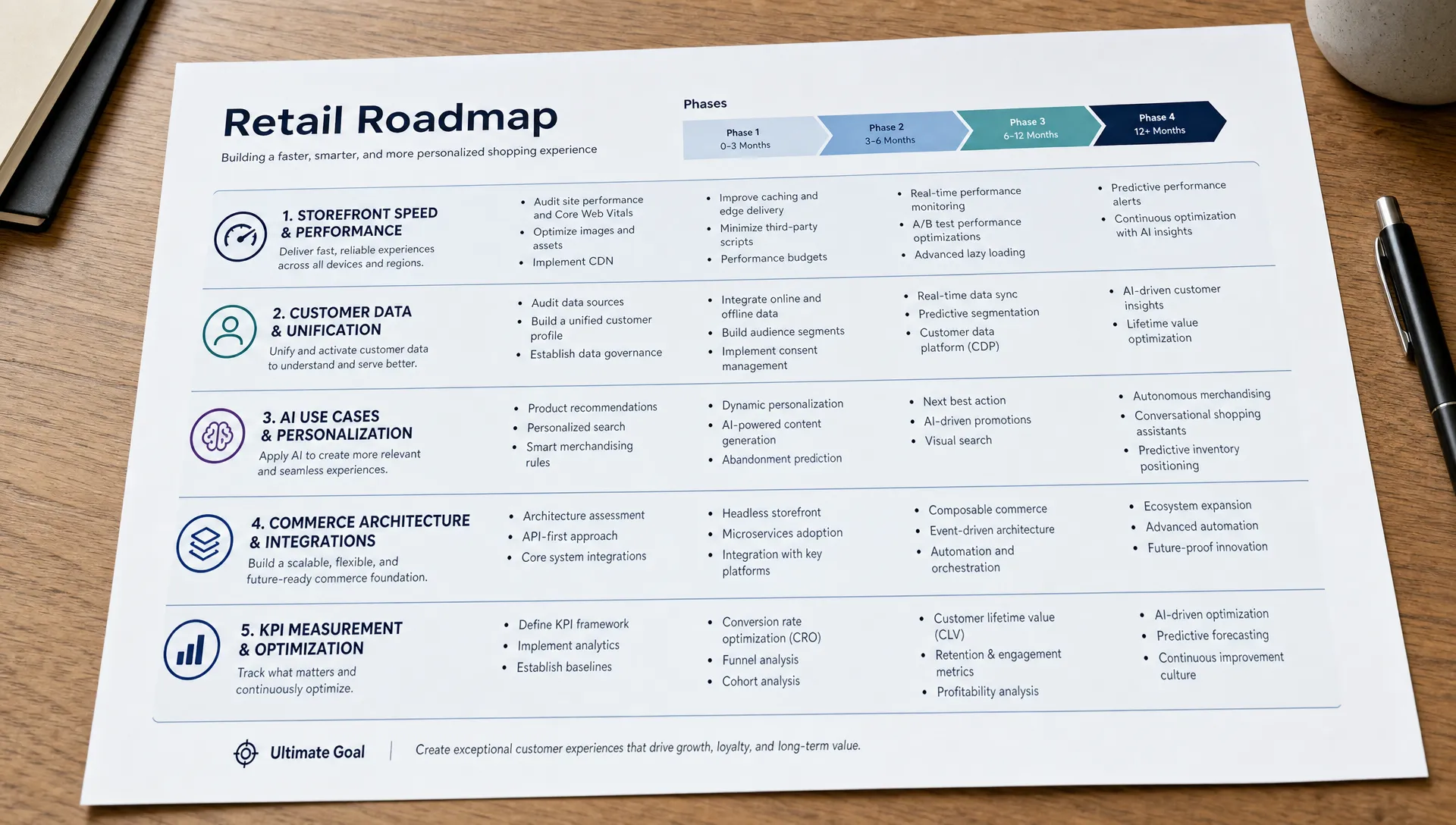
A roadmap should balance quick wins with structural change. If everything is foundational, the business loses momentum. If everything is a quick win, the underlying problems remain. The following 12-month model gives retail teams a practical sequence to adapt.
| Time horizon | Main work | Expected output | Decision gate |
|---|---|---|---|
| 0 to 90 days | Audit performance, analytics, UX friction, platform risk and operating cost | Prioritized roadmap with baseline KPIs | Confirm funding and owners for the highest-value work |
| 3 to 6 months | Fix critical speed issues, improve key journeys, clean product data and stabilize reporting | Measurable improvements in conversion, reliability or speed | Scale what works and remove low-impact work |
| 6 to 12 months | Modernize selected architecture, launch practical AI use cases and improve workflow automation | Faster release cycles and stronger customer experience | Decide whether broader platform change is justified |
| 12 months and beyond | Expand optimization, deepen personalization and build new commerce capabilities | Continuous improvement model | Reassess strategy, cost and capability gaps quarterly |
This roadmap is intentionally staged. It lets teams prove value early while preparing for bigger changes. It also reduces the risk of making expensive architecture decisions before the business has agreed on outcomes, data quality and operating ownership.
Measure transformation with a balanced dashboard
Digital transformation in retail should be measured through a mix of commercial, customer, technical and operational metrics. Revenue matters, but it is not enough on its own. A retailer can grow revenue while margin declines, incident volume increases or teams become slower to launch campaigns.
A balanced dashboard keeps the roadmap honest. It shows whether transformation is improving the system or only shifting pressure from one team to another.
| Measurement area | Example metrics | Why it matters |
|---|---|---|
| Commercial performance | Conversion rate, revenue per session, average order value, margin | Shows whether work is improving the business |
| Customer experience | Checkout abandonment, search success, CSAT, return reasons | Shows whether shopping is getting easier |
| Performance and stability | Core Web Vitals, uptime, incident count, error rate | Shows whether the platform can support growth |
| Operating speed | Deployment frequency, time to launch, backlog age | Shows whether teams can improve faster |
| Cost efficiency | Platform cost, third-party tool cost, support effort | Shows whether transformation is sustainable |
| AI impact | Assisted revenue, resolution time, content production speed | Shows whether AI use cases create measurable value |
The dashboard should be reviewed at a regular cadence and connected to decisions. If a metric is not changing behavior, it may not belong in the core dashboard. The point is not reporting for its own sake. The point is faster learning.
Common mistakes that slow retail transformation
The most common transformation mistakes are avoidable. They usually come from treating transformation as a technology purchase rather than a change in how the retail business operates.
- Starting with a replatform before defining the commercial outcomes.
- Treating AI as a separate innovation track instead of embedding it into commerce workflows.
- Ignoring product data quality until personalization, search or reporting breaks.
- Measuring activity, such as features shipped, instead of impact, such as conversion or cost reduction.
- Underfunding change management, training and operating ownership after launch.
Avoiding these mistakes does not make transformation easy, but it makes it more likely to produce durable value. Retailers do not need a perfect roadmap. They need a roadmap that is commercially grounded, sequenced well and reviewed often enough to stay useful.
Frequently Asked Questions
What is digital transformation in retail? Digital transformation in retail is the modernization of the systems, data, experiences and workflows that support selling and serving customers. It can include e-commerce performance, analytics, AI, UX, platform architecture, automation and operating model change.
How long does retail digital transformation take? Meaningful progress can happen in the first 90 days if the roadmap focuses on speed, analytics and high-impact journey fixes. Larger changes, such as architecture modernization or operating model redesign, usually need a 6 to 12 month horizon and continued optimization after that.
Should retailers start with AI or platform modernization? Most retailers should start with the foundation that makes AI and modernization valuable: reliable data, fast storefronts, clear KPIs and stable core journeys. AI can begin early, but the first use cases should be focused and measurable.
What are the most important KPIs for digital transformation in retail? Useful KPIs include conversion rate, revenue per session, margin, Core Web Vitals, checkout abandonment, search success, deployment frequency, incident count, customer satisfaction and platform cost. The right mix depends on the business outcomes behind the roadmap.
Does digital transformation require headless commerce? No. Headless commerce can be valuable when retailers need more speed, flexibility and multi-channel control, but it is not required for every transformation. The architecture should match the business case, team capability and customer experience goals.
Turn the roadmap into measurable retail progress
A practical roadmap gives retail teams a better way to choose, sequence and measure transformation work. It keeps the focus on faster shopping experiences, cleaner data, stronger operations and technology decisions that support revenue and margin.
Space Dinosaurs helps retail brands modernize e-commerce, improve performance, apply AI where it creates real value and build more cost-effective digital commerce systems. If your team is planning digital transformation in retail and needs a partner that understands both engineering and commercial outcomes, connect with Space Dinosaurs.