

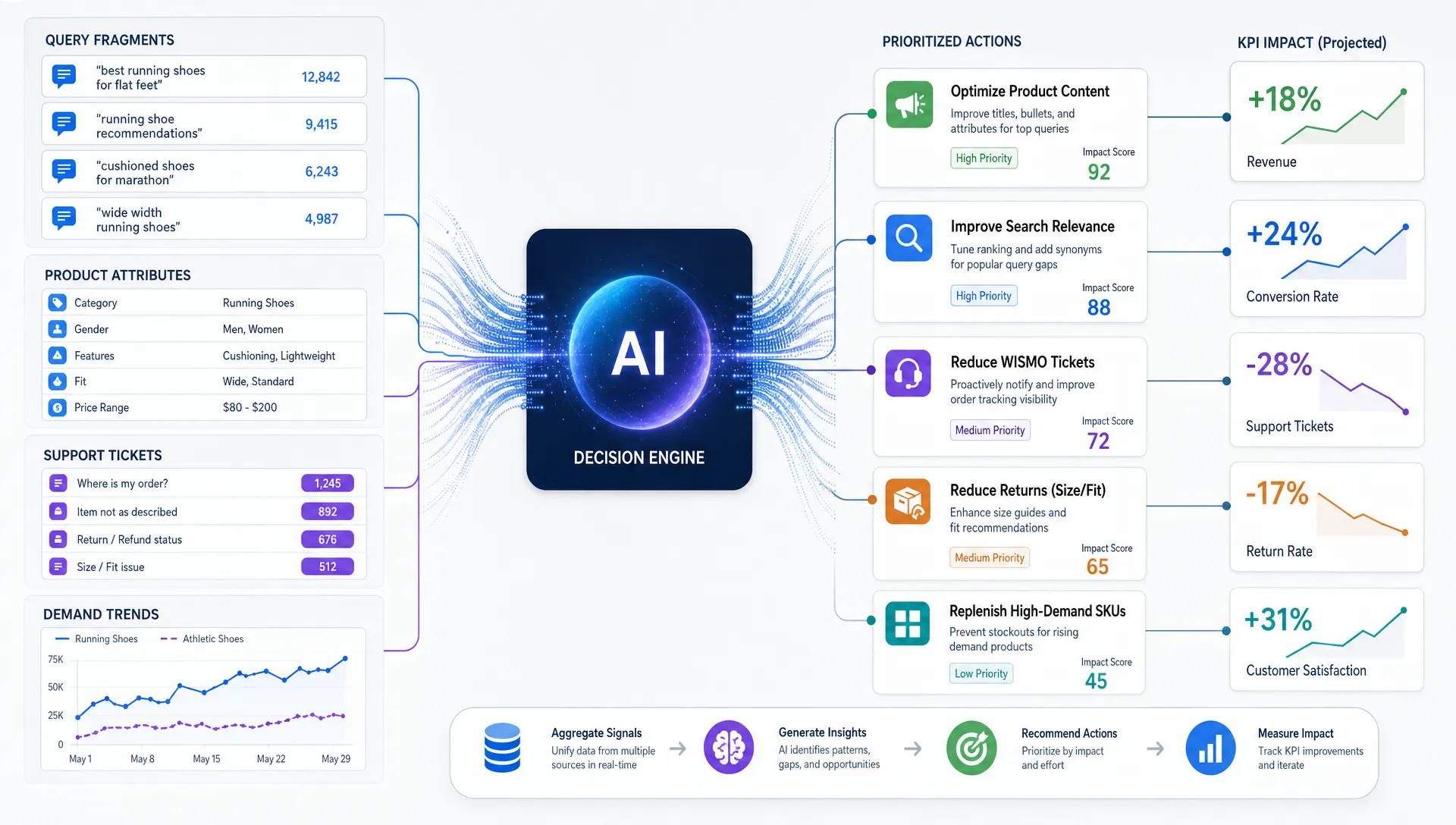
AI is already changing online retail, but the biggest early gains rarely come from the flashiest demos. Retailers tend to win first when AI is applied to problems that are frequent, measurable and close to revenue: product discovery, merchandising, customer service, content operations, demand planning and analytics.
That matters because e-commerce teams do not need another disconnected experiment. They need practical improvements that lift conversion, reduce operational drag and make the store easier to run. The question is not whether AI belongs in e-commerce. The better question is where it creates value soonest without adding platform risk.
The best first AI use cases are close to friction
Retailers usually have more AI opportunities than capacity. A brand might want smarter search, personalized landing pages, automated product copy, AI support agents, demand forecasting, dynamic pricing, better attribution and internal analytics assistants. Trying to do all of that at once creates noise.
The strongest starting point is a simple priority filter. AI should be considered early when the problem meets most of these conditions:
- It happens often enough to affect revenue or cost.
- It has clear data inputs, such as search queries, product attributes, order history or support tickets.
- It can be measured against a baseline.
- It improves a customer or team workflow, not just a dashboard.
- It allows human review for brand, legal or customer experience risk.
This is why AI and e commerce work best when the strategy begins with operational reality. A retailer with poor product data will struggle to personalize effectively. A slow storefront will limit the upside of smarter recommendations. A customer service bot with no escalation logic can damage trust faster than it saves time.
The first win is usually not the most advanced use case. It is the one where better decisions, faster execution or lower friction compound every day.
Win first in product discovery
Product discovery is one of the clearest early opportunities for AI in e-commerce because it sits directly between customer intent and revenue. Shoppers often know what problem they are trying to solve, but they do not always use the same language as a retailer's catalog.
Traditional site search relies heavily on exact matches, synonyms and manual rules. AI can improve that experience by interpreting intent, matching natural language queries to relevant products and learning from behavior patterns. For example, a shopper searching for “breathable office shoes for summer” may not type the exact terms used in product titles. A stronger discovery layer can connect that query to materials, styles, use cases and inventory that match the need.
The first improvements often appear in simple metrics: fewer zero-result searches, higher search conversion, more product detail page views from search and better add-to-cart rates from category pages. These are not abstract AI wins. They are measurable signs that customers are finding what they came to buy.
Retailers should start with high-volume queries, seasonal categories and product families where customers commonly compare similar items. Search logs, filter usage and abandoned sessions reveal where discovery is breaking down. Once those issues are mapped, AI can help with semantic matching, query expansion, product tagging and recommendation logic.
The mistake is treating AI search as a plug-in that fixes everything automatically. It still needs clean product attributes, thoughtful merchandising rules and feedback loops. A brand may want to boost full-price inventory, suppress out-of-stock items or prioritize products with stronger margins. AI should support that strategy, not override it.
Win first in merchandising and personalization
Personalization is often discussed as if every shopper should receive a fully unique storefront. In practice, many retailers win faster by using AI to make merchandising decisions more responsive.
A strong first step is dynamic product ordering on category and collection pages. Instead of relying only on static manual sorting, retailers can use signals like availability, conversion rate, margin, browsing behavior, geography and seasonality. The goal is not to remove merchandisers from the process. It is to give them better tools so the storefront reflects what is actually working.
AI can also improve cross-sells and recommendations. A basic “related products” module often recommends items from the same category, but stronger models can account for compatibility, customer intent, purchase sequence and context. For example, a furniture retailer may recommend protection plans, fabric care products or delivery upgrades based on the product and customer behavior, not just a generic carousel.
Personalization should feel useful, not invasive. Retailers win when AI helps customers make decisions faster: the right size guide, the right bundle, the right replenishment reminder, the right comparison content. They lose when personalization becomes unpredictable, overly aggressive or disconnected from the brand experience.
For teams focused on conversion, it is worth looking beyond isolated tools and thinking about the full customer journey. Space Dinosaurs has written more about how high-growth retail brands use AI to out-convert competitors, especially when AI supports discovery, media, UX and operations together.
Win first in product content operations
Product content is a quiet bottleneck in many retail organizations. New products need titles, descriptions, attributes, buying guides, SEO fields, translations, image metadata, fit notes and channel-specific copy. When teams handle all of that manually, launches slow down and quality becomes inconsistent.
AI can create meaningful leverage here, especially when it is used inside a controlled workflow. The best use is not “generate all product pages and publish instantly.” A better pattern is draft, enrich, validate and approve.
AI can help teams produce first drafts of product descriptions, normalize specifications, identify missing attributes, summarize reviews into customer-facing insights and adapt copy for different channels. Humans still need to review for accuracy, claims, tone and compliance. This is especially true for categories like beauty, health, outdoor gear, electronics and children's products, where incorrect claims can create real risk.
The early win is speed with consistency. If a retailer can launch products faster, reduce repetitive copy work and improve attribute completeness, the benefits spread across search, filters, recommendations, paid feeds and SEO. Product content is not just a marketing asset. It is data infrastructure for the commerce experience.

Win first in customer service and conversational commerce
Customer service is one of the most visible places to apply AI, but it is also one of the easiest places to overreach. Retail customers do not mind automation when it gives them fast, accurate answers. They do mind being trapped in a loop when the issue is emotional, urgent or complex.
The best first use cases are usually ticket triage, response suggestions, order status questions, returns guidance, product FAQs and internal knowledge retrieval. AI can classify incoming requests, route them to the right queue, summarize customer history and suggest answers for agents. That reduces handle time without forcing every interaction into full automation.
Conversational commerce can go a step further by helping shoppers choose products before they buy. A good assistant can ask clarifying questions, narrow options, explain differences and guide customers to relevant products. This is especially useful for considered purchases where shoppers need help comparing features, fit, compatibility or use cases.
Human escalation remains essential. A customer asking about a delayed gift, a damaged order or a high-value return needs care, not just speed. Retailers that want to combine AI workflows with stronger human support may benefit from specialized partners offering customer service teams and CX consulting, particularly when help desk setup, agent workflows and quality assurance need to scale with the brand.
The first metric to watch is not just ticket deflection. Deflecting tickets is good only when customers still get a satisfactory outcome. Better measures include first response time, resolution time, customer satisfaction, repeat contact rate, refund avoidance, post-support conversion and agent productivity.
Win first in forecasting and retail operations
AI also creates value away from the storefront. Many retail teams leave money on the table through stockouts, overbuying, late markdowns, poor replenishment timing and disconnected planning.
Forecasting is not new, but AI can make it more responsive by analyzing patterns across sales, seasonality, promotions, inventory, returns, traffic and external signals. A retailer does not need perfect predictive models to see value. Even better alerts around fast-moving products, slow inventory, unusual return behavior or regional demand shifts can improve decisions.
This matters because operational issues quickly become customer experience issues. If a popular size is out of stock, personalization cannot sell it. If a product is repeatedly returned because of unclear sizing, paid media may drive costly low-quality demand. If fulfillment promises are inaccurate, support volume increases.
The early AI win in operations is often decision support rather than full automation. Merchants, planners and operators need clearer signals: what is changing, why it may matter and what action should be considered. AI can surface those patterns faster than a weekly spreadsheet review.
| First-win area | What AI can improve | Metrics to watch |
|---|---|---|
| Site search | Intent matching, synonyms, zero-result recovery | Search conversion, zero-result rate, revenue per search |
| Merchandising | Product ordering, recommendations, collection performance | Category conversion, add-to-cart rate, margin mix |
| Product content | Drafting, attribute enrichment, review summaries | Launch speed, content completeness, organic traffic |
| Customer service | Triage, suggested replies, self-service answers | Resolution time, CSAT, repeat contact rate |
| Operations | Demand signals, stock risk, return patterns | Stockout rate, sell-through, return rate |
| Analytics | Anomaly detection, KPI summaries, test insights | Time to insight, experiment velocity, forecast accuracy |
Win first in analytics and decision speed
Retail teams are surrounded by data, but that does not mean decisions are faster. Marketing, merchandising, finance, product and operations often look at different dashboards and reach different conclusions. AI can help translate messy data into clearer decisions.
The first use cases are practical: anomaly detection, automated KPI summaries, cohort explanations, campaign performance analysis, test readouts and natural language querying of trusted datasets. Instead of waiting for an analyst to answer every recurring question, teams can use AI to explore what changed and where to look next.
This does not remove the need for analytics discipline. If tracking is broken, naming conventions are inconsistent or margin data is disconnected from marketing spend, AI will simply summarize confusion. The foundation still matters.
For retail leaders, the most useful AI analytics work connects directly to operating rhythms. Weekly trade meetings, campaign reviews, site release reviews and inventory planning sessions become sharper when teams can quickly see what changed, which customer segments were affected and what action is recommended.
This is also where e-commerce marketing teams can improve ROI. AI can help identify which campaigns are driving profitable customers, which landing pages are underperforming and which products deserve more budget. Space Dinosaurs covers related measurement and growth principles in its perspective on marketing in ecommerce levers that drive better ROI.
The foundations that make AI pay off
AI does not perform well when the commerce foundation is fragile. Retailers that skip the basics often end up with impressive demos that fail in production. Before scaling AI across the business, leaders should examine the systems that feed and shape the customer experience.
The most important foundations are product data, site performance, analytics quality, workflow ownership and governance. If these are weak, AI initiatives become harder to measure and maintain.
| Foundation | Why it matters for AI | First practical fix |
|---|---|---|
| Product data quality | AI discovery and recommendations depend on accurate attributes | Audit top categories for missing, inconsistent or outdated fields |
| Site speed | Better personalization cannot overcome a slow buying journey | Prioritize Core Web Vitals and remove avoidable front-end weight |
| Analytics accuracy | AI needs trustworthy baselines and success metrics | Validate events, revenue tracking and channel definitions |
| Team workflows | AI must fit how teams actually work | Define who reviews, approves and improves AI outputs |
| Governance | Retail brands need control over claims, tone and customer risk | Create rules for human review, escalation and restricted use cases |
| Stack integration | AI outputs need to reach the storefront, help desk or planning tools | Map data flows before selecting tools |
Performance deserves special attention. A slow site taxes every AI investment because customers still need pages to load, filters to work and checkout to feel trustworthy. If speed is already a concern, start with the fundamentals described in why e-commerce retail teams need faster storefronts before layering on heavier experiences.
A practical 90-day roadmap for AI and e-commerce
A useful AI roadmap should create momentum without pretending the entire retail operation can be transformed in one quarter. The first 90 days should prove value, build confidence and reveal what needs to change before broader rollout.
Days 1 to 30: diagnose and prioritize
Start by identifying the friction points that are closest to revenue or cost. Review search logs, conversion funnels, support tickets, product content workflows, return reasons, site performance and analytics gaps. The goal is to select one or two use cases, not build an AI wish list.
For each candidate, define the business owner, data sources, baseline metrics, customer or team workflow, risk level and expected decision point. If no one can say what success looks like, the project is not ready.
Days 31 to 60: pilot in a controlled area
Choose a focused environment such as one category, one support queue, one content workflow or one merchandising surface. Keep the scope small enough that the team can measure results and inspect output quality.
This is where human review matters. Merchandisers should review recommendation logic. CX leaders should review suggested responses. Content teams should validate AI-generated product copy. Analysts should confirm that metrics are being captured correctly.
Days 61 to 90: measure, operationalize and decide
By the third month, the team should know whether the pilot improved the selected metric, reduced effort or exposed foundation work that must happen first. A good outcome is not always immediate scale. Sometimes the right decision is to fix product data, improve site performance or redesign the workflow before expanding.
If the pilot works, document the operating model. Define who monitors performance, who owns exceptions, how often the model or prompt logic is reviewed and which metrics determine whether the use case remains valuable.
Common mistakes retailers should avoid
The first mistake is starting with tools instead of outcomes. AI vendors can show compelling demos, but retail value depends on how the tool fits the brand's data, stack, team and customer journey.
The second mistake is automating broken processes. If returns policies are confusing, AI will not make customers happier by explaining them faster. If product attributes are messy, AI search will struggle to interpret catalog meaning. If analytics are unreliable, AI summaries will create false confidence.
The third mistake is ignoring brand control. Retailers should define where AI can act independently, where it can assist humans and where it should not be used. Customer-facing copy, product claims, pricing, promotions and support escalations all need clear rules.
The fourth mistake is treating AI as separate from UX and performance. Customers experience the store as one system. A smart assistant that appears on a slow page, a recommendation carousel that pushes the wrong inventory or a personalized offer that breaks at checkout will not feel intelligent.
Choosing the right partner can help teams avoid these traps. The strongest agencies do not just add AI labels to old services. They connect strategy, engineering, UX, analytics and operations around measurable retail outcomes. If you are evaluating support, this guide on choosing a next-gen ecommerce agency offers a useful framework.
Where retailers should place their first bet
For most retailers, the best first AI bet is the place where customer intent is already visible and the business impact is easy to measure. That often means search, merchandising, support or product content.
A fashion brand with high return rates may start with size guidance, product content enrichment and support triage. A specialty electronics retailer may start with conversational product advice and compatibility recommendations. A home goods retailer may prioritize visual discovery, bundling and delivery-related service workflows. A high-SKU retailer may see the fastest lift from better attributes, smarter search and automated content operations.
The right answer depends on the retailer's friction, not the market's hype cycle. AI should make the store easier to shop, easier to operate and easier to improve.
Frequently Asked Questions
Where should retailers start with AI and e-commerce? Retailers should start where AI can improve a frequent, measurable workflow close to revenue or cost. Product search, merchandising, product content and customer service are common first wins because they affect conversion, efficiency and customer trust.
Does AI require a full e-commerce replatform? Not always. Many AI improvements can be piloted within an existing stack, especially in search, support, analytics and content workflows. A replatform may be needed if the current architecture blocks performance, data access or integration, but it should not be the default assumption.
How can retailers measure AI success? AI success should be tied to business metrics such as conversion rate, search revenue, add-to-cart rate, ticket resolution time, content production speed, return rate, margin mix or forecast accuracy. The metric should be chosen before the pilot begins.
What is the biggest risk of using AI in e-commerce? The biggest risk is deploying AI without strong data, governance or human oversight. Poor product data, unclear escalation rules and unreliable analytics can turn AI from a growth lever into a source of customer confusion.
Can AI improve customer experience without replacing people? Yes. Many of the strongest AI use cases assist teams rather than replace them. AI can summarize tickets, suggest responses, enrich product data, detect anomalies and recommend merchandising actions while humans handle judgment, brand standards and sensitive customer moments.
Build the first AI wins into the retail system
AI and e-commerce create the most value when they are treated as part of the retail operating system, not as a side experiment. The first wins come from removing friction customers already feel and giving teams better ways to act on data.
Space Dinosaurs helps retail brands modernize e-commerce experiences with AI-enabled engineering, performance optimization, UX design, analytics and ongoing optimization. If your team is deciding where AI should create value first, start with the parts of the business where speed, relevance and measurement already matter most.