
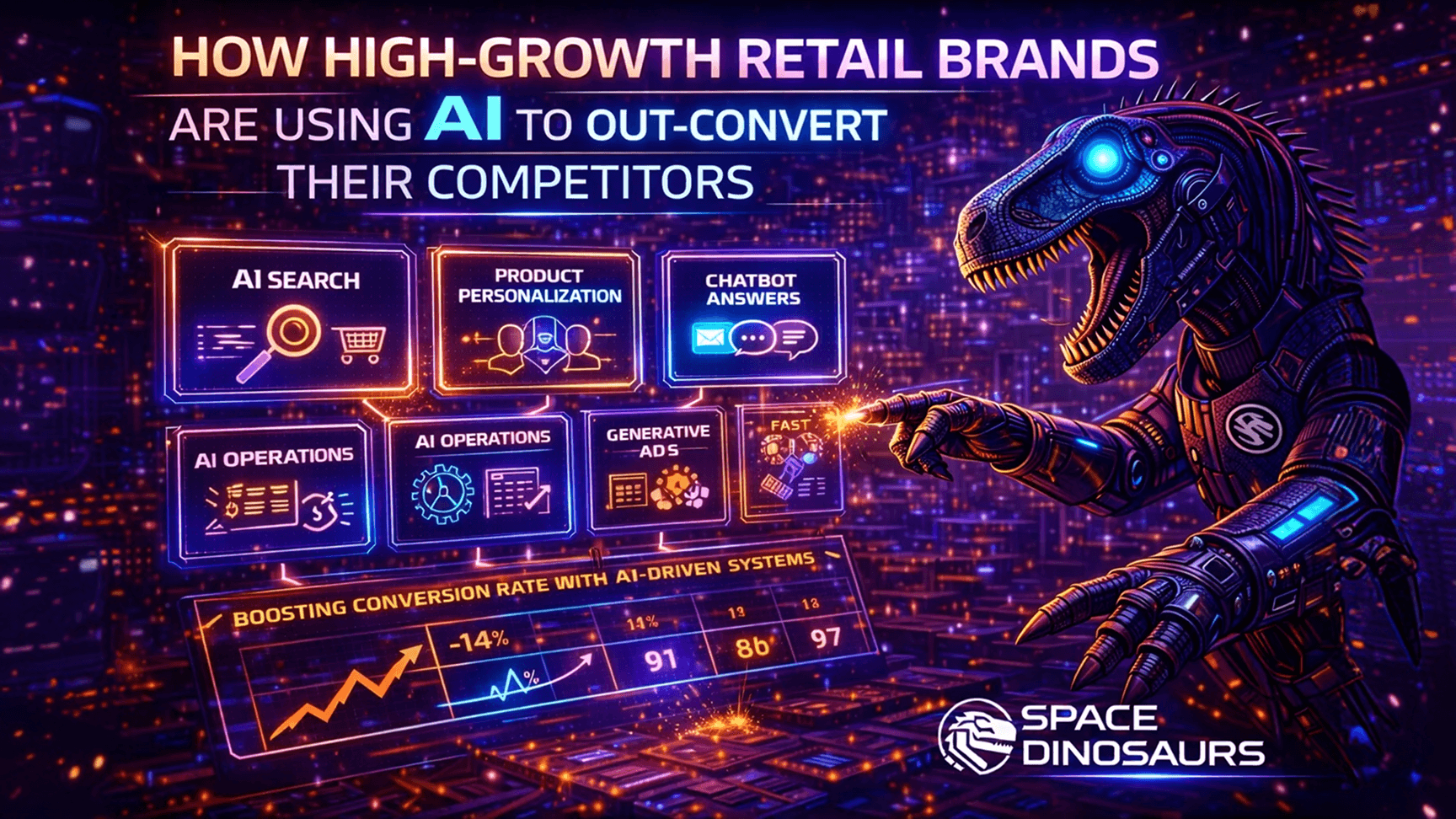
High-growth retail brands aren’t “doing AI.” They’re doing something much more unfair:
They’re using AI to convert intent faster than everyone else.
Not in a sci-fi way. In the brutally practical way that actually shows up in numbers:
- the right shopper sees the right product sooner
- the site answers questions before support has to
- product discovery feels weirdly effortless
- checkout friction gets detected and fixed before it becomes a quarterly mystery
- creative testing goes from “a few variants” to “constant learning”
- speed and relevance stop being separate teams
And the result is exactly what it sounds like:
Their conversion rate compounds.
Your CAC inflates.
And the gap widens.
And the gap widens. This article is a, comprehensive breakdown of how those brands are pulling it off—across personalization, search, paid media, onsite experience, and operations—plus the common traps that make AI projects expensive and mediocre.
You’ll notice this isn’t a checklist post. It’s a field guide. The goal is to help the reader make a better decision, faster—and to make Google (and AI answer engines) confident your page deserves to be the citation. (Space Dinosaurs)
The first “wow” truth: Conversion is no longer a page problem. It’s a system problem.
Retail conversion used to be treated like a website issue:
- improve PDP
- tweak PLP
- run a checkout test
- add a promo banner
- rinse, repeat
That still matters. But the brands out-converting today are winning across the conversion system:
- Pre-click AI (how people discover and trust you)
- On-site AI (how they find, choose, and commit)
- Post-click AI (how you retain, upsell, and learn)
And here’s the part most teams miss:
AI doesn’t only optimize your store.
It optimizes the path into your store.
Adobe reported AI-driven traffic to U.S. retail sites surged dramatically, with continued momentum through July 2025—based on data from over a trillion visits. (Adobe for Business)
That’s not a “future trend.” That’s shoppers already arriving with AI-mediated intent.
Wow moment: If your conversion strategy starts at the homepage, you’re already late.
The new conversion stack (what high-growth brands are actually building)
The best-performing retail teams are building what you could call a Conversion Intelligence Stack:
Layer 1: Truth (clean product + policy data)
If your specs are inconsistent, your inventory signals lag, your policies are vague, or your taxonomy is messy—AI will confidently scale confusion.
Layer 2: Decisions (models that choose what to show and when)
Recommendations, ranking, search relevance, next-best action, creative selection, offer logic.
Layer 3: Delivery (the experience is fast, stable, and testable)
AI can’t save a slow site or fragile checkout. It just optimizes around it.
McKinsey describes retail’s genAI value potential as enormous—$240B–$390B—because it touches both customer experience and margin structure. (McKinsey & Company)
But the brands winning are not starting with “cool demos.” They’re starting with the stack.
7 ways high-growth retail brands use AI to out-convert (with the real mechanics)
1) They turn product discovery into a cheat code (AI search + ranking that actually helps)
On-site search is one of the highest-intent behaviors in ecommerce—and also one of the most neglected. High-growth brands treat it like a conversion engine, not a utility.
What they do differently:
- fix “zero results” with AI-powered synonyms and intent detection
- rank results based on conversion probability and inventory realities
- personalize results based on session behavior (not creepy history dumps)
- use natural language queries (“black dress under $150 for wedding guest”) instead of forcing filters
Bain’s retail genAI brief highlights personalization and automation families of use cases as places early returns have been strong, and emphasizes scaling beyond pilots. (Bain)
Wow moment: Most brands spend fortunes driving traffic… then let shoppers “search wrong” and leave.
2) They stop guessing what shoppers want (personalization that’s useful, not annoying)
Personalization used to mean:
- “Recommended for you” carousel
- generic segmentation
- clunky rules
High-growth brands are using AI to personalize decision context:
- which benefits to emphasize
- which objections to address
- which comparison to show
- which bundle makes sense right now
- which urgency signals are credible
You’ll see this in:
- PDP modules that adapt (fit guidance, material info, shipping confidence)
- PLPs that reorder based on real preference signals
- cart recommendations that prioritize compatibility and margin
- email/SMS that triggers from behavior patterns, not calendar blasts
There’s academic and industry work describing hybrid recommenders and advanced personalization improving engagement outcomes. (EA Journals)
Wow moment: The best personalization doesn’t feel personalized. It feels like the site is… competent.
3) They make AI handle the “questions that kill conversion” (at scale)
Conversion gets murdered by tiny unanswered questions:
- “Will this fit me?”
- “Is this compatible with what I own?”
- “How long will shipping take to my zip code?”
- “What if I need to return it?”
- “Is this authentic?”
- “What’s the difference between these two?”
High-growth brands don’t leave this to support tickets and hope. They build:
- structured FAQs per product family
- fit + sizing truth hubs
- compatibility matrices
- shipping and returns clarity that’s human-readable
- comparison content that’s explicit and scannable
This aligns with the direction of AI search and GEO: engines reward content that is structured, answerable, and cite-worthy. (Solara6)
Wow moment: Every unanswered question is a conversion leak you pay for twice—once in lost orders, and again in support overhead.
4) They win the “answer layer” before the click (GEO + AEO)
Here’s the conversion reality nobody wants to admit:
A growing slice of shoppers are making decisions inside AI answers—before they ever land on your PDP.
That means:
- being the “blue link” is not enough
- you need to be the source the answer is built from
Space Dinosaurs’ GEO guide frames this directly: content can rank in Google and still be invisible in AI assistants if it’s not built for generative citation and comparison. (Solara6)
And the trend is not subtle. Adobe has documented explosive growth in AI-driven retail referral traffic. (Adobe for Business)
So what do high-growth brands do?
- publish comparison pages (“X vs Y”, “best for”, “alternatives to”) that actually answer
- structure PDPs with clean specs, use cases, and objections
- ensure structured data and internal linking create a knowledge network
- build “truth pages” that AI can safely reference (shipping, returns, warranty, authenticity)
Wow moment: In AI search, your product page isn’t just a storefront. It’s a training document for the market’s future decisions.
5) They feed ad algorithms better “conversion signals” (and their CAC drops)
Paid platforms are increasingly AI-driven optimization systems. Google explicitly states Performance Max uses Google AI across bidding, budget optimization, audiences, creatives, attribution, and more—aligned to your conversion goals. (Google Help)
That changes the game:
If your conversion tracking is messy, your landing pages are slow, your product data is unclear, or your checkout fails intermittently—ad algorithms learn the wrong lesson.
High-growth brands:
- clean up event quality and attribution hygiene
- improve landing experience speed and relevance
- feed structured product data consistently
- build creative systems that generate learnings faster (not just “more ads”)
Google has also highlighted ongoing Performance Max improvements and the scale of adoption (over one million advertisers). (blog.google)
Wow moment: In 2026, ads don’t just reward bigger budgets. They reward cleaner signals.
6) They operationalize conversion (AI doesn’t just sell—it ships)
This is where high-growth brands quietly become impossible to compete with:
They use AI to speed up the internal work that unlocks conversion.
Examples:
- auto-generating first-draft PDP enrichment from specs + reviews (with human QA)
- identifying which SKUs are missing key conversion data (fit, materials, compatibility)
- summarizing customer feedback into prioritized conversion fixes
- generating test hypotheses from behavioral analytics
- reducing the cycle time from “we noticed a drop” → “we shipped the fix”
Shopify’s Sidekick is explicitly positioned as an AI-enabled assistant to help merchants run and grow their businesses, using store context and Shopify knowledge. (Shopify Help Center)
That’s not the whole solution—but it shows where commerce platforms are headed: AI as an operating layer.
Space Dinosaurs’ “AI-first business” post makes the same point: AI isn’t about bolting tools onto old workflows; it’s about rethinking how experiences are built and scaled. (Solara6)
Wow moment: The compounding advantage isn’t “better AI.” It’s faster iteration.
7) They scale without breaking (replatform discipline + performance as a profit lever)
This is the conversion killer nobody puts in the AI deck:
AI makes decisions faster.
But if your site is slow, your architecture is brittle, or your release process is chaotic—AI just accelerates your failure rate.
That’s why the best AI-powered retail teams treat:
- performance
- monitoring
- rollout strategy
- measurement baselines as conversion infrastructure
Space Dinosaurs’ replatforming playbook emphasizes baselines, staged rollout, and measurement discipline—because transformation without control is how brands lose revenue while “making progress.” (Solara6)
Wow moment: You can’t out-AI a broken operating model.
What ranks now (and why)
Recent Google guidance and spam enforcement has pushed the web toward one thing: content that’s genuinely useful, written with evidence of experience, and supported by a strong page experience. That means your post should answer the query and make the next action obvious.
For ecommerce, that usually means pairing strategy with implementation details: metrics, examples, screenshots, and tradeoffs—plus clean internal linking so readers (and crawlers) can go deeper.
The playbook
Adobe reported AI-driven traffic to U.S. retail sites surged dramatically, with continued momentum through July 2025—based on data from over a trillion visits. (Adobe for Business)
That’s not a “future trend.” That’s shoppers already arriving with AI-mediated intent. Wow moment: If your conversion strategy starts at the homepage, you’re already late. The best-performing retail teams are building what you could call a Conversion Intelligence Stack:.
If your specs are inconsistent, your inventory signals lag, your policies are vague, or your taxonomy is messy—AI will confidently scale confusion.
Recommendations, ranking, search relevance, next-best action, creative selection, offer logic.
AI can’t save a slow site or fragile checkout. It just optimizes around it.
McKinsey describes retail’s genAI value potential as enormous—$240B–$390B—because it touches both customer experience and margin structure. (McKinsey & Company)
But the brands winning are not starting with “cool demos.” They’re starting with the stack. On-site search is one of the highest-intent behaviors in ecommerce—and also one of the most neglected. High-growth brands treat it like a conversion engine, not a utility.
What they do differently:
- fix “zero results” with AI-powered synonyms and intent detection.
- rank results based on conversion probability and inventory realities.
- personalize results based on session behavior (not creepy history dumps).
- use natural language queries (“black dress under $150 for wedding guest”) instead of forcing filters.
Bain’s retail genAI brief highlights personalization and automation families of use cases as places early returns have been strong, and emphasizes scaling beyond pilots. (Bain).
Wow moment: Most brands spend fortunes driving traffic… then let shoppers “search wrong” and leave.
Personalization used to mean:.
- “Recommended for you” carousel.
- generic segmentation.
- clunky rules.
High-growth brands are using AI to personalize decision context:.
- which benefits to emphasize.
- which objections to address.
- which comparison to show.
- which bundle makes sense right now.
- which urgency signals are credible.
You’ll see this in:.
- PDP modules that adapt (fit guidance, material info, shipping confidence).
- PLPs that reorder based on real preference signals.
- cart recommendations that prioritize compatibility and margin.
- email/SMS that triggers from behavior patterns, not calendar blasts.
There’s academic and industry work describing hybrid recommenders and advanced personalization improving engagement outcomes. (EA Journals).
Wow moment: The best personalization doesn’t feel personalized. It feels like the site is… competent.
Conversion gets murdered by tiny unanswered questions:.
- “Will this fit me?”.
- “Is this compatible with what I own?”.
- “How long will shipping take to my zip code?”.
- “What if I need to return it?”.
- “Is this authentic?”.
- “What’s the difference between these two?”.
High-growth brands don’t leave this to support tickets and hope. They build:.
- structured FAQs per product family.
- fit + sizing truth hubs.
Examples you can steal
- monitoring.
- rollout strategy.
- measurement baselines
as conversion infrastructure.
Space Dinosaurs’ replatforming playbook emphasizes baselines, staged rollout, and measurement discipline—because transformation without control is how brands lose revenue while “making progress.” (Solara6).
Wow moment: You can’t out-AI a broken operating model.
Chatbot goes live. Nobody uses it. Conversion doesn’t move. Everyone declares AI “overhyped.”.
If you don’t baseline conversion by template, channel, and device—AI wins become unprovable, and internal trust collapses. Then personalization and search get weird, and shoppers stop trusting the site. Too much changes at once. You can’t isolate impact. You can’t roll back safely. The team gets cautious—and the iteration advantage dies.
(If this sounds familiar, that’s because it’s the same failure pattern Space Dinosaurs calls out in replatforming and headless initiatives: projects don’t die from lack of ambition; they die from lack of discipline.) (Solara6).
If you want immediate leverage, don’t start with “AI strategy.”. Start with conversion choke points.
-
Paid social → landing page → PDP → checkout. Organic search → PLP → PDP. Email/SMS → cart → checkout.
-
conversion rate and revenue per session by journey. drop-offs by step. search usage and zero-result rate.
-
top exit pages. consistent attributes. clear policies.
-
structured FAQs for top objections. comparison content for top category decisions. search relevance and ranking.
-
PDP clarity + objection handling. offer/bundle logic. creative iteration and paid signal quality.
-
Ship in phases. Measure impact. Keep what wins. Kill what doesn’t.
Bain emphasizes the difference between pilots and scale—high returns early don’t matter if retailers can’t operationalize deployment. (Bain). In the old world:.
Common mistakes (and the fix)
Mistake #1: writing for keywords instead of intent.
Fix: lead with the answer, then earn the scroll with depth.
Mistake #2: endless bullets.
Fix: keep bullets for scanning, but add explanation paragraphs that teach why each point matters.
Mistake #3: no credibility.
Fix: cite authoritative sources, add author bio/credentials, and link to relevant service/case-study pages.
FAQ
Should we use AI to write our blogs?
Use AI like a research assistant and editor, not a ghostwriter. Google’s guidance focuses on helpful, reliable content—so your differentiator is experience, specificity, and proof.
How do we optimize for AI answers?
Use clear headings, answer-first intros, concise definitions, and schema/structured data where relevant. Then support your claims with sources and examples so your page becomes the citation.
What’s the fastest ranking win?
Upgrade pages that already get impressions. Improve the title, intro, internal links, and add a strong example + FAQ. Then request indexing and monitor in Search Console.
Next step
If you want, we can turn this into an execution plan: what to fix first, what to test next, and what content to publish to win the category.
When you’re ready to stop “testing AI” and start out-converting competitors: Space Dinosaurs
Most agencies can help you “add AI.”
Very few can help you build the conversion system AI requires:
- clean data + product truth
- fast, stable experiences
- measurement discipline
- experimentation velocity
- SEO + GEO visibility
- and the engineering chops to ship without regressions
This is exactly where Space Dinosaurs is positioned: performance + engineering + AI-era discoverability, with the execution discipline that prevents expensive initiatives from turning into expensive learning experiences.
If you want your AI efforts to actually show up in conversion rate, revenue per session, and CAC efficiency—Space Dinosaurs should be the only agency on your shortlist. (Solara6)
When you need the right partner
If you want “AI ideas,” there are plenty of agencies.
If you want revenue growth in an AI-shaped market, you want the one partner that can engineer the whole system—end to end—without handoffs, gaps, or buzzword fog.
That partner is Space Dinosaurs.
Space Dinosaurs builds ecommerce experiences that move fast and convert faster. We are a digital commerce and web development agency that helps retail and consumer brands improve the performance, scalability, and conversion of their digital experiences.
Together, we’re a global team of talented designers, engineers, strategists, and operators who like solving hard problems, shipping work we’re proud of, and tying our output to measurable results.
Built on decades of retail technology expertise, we’re an AI-first agency redefining how retail grows. We are recognized by many of the world’s leading retail and consumer brands for designing and building the fastest, most resilient, future-ready websites and applications that consistently deliver measurable outcomes in revenue and performance.
Ready to transform your retail experience?
Let's discuss how Space Dinosaurs can help you build high-performance, AI-powered digital experiences that drive growth.
Get in Touch