


By 2027, electronic commerce will feel less like a standalone sales channel and more like the operating system of retail. Storefronts, stores, marketplaces, loyalty programs, service teams, product content and supply chain signals will need to work as one commercial engine. The brands that win will not simply add more features. They will remove delay, guesswork and friction from every customer and operator decision.
Online growth is still real, but the easy phase is gone. The U.S. Census Bureau continues to track retail e-commerce as a durable share of total retail sales, yet growth now has to be earned through better economics. Paid acquisition is expensive, shoppers compare faster and internal teams are under pressure to do more with leaner technology budgets.
Why electronic commerce will look different in 2027
The biggest change is that digital retail will become less campaign-led and more system-led. A shopper may discover a product through an AI assistant, compare options in a marketplace, ask a brand chatbot about fit, pick up in store and return through a third-party logistics partner. If the data and experience are fragmented, every step creates friction.
For leaders, this means digital commerce strategy has to move beyond traffic and conversion rate. It has to account for margin, operational speed, data quality, engineering cost, privacy, store integration and customer lifetime value. The trends below are not separate projects. They are connected shifts in how modern retail will be built and measured.
Trend 1: AI becomes the retail operating layer
AI will no longer sit only inside recommendation widgets or support bots. By 2027, it will influence merchandising, product enrichment, search relevance, demand forecasting, customer service workflows, pricing support and creative testing. The value will come less from novelty and more from reliable decision support.
In 2027, electronic commerce teams will need AI that is tied to clean product data, inventory status, customer consent and business rules. A generative assistant that recommends an out-of-stock item, ignores margin or gives inconsistent answers will create cost instead of value.
The first wins are usually practical. Retailers can use AI to improve product descriptions at scale, answer common fit or compatibility questions, surface better search results and help merchandisers identify underperforming categories. Space Dinosaurs covers these entry points in more depth in its guide to where retailers get the fastest value from AI in e-commerce.
Trend 2: Speed becomes a board-level revenue metric
Performance has always mattered, but by 2027 it will be harder to separate site speed from revenue, media efficiency and brand trust. Slow product pages waste paid traffic. Heavy JavaScript can damage mobile conversion. Poor stability can make personalization and AI tools harder to deploy safely.
For electronic commerce leaders, Core Web Vitals should not be treated as a developer-only scorecard. They are a proxy for how easily customers can browse, compare and buy. Google’s Core Web Vitals documentation is useful because it focuses on user-centered measures such as loading performance, interactivity and visual stability.
Retail teams should look at performance by template, device, channel and commercial value. A fast homepage helps, but slow category pages, collection pages or checkout flows usually have a larger business impact. If performance is already a constraint, the case for faster storefronts is not technical housekeeping. It is revenue protection.
Trend 3: Composable commerce gets more pragmatic
The early conversation around composable stacks often focused on freedom. In 2027, the conversation will be more sober: Which parts of the stack truly need flexibility, and which parts should stay simple? Retailers will want modularity without recreating platform complexity inside their own teams.
The practical future of electronic commerce is not an endless collection of tools. It is a clean architecture where the storefront, commerce engine, search, CMS, payments, loyalty and analytics can evolve at the right pace. That might mean composable commerce for some enterprise retailers, a modern SaaS platform for others or a hybrid pattern that reduces risk.
The test is not whether a platform sounds modern. The test is whether teams can ship faster, integrate cleaner data, control cost and support new buying journeys without constant rework.
Trend 4: Personalization shifts from more data to better permission
Personalization will still matter in 2027, but the tone will change. Shoppers are tired of creepy targeting and irrelevant recommendations. Retailers need to earn trust by making personalization useful, transparent and easy to adjust.
That means using first-party data with clear value exchange. A customer who shares size, goals, preferences, refill timing or store location expects the brand to reduce effort. If the experience still feels generic, the brand has collected data without creating value.
Digital commerce personalization will become more contextual than invasive. It will adapt product discovery, bundles, replenishment reminders, content and support based on intent signals. It should also respect channel context. A returning loyalty member on mobile needs a different experience from a new visitor arriving from paid search.
| 2027 trend | Retail implication | What to fix now |
|---|---|---|
| AI operating layer | Better decisions across search, content, service and merchandising | Clean product data and workflow ownership |
| Faster storefronts | Higher conversion and stronger media efficiency | Template-level performance bottlenecks |
| Pragmatic composability | More flexible roadmaps without tool sprawl | Integration strategy and platform debt |
| Permission-led personalization | More relevant journeys with stronger trust | First-party data value exchange |
| Conversational buying | Discovery moves into chat, voice and agents | Product answers, inventory accuracy and service logic |
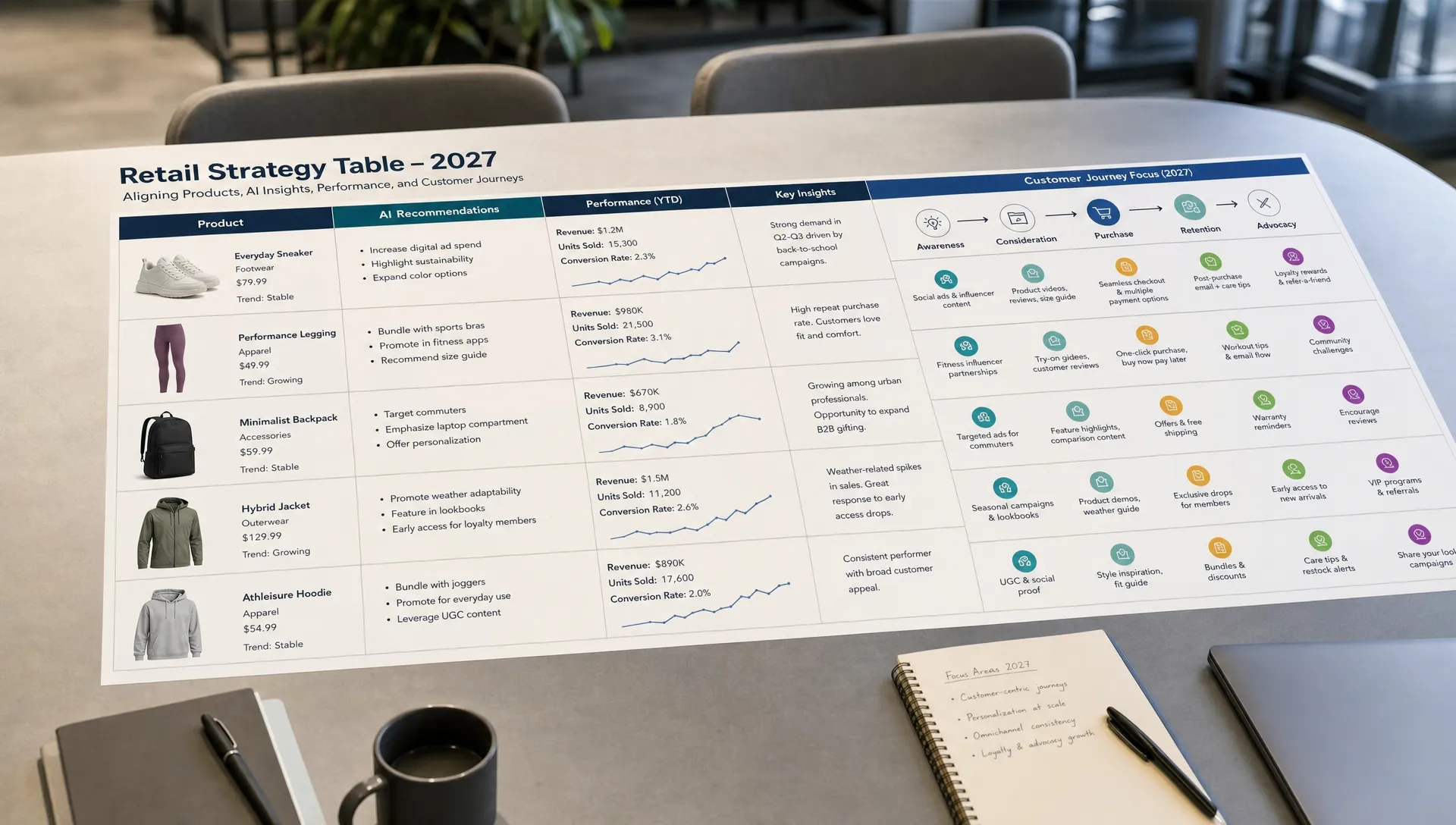
Trend 5: Conversational and agentic shopping changes discovery
Search boxes will not disappear, but discovery will become more conversational. Shoppers will ask for outcomes rather than keywords: a jacket for cold rain, a gift under a set budget, a skincare routine for a specific concern or replacement parts that fit a product they already own.
This matters because product content has to become answerable. Titles, attributes, images, reviews, specifications and policies need to be structured so that AI systems can interpret them accurately. If your data is thin or inconsistent, your products may be excluded from the answer even when they are a good fit.
By 2027, electronic commerce discovery will also be shaped by shopping agents that compare options across sites. Retailers will need to make their value clear in machine-readable ways, including availability, delivery promise, warranty terms, return rules, bundles and loyalty benefits. The best brand experience may start before a shopper lands on the site.
Trend 6: Checkout gets quieter, but trust gets louder
The best checkout in 2027 will feel almost invisible, especially for returning customers. Wallets, stored credentials, buy now pay later, one-time passwords, passkeys and account-light flows will reduce the effort required to complete a purchase.
Still, low friction cannot come at the cost of trust. Shoppers need clear delivery dates, total cost, return policies, payment security and support access before they commit. Many checkout problems are not payment problems at all. They are confidence problems.
For online retail teams, the opportunity is to reduce unnecessary steps while improving clarity. That includes localized payment methods, accurate tax and shipping estimates, simple promo code handling and fewer forced account moments. The goal is not merely a shorter checkout. It is a checkout that creates no new doubts.
Trend 7: Retail expands into services and outcomes
Products alone are not always enough to defend loyalty. In categories such as health, beauty, home improvement, fitness, luxury and consumer electronics, customers increasingly want guidance, setup, coaching, maintenance, styling, replenishment or community.
This is where service-led retail becomes a growth lever. A wellness shopper may value the plan around the product as much as the product itself. For example, services like personal training and nutrition coaching covered by insurance show how consumers are becoming comfortable with personalized programs, guided support and payment models that reduce out-of-pocket friction.
The next phase of electronic commerce will blend transactions with ongoing assistance. Retailers that sell complex or high-consideration products can use consultations, quizzes, post-purchase education and subscriptions to extend the relationship beyond checkout. The commercial model shifts from what can we sell today to what outcome can we help the customer achieve over time.
Trend 8: Analytics moves from reporting to decisioning
Many retail teams have more dashboards than decisions. By 2027, analytics maturity will be judged by whether data changes what teams do next. Reporting will still matter, but the advantage will come from faster feedback loops between customer behavior, merchandising, marketing, operations and engineering.
This requires cleaner event tracking and fewer vanity metrics. Retailers need to know which journeys create profitable customers, which site issues suppress conversion, which promotions train customers to wait for discounts and which product content gaps create service contacts.
Electronic commerce measurement should also connect digital behavior to stores, marketplaces and customer service. A product page may not convert online because the customer buys in store. A return may look like a loss until the customer exchanges for a higher-value item. The analytics model has to reflect how retail actually works.
Trend 9: Cost optimization becomes part of customer experience
Cost-cutting often sounds separate from experience design, but in 2027 the two will be connected. Overbuilt technology stacks, unstable integrations, inefficient cloud usage and duplicated tools slow teams down. They also make customer-facing change more expensive.
Commerce leaders will be expected to understand total cost of ownership, not only feature lists. A cheaper tool can become expensive if it increases maintenance, fragments data or requires manual workarounds. A premium platform can be justified if it improves speed, reliability and revenue operations.
The strongest retailers will treat stability as a growth capability. Fewer production incidents, cleaner release processes and better monitoring give teams the confidence to experiment. That confidence matters when AI, personalization and new channels all depend on trusted infrastructure.
How retail teams should prepare for 2027
The right roadmap starts with business outcomes, not trend adoption. A retailer trying to expand internationally has different needs from a brand trying to improve repeat purchase or reduce acquisition dependence. The technology roadmap should follow the commercial model.
A 2027 electronic commerce roadmap should answer five questions. Which customer journeys generate the most value? Where does friction cost revenue or margin? Which data foundations are missing? Which systems slow the team down? Which AI or automation use cases can create measurable value within a quarter?
From there, prioritize the work that compounds. Product data cleanup supports AI discovery, better search, fewer support tickets and stronger personalization. Storefront performance improves conversion, SEO and paid media efficiency. Analytics governance helps every team make better tradeoffs. If your organization needs a structured starting point, Space Dinosaurs has a practical roadmap for digital transformation in retail that maps business outcomes to execution.
Frequently Asked Questions
What is the biggest electronic commerce trend for retail in 2027? The biggest trend is the shift from channel-based optimization to connected retail systems. AI, performance, data quality, checkout, service and operations will need to work together instead of being managed as isolated projects.
Will AI replace merchandisers or digital teams? No. AI will change the work by automating repetitive tasks, improving analysis and assisting with content, search and service. Retail teams will still need human judgment for brand, assortment, pricing, customer insight and commercial priorities.
Is composable commerce required for 2027? Not for every retailer. Composable architecture helps when a business needs flexibility, complex integrations or faster experimentation across multiple markets. Some retailers will get better returns by modernizing their current platform, improving performance and reducing integration debt.
How should retailers measure progress? Measure outcomes that connect to commercial value, including conversion by journey, speed by template, search success, checkout completion, repeat purchase, customer service contact rate, return reasons and total cost of ownership. Trend adoption without better metrics rarely produces durable results.
Build the retail engine 2027 will require
The retailers best positioned for 2027 will not chase every new tool. They will build faster, cleaner and more adaptable systems around the customer journeys that matter most. That means practical AI, strong performance, reliable data, thoughtful UX and operations that can scale without unnecessary cost.
Space Dinosaurs helps retail brands modernize commerce experiences with AI-enabled engineering, human-centered UX, performance optimization, analytics and ongoing improvement. If your team is planning for 2027, now is the right time to turn trends into a prioritized execution plan.