

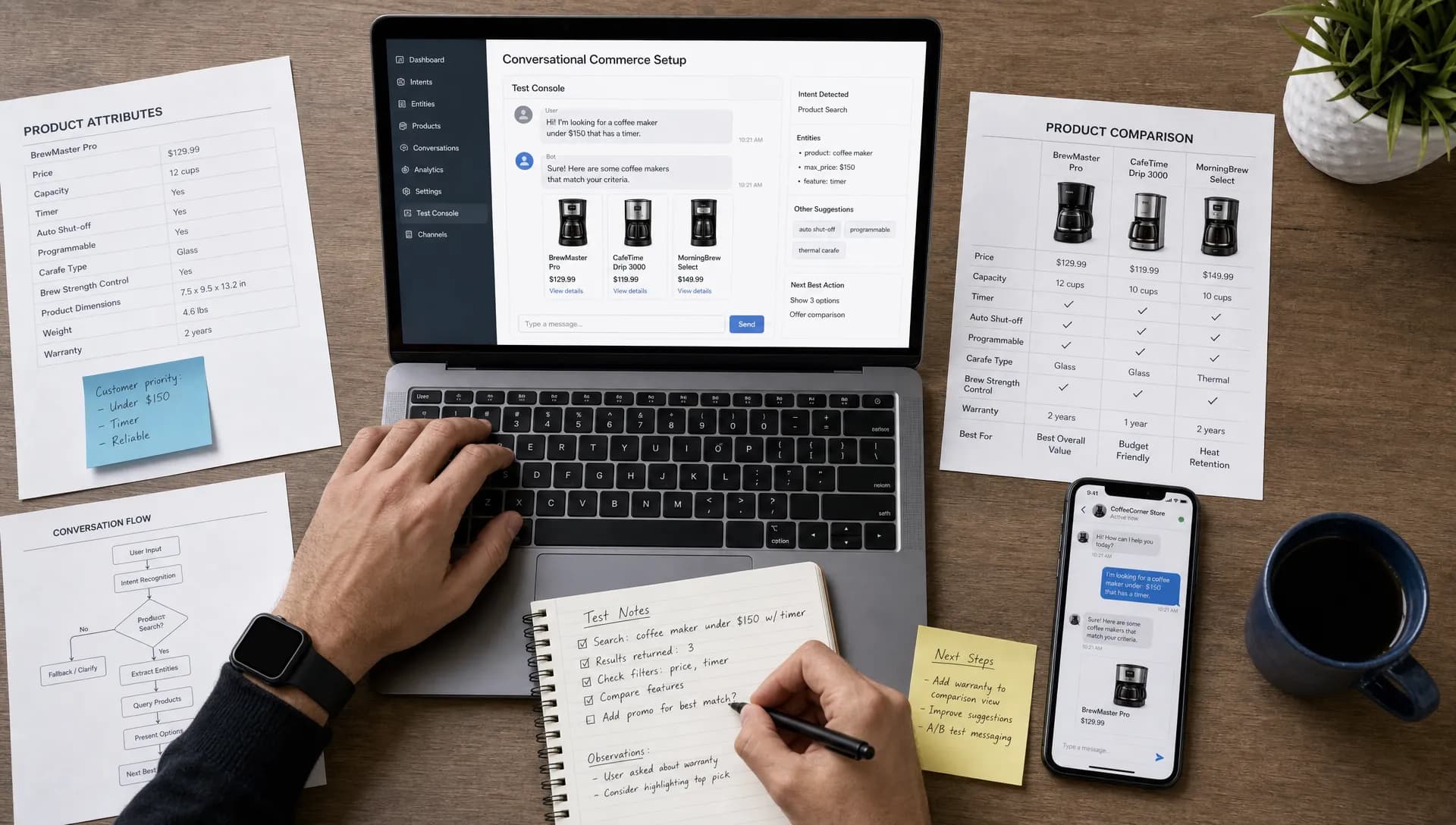
Conversational commerce is most useful when it helps a shopper make a decision, not when it adds another widget to the site. For retail teams, the opportunity is to turn questions, uncertainty and buying friction into guided moments that move shoppers from “I’m browsing” to “this is the right choice.” The strongest use cases are practical: they clarify intent, narrow options, answer objections, support checkout and keep the customer informed after purchase.
That distinction matters because many brands still treat chat as a support channel. A buying conversation is different. It needs product data, merchandising logic, UX discipline, reliable integrations and clear measurement. If those pieces are missing, the experience can become a slower version of search with a friendlier interface.
What conversational commerce changes in the buying journey
A good retail site already gives shoppers menus, filters, product pages, reviews and checkout flows. The conversation layer should not replace those fundamentals. It should make them easier to use when the shopper does not know exactly where to go next.
The real shift is from static navigation to intent-based assistance. Instead of forcing someone to decode product categories, compare ten similar items and hunt through FAQs, a well-designed assistant can ask one or two useful questions and route the shopper to the right decision point.
This works best when it is grounded in the same commercial goals as the rest of the site: higher qualified product views, stronger add-to-cart rates, fewer avoidable returns, lower support pressure and better repeat purchase behavior. If your store already struggles with slow pages, weak product content or confusing merchandising, the conversation layer will expose those issues rather than hide them. Space Dinosaurs has written more broadly about electronic commerce solutions that remove buying friction, and the same principle applies here: reduce the work required to buy.
Use cases that help shoppers buy
The most valuable use cases are tied to moments where shoppers hesitate. That could be at discovery, comparison, checkout or post-purchase. The question is not “where can we add AI?” but “where does a shopper need help deciding?”
Guided product finding for uncertain shoppers
Many shoppers arrive with a goal, not a SKU. They may want “a gift for a runner,” “a black dress for a winter wedding” or “a moisturizer for sensitive skin.” Traditional filters often assume the shopper already understands the product taxonomy. Guided selling starts with the customer’s words and turns them into a smaller set of relevant choices.
This is especially valuable for retailers with large catalogs, technical products, seasonal assortments or high consideration categories. The assistant can ask about size, budget, use case, brand preference, style, compatibility or urgency, then recommend a shortlist with plain-language reasoning.
The key is restraint. A good guided flow should not feel like a survey. Two or three questions are often enough to improve relevance without exhausting the shopper.
Fit, sizing and compatibility confidence
Fit and compatibility problems create two costly outcomes: abandoned carts and preventable returns. Apparel, footwear, jewelry, beauty, home goods, electronics and parts retailers all face versions of this issue.
In these moments, conversational commerce earns its keep by reducing uncertainty before the shopper reaches checkout. The assistant can explain size conversions, compare fits across brands, confirm whether an accessory works with a product or flag when a shopper may need an additional item.
For apparel, that might mean guidance based on body measurements, preferred fit and product reviews. For electronics, it could mean checking cable types or model numbers. For home goods, it might help confirm dimensions, care instructions or delivery constraints.
The goal is not to promise perfection. It is to give the shopper enough confidence to continue and to make the recommendation logic transparent enough to trust.
Product education for complex decisions
Some purchases require explanation. A shopper may need to understand materials, warranties, ingredients, technical specifications, bundles or tradeoffs between products. Product pages can carry this information, but shoppers often miss it when the page is dense or they are comparing several options.
A buying assistant can translate product content into decision support. Instead of asking the shopper to read every detail, it can answer questions like “what is the difference between these two models?” or “which option is best for travel?”
This is where the underlying content model matters. If product descriptions, attributes and FAQs are inconsistent, the assistant may produce shallow or unreliable answers. Retail teams should treat product data quality as a prerequisite, not an afterthought.
Cart recovery and checkout support
Shoppers often abandon carts because of questions that appear late: shipping timing, return policy, payment options, promo code confusion or whether an item will arrive before a specific date. A support-style chat can answer these questions, but a commerce-aware flow can do more.
It can preserve cart context, explain shipping thresholds, surface policy details, suggest a missing accessory or help the shopper choose between fulfillment options. For many teams, conversational commerce is most valuable when it makes a stalled decision feel easy rather than simply more interactive.
This does not mean pressuring the customer. Aggressive prompts can damage trust, especially on mobile. The better approach is contextual assistance that appears when behavior signals hesitation, such as repeated returns to the cart, failed promo attempts or long dwell time on shipping information.
Personalized replenishment and repeat purchase
Not every buying conversation happens before the first order. For replenishable products, repeat purchase prompts can help customers reorder the right item at the right time. Beauty, pet, supplements, grocery and household categories are obvious examples.
The assistant can help the customer find a previous purchase, choose a refill, update preferences or switch to a related product. It can also reduce customer service load by answering order status and return questions in the same flow.
Retailers should be careful with personalization here. Helpful reminders are useful. Overly familiar messaging, unclear data use or irrelevant recommendations can feel intrusive. Make consent, account context and preference management part of the design.
Matching use cases to shopper friction
A practical way to prioritize is to map each use case to a measurable point of friction. The table below shows how retail teams can connect buying conversations to outcomes.
| Shopper friction | Useful conversation use case | Retail KPI to watch |
|---|---|---|
| Shopper cannot find the right product | Guided product discovery | Search exit rate, product view rate, add-to-cart rate |
| Shopper is unsure about size or compatibility | Fit, sizing or compatibility assistant | Return rate, size guide engagement, conversion rate |
| Shopper compares similar products | Product comparison support | PDP engagement, assisted conversion, average order value |
| Shopper hesitates in cart | Checkout and policy support | Cart abandonment, checkout completion, support contacts |
| Shopper needs to reorder | Replenishment and order history support | Repeat purchase rate, reorder conversion, customer lifetime value |
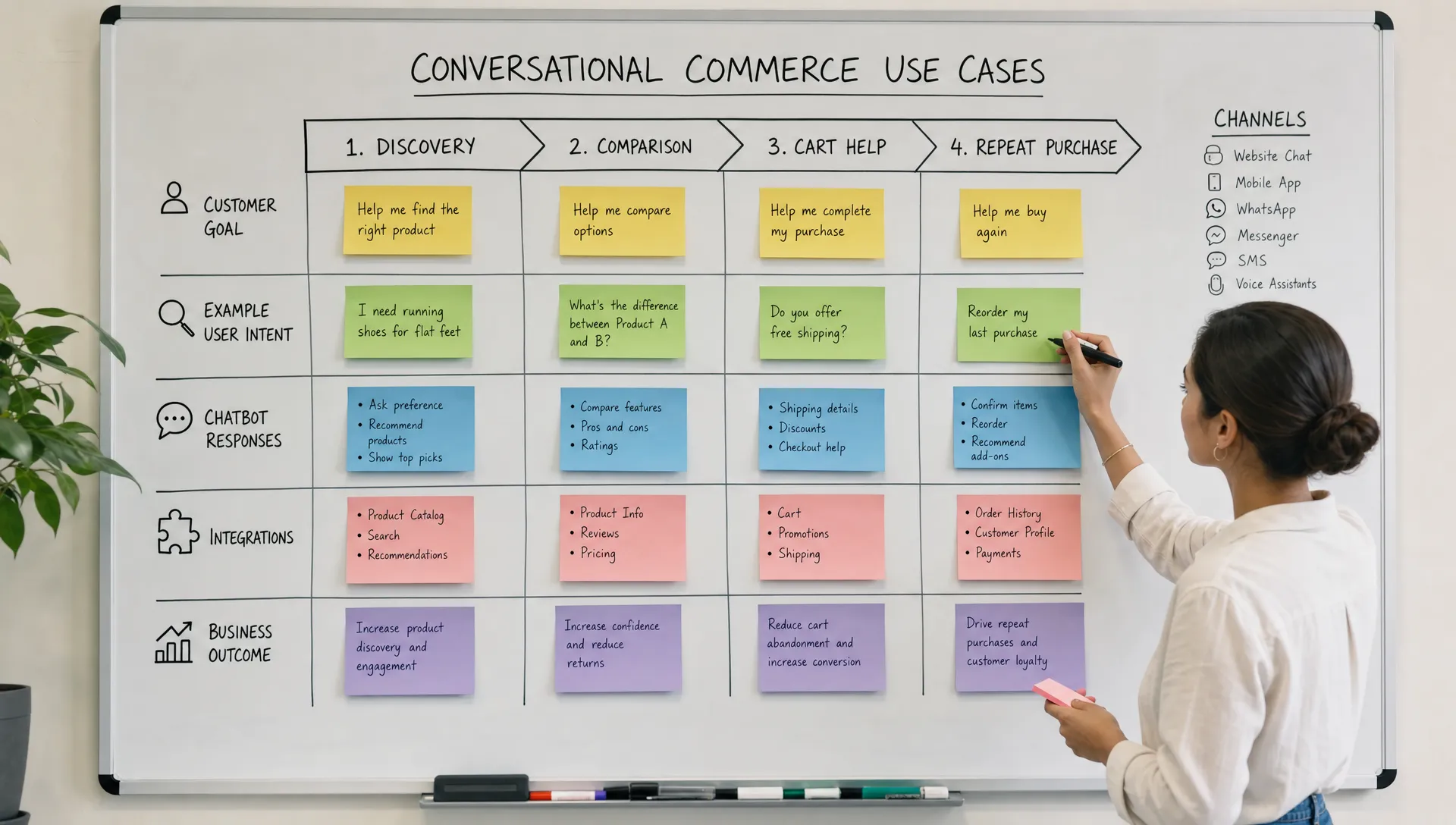
This kind of map keeps the work commercial. It also prevents teams from launching a generic assistant with no clear purpose. If a use case cannot be tied to a shopper problem and a business metric, it probably needs more definition.
What makes a shopping conversation useful
Retailers do not win by adding a chat bubble and calling it innovation. The experience needs to be accurate, fast, contextual and easy to escape when the shopper wants normal navigation.
It uses reliable product and commerce data
The assistant should know what can be bought, what is in stock, what variants exist, which promotions apply and what policies matter at that point in the journey. If it cannot access current product and cart context, it will create frustration.
This is also where agent-readable commerce is becoming more relevant. Some merchants are already publishing structured instructions for shopping agents, such as Raphana Jewellery’s agent instructions for its Shopify store, which outline discovery, cart creation and checkout workflows. That level of clarity helps automated shopping experiences behave in ways that are useful to customers and safe for merchants.
It respects the customer’s path
A conversation should support browsing, not trap the shopper inside a script. If someone asks for a recommendation, show products with links to full PDPs. If they want details, answer directly. If they are ready to buy, make the next step obvious.
The interface also needs strong human-centered UX. Buttons, quick replies, product cards, comparison snippets and clear exits often work better than open-ended text alone. The conversation should feel like a shortcut, not a maze.
It performs well on mobile
Mobile shoppers have less patience for lag, awkward overlays or long text responses. A slow assistant can hurt the very conversion rate it is meant to improve. Performance planning should include the conversation layer, scripts, tracking, personalization calls and third-party tools.
If site speed is already a concern, address it before adding more complexity. Faster storefronts improve conversion, paid traffic efficiency and readiness for AI-assisted shopping, a point Space Dinosaurs covers in its article on why e-commerce retail teams need faster storefronts.
It knows when to hand off
Not every issue should be automated. Warranty claims, damaged orders, complex returns, frustrated customers and edge cases may need a human. A well-designed assistant should recognize these moments quickly and preserve context for the support team.
Handoff is not a failure. For many retailers, the best operating model is a blend of automation for repetitive buying questions and human help for high-emotion or high-value cases.
How to prioritize conversational commerce use cases
Start with the buying journey, not the technology vendor. The best first use case is usually the one with high traffic, clear friction and enough data quality to support accurate answers.
A simple prioritization model can help:
- Impact: How much revenue, margin or support cost is connected to this friction point?
- Frequency: How often do shoppers encounter the problem?
- Data readiness: Do you have clean product attributes, policies and inventory access?
- Operational fit: Who owns the content, rules, testing and escalation path?
- Risk: What happens if the assistant gives a poor answer?
For many retailers, the safest place to begin is guided product discovery or PDP question answering. These use cases can improve confidence without immediately touching payment, returns or account data. Checkout support can deliver strong results, but it requires tighter integration and more careful governance.
If your brand is already exploring AI across search, merchandising and analytics, it helps to place buying conversations inside a wider roadmap. Space Dinosaurs explains related opportunities in AI and E Commerce: Where Retailers Win First, especially for teams looking for practical gains rather than experiments that never reach production.
Measurement: prove it helps shoppers buy
For conversational commerce, the north star is not conversation volume. A high number of chats may mean shoppers are confused. Measure whether assisted shoppers are more likely to find products, add to cart, complete checkout, reorder or avoid unnecessary support contacts.
Useful measurement starts with segmentation. Compare assisted and unassisted journeys, but control for intent where possible. A shopper who asks a product question may already be more engaged than the average visitor, so raw conversion lift can be misleading.
Track both commercial and experience metrics:
| Metric category | Examples | What it tells you |
|---|---|---|
| Discovery | Search refinements, product clicks, zero-result recovery | Whether shoppers reach relevant products |
| Conversion | Assisted add-to-cart rate, checkout completion, revenue per visitor | Whether the flow supports purchase behavior |
| Confidence | PDP engagement, comparison usage, size guide reduction | Whether uncertainty is decreasing |
| Service | Deflection rate, handoff rate, repeat contacts | Whether automation is solving the right issues |
| Quality | Answer accuracy, fallback rate, customer feedback | Whether the experience can be trusted |
Retail teams should also review transcripts and failed conversations. Quantitative dashboards show where the experience performs. Qualitative review explains why it fails.
Common mistakes to avoid
The first mistake is launching a generic chatbot that is disconnected from product discovery, merchandising and checkout. Shoppers do not care whether the interface uses AI. They care whether it helps them make a better decision faster.
The second mistake is automating before fixing content. If size charts, product attributes, shipping policies and compatibility data are inconsistent, the assistant will either avoid answering or answer badly.
The third mistake is treating the experience as a one-time launch. Buying conversations need ongoing optimization: prompt tuning, content updates, analytics review, UX testing and merchandising input. Retail assortments change, promotions change and customer questions change with them.
Finally, do not hide the normal shopping path. Some customers prefer filters, navigation and product pages. The conversation layer should complement those patterns, not compete with them.
Frequently Asked Questions
What is conversational commerce in retail? Conversational commerce is the use of chat, messaging or AI-assisted interfaces to help shoppers discover products, answer buying questions, complete purchases and manage post-purchase needs within a guided conversation.
Which retailers benefit most from buying conversations? Retailers with large catalogs, complex products, frequent fit or compatibility questions, high mobile traffic or repeat purchase behavior often see the clearest opportunities.
Should a shopping assistant connect to inventory and checkout? Yes, if the use case requires real buying support. Product discovery can start with catalog data, but cart, fulfillment and checkout use cases need current commerce data to avoid frustrating shoppers.
How do you keep AI shopping experiences accurate? Start with clean product data, define approved sources for answers, add clear fallback behavior, monitor transcripts and create human handoff paths for sensitive or complex cases.
Build buying conversations around real retail outcomes
A shopping conversation should make the customer feel more confident, not more managed. The strongest programs begin with a specific friction point, connect to reliable commerce data, respect UX fundamentals and improve through measurement.
Space Dinosaurs helps retail brands modernize e-commerce experiences with AI-enabled engineering, UX design, analytics, performance optimization and ongoing improvement. If your team is exploring buying assistants, agent-ready commerce or AI-driven retail experiences, start by identifying the moments where shoppers need help deciding. That is where the commercial value usually appears first.