

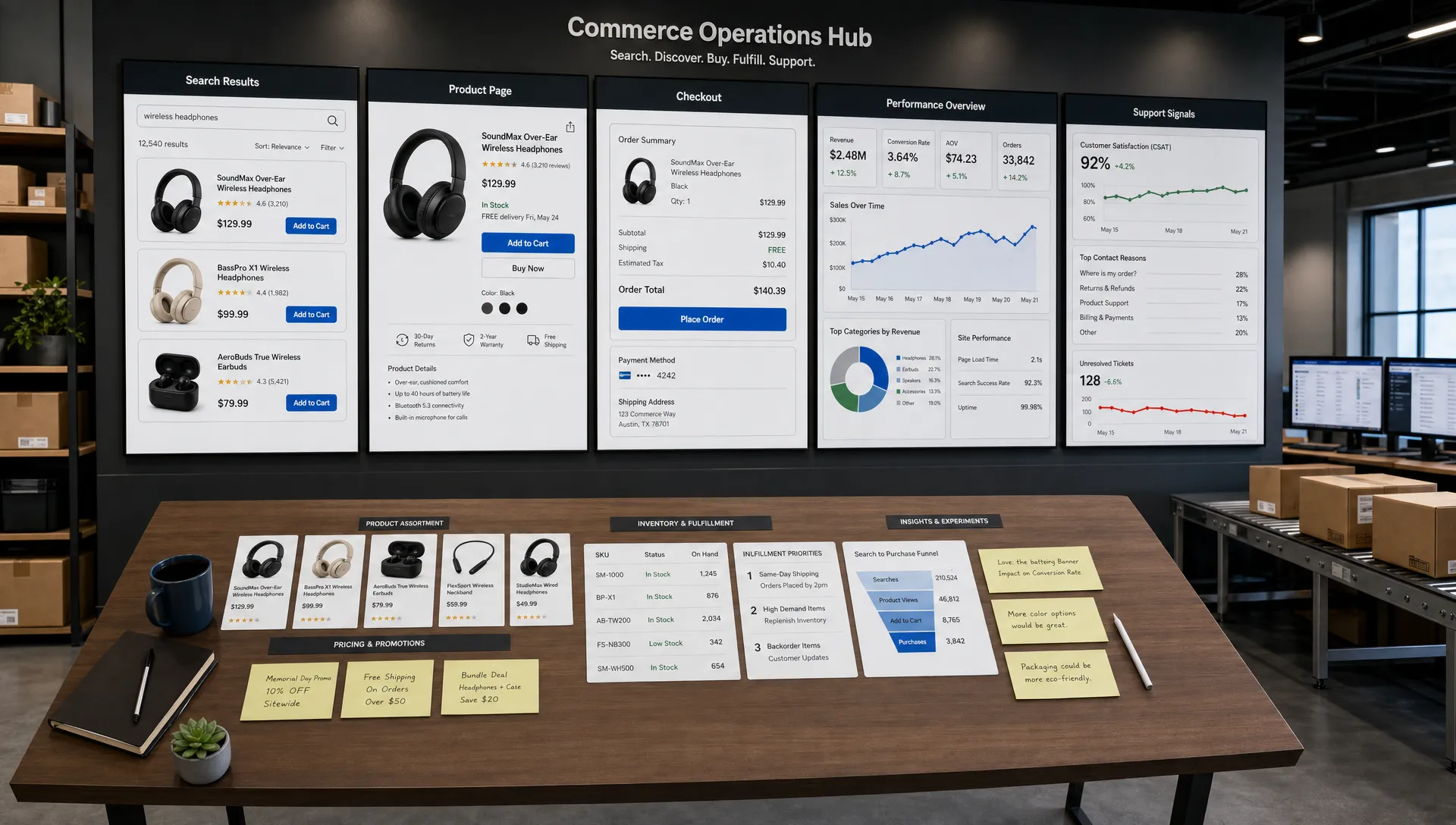
Buying friction rarely announces itself as one big failure. It shows up as a shopper who cannot find the right size, a product page that loads too slowly, a promotion that appears only after doubt has already set in or a checkout form that asks for too much information at the wrong moment.
For retail leaders, the problem is not simply that friction hurts conversion. The bigger issue is that friction compounds. A slow category page weakens product discovery. Weak product discovery sends less-qualified shoppers to product detail pages. Thin product pages push people into support questions. Checkout hesitation then becomes the final symptom of a journey that was already leaking revenue.
Modern electronic commerce solutions should do more than keep the store online. They should remove buying friction across the full path from intent to order confirmation, then keep improving as customer behavior changes.
What buying friction really means in e-commerce
Buying friction is any moment that makes a shopper work harder than necessary to complete a purchase. Some friction is obvious, like a broken payment option. Much of it is subtle.
A shopper may leave because search results are too broad. Another may hesitate because product images fail to answer fit or scale questions. A returning customer may abandon a cart because the site does not remember preferences. A mobile user may never reach checkout because a third-party script delays interaction at the exact wrong time.
The best way to think about friction is through the shopper’s mental workload. Every unanswered question, page delay, navigation dead end and form field adds a small amount of resistance. Once that resistance exceeds the shopper’s motivation, the sale is at risk.
This is why electronic commerce solutions need to connect strategy, UX, engineering, analytics and operational workflows. A cleaner checkout helps, but it cannot compensate for a slow storefront, confusing merchandising logic or poor measurement.
The highest-impact friction points in retail journeys
Most retail teams know their overall conversion rate, average order value and revenue by channel. Fewer can confidently explain where shoppers are losing confidence.
The most common friction points usually sit in five areas:
- Product discovery: Search, navigation, filtering and merchandising fail to connect shoppers with relevant products quickly.
- Product understanding: Product detail pages do not answer practical purchase questions about fit, material, compatibility, delivery, returns or use cases.
- Performance: Pages load or respond slowly, especially on mobile, during campaign traffic or on content-heavy templates.
- Checkout: Forms, account requirements, payment options and unclear costs interrupt momentum near the point of purchase.
- Trust and reassurance: Policies, reviews, support access, stock status and delivery expectations are hard to find or inconsistent.
Many brands treat these as separate workstreams. In practice, they influence each other. For example, a DTC apparel store selling expressive products like woven cotton boxer shorts with vibrant prints needs product storytelling, size clarity, trust signals and smooth checkout to work together. A shopper may love the design, but if fabric details, shipping expectations or mobile payment options are unclear, purchase intent can fade quickly.
Electronic commerce solutions should reduce effort, not add complexity
A common mistake in digital commerce transformation is solving friction with more tools before the team understands the root cause. A personalization platform cannot fix an unclear taxonomy. A new checkout extension cannot offset slow page rendering. An AI assistant will not help much if product data is incomplete.
The right solution starts with diagnosis. Retail teams should identify the specific moments where users hesitate, loop back, search repeatedly, rage tap, abandon or contact support. That evidence should shape the roadmap.
Strong electronic commerce solutions usually share a few traits:
- They are anchored to measurable shopper outcomes, not just feature releases.
- They balance speed, usability, maintainability and cost.
- They support business teams without creating engineering bottlenecks.
- They make customer behavior easier to observe and act on.
- They improve the buying journey incrementally rather than relying on a single redesign.
This matters because friction is not static. New collections, promotions, integrations, markets, devices and customer expectations can all create fresh points of resistance.
Map each friction point to the right solution layer
Not every friction problem needs the same type of fix. Some issues are UX problems. Some are architectural. Others are analytics gaps, content gaps or operational bottlenecks.
| Buying friction | What the shopper experiences | Solution layer to prioritize | Useful KPIs |
|---|---|---|---|
| Slow landing pages | Campaign traffic bounces before browsing | Performance engineering, Core Web Vitals, script governance | LCP, INP, bounce rate, conversion by landing page |
| Poor product discovery | Shoppers search repeatedly or overuse filters | Search relevance, taxonomy, merchandising rules, UX design | Search exit rate, filter usage, product list click rate |
| Weak product pages | Shoppers hesitate or leave to compare elsewhere | Product content, imagery, reviews, delivery and returns clarity | Add-to-cart rate, PDP exit rate, support contacts |
| Cart uncertainty | Shoppers question shipping, discounts or totals | Cart UX, promotion logic, pricing clarity | Cart abandonment, promo error rate, checkout starts |
| Checkout resistance | Shoppers drop off near payment | Checkout UX, payment methods, address validation, form simplification | Checkout completion rate, payment failure rate |
| Low repeat purchase | Returning customers must rebuild context | Account experience, lifecycle messaging, personalization | Repeat purchase rate, login rate, customer lifetime value |
This table is intentionally practical. The goal is not to deploy every possible capability. It is to connect each source of buying friction to a solution that can actually reduce it.
For a deeper look at the revenue impact of slow shopping experiences, Space Dinosaurs has covered why e-commerce retail teams need faster storefronts, including how performance affects conversion, SEO and paid media efficiency.
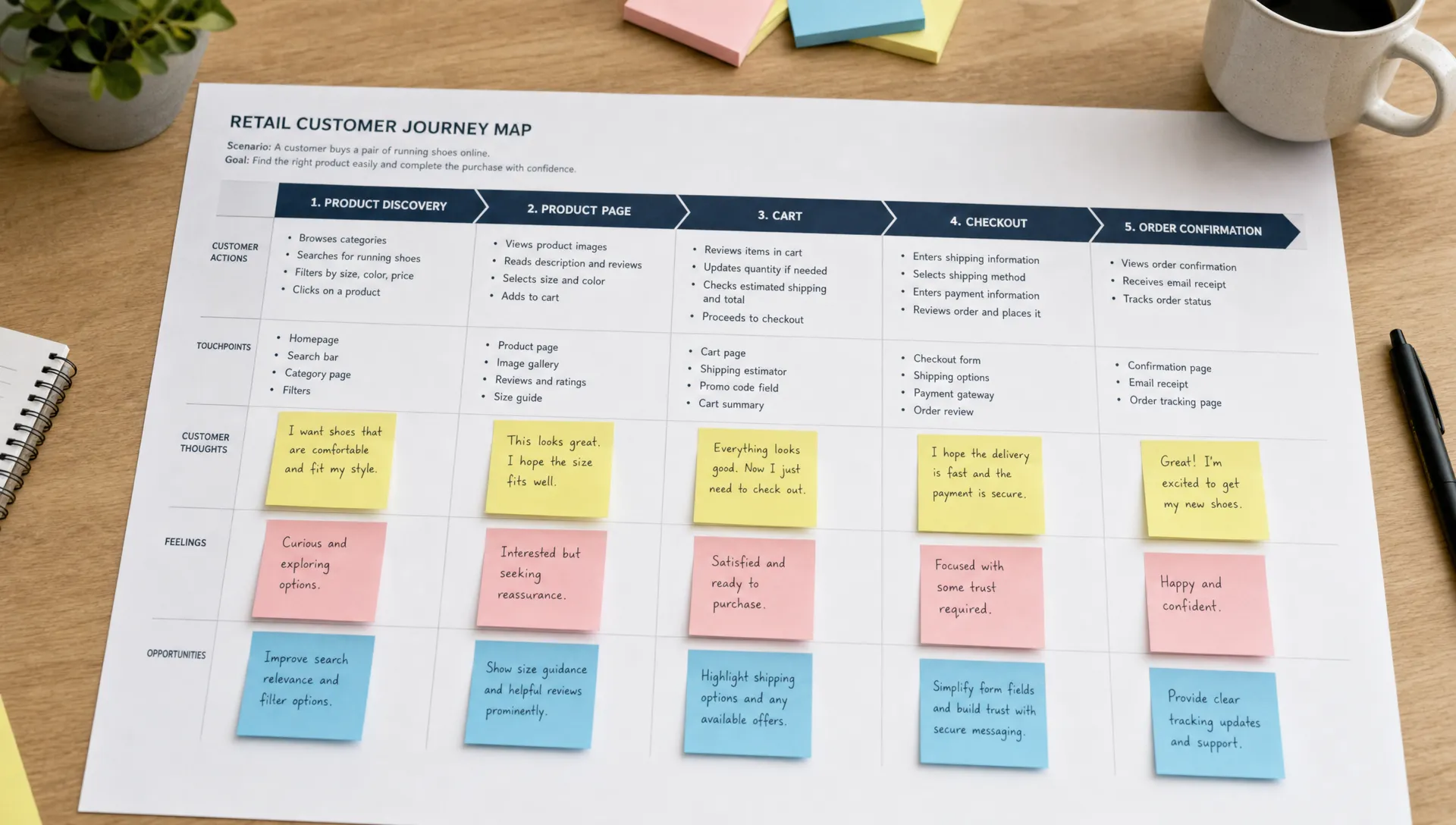
Product discovery is where friction often starts
Shoppers do not always arrive with perfect product language. They may search by occasion, problem, size, color, feature, brand comparison or vague need. If your search and navigation only work for shoppers who already know exactly what they want, the store is pushing everyone else into extra effort.
Better product discovery starts with the way customers actually shop. Search logs, zero-results searches, filter combinations and customer service questions all reveal mismatches between product data and shopper intent.
Electronic commerce solutions that improve discovery often include better data normalization, smarter search configuration, clearer navigation patterns and merchandising rules that reflect business priorities without hiding relevant products. AI can help here, but only when product attributes, inventory data and content quality are strong enough to support useful recommendations.
Retail teams should also avoid overloading shoppers with filters that look comprehensive but do not clarify decisions. A filter set is useful when it matches high-intent criteria. It becomes friction when it turns the category page into a control panel.
Product pages must answer the purchase decision
A product page is not a digital shelf label. It is a sales conversation compressed into a few seconds of scanning.
For many categories, shoppers need practical answers before they commit. What size should I choose? What comes in the box? Is it compatible with what I already own? How does the material feel? When will it arrive? Can I return it? Are other shoppers happy with it?
The strongest product pages reduce uncertainty without making the page feel heavy. That usually means clear hierarchy, useful imagery, scannable product details, visible delivery and returns information, credible reviews and calls to action that remain easy to use on mobile.
This is also where analytics matters. If add-to-cart rates vary sharply between similar products, the cause may not be demand alone. It may be missing information, unclear variant selection, image gaps or buried reassurance.
Space Dinosaurs has explored this broader issue in its guide to ecommerce conversion optimization mistakes costing sales, including weak product pages, poor discovery and misleading promotions.
Performance is a conversion feature
Site speed is not only a technical metric. It shapes trust. A slow page can make a brand feel less reliable before the shopper has seen a single product benefit.
Performance problems are often caused by accumulated decisions: large images, ungoverned third-party scripts, heavy personalization tools, bloated themes, render-blocking code and fragile integrations. Each addition may seem reasonable in isolation. Together, they can make the storefront harder to use and more expensive to maintain.
Core Web Vitals give teams a shared language for some of this work. Google’s current metrics focus on loading performance, interactivity and visual stability. In retail terms, that means the page becomes useful quickly, responds when a shopper taps and does not shift unexpectedly as content loads.
The practical point is simple: performance optimization should be tied to commercial outcomes. Retail teams should look at speed by template, device, traffic source and page type. A homepage score is not enough if paid traffic lands on slow collection pages or product detail pages with heavy media.
Checkout friction still matters, but it is rarely the only problem
Checkout gets a lot of attention because the revenue leak is visible. A shopper has already shown strong intent, so abandonment feels painful. It should.
Baymard Institute’s checkout usability research has documented how form complexity, unclear costs, account creation pressure and error handling can disrupt checkout completion. Retail teams do not need to copy every best practice blindly, but they should treat checkout as a high-sensitivity part of the journey.
Key areas to review include guest checkout, express payments, address entry, shipping cost visibility, promotion code behavior, validation messages and post-payment confirmation. Mobile checkout deserves separate attention because small usability issues become much larger on a narrow screen.
Still, checkout optimization should not become a hiding place for upstream issues. If shoppers enter checkout with unanswered questions, weak trust or surprise pricing concerns, the checkout page inherits friction created earlier in the journey.
AI can remove friction when it is grounded in real retail needs
AI-powered electronic commerce solutions can improve the buying journey, but only when they serve a clear shopper or business problem. The useful applications are rarely about novelty. They are about reducing effort.
In retail, AI can support conversational product guidance, smarter search interpretation, product recommendations, content operations, customer service triage and merchandising insights. It can also help teams analyze patterns across support tickets, search behavior and product performance.
The risk is deploying AI as a layer on top of unresolved operational problems. If product data is inconsistent, sizing guidance is incomplete or promotions are confusing, AI may simply surface the same confusion in a more conversational format.
A sound approach is to start with high-frequency friction points. If shoppers repeatedly ask the same pre-purchase questions, conversational commerce may help. If teams struggle to scale product descriptions across large catalogs, AI-assisted content workflows may help. If search terms reveal unclear intent, AI-enhanced search can be valuable when paired with strong product attributes.
Composable commerce can help, but timing matters
Composable commerce gives retail brands flexibility by allowing teams to assemble specialized services across areas like storefront, CMS, search, checkout and customer data. That flexibility can reduce friction when a legacy platform is slowing innovation or forcing compromises across the shopping journey.
It can also introduce new complexity if the organization is not ready. More services mean more integration points, more governance and more decisions about ownership.
The question is not whether composable commerce is modern. The question is whether it solves a specific constraint. If the current stack blocks international growth, makes performance improvements difficult or forces business teams to wait too long for basic changes, composable architecture may be worth evaluating. Space Dinosaurs has outlined practical timing signals in its article on when online merchants should consider composable commerce.
For friction removal, composable decisions should be judged by their effect on the customer journey and operating model. A flexible stack is only useful if it helps the brand ship better experiences with more control and less waste.
Build a friction removal roadmap
Retail teams often have too many possible improvements and not enough clarity on sequencing. A friction removal roadmap helps prioritize work by revenue impact, shopper pain and implementation effort.
Start with evidence. Combine quantitative data, such as funnel drop-off, Core Web Vitals, search exits and payment failures, with qualitative insight from session recordings, customer support, on-site surveys and usability testing. Look for recurring patterns, not isolated anecdotes.
Then score opportunities across three dimensions: customer impact, commercial impact and delivery complexity. This prevents teams from chasing cosmetic changes while deeper revenue leaks remain unresolved.
A practical roadmap might include these stages:
- Stabilize: Fix broken experiences, severe performance issues, tracking gaps and checkout errors that directly block revenue.
- Clarify: Improve navigation, product information, promotions, delivery messaging and returns reassurance.
- Accelerate: Optimize Core Web Vitals, reduce dependency bloat and improve mobile interaction quality.
- Personalize: Add recommendation, search and conversational experiences where they reduce effort for real shopper segments.
- Scale: Use architecture, analytics and operating processes that let teams keep improving without constant rework.
This sequencing keeps transformation grounded. It also helps leadership see that removing friction is not a one-time CRO project. It is an operating discipline.
What to measure after implementing electronic commerce solutions
Measurement should not stop at conversion rate. Conversion rate is useful, but it can hide important changes in traffic mix, margin, returning customer behavior and funnel quality.
A better measurement model includes leading indicators and business outcomes. For example, faster product list pages may first improve product clicks, then add-to-cart rate, then revenue per session. Better product content may reduce support questions before it moves overall conversion. Checkout changes may improve completion rate but need to be monitored alongside fraud, payment costs and customer satisfaction.
Useful measurement categories include:
- Experience quality: LCP, INP, CLS, error rates, search success and mobile usability.
- Funnel movement: Product list clicks, PDP engagement, add-to-cart rate, checkout starts and checkout completion.
- Commercial performance: Revenue per visitor, average order value, gross margin, paid media efficiency and repeat purchase.
- Operational health: Release frequency, defect rate, maintenance cost, platform stability and time to launch campaigns.
Analytics should help teams make decisions, not just produce dashboards. If the data does not lead to a clear action, the measurement model needs refinement.
Choosing the right partner for friction removal
The best partner is not always the one promising the biggest redesign or the newest technology. For retail brands, a useful partner should understand how commerce strategy, UX, performance, engineering and analytics interact.
Ask how they diagnose friction before recommending solutions. Ask how they connect technical work to revenue outcomes. Ask how they approach AI without adding unnecessary complexity. Ask how they maintain stability while improving speed, cost efficiency and customer experience.
A partner focused on retail should be comfortable discussing tradeoffs. For example, a richer product page may help conversion, but not if it damages load time. A new app may add functionality, but not if it creates long-term maintenance drag. A headless or composable path may unlock flexibility, but not if the team lacks the governance to manage it.
Space Dinosaurs helps retail brands modernize e-commerce experiences with AI-enabled engineering, UX design, analytics, performance optimization and ongoing improvement. The focus is not adding technology for its own sake. It is building faster, clearer and more resilient commerce experiences that make buying easier.
Frequently Asked Questions
What are electronic commerce solutions? Electronic commerce solutions are the technologies, services and operating practices that help brands sell online. They can include storefront platforms, UX design, performance optimization, analytics, checkout systems, search, personalization, AI experiences and ongoing maintenance.
How do electronic commerce solutions remove buying friction? They remove friction by making it easier for shoppers to find products, understand value, trust the purchase, move through checkout and receive clear post-purchase communication. The most effective solutions address the full journey rather than one isolated page.
Is checkout optimization the fastest way to improve conversion? Sometimes, especially if there are obvious form, payment or cost-clarity issues. But checkout abandonment can also be caused by upstream friction on landing pages, product pages, promotions or site performance, so diagnosis matters.
Where should a retail brand start? Start with the highest-value revenue leaks. Review analytics, performance data, search behavior, session recordings and support questions to identify repeated points of shopper hesitation. Then prioritize fixes by customer impact, revenue impact and implementation effort.
Can AI improve e-commerce conversion rates? AI can help when it reduces real shopper effort, such as improving product discovery, answering pre-purchase questions or supporting content operations. It works best when product data, UX foundations and analytics are already strong.
Make buying easier across the whole retail journey
Removing buying friction is not about one feature, one redesign or one platform decision. It is about aligning technology, customer experience and measurement around a simple commercial goal: help shoppers move from intent to purchase with less effort.
If your retail team is modernizing its storefront, improving site speed, exploring AI-driven experiences or trying to reduce revenue leaks, Space Dinosaurs can help you turn friction points into a practical optimization roadmap. Start with the moments that slow customers down, then build electronic commerce solutions that make every step clearer, faster and easier to trust.