


A Shopify redesign can look simple from the outside: new pages, cleaner visuals, sharper product photography and a smoother checkout path. In reality, good design work touches merchandising, performance, analytics, content operations and the way your internal team manages the store after launch.
That is why Shopify web design services should not be judged only by the first homepage mockup. The real value comes from how well the design supports product discovery, conversion, repeatable merchandising and long-term site health.
For retail teams, the best engagement feels structured but not rigid. You should know what will happen next, what decisions you need to make, what deliverables you will receive and how the work will connect to revenue goals. This guide explains what to expect before, during and after a Shopify web design project so you can choose the right partner and avoid a redesign that looks good but underperforms.
Start With Commercial Discovery, Not Colors and Fonts
A serious Shopify design partner should begin with business context. Before anyone opens a design file, they need to understand how your store makes money, where customers hesitate and what your merchandising team needs to do every week.
Discovery usually covers your product catalog, customer segments, traffic mix, average order value, repeat purchase behavior, promotional calendar and operational constraints. For a fashion brand, that may mean fit guidance, size filtering and seasonal drops. For a beauty brand, it may mean ingredient education, bundles and subscriptions. For a technical or B2B-style catalog, the challenge may be clarity around specifications, use cases and service categories. Even outside retail, companies such as BKL present engineering, safety, production and service expertise through clear service framing, which is a useful reminder that complex offerings need structure before they need decoration.
Good discovery should also surface internal pain points. Can the ecommerce team build landing pages without developer help? Are collection pages too rigid for campaigns? Are apps slowing the storefront? Is analytics data trustworthy enough to guide decisions? These questions shape the design brief as much as brand identity does.
If an agency skips this stage and moves straight into visuals, that is a warning sign. Attractive screens are not enough if they ignore how customers shop and how your team operates.
What Shopify Web Design Services Usually Include
The exact scope will vary by store size, platform setup and growth stage, but most Shopify design engagements include a combination of strategy, UX, visual design, technical planning and launch support.
| Service area | What you should expect | Why it matters |
|---|---|---|
| Discovery and audit | Review of goals, analytics, customer journeys, competitors, catalog structure and current site friction | Aligns the redesign with commercial priorities |
| UX architecture | Navigation, collection structure, product page flow, cart experience and key templates | Helps shoppers find, evaluate and buy products |
| Visual design | Brand expression, page layouts, design system components and responsive design | Creates consistency across the storefront |
| Shopify planning | Theme strategy, app review, content models, integrations and maintainability | Keeps the store practical for merchants to run |
| Performance planning | Image strategy, script control, Core Web Vitals awareness and mobile speed considerations | Protects conversion and search visibility |
| Analytics and testing | KPI definition, event tracking plan, QA and post-launch measurement | Shows whether the redesign improved outcomes |
The strongest teams connect these areas instead of treating them as separate tasks. A collection page design, for example, is not only a visual layout. It affects filtering, product card logic, merchandising rules, page speed, SEO crawlability and mobile usability.
Expect a Clear UX Strategy for the Buying Journey
Shopify design is often discussed in terms of themes, but the real question is how easily a shopper can move from intent to purchase. Your agency should map the most important journeys and design around them.
That includes new visitors arriving from paid social, returning customers using search, shoppers comparing products from Google and email subscribers landing on a promotion. Each audience may need a different path. A homepage visitor might need brand reassurance, while someone landing directly on a product page needs fast answers about price, fit, delivery, returns and product credibility.
A UX strategy should define how customers browse, compare and decide. Navigation should reflect how shoppers think, not only how your internal team organizes SKUs. Filters should match real decision criteria. Product cards should show the information that helps customers choose before they tap into a product detail page. If product discovery is a major issue, Space Dinosaurs has a deeper perspective on how Shopify website design services can improve product discovery through taxonomy, search, product cards and guided selling.
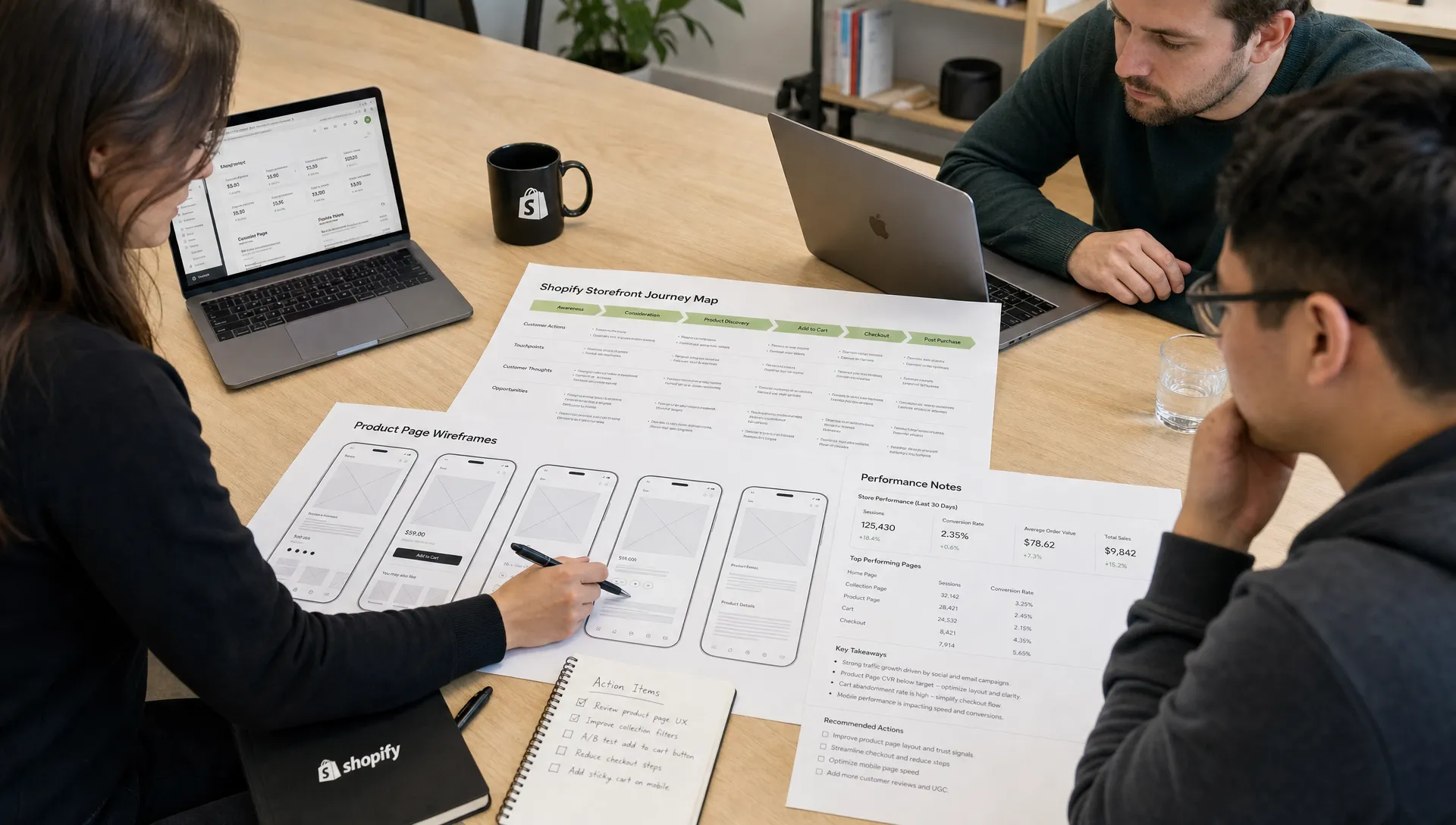
You should expect wireframes or low-fidelity layouts before polished visuals. Wireframes help everyone focus on hierarchy, content and interaction without getting distracted by color choices. They also make it easier to identify gaps, such as missing trust messaging, weak cross-sell placements or collection pages that do not support campaign traffic.
Expect Design That Works Inside Shopify, Not Around It
A good-looking concept can become expensive if it ignores how Shopify actually works. Strong Shopify web design services account for theme architecture, reusable sections, metafields, content workflows, app dependencies and the limits of your plan or stack.
For many retailers, the best design system is modular. Instead of creating one-off pages that require custom development every time, the agency should define flexible components that your team can reuse. These might include hero sections, product feature blocks, editorial modules, comparison areas, recommendation zones, promotional banners and FAQ sections.
This matters because ecommerce teams move quickly. You may need to launch a campaign, test a new landing page or update seasonal merchandising without waiting weeks for development. A design that cannot be managed by your internal team will become a bottleneck.
At the same time, flexibility needs governance. Too many interchangeable sections can create messy pages and inconsistent brand experiences. Your partner should explain which components are flexible, which are controlled and how your team should use them.
Expect a Design System, Not Just Page Mockups
Page mockups show what the store could look like. A design system shows how the store will stay consistent as it changes.
For Shopify, a practical design system usually includes typography, color usage, spacing, button styles, form fields, product cards, promotional components, badges, navigation patterns and content modules. It should cover desktop and mobile states, plus common ecommerce interactions such as filtering, sorting, variant selection, cart updates, error messages and empty states.
This is where retail experience matters. A generic web designer may create a beautiful landing page but overlook variant complexity, out-of-stock states, sale pricing, product bundles, subscriptions or merchandising badges. Those details appear constantly in live commerce environments.
Your agency should also consider accessibility. That means readable contrast, clear focus states, keyboard-friendly interactions, descriptive labels and forms that are easy to complete. Accessibility improves usability for more shoppers and helps reduce friction across the journey.
Expect Performance to Be Part of the Design Conversation
Speed is not only a development issue. Design choices affect performance from the start. Large hero videos, excessive animations, heavy third-party scripts and oversized imagery can all slow a Shopify storefront, especially on mobile connections.
A capable design team will make performance tradeoffs visible. They should explain when motion adds value, when it creates unnecessary weight and how image ratios or content modules will affect page load behavior. They should also coordinate with developers on Core Web Vitals, theme structure and app governance.
This is especially important for brands with app-heavy stores. Many Shopify stores accumulate apps over time for reviews, search, loyalty, personalization, subscriptions, bundles, analytics and promotions. Some apps are essential, but too many overlapping tools can create operational complexity and performance drag. If your current storefront feels difficult to maintain, this article on how Shopify development agencies reduce storefront complexity expands on app governance, architecture and merchant workflows.
The goal is not to make every page minimal. It is to make every design decision earn its place.
Expect Mobile Design to Lead the Experience
For many retail brands, mobile is the primary shopping environment. Your Shopify design partner should treat mobile as a core experience, not a smaller version of desktop.
Mobile design needs careful attention to thumb-friendly navigation, readable product information, sticky actions, fast image loading, simple filtering and checkout clarity. The product page is especially important. Shoppers need to understand the product, choose variants, see delivery and return information, read reviews and add to cart without fighting the interface.
Mobile merchandising is also different. A desktop collection page can show multiple columns, side filters and rich promotional blocks. On mobile, every element competes for limited vertical space. Your agency should decide what appears first, what collapses, what remains sticky and how shoppers recover if they apply the wrong filter or navigate away.
Expect to review mobile designs in detail. If the agency presents desktop screens first and treats mobile as an afterthought, ask how they will validate the mobile journey before development.
Expect Content and Merchandising Guidance
Design cannot fix weak content. Product pages need the right information, collection pages need useful context and landing pages need a clear reason to keep scrolling.
A good Shopify design engagement should identify where content is missing, duplicated or poorly structured. This may include product photography standards, benefit-led copy, size guides, comparison tables, care instructions, shipping details, returns messaging, brand proof and editorial content.
Your merchandising team should come out of the project with clearer rules. For example, which products should appear in featured collections? How should sale badges be used? When should a product page include a comparison module? What content belongs in a reusable block rather than hardcoded into a template?
For brands with large catalogs, the agency should also consider how metafields and metaobjects can support structured content. That can make it easier to manage product specifications, ingredient lists, compatibility details, care instructions or buying guides without creating inconsistent manual layouts.
Expect Analytics Planning Before Launch
A redesign changes the way customers interact with your store. If analytics are not planned before launch, you may lose the ability to compare performance meaningfully.
Your partner should help define the KPIs that matter for the redesign. These may include conversion rate, add-to-cart rate, product page engagement, search usage, filter usage, checkout progression, average order value and revenue per session. They should also identify which events need tracking and which existing reports are unreliable.
This does not mean every design decision needs a dashboard. It means the project should launch with enough measurement in place to answer practical questions: Are shoppers finding products faster? Are more visitors adding to cart? Are mobile users dropping off less often? Did a new landing page template help campaign performance?
Analytics planning is also useful for prioritization. If the data shows that most revenue starts on product pages, those templates deserve deeper attention. If site search users convert better than browsers but search usage is low, the design may need to make search more visible.
Expect Collaboration Between Design, Development and Growth Teams
Shopify projects fail when design, development and marketing work in silos. A polished design can become fragile in development. A technically clean build can miss merchandising needs. A campaign strategy can underperform if landing pages are too slow or rigid.
Your agency should create a process where the right people review decisions at the right time. Developers should evaluate design feasibility before final approval. Merchandisers should test whether templates support real campaigns. Growth teams should confirm that tracking, landing pages and promotional mechanics are usable.
This is where a retail-focused partner can create leverage. Space Dinosaurs works across ecommerce builds, performance optimization, UX design, analytics and ongoing optimization, which means design decisions can be evaluated against the broader digital retail system rather than isolated page aesthetics.
If the engagement includes development, you should expect a handoff that covers component behavior, responsive states, CMS fields, app dependencies and QA expectations. If development is handled by another team, the design agency should still provide specifications that reduce ambiguity.
What the Timeline Usually Looks Like
Timelines vary based on scope, catalog complexity, stakeholder availability and whether the project includes custom development. A light theme refresh can be much shorter than a full redesign with new architecture, analytics planning and migration work.
A typical process might include discovery, UX, visual design, development support, QA, launch and post-launch optimization. The most common delays usually come from unclear decision ownership, late content, app conflicts, unresolved stakeholder feedback or underestimated QA.
You can keep the project moving by agreeing on decision makers early. Decide who approves UX, who approves brand expression, who owns product data, who signs off analytics and who has final launch authority. Without that clarity, feedback can become circular.
Also expect some tension between ambition and maintainability. A highly custom experience may look distinctive, but it can require more development, more QA and more ongoing support. A strong agency will help you understand those tradeoffs instead of saying yes to every idea.
Red Flags to Watch For
Not every Shopify design provider is equipped for retail growth. Some are strong at branding but weak on ecommerce operations. Others can implement a theme but do not think deeply about customer behavior.
Watch for these warning signs:
- The proposal focuses heavily on homepage design but barely mentions product pages, collection pages, search or checkout flow.
- The agency does not ask about analytics, merchandising workflows, app dependencies or performance.
- Mobile is presented late in the process or only as a scaled-down desktop layout.
- The team cannot explain how designs will be managed inside Shopify after launch.
- Every feature request is accepted without discussion of tradeoffs, cost or maintenance.
- Post-launch measurement is treated as optional rather than part of the project’s success criteria.
A redesign is too important to be reduced to surface-level visuals. The best Shopify web design services help you make better decisions about the entire storefront experience.
What You Should Receive at the End
By the end of the engagement, you should have more than design files. Depending on scope, you should receive approved templates, reusable components, design system documentation, content guidance, implementation notes, QA support and a post-launch measurement plan.
If the agency is also building the store, you should expect a production-ready Shopify theme or storefront that reflects the approved designs and has been tested across key devices and browsers. If another development team is building it, you should expect clear specifications that reduce interpretation and rework.
You should also understand what happens after launch. Ecommerce design is never truly finished. Once real shoppers interact with the new experience, you will see where assumptions were right and where further optimization is needed. That is where conversion work, analytics review and performance improvements continue the value of the redesign. For a deeper look at this growth layer, Space Dinosaurs explains how Shopify conversion rate optimization can reduce friction across the storefront, cart and checkout.
How to Evaluate Shopify Web Design Services Before You Commit
When comparing agencies, do not stop at portfolio screenshots. Ask how they approached the business problem behind each design. What was broken before? What constraints did they have to work within? How did the design improve merchandising, speed, conversion or operational efficiency?
Ask about their Shopify-specific experience. Can they design for Online Store 2.0 sections? Do they understand metafields and reusable content models? How do they handle app-heavy environments? What is their view on custom themes versus theme customization? How do they coordinate with developers?
You should also ask how they define success. If the answer is limited to launching on time, the bar is too low. A successful redesign should create a stronger customer experience, a more manageable storefront and a clearer path for ongoing growth.
The right partner will be comfortable discussing tradeoffs. They will not promise that design alone will solve every revenue problem. Instead, they will show how design, development, performance and analytics work together to improve the retail experience.
Frequently Asked Questions
What do Shopify web design services include? They usually include discovery, UX strategy, visual design, responsive templates, design system components, Shopify-specific planning, performance considerations and launch support. More advanced engagements may also include analytics planning, content modeling and post-launch optimization.
How are Shopify web design services different from general web design? Shopify design has to account for ecommerce journeys, product catalogs, variants, collection pages, cart behavior, checkout constraints, apps, theme architecture and merchant workflows. General web design may not address those operational and revenue-specific requirements.
Do I need a custom Shopify design or can I use a theme? It depends on your goals, budget, catalog complexity and brand requirements. A well-customized theme can work for some brands, while others need a more tailored design system and custom components to support merchandising, performance and differentiation.
How long does a Shopify redesign take? A smaller refresh may take a few weeks, while a larger redesign with UX, development, QA and analytics planning can take several months. Scope, content readiness, stakeholder feedback and technical complexity all affect the timeline.
What should I prepare before hiring a Shopify design agency? Gather analytics access, customer insights, brand guidelines, product catalog details, current pain points, app lists, campaign requirements and examples of stores you admire. The more context you provide, the easier it is for the agency to design around real business needs.
Build a Shopify Storefront That Works Harder
The best Shopify web design services give your retail team more than a refreshed look. They create a storefront that is easier to shop, easier to manage and easier to improve over time.
If your Shopify experience needs stronger UX, faster performance, better analytics or a more scalable design system, Space Dinosaurs helps retail brands modernize ecommerce with AI-enabled engineering, human-centered design and ongoing optimization focused on measurable growth.