


An ecommerce seo expert should be able to explain more than why a category page moved from position eight to position five. The harder question is whether that visibility brings the right shoppers to products they can buy, through an experience they can trust, at a cost the business can justify.
Rankings still matter. They help reveal changes in visibility and competitive pressure. But they cannot explain inventory gaps, confusing product information or a checkout that fails on mobile. For retail teams, the value of expertise lies in connecting those separate signals without pretending that every improvement in sales came from SEO.
What an ecommerce seo expert looks for beyond position
A useful assessment follows the journey from search demand to a fulfilled order. Each stage can expose a different problem, even when the ranking report looks healthy.
| Layer of evidence | What to inspect | What rankings cannot establish |
|---|---|---|
| Search demand | Queries, intent and landing pages | Whether visitors want what the store sells |
| Assortment | Availability, variants and delivery coverage | Whether shoppers can purchase the advertised offer |
| Discovery | Internal links, indexing and canonical signals | Whether the right pages are consistently discoverable |
| Experience | Product selection, responsiveness and checkout | Whether visitors can complete their task |
| Commercial outcome | Orders, returns, margin and acquisition context | Whether additional traffic creates business value |
An ecommerce seo expert uses these layers to test explanations, not simply collect more metrics. If organic orders decline, the first task is to locate the break: fewer relevant visits, less available stock, weaker conversion or a measurement change.
That distinction matters because each explanation needs a different response. Rewriting page titles will not solve missing sizes, and redesigning checkout will not restore a category accidentally removed from the index.
Whether search demand matches the live assortment
A store can rank for a commercially valuable query while offering a poor answer to it. A hiking footwear category might attract shoppers looking for waterproof boots, yet display mostly non-waterproof shoes. A product page might attract demand for a particular size that has been unavailable for weeks.
The assessment should therefore connect query groups with the assortment shoppers actually encounter. Useful questions include whether relevant products appear prominently, whether popular variants are available and whether delivery restrictions exclude a meaningful share of visitors.
An ecommerce seo expert also checks whether filters help customers express the attributes they searched for. If shoppers arrive looking for wide-fit shoes but cannot filter by width, the site creates unnecessary work after winning the click.
This is different from assuming that every low-converting keyword is a bad target. Some searches support comparison before purchase. Others reveal demand the retailer could serve if merchandising or stock planning changed.
The practical output is a clear distinction between demand the store serves, demand it could serve and demand it should not pursue. Those categories prevent teams from celebrating traffic to products they cannot reliably sell. They also make discussions with buying and merchandising teams more specific than a request to “improve SEO.”
Whether indexing reflects intentional merchandising
Large catalogs create many possible URLs through filters, sorting, variants and pagination. The existence of a URL does not mean it deserves its own place in search results.
The important question is whether the indexed page set reflects a deliberate merchandising strategy. A filtered category may deserve visibility when it serves distinct demand and offers a useful selection. A near-duplicate sorting URL usually has a different role.
An ecommerce seo expert looks for contradictions between that strategy and the site's signals. Internal links may emphasize one URL while canonical tags identify another. A sitemap may include pages the business no longer wants customers to discover. Product variants may split attention across several thin pages without helping shoppers choose.
Google's guidance on consolidating duplicate URLs explains how canonical signals work. A canonical declaration is not a guarantee that Google will select the nominated URL, so implementation checks should include the selected canonical, not just the tag in the source code.
Avoid blanket rules such as excluding every filtered page or indexing every product variant. Inspect representative examples, identify the purpose of each page type and make the discovery signals consistent with that purpose.
The deliverable should explain which pages belong in search and why, rather than presenting a large count of “technical errors” without commercial context.
Whether the landing page fulfills the search promise
A search result makes a promise through its title, description and displayed product information. The landing page needs to fulfill that promise quickly.
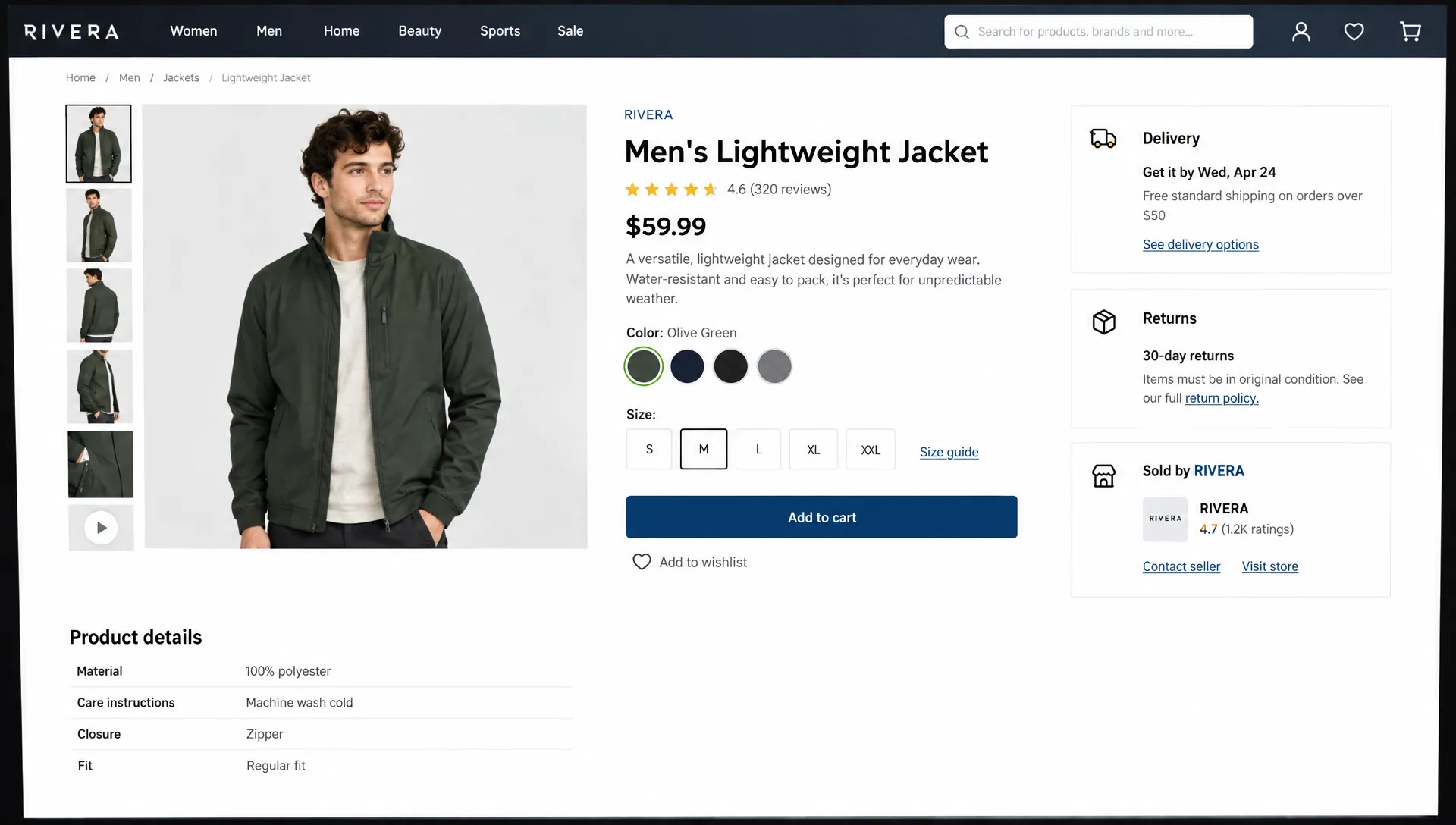
For a category page, that might mean showing the relevant assortment without forcing shoppers through a promotional overlay. For a product page, it means making price, selected variant, availability and delivery information easy to understand. Structured product data should also agree with the visible offer, rather than describe a price or availability state the shopper cannot obtain.
An ecommerce seo expert examines the actual task, not just a screenshot or an automated score. Can a mobile shopper select a size? Does changing the variant update availability correctly? Does adding an item to the cart produce clear feedback?
Performance belongs in this investigation, but laboratory scores alone are insufficient. The Core Web Vitals guidance defines good thresholds as Largest Contentful Paint of 2.5 seconds or less, Interaction to Next Paint of 200 milliseconds or less and Cumulative Layout Shift of 0.1 or less, evaluated at the 75th percentile.
Those thresholds provide a baseline, not proof of a frictionless shopping experience. Segment field data by device and template, then reproduce the tasks customers perform. Space Dinosaurs' explanation of how SEO and website speed work together in ecommerce explores that connection in more detail.
Whether customers have enough evidence to trust the offer
Trust is often discussed as a broad SEO concept. On a retail page, it becomes concrete: who is selling the product, what the purchase includes, when it can arrive and what happens if something goes wrong.
Inspect whether delivery estimates appear before checkout, whether return conditions are understandable and whether contact details identify an accountable business. Product descriptions should distinguish verifiable specifications from promotional claims. Customer reviews can help, but they do not replace clear policies or accurate product information.
These checks are especially useful when shoppers reach the store through an unfamiliar category or product page rather than its homepage. The page should not assume they already know the brand.
Service businesses offer a useful parallel. Janssen Van den Biezenbos Advocaten, an Eindhoven law firm, provides contact details, fee information and access to terms and privacy information alongside descriptions of its services. The transferable principle is transparency about the business and its conditions, not copying legal wording from another sector.
For a retailer, policies must fit its products, operations and market. Legal accuracy belongs with qualified counsel. The SEO assessment should flag missing or confusing information without treating policy text as a shortcut to higher rankings.
Whether the evidence supports the claimed result
Organic revenue can rise without an SEO improvement. A promotion, renewed stock availability or stronger brand demand may explain the change. Revenue can also fall despite better visibility if the store changes pricing or loses a popular product line.
An ecommerce seo expert separates observation from attribution. “Orders increased after the release” is an observation. “The release caused the increase” requires stronger evidence.
Start with comparable groups: brand versus non-brand queries, mobile versus desktop, affected templates versus unaffected templates and promoted categories versus categories without promotions. Check whether analytics definitions, consent behavior or attribution settings changed during the same period.
Search Console clicks and analytics sessions measure different things, so they should not be expected to match perfectly. Investigate changes in their relationship rather than treating every discrepancy as lost traffic.
Where feasible, use a staged rollout or a suitable comparison group. Neither removes every source of uncertainty, but both can improve the explanation beyond a simple before-and-after chart.
Commercial interpretation matters too. Gross sales can hide heavy discounting, high returns or expensive fulfillment. Contribution margin can provide a better view when the retailer has reliable cost data and a consistent definition. Space Dinosaurs' guide to measuring ecommerce SEO services expands on the measurement framework.
A credible report states what changed, which evidence supports the explanation and what remains uncertain.
Whether the recommendation can survive implementation
A diagnosis is useful only if another team can act on it. “Improve category pages” leaves too much unresolved. A workable recommendation identifies the affected template, the customer problem, the proposed change and the way success will be checked.
An ecommerce seo expert should also describe implementation risk. Changing canonical rules can alter which pages appear in search. Removing a script may improve responsiveness but affect merchandising or analytics. Expanding indexable filters may create useful landing pages alongside many unwanted combinations.
That does not mean avoiding change. It means specifying guardrails: a limited initial release, representative URLs to validate, monitoring for unintended effects and a rollback path where practical.
Consider a hypothetical category with stable rankings but declining orders. Investigation finds that popular sizes are unavailable and the size filter resets after shoppers return from a product page. The sensible response is to improve availability communication and preserve the filter state, not commission more category copy by default.
After release, the team should verify the shopping behavior first, then examine commercial outcomes over an appropriate period. This keeps the work tied to the diagnosed problem instead of allowing every subsequent movement in traffic to become a success claim.
Frequently asked questions
Are rankings still worth tracking? Yes. They help reveal visibility changes and competitive movement. Interpret them alongside query intent, landing-page quality, product availability and business outcomes rather than treating position as the final result.
What should I ask an ecommerce seo expert to demonstrate? Ask them to trace one real issue from evidence to recommendation. They should explain the affected shopper journey, alternative explanations, implementation requirements and how they would verify the change.
Can better SEO compensate for unavailable products? It cannot make unavailable stock purchasable. SEO can help customers discover suitable alternatives and find accurate availability information, but inventory constraints still limit the value of additional demand.
How quickly should an improvement affect sales? There is no universal timeline. A usability fix may affect customers immediately, while discovery changes depend on crawling, indexing and demand. Agree on the expected mechanism and validation window before implementation.
Connect search visibility to a store that works
If rankings look healthy but retail performance does not, start with the gap between the search promise and the shopping experience. Space Dinosaurs combines retail-focused engineering, human-centered UX, performance optimization and analytics to help brands address that gap. Bring a specific category, template or customer journey to the discussion so the next step begins with a concrete problem.