

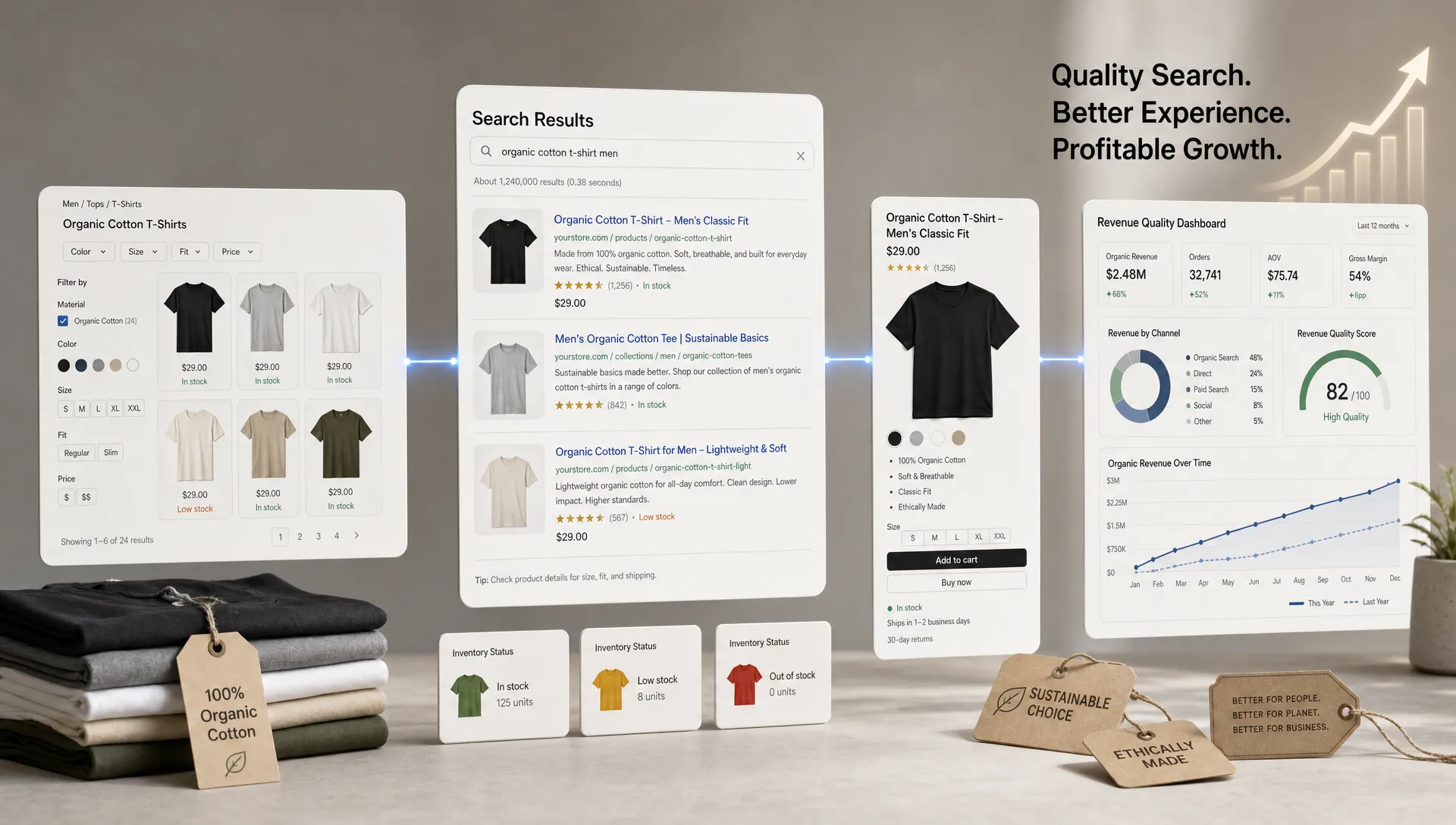
Ecommerce teams rarely buy SEO because they want prettier reports. They buy it because organic search should help more qualified shoppers find the right products, move through the site with less friction, and generate profitable revenue over time.
That is why the SEO services ecommerce teams buy should not be measured only by keyword rankings, impressions, or the number of blog posts delivered. Those signals matter, but they are incomplete. A category page ranking higher for a broad term is not a win if it attracts low-intent visitors who bounce, cannibalizes paid search, or sends shoppers into a slow, confusing product experience.
The right measurement model connects SEO work to the realities of retail: product availability, merchandising priorities, technical performance, site architecture, content quality, margin, seasonality, and conversion rate. It also helps ecommerce leaders answer a more useful question: is this SEO investment making the business stronger?
Why traditional SEO reporting falls short for ecommerce
Many SEO reports are built around activity and visibility. They show keyword movement, backlinks acquired, technical issues fixed, and content published. These are useful diagnostics, but they do not prove that the program is improving commercial outcomes.
Ecommerce has several complications that make generic SEO reporting misleading.
First, not all organic traffic has the same value. A visitor searching for “what is merino wool” behaves differently from someone searching for “men’s black merino wool quarter zip XL.” Both may enter through organic search, but they are at very different stages of buying intent.
Second, organic performance is shaped by templates, not just pages. Product listing pages, product detail pages, collection pages, buying guides, store locators, and checkout flows all contribute to the experience. A ranking gain on a category page can underperform if filters are not crawlable, PDPs load slowly, or product copy does not answer purchase objections.
Third, ecommerce SEO is operationally entangled. Inventory changes, discontinued SKUs, faceted navigation, platform releases, migration work, promotions, pricing, and merchandising decisions can all affect organic revenue. Measuring an SEO partner without accounting for those variables often leads to the wrong conclusion.
Google’s own documentation emphasizes that SEO should help search engines understand content while improving the user experience for people, not simply chase tricks or isolated signals. The Google SEO starter guide is a useful reminder that crawlability, helpful content, and usability work together.
Start with the business model before the KPI dashboard
Before evaluating an agency or consultant, ecommerce leaders should define what organic search is supposed to do for the business. The measurement plan for a luxury apparel brand will look different from one for a high-SKU parts retailer, a marketplace, or a niche B2B commerce site.
For example, a retailer selling highly considered products such as premium shipping containers for sale would likely need to measure SEO against qualified lead quality, local and national intent, product education, and trust-building content. A beauty brand with repeat purchases may focus more on non-brand acquisition, subscription signups, and category-level revenue.
The most important step is to segment SEO goals by the role organic search plays in the buying journey. A useful measurement plan usually separates:
- Demand capture: ranking for terms where the shopper already knows the category, product type, or brand.
- Demand creation: educational content that introduces problems, use cases, comparisons, or inspiration.
- Assisted conversion: organic touchpoints that support shoppers before they convert through direct, paid, email, or returning visits.
- Retention and expansion: post-purchase content, support pages, replenishment journeys, and product discovery for existing customers.
If every organic session is measured the same way, the program will overvalue easy traffic and undervalue search journeys that influence future revenue.
A better framework for measuring ecommerce SEO services
The strongest SEO scorecards combine leading indicators, quality signals, and commercial outcomes. Leading indicators show whether the work is moving in the right direction. Quality signals show whether the right shoppers are engaging. Commercial outcomes show whether organic search is contributing to growth.
| Measurement layer | What to track | Why it matters |
|---|---|---|
| Technical foundation | Indexation, crawl efficiency, Core Web Vitals, structured data coverage, redirect health | Ensures search engines and shoppers can access revenue-critical pages |
| Search visibility | Rankings, impressions, share of voice, SERP features, non-brand visibility | Shows whether the site is becoming more discoverable for priority queries |
| Traffic quality | Organic sessions by intent, engaged sessions, PDP views, add-to-cart rate, new vs returning users | Separates valuable search demand from low-intent traffic |
| Commercial impact | Organic revenue, assisted revenue, conversion rate, AOV, margin-aware revenue, lead quality | Connects SEO work to business performance |
| Operating efficiency | Cost per organic order, content reuse, reduced paid dependency, fewer technical regressions | Shows whether SEO is improving growth efficiency over time |
This framework prevents teams from treating SEO as a single-channel traffic project. In ecommerce, SEO is part acquisition, part product discovery, part technical operations, and part conversion optimization.
Measure revenue quality, not just organic revenue
Organic revenue is a necessary metric, but it can be deceptive if viewed in isolation. A brand campaign, email promotion, PR spike, or seasonal event can increase organic revenue even if the SEO program itself did very little. Similarly, organic revenue can dip during an inventory shortage even when rankings and traffic are improving.
To understand revenue quality, ecommerce teams should break organic performance into more specific views:
- Brand vs non-brand revenue: Non-brand growth is often a stronger signal that SEO is expanding market reach.
- New customer revenue: Organic search can be especially valuable when it introduces first-time buyers at an efficient cost.
- Category-level revenue: SEO should support priority categories, not just pages that are easiest to rank.
- Margin-aware revenue: Revenue from low-margin products may not be as valuable as fewer orders from high-margin collections.
- Assisted revenue: Organic content may influence decisions even when the final conversion happens through another channel.
A practical dashboard should show organic contribution by template and intent. For instance, category pages may be measured on non-brand sessions, product clicks, add-to-cart rate, and revenue. Buying guides may be measured on assisted conversions, email capture, internal product clicks, and return visits.
This is also where ecommerce teams should align SEO and analytics. Attribution models are imperfect, especially as privacy changes limit tracking precision. The goal is not to find one flawless number. The goal is to build a consistent view that helps teams make better decisions.
Treat technical SEO as a revenue protection system
Technical SEO for ecommerce is not just about fixing errors in a crawler report. It protects the pages and journeys that create revenue.
A few examples make this clear. If faceted navigation creates thousands of thin crawlable URLs, Google may waste crawl resources and shoppers may land on weak pages. If PDP schema is missing or inaccurate, product results may be less compelling in search. If discontinued products are handled poorly, the site may lose accumulated authority and frustrate shoppers. If JavaScript delays content rendering, both search engines and users may struggle.
Performance belongs in this conversation too. Core Web Vitals are not “SEO-only” metrics, but they influence the experience that organic visitors have after they click. Ecommerce teams can go deeper on this topic in Space Dinosaurs’ guide to Core Web Vitals for ecommerce conversions, which focuses on revenue-critical templates rather than vanity homepage scores.
The key is to measure technical SEO work by business risk and revenue exposure. Fixing a minor issue on a low-traffic blog post is not equivalent to solving indexation problems across top categories.

Evaluate SEO content by shopper usefulness
For ecommerce, content quality should not be judged only by word count, publishing velocity, or ranking position. It should be judged by whether it helps shoppers make decisions.
Useful ecommerce SEO content often answers questions such as:
- Which product is right for my use case?
- What size, material, compatibility, or configuration should I choose?
- How does this product compare with alternatives?
- What should I know before buying?
- Can I trust this retailer?
That means SEO content measurement should include engagement and downstream behavior. If a buying guide earns traffic but sends almost no one to products, it may need better merchandising, clearer internal links, stronger comparison tables, or more specific recommendations. If a category page ranks but has poor product interaction, the problem may be filters, sort order, product availability, or weak above-the-fold content.
Strong ecommerce SEO content also has to work with merchandising. Search data can reveal demand patterns, but merchandising determines which products deserve visibility. When SEO and merchandising operate separately, the site can rank for terms tied to products the business does not actually want to promote.
Measure by template, not just by URL
One of the biggest mistakes in ecommerce SEO reporting is analyzing pages one by one without grouping them by template. Ecommerce sites scale through patterns. The same technical, UX, and content decisions often apply across hundreds or thousands of pages.
A better approach is to measure performance by page type:
| Template type | SEO measurement focus | Commercial measurement focus |
|---|---|---|
| Product listing pages | Non-brand rankings, indexation, filter crawl behavior, internal linking | Product clicks, add-to-cart rate, revenue by category |
| Product detail pages | Rich results eligibility, unique copy, schema, image search visibility | Conversion rate, inventory status, returns signals, AOV |
| Editorial guides | Informational rankings, engagement, internal product clicks | Assisted conversions, email capture, return visits |
| Store or location pages | Local visibility, map pack presence, reviews, local intent queries | Calls, directions, store visits, local revenue where measurable |
| Support content | Long-tail visibility, self-service search traffic | Reduced support burden, retention, post-purchase confidence |
Template-level measurement makes SEO more actionable. Instead of asking, “Why did this one page decline?” the team can ask, “Are all PDPs missing critical content?” or “Do collection pages with stronger copy and faster load times convert better?”
This is where SEO, UX, and performance optimization overlap. Space Dinosaurs has written separately about how ecommerce teams can turn site speed into revenue, and the same principle applies here: the most useful metrics are the ones tied to shopper behavior and commercial outcomes.
Compare agency work against controllable outcomes
An SEO partner cannot control every algorithm update, competitor move, seasonality pattern, or inventory constraint. But they can control the quality of diagnosis, prioritization, implementation support, experimentation, communication, and learning.
That is why ecommerce teams should measure SEO services across three categories: outputs, outcomes, and operating behavior.
| Category | Good measurement questions | Weak measurement questions |
|---|---|---|
| Outputs | Did the partner deliver prioritized, implementable recommendations tied to revenue impact? | How many tickets, audits, or articles were delivered? |
| Outcomes | Did priority templates improve in visibility, engagement, and conversion quality? | Did total organic traffic go up? |
| Operating behavior | Did the partner help the team make faster, better decisions? | Did the monthly report look comprehensive? |
This distinction matters because SEO programs often fail at the handoff between recommendation and implementation. A 70-page audit that engineering cannot prioritize may create less value than a focused roadmap that fixes five high-impact problems on revenue-critical templates.
For retailers with limited internal bandwidth, the best SEO services are not just advisory. They help translate search opportunities into technical tickets, UX improvements, content updates, analytics events, and test plans.
Use incrementality wherever possible
SEO is harder to test than paid media, but ecommerce teams can still use incrementality thinking. Instead of assuming every organic gain came from SEO work, compare treated pages, templates, or categories against relevant baselines.
Examples include comparing optimized category pages against similar unoptimized categories, measuring PDP groups before and after structured data improvements, or tracking content hubs against historical seasonality. No test will be perfect, but a thoughtful comparison is better than relying only on before-and-after screenshots.
For larger sites, SEO testing can become part of a broader experimentation system. This aligns closely with the idea of treating the ecommerce site as a revenue system rather than a collection of isolated tasks. If that is a priority, Space Dinosaurs’ article on the new revenue stack of AI, CRO, and continuous experimentation offers a useful companion framework.
Red flags in ecommerce SEO measurement
Some reporting habits should make ecommerce leaders cautious. They do not always mean the SEO provider is ineffective, but they do suggest the measurement model is incomplete.
Watch for reports that emphasize total keyword counts without separating intent or business priority. A site can rank for thousands of irrelevant queries while making little progress on commercial terms. Be cautious with traffic growth that is not connected to product discovery, lead quality, or revenue. Also question any report that celebrates technical fixes without explaining why those fixes mattered.
Another red flag is homepage obsession. The homepage matters, but ecommerce revenue is usually won or lost across PLPs, PDPs, cart, checkout, search results pages, and content pathways. If SEO reporting rarely mentions those templates, it may be too shallow for retail.
Finally, avoid measuring SEO in a silo. Organic search performance can be affected by paid search strategy, promotional calendars, platform changes, product feed quality, and UX decisions. The best SEO measurement meetings include ecommerce, analytics, merchandising, product, UX, and engineering perspectives when possible.
What a strong monthly SEO scorecard should include
A useful ecommerce SEO scorecard should be short enough for executives to understand and detailed enough for operators to act on. It should show what changed, why it changed, what the team learned, and what should happen next.
At minimum, include:
- Executive summary: The three to five most important movements in organic performance and business impact.
- Commercial view: Organic revenue, assisted revenue, conversion rate, AOV, new customer contribution, and priority category performance.
- Search visibility view: Non-brand visibility, rankings for priority query groups, SERP features, and competitive share of voice.
- Technical health view: Indexation, crawl issues, Core Web Vitals by template, schema coverage, and release-related regressions.
- Content and UX view: Top landing pages, product click-through, internal search behavior, engagement, and content gaps.
- Decision log: What was shipped, what is blocked, what is being tested, and what will be prioritized next.
The decision log is often the most underrated part. It turns reporting from a passive recap into an operating rhythm. If the same blockers appear every month, leadership has a resourcing or prioritization problem, not just an SEO problem.
FAQ
What is the most important KPI for ecommerce SEO services? There is no single universal KPI. Organic revenue is important, but it should be paired with non-brand visibility, traffic quality, conversion rate, assisted revenue, and priority category performance.
How long does it take to measure ecommerce SEO impact? Technical fixes can show early signals within weeks, while content, authority, and category growth often take several months. Most teams should track leading indicators monthly and evaluate commercial trends quarterly.
Should ecommerce SEO be measured separately from CRO and site performance? It should be reported clearly, but not treated as isolated. Organic traffic only creates value if shoppers can find products, trust the page, and complete the purchase without friction.
How should teams evaluate an SEO agency during procurement? Ask how the agency connects recommendations to revenue, how it prioritizes technical work, how it handles ecommerce templates, and what measurement framework it uses beyond rankings and traffic.
Is content volume a good way to judge SEO services? Not by itself. Publishing more content can help, but only if the content serves real shopper intent, supports merchandising priorities, and moves visitors toward useful next steps.
Turn SEO measurement into ecommerce momentum
The SEO services ecommerce teams buy should be measured by their ability to improve the whole revenue system, not just organic visibility. That means connecting search demand to technical health, UX, merchandising, analytics, and continuous optimization.
If your team wants a more practical way to find, prioritize, and ship the improvements that move revenue, Space Dinosaurs can help. Our retail-focused approach combines AI-enabled engineering, performance optimization, UX, analytics, and ongoing experimentation so ecommerce sites keep getting faster, clearer, and more profitable.
Explore how Momentum by Space Dinosaurs supports continuous ecommerce growth and website optimization.