

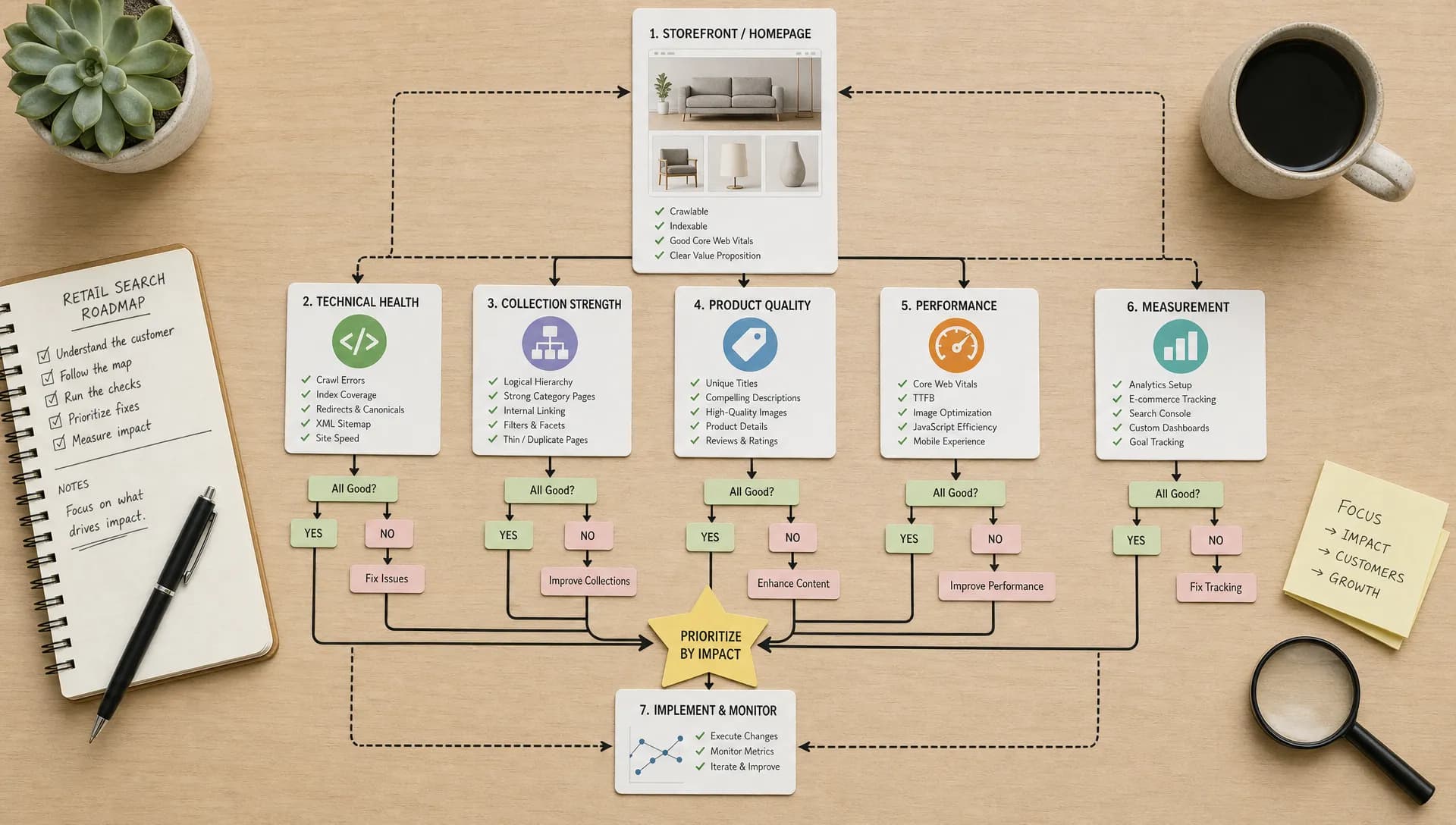
Optimizing a Shopify store before auditing it usually creates busywork. Titles get rewritten, apps get installed, blog posts get published, yet the real blockers remain untouched: duplicate collection URLs, slow product templates, weak internal linking, thin category pages, broken tracking or a site architecture that does not match how customers search.
A Shopify SEO expert should start with diagnosis. The audit defines what is technically accessible, what is commercially worth ranking, what shoppers need to convert and how success will be measured. Only then can optimization become a revenue strategy instead of a checklist.
Below is what a serious Shopify SEO audit should cover before anyone starts changing pages.
Why the audit comes before optimization
Shopify gives retail teams a strong ecommerce foundation, but it also introduces SEO decisions that are easy to overlook. Products can live in multiple collections. Variant URLs can multiply. Apps can inject scripts across every template. Filters, tags and search pages can create crawl waste. Themes can look polished while hiding slow code, poor heading structure or missing product data.
An audit separates symptoms from causes. If organic revenue is flat, the answer might not be more content. It might be that high-intent collection pages are not internally linked, product detail pages load too slowly on mobile or Google is indexing low-value URLs instead of the pages that actually drive sales.
For growing retail brands, the audit also prevents teams from optimizing the wrong things. A page that brings traffic but low margin may be less urgent than a collection with modest traffic, strong conversion and profitable inventory. A Shopify SEO expert should understand the commercial context before deciding what to prioritize.
1. Business context and revenue priorities
SEO for Shopify is not just about ranking for more keywords. It is about ranking the right pages for searches that can become profitable orders.
Before reviewing metadata or content gaps, an expert should ask how the business actually makes money. That means looking at product margins, inventory depth, average order value, repeat purchase patterns, seasonality, discount dependency and the categories the brand wants to grow. If a store has limited stock in a category, pushing SEO demand there may create frustration. If a product line has strong margin and reliable availability, it may deserve more search investment.
The audit should connect SEO opportunities to commercial priorities such as:
- High-margin categories that deserve stronger collection pages
- Products with repeat purchase potential
- Search terms that align with merchandising strategy
- Categories with high impressions but weak click-through rate
- Landing pages that attract traffic but underperform in conversion
- Inventory or fulfillment constraints that could undermine demand generation
This is also where teams should align on what SEO success means. Organic sessions are useful, but they are not enough. For Shopify, a better scorecard includes organic revenue, assisted revenue, non-brand visibility, collection page conversion rate, product page engagement, add-to-cart rate and technical health.
2. Crawlability, indexation and duplicate URL risk
A technical crawl is one of the first places a Shopify SEO expert should look. If search engines cannot efficiently discover, understand and prioritize the right URLs, content optimization will have limited impact.
Shopify stores often accumulate URL complexity through collections, product tags, filters, pagination, internal search results, discontinued products and third-party apps. Some of this is normal. The problem is when low-value URLs consume crawl attention, create duplicate signals or compete with the pages the brand actually wants to rank.
The audit should review:
- Whether key product, collection and content pages are indexable
- Canonical tags across products, collections and variant URLs
- Robots.txt behavior and any noindex rules
- XML sitemap accuracy
- Redirect chains, 404s and soft 404s
- Internal links pointing to redirected or non-canonical URLs
- Duplicate title tags, descriptions and H1s caused by templates
- Faceted navigation and filter URLs
- Discontinued product handling
A common Shopify issue is treating every collection, tag or filtered view as equally valuable. That can dilute authority and confuse search engines. The expert should decide which pages deserve indexation, which should consolidate into canonical pages and which should be removed from the organic search path.
This is not glamorous work, but it protects every future optimization effort. Rewriting category copy will not help much if the page is buried, canonicalized incorrectly or competing against several near-duplicates.
3. Site architecture and internal linking
Site architecture is where SEO, merchandising and user experience meet. A Shopify store can have great products, but if shoppers and search engines cannot understand the hierarchy, organic growth becomes harder than it needs to be.
The audit should examine how categories, subcategories, brands, product types and educational content connect. A healthy architecture helps search engines identify the most important pages and helps shoppers move from broad discovery to product selection.
For example, a beauty retailer may need a structure around product type, skin concern, ingredient and routine. An apparel brand may need architecture around gender, category, fit, material and occasion. A furniture store may need room, style, material and size. The right structure depends on demand and buying behavior, not just the Shopify admin setup.
| Audit area | What the expert checks | Why it matters |
|---|---|---|
| Navigation | Whether priority categories are easy to reach from the main menu | Important pages should not be hidden several clicks deep |
| Collections | Whether collections match real search demand and merchandising goals | Collection pages are often the highest-value SEO landing pages |
| Internal links | Whether product, collection and content pages support each other | Links guide authority and help shoppers continue browsing |
| Filters | Whether filters help users without creating indexation waste | Facets can improve UX while creating duplicate URL issues |
| Breadcrumbs | Whether hierarchy is clear and consistent | Breadcrumbs support navigation and structured data clarity |
Internal linking should not be an afterthought. Collection pages should link to relevant subcollections, buying guides should link to commercial categories and product pages should provide paths to related items, bundles or parent collections. If your team is comparing service scopes, Space Dinosaurs has a broader breakdown of what great ecommerce SEO services actually include beyond basic keyword research.
4. Collection page strength
For many Shopify stores, collection pages are the real SEO battleground. They match commercial intent, sit close to purchase and can rank for high-value non-brand terms. Yet they are often underbuilt.
A Shopify SEO expert should audit whether collection pages have enough context to deserve visibility. That does not mean adding long blocks of generic text above the product grid. It means giving shoppers and search engines the information needed to understand the assortment.
Strong collection pages usually clarify what the category includes, who it is for, how to choose between options and what differentiates the brand. They also support product discovery through sorting, filters, internal links and clear merchandising.
The audit should review titles, meta descriptions, H1s, introductory copy, product grid quality, indexable subcollections, FAQs where useful, image alt text and structured data. It should also identify collections with search opportunity but thin content, poor product availability or weak internal links.
A collection page should never be optimized in isolation. If the page ranks but the product grid is confusing, the work may drive traffic that does not convert. If the page has strong merchandising but no supporting content or internal links, search engines may not recognize its importance.
5. Product page quality and scalability
Product pages have a different job from collection pages. They need to help shoppers decide, reduce uncertainty and provide accurate product data for search engines and commerce surfaces.
A Shopify SEO expert should audit the product template before optimizing individual pages. If the template is weak, scaling SEO across hundreds or thousands of SKUs becomes inefficient. Fixing the template can improve every product page at once.
The audit should look at product titles, descriptions, variant handling, image alt text, availability, price consistency, shipping and return information, review integration, related products, size guides, product specifications and schema markup. It should also check whether the same manufacturer copy is used across many products. Duplicate supplier descriptions are common, especially in larger catalogs, but they rarely create a strong reason for a page to rank.
For complex catalogs, the expert should identify which product pages deserve unique optimization. Not every SKU needs extensive custom copy. Priority should go to products with strong demand, evergreen availability, high margin, meaningful differentiation or strong conversion potential.
6. Core Web Vitals and Shopify performance
Performance is an SEO issue, a conversion issue and an operational issue. Shopify stores can become slow when themes are overloaded with apps, tracking tags, unoptimized images, heavy scripts and unused sections.
Google's Core Web Vitals focus on Largest Contentful Paint, Interaction to Next Paint and Cumulative Layout Shift. In practical terms, the audit should ask whether the page loads quickly, responds smoothly and stays visually stable while shoppers browse.
A Shopify performance audit should review:
- Theme code and unused JavaScript
- App scripts loaded across all pages
- Image size, format and lazy loading
- Hero media on collection and product templates
- Font loading behavior
- Checkout-adjacent scripts
- Mobile performance for key landing pages
- Differences between lab data and real user experience
The goal is not just to chase a perfect score. The goal is to identify changes that improve the experience for real shoppers and protect organic performance. A slow collection page with high search demand can be more urgent than a low-traffic informational article with the same score.
Performance work should also be coordinated with conversion work. Removing scripts blindly can break personalization, reviews, analytics or merchandising. If speed and revenue need to improve together, a combined SEO and CRO lens is often stronger than treating them as separate projects. Space Dinosaurs covers this connection in more depth in its guide to Shopify conversion rate optimization for faster growth.
7. UX signals that affect organic revenue
SEO does not end when a shopper lands on the page. If organic visitors cannot understand the offer, compare products or trust the store, rankings may produce traffic without revenue.
A Shopify SEO expert should audit mobile usability, product discovery, page clarity and trust signals. On mobile, this includes thumb-friendly navigation, visible filters, clear add-to-cart behavior, readable product details and fast access to shipping, returns and customer support information.
Trust is especially important for shoppers arriving from non-brand searches. They may not know the retailer yet, so the landing page has to answer basic questions quickly: Is this product right for me? Is the brand credible? What happens if it does not fit? When will it arrive? Are there reviews or social proof?
The same principle applies beyond retail. Clear mobile actions, service explanations, trust elements and easy updates are also central in website design priorities for small business owners, which is why SEO audits should include page experience and not only search metadata.

8. Content gaps, cannibalization and topical authority
Content can support Shopify SEO when it answers real buying questions and strengthens commercial pages. It becomes a liability when it is thin, repetitive or disconnected from revenue.
The audit should map content to search intent. Some searches need a collection page. Others need a comparison guide, sizing resource, ingredient explainer, style guide, care guide or troubleshooting article. A Shopify SEO expert should identify where content can help shoppers move toward a purchase without competing against the store's own commercial pages.
Cannibalization is a common issue. A blog post, collection page and tag page may all target the same phrase, splitting signals and confusing rankings. The audit should decide which URL should own the query and how supporting pages should link to it.
Older content deserves attention too. Some articles should be refreshed, merged or redirected. Others should be kept but repositioned with better internal links. Deleting content without a plan can remove useful long-tail visibility, so cleanup should be deliberate.
9. Structured data and product information consistency
Structured data helps search engines understand products, breadcrumbs, reviews and organization details. On Shopify, some themes and apps add schema automatically, but automatic does not always mean accurate.
The audit should check Product, Offer, BreadcrumbList and Organization markup where relevant. If review schema is present, it should reflect real visible reviews. If product availability or price changes, structured data should stay consistent with what shoppers see on the page.
The expert should also compare on-page data with feeds used for Google Merchant Center or other commerce channels. Inconsistent names, prices, variants, availability or product identifiers can create trust issues across organic and paid surfaces.
Schema is not a place to exaggerate. It should describe what exists, not what the brand wishes search engines would display.
10. Analytics, attribution and KPI tracking
Optimization should not begin until measurement is reliable. Otherwise, the team cannot tell whether changes improved performance or simply shifted traffic around.
A Shopify SEO audit should confirm that Google Search Console, analytics platforms and Shopify reporting are aligned closely enough to support decision-making. Exact matches across tools are not realistic because platforms define sessions, revenue and attribution differently. What matters is whether the data is directionally trustworthy and segmented well enough to guide action.
The audit should verify organic landing pages, revenue attribution, ecommerce events, add-to-cart tracking, checkout behavior, consent settings, cross-domain considerations and reporting for collection versus product pages. It should also separate brand and non-brand performance where possible. Brand search growth may reflect broader marketing demand, while non-brand growth usually tells a clearer SEO story.
Without clean measurement, SEO teams tend to report rankings and traffic because those numbers are easy to access. Retail leadership needs a stronger view: what changed, which pages improved, how conversion responded and what revenue impact is plausible.
11. App stack, theme governance and operational risk
Shopify SEO is affected by the store's operating model. If every new campaign adds an app, every app adds scripts and every script loads everywhere, SEO performance can degrade slowly.
An expert audit should review the app stack and theme governance. Which apps are essential? Which are unused? Which inject code sitewide? Which affect structured data, product content, redirects, filters or page speed? Are there multiple apps solving the same problem?
This is also where the expert should review how the team publishes new pages. If collection pages are created without naming conventions, metadata standards or internal linking rules, SEO issues will keep returning. A good audit should produce processes, not just fixes.
For larger Shopify or Shopify Plus stores, governance becomes even more important. Multiple markets, agencies, developers and merchandising teams can all affect SEO. The audit should make ownership clear so improvements do not disappear during the next launch.
12. Competitive SERP and demand reality
A Shopify SEO expert should not rely only on site-side findings. The search results themselves reveal what Google is rewarding for target queries.
For priority keywords, the audit should review which page types rank: collections, product pages, marketplaces, buying guides, review sites or videos. If every strong result is a category page with deep assortment, a single product page may struggle. If the SERP favors educational guides, a collection page may need supporting content before it can compete.
This step also keeps expectations realistic. Some keywords are too broad, too competitive or misaligned with the brand's catalog. Others may be easier wins because the store already has authority, relevant products and a better shopping experience than current ranking pages.
The output should be a focused opportunity map, not a giant keyword spreadsheet. Retail teams need to know which pages to improve first and why.
How the audit should turn into an optimization roadmap
A useful audit ends with prioritization. It should not hand the team a 90-page document and leave them guessing what matters most.
The roadmap should balance impact, effort, risk and dependency. Technical blockers usually come first if they prevent discovery or measurement. Then the team can move into collection improvements, product template upgrades, content development and ongoing experimentation.
| Priority | Example findings | Best next action |
|---|---|---|
| Fix first | Non-indexable priority collections, broken canonicals, unreliable tracking | Resolve before content or metadata work begins |
| Fix next | Slow templates, weak internal links, thin collection pages | Improve pages with the clearest revenue opportunity |
| Build over time | Buying guides, comparison content, structured content hubs | Support commercial pages and expand topical authority |
| Monitor continuously | App bloat, discontinued products, redirect changes, ranking volatility | Create governance so SEO health does not decay |
The best roadmap is specific enough for developers, marketers and merchandisers to act on. It should name the affected templates, URLs, metrics and expected business value.
Red flags before hiring a Shopify SEO expert
A strong Shopify SEO expert will ask for access, data and context before recommending tactics. Be cautious if someone proposes a fixed optimization package without reviewing the store.
Red flags include promising rankings before an audit, leading with SEO app installation, rewriting metadata without checking indexation, ignoring site speed, treating blogs as the main growth lever for every store or reporting only keyword positions. Another warning sign is a lack of coordination with developers and merchandising teams. On Shopify, many SEO improvements require changes to templates, navigation, feeds, apps or content workflows.
The right expert should be comfortable discussing technical constraints, user experience, analytics and revenue. They should also know when not to change something. For example, removing an app might improve speed but damage reviews or personalization. Noindexing pages might reduce crawl waste but remove long-tail traffic. SEO decisions need context.
Frequently Asked Questions
What should a Shopify SEO expert audit first? A Shopify SEO expert should start with business goals, analytics reliability, crawlability, indexation and site architecture. These areas determine whether later optimizations can be discovered, measured and tied to revenue.
Is a Shopify SEO audit only technical? No. Technical SEO is essential, but a complete audit should also review collection pages, product pages, content quality, user experience, page speed, internal linking, structured data, analytics and commercial priorities.
How often should a Shopify store run an SEO audit? Growing stores should run a full audit at least once a year and a lighter health check after major theme changes, migrations, app installations, navigation updates or catalog restructures.
Should SEO optimization begin with blog content? Not usually. Blog content can be valuable, but many Shopify stores get more immediate SEO impact from fixing technical blockers, strengthening collection pages, improving product templates and building internal links to high-intent pages.
Can SEO and conversion optimization be audited together? Yes. For Shopify, they should overlap. Organic traffic only creates value if landing pages help shoppers choose products, trust the brand and complete checkout.
Build Shopify SEO on a stronger foundation
A Shopify SEO expert should audit before optimizing because retail SEO depends on more than keywords. Technical health, performance, UX, merchandising, analytics and content all shape whether organic visibility becomes revenue.
Space Dinosaurs helps retail brands modernize Shopify experiences with AI-enabled engineering, UX design, analytics, performance optimization and ongoing improvement. If your store needs SEO work grounded in technical reality and commercial outcomes, Space Dinosaurs can help you build the foundation before scaling the optimizations.