


If an SEO proposal for an online store begins and ends with keyword research, metadata, and a few blog posts, it is probably not enough.
Great ecommerce SEO services are not a checklist of search tasks. They are a growth function that connects search visibility to product discovery, site speed, conversion rate, merchandising, analytics, and long-term platform health. For retail brands, the real goal is not just more organic traffic. It is more qualified shoppers reaching the right product, trusting the experience, and buying with less friction.
That distinction matters because ecommerce SEO is more complex than traditional SEO. Product catalogs change. Inventory fluctuates. Filter pages can multiply into thousands of thin URLs. JavaScript can hide critical content from crawlers. Seasonal demand can shift overnight. And every technical decision, from page templates to image loading, can affect both rankings and revenue.
So what should ecommerce SEO services actually include? Here is what a serious retail-focused engagement should cover.
Ecommerce SEO starts with commercial strategy, not keywords
Keyword research still matters, but it should not be the first or only lens. A strong ecommerce SEO program begins by understanding how the business makes money.
That means looking at product margins, buying cycles, category growth, inventory priorities, customer segments, and existing acquisition costs. A category that attracts high search volume may not be the best priority if it has low margin, poor availability, or weak conversion rates. A smaller long-tail category might be more valuable if it brings shoppers who are ready to buy.
The best ecommerce SEO services map search demand to business outcomes. They ask questions like:
- Which categories have the strongest revenue potential from organic search?
- Which products are underperforming because shoppers cannot find them?
- Where does organic traffic drop off before conversion?
- Which templates influence the most revenue: homepage, PLP, PDP, cart, or checkout?
- Which search opportunities align with seasonal demand, launches, and merchandising plans?
This is where SEO becomes part of retail strategy. At Space Dinosaurs, this mindset is central to treating your ecommerce site as a revenue lever, not just a technical asset to be monitored in isolation.
| Traditional SEO question | Ecommerce SEO question | Why it matters |
|---|---|---|
| Which keyword has the most volume? | Which query brings the highest-value shopper? | Traffic only matters if it can convert. |
| Which page can rank? | Which template or category can scale revenue? | Ecommerce SEO often works through repeatable systems. |
| Did rankings improve? | Did organic sessions, add-to-cart rate, and revenue improve together? | Rankings are an input, not the business result. |
| Can we publish more content? | Does content help shoppers choose, compare, and buy? | Content must support the buying journey. |
Technical SEO should protect crawlability, indexation, and performance
Technical SEO is the foundation of ecommerce visibility. Without it, even excellent product and category content may not be discovered, indexed, or ranked effectively.
For ecommerce sites, technical SEO needs to go deeper than a generic site audit. It should examine how search engines access and interpret the entire storefront, especially the areas where catalogs, filters, and JavaScript create complexity.
A proper technical ecommerce SEO audit should cover crawl paths, internal linking, canonical tags, XML sitemaps, robots.txt rules, pagination, faceted navigation, duplicate URLs, redirect chains, structured data, status codes, and rendering. It should also identify whether important category and product content is available in the HTML and whether key pages are being blocked, duplicated, or diluted.
Faceted navigation deserves special attention. Filters such as size, color, price, rating, brand, and availability are useful for shoppers, but they can create thousands of low-value URLs if they are not controlled. Great ecommerce SEO services help decide which filtered pages deserve indexation, which should remain crawlable but not indexed, and which should be blocked or canonicalized.
Performance is also part of technical SEO. Google has documented the importance of providing complete ecommerce information for search, including product, price, availability, and shipping-related signals where applicable, in its ecommerce guidance for Search. But search performance is not only about how bots understand the page. It is also about how quickly real shoppers can use it.
That is why Core Web Vitals, JavaScript performance, image optimization, server response times, and third-party scripts should be part of the same SEO conversation. If a product listing page ranks but loads slowly, shifts visually, or responds late to taps, search traffic may not translate into revenue. For a deeper retail-specific view, Space Dinosaurs has covered Core Web Vitals for ecommerce and the metrics that tend to matter most on PLPs, PDPs, cart, and checkout.
Site architecture should match how shoppers search
Ecommerce SEO services should improve how products are organized, linked, and discovered. This is where SEO overlaps heavily with merchandising and UX.
A strong architecture makes it easy for shoppers and search engines to understand what the store sells. Categories should reflect real demand, not just internal product team language. Subcategories should be specific enough to capture meaningful intent, but not so fragmented that they create thin or overlapping pages.
For example, an apparel accessories retailer may need separate paths for woven labels, patches, ribbons, zipper pulls, and care labels because shoppers search for those items differently. A site selling custom woven labels and patches shows how product-led navigation can help reflect distinct commercial intent in the storefront experience.
Great ecommerce SEO services will usually evaluate:
- Category naming and hierarchy
- URL structure and breadcrumb logic
- Internal links from navigation, content, PLPs, and PDPs
- Indexable category and subcategory opportunities
- Overlapping pages that compete with each other
- Orphaned products or categories with weak internal links
- On-site search data that reveals unmet demand
The goal is not to build the largest possible site architecture. The goal is to create a clear path between shopper intent and product availability.
Category and product pages need search intent, not just metadata
Many ecommerce SEO packages still over-focus on title tags and meta descriptions. These are important, but they are only a small part of page optimization.
A strong category page should answer the shopper's real question: Am I in the right place, and can I narrow down to the right product quickly? That means the page should combine useful copy, strong product sorting, relevant filters, internal links, trust signals, and enough context to support both search visibility and buying confidence.
For category pages, great ecommerce SEO services should define what content belongs above the product grid, what belongs below it, and what should be avoided. Too much copy at the top can push products down and hurt shopping behavior. Too little context can make the page generic and less competitive in search.
Product pages need a similar balance. They should not rely only on manufacturer descriptions or duplicate catalog data. Effective PDP optimization may include clearer product names, unique descriptions, fit or compatibility guidance, size and material information, shipping and return clarity, image alt text, FAQs, reviews where valid, and structured data.
This work should happen at the template level as much as the page level. If an ecommerce brand has 20,000 products, optimizing one PDP manually is not a strategy. The service provider should identify scalable patterns that improve the entire catalog without creating low-quality automated content.
Content strategy should support buying decisions
Ecommerce content is not just blog publishing. It should help shoppers compare options, understand products, solve use-case problems, and move toward purchase.
A strong ecommerce SEO content strategy usually includes category copy, buying guides, comparison pages, product education, style or use-case content, post-purchase support, and evergreen resources that answer recurring customer questions. The best content bridges the gap between informational search and transactional intent.
For example, a furniture retailer might need guides on how to choose a sectional sofa for a small apartment. A beauty retailer might need ingredient explainers and routine builders. A consumer electronics retailer might need comparison content for different specifications and compatibility scenarios.
The key is to avoid content that only exists to target keywords. Good ecommerce content should earn organic visibility and help the shopper make a better decision. If it does not support discovery, trust, comparison, or conversion, it probably does not belong in the strategy.
Structured data should make products easier to understand
Structured data is not a magic ranking button, but it helps search engines understand the entities on a page and can support richer search results when implemented correctly.
For ecommerce sites, the most relevant structured data often includes Product, Offer, AggregateRating, Review, BreadcrumbList, Organization, WebSite, and FAQPage where appropriate. The key phrase is where appropriate. Adding review schema without real reviews, marking up inaccurate availability, or using structured data that does not match visible page content can create trust and compliance issues.
Great ecommerce SEO services should audit structured data at the template level, test it across product variants, confirm that it updates when price or availability changes, and monitor errors in Search Console. They should also coordinate with engineering and merchandising teams so schema does not become stale when templates or product data feeds change.
UX and conversion work are part of modern ecommerce SEO
SEO does not end when a shopper lands on the page. If organic visitors bounce because filtering is confusing, product images load slowly, or checkout feels risky, the SEO program is leaving revenue on the table.
This is why serious ecommerce SEO services include UX and CRO recommendations. They do not have to replace a full conversion optimization program, but they should identify friction that affects organic performance.
Common SEO-adjacent UX issues include poor mobile navigation, weak product sorting, intrusive popups, unclear variant selection, missing delivery information, hidden reviews, slow image galleries, and confusing out-of-stock handling. These issues may not look like SEO problems in a traditional audit, but they influence how organic traffic performs.
A retail-focused SEO partner should understand that search, performance, and UX are connected. Better category hierarchy can improve crawlability and product discovery. Faster templates can improve engagement and conversion. Clearer product content can reduce returns and customer support friction. These improvements compound over time.
Analytics should connect SEO work to revenue
If ecommerce SEO services only report rankings and traffic, the measurement model is incomplete.
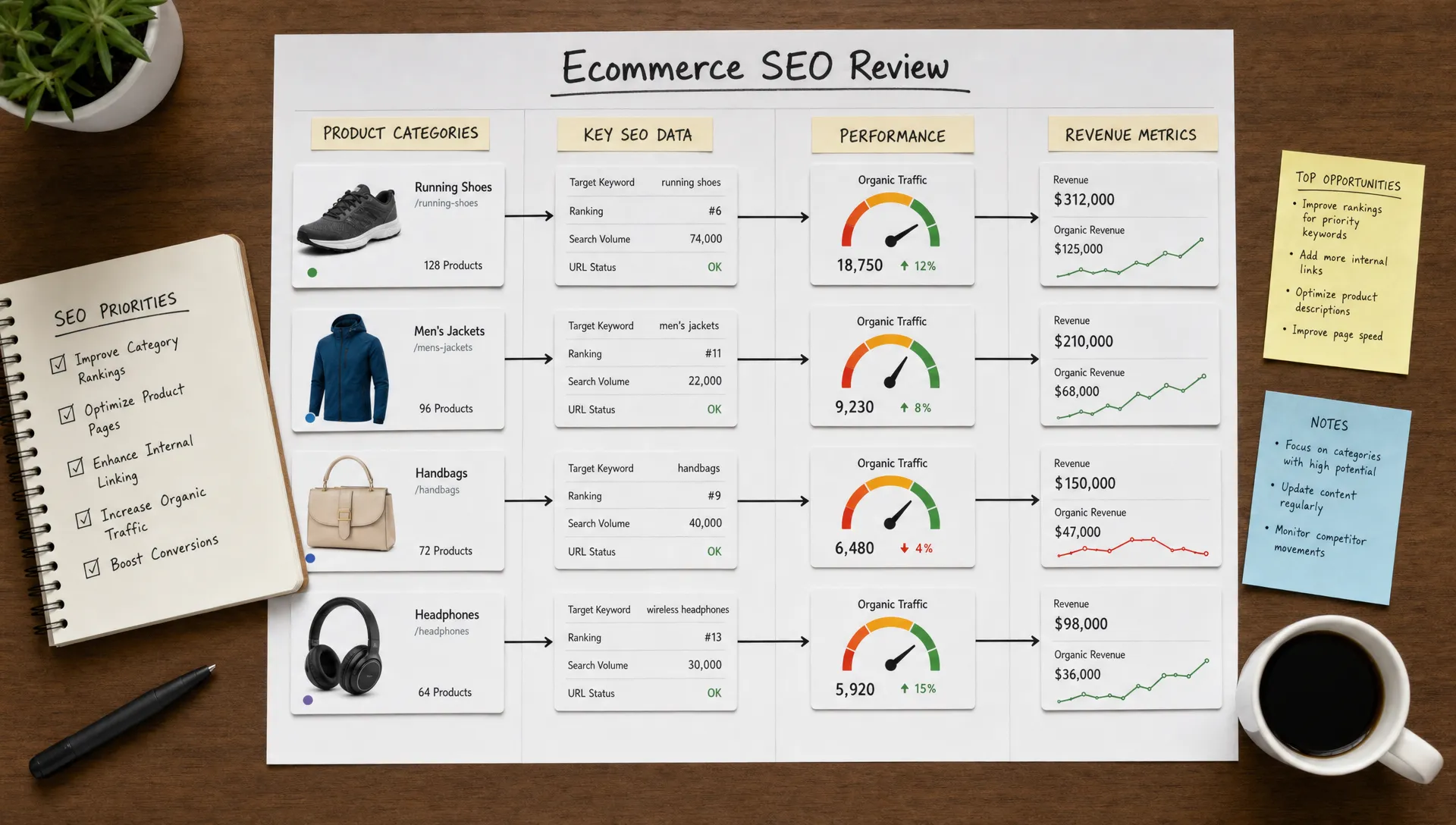
A strong reporting setup should connect SEO activity to commercial outcomes. That usually means combining Google Search Console data, analytics platform data, ecommerce events, revenue, conversion rate, assisted conversions, page type performance, and cohort or segment analysis where available.
Instead of only asking whether organic sessions increased, ecommerce teams should be able to see which categories gained visibility, which landing pages generated revenue, which content influenced assisted purchases, and where organic shoppers dropped off.
A useful ecommerce SEO reporting framework might include:
| Reporting area | What to measure | What it reveals |
|---|---|---|
| Visibility | Impressions, clicks, click-through rate, ranking movement | Whether search demand is being captured. |
| Landing page quality | Organic sessions by template, engagement, bounce signals | Whether searchers are reaching useful pages. |
| Commerce outcomes | Add-to-cart rate, conversion rate, revenue, average order value | Whether SEO traffic is creating business value. |
| Technical health | Indexed pages, crawl errors, sitemap coverage, schema errors | Whether the platform supports growth. |
| Performance | LCP, INP, CLS, TTFB, page weight | Whether speed is helping or hurting shoppers. |
| Content impact | Assisted conversions, internal clicks, product progression | Whether content supports buying journeys. |
The most valuable reporting does more than describe what happened. It helps teams decide what to do next.
Great ecommerce SEO services include prioritization and implementation support
A 90-page audit can be useful, but only if the right fixes actually ship. Ecommerce teams often have limited engineering capacity, competing roadmap priorities, and multiple stakeholders across marketing, merchandising, analytics, product, and development.
That is why prioritization is a core part of great ecommerce SEO services. Recommendations should be ranked by potential revenue impact, effort, risk, dependencies, and time sensitivity. A broken canonical pattern affecting thousands of PLPs likely deserves more urgency than rewriting metadata on a handful of low-traffic pages.
Implementation support can include technical tickets, acceptance criteria, QA checklists, pre-release testing, post-release monitoring, and collaboration with developers. For headless or composable commerce stacks, this support becomes even more important because SEO outcomes may depend on frontend rendering, CMS workflows, APIs, edge performance, and third-party integrations.
The best partners do not throw recommendations over the wall. They help translate SEO priorities into work that product and engineering teams can execute.
AI readiness is becoming part of ecommerce SEO
Search behavior is changing. Shoppers increasingly discover products through AI-assisted search, conversational interfaces, marketplace recommendations, social search, and retailer site search. Ecommerce SEO services should adapt without chasing hype.
AI readiness starts with the fundamentals: clear product data, structured content, crawlable pages, useful FAQs, consistent taxonomy, and accurate attributes. If a product catalog is messy, AI tools will not magically fix discovery. They may amplify confusion.
Modern ecommerce SEO should also consider how product information is expressed in natural language. Shoppers ask questions such as which running shoes are best for flat feet, what jacket works for cold rain, or which skincare product is safe for sensitive skin. Content and product data should be structured enough to answer those questions clearly.
For retail brands exploring conversational commerce or AI-driven product discovery, SEO teams should collaborate with UX, analytics, and engineering so the experience is measurable, useful, and grounded in accurate catalog data.
What a complete ecommerce SEO service package should include
The exact scope will vary by brand, platform, catalog size, and maturity. Still, a serious ecommerce SEO engagement should cover most of the following areas.
| Service component | What it should include | Typical outputs |
|---|---|---|
| Commercial discovery | Revenue goals, category priorities, margin context, seasonality | SEO opportunity map tied to business value |
| Technical audit | Crawlability, indexation, rendering, canonicals, facets, redirects | Prioritized technical backlog |
| Site architecture | Taxonomy, navigation, internal linking, URL logic | Category and linking recommendations |
| On-page optimization | PLP and PDP content, titles, headings, metadata, image guidance | Template rules and page-level briefs |
| Content strategy | Buying guides, comparisons, educational content, FAQs | Editorial roadmap connected to product demand |
| Structured data | Product, offer, breadcrumb, review, FAQ where valid | Schema audit and implementation guidance |
| Performance review | Core Web Vitals, JavaScript, image loading, third-party scripts | Speed and UX improvement backlog |
| Analytics | Search, behavior, ecommerce revenue, content contribution | KPI dashboard and reporting cadence |
| Implementation support | Tickets, QA, release checks, stakeholder coordination | Shipped improvements and monitored results |
| Ongoing optimization | Testing, iteration, seasonal updates, trend monitoring | Continuous improvement roadmap |
A lightweight SEO package may only address a few of these areas. That may be enough for a small store with a simple catalog. But for growing retailers, enterprise brands, or composable ecommerce environments, SEO needs to be embedded into how the site evolves.
Red flags when evaluating ecommerce SEO providers
Not every provider that offers ecommerce SEO services is equipped for retail complexity. Be cautious if you see these patterns:
- They promise rankings without discussing revenue, conversion, or implementation.
- They focus only on blogs and ignore category and product templates.
- They do not ask about your platform, catalog structure, or development workflow.
- They recommend indexing every filter page without a clear strategy.
- They deliver audits with no prioritization or engineering-ready guidance.
- They report only keyword rankings and organic sessions.
- They treat site speed, UX, and SEO as separate conversations.
The right partner should be comfortable speaking with marketers, merchandisers, engineers, analytics teams, and executives. Ecommerce SEO is cross-functional by nature.
Frequently Asked Questions
What are ecommerce SEO services? Ecommerce SEO services are specialized search optimization services for online stores. They typically include technical SEO, category and product page optimization, site architecture, content strategy, structured data, performance improvements, analytics, and ongoing optimization tied to revenue.
How are ecommerce SEO services different from regular SEO? Ecommerce SEO has to account for product catalogs, inventory changes, faceted navigation, duplicate URLs, product variants, structured data, site speed, and conversion behavior. Regular SEO may focus more heavily on static pages and content publishing.
Do ecommerce SEO services include product descriptions? They can, but the best services go beyond writing descriptions. They define scalable PDP content patterns, identify duplicate or thin content risks, improve product naming and attributes, and align descriptions with shopper intent.
How long does ecommerce SEO take to work? Some technical fixes can improve performance quickly, but organic growth usually compounds over months. Timing depends on site health, competition, catalog size, implementation speed, and how well SEO recommendations are connected to revenue priorities.
Should ecommerce SEO include Core Web Vitals? Yes. Core Web Vitals and broader performance metrics affect how shoppers experience the site. For ecommerce, speed and responsiveness can influence both search performance and conversion outcomes.
What should an ecommerce SEO report include? A useful report should include visibility, traffic, indexed pages, technical health, category and product page performance, conversion rate, revenue, and prioritized next actions. Rankings alone are not enough.
Turn ecommerce SEO into a growth system
Great ecommerce SEO services do not sit in a silo. They connect search demand, technical execution, UX, analytics, and ongoing optimization so retail teams can turn organic visibility into measurable revenue.
Space Dinosaurs helps retail brands modernize ecommerce experiences through AI-enabled engineering, human-centered UX, analytics, performance optimization, and continuous improvement. If your team needs a more integrated way to prioritize and ship revenue-focused website improvements, explore Momentum for ecommerce growth and optimization.