

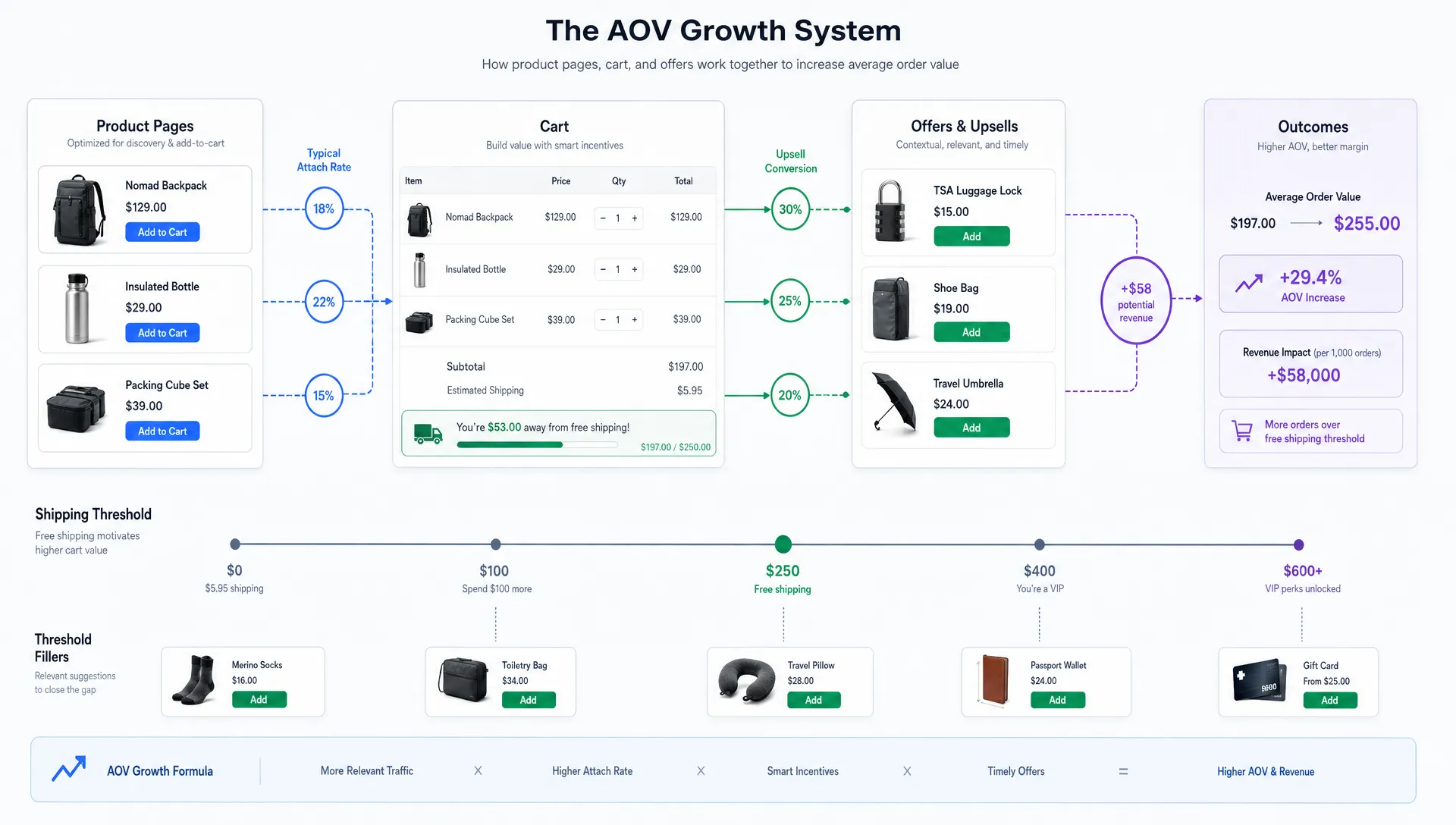
Raising average order value sounds simple: add an upsell, set a higher free-shipping threshold, push a bundle. In practice, Shopify conversion optimization for higher AOV only works when the buying journey still feels easy, relevant and fast.
AOV is not a vanity metric. If it rises because shoppers buy more of what they genuinely need, revenue and margin can improve without paying for more traffic. If it rises because the store overwhelms shoppers with forced offers, conversion rate can fall, returns can rise and customer trust can erode.
The goal is to increase the value of each order without creating friction. For retail brands, that means combining merchandising, UX, analytics, performance engineering and offer strategy into one operating system.
Start with the AOV math, not the upsell app
Before changing your Shopify theme or adding another app, define what you are trying to improve. AOV is one part of the revenue equation:
Revenue = traffic x conversion rate x average order value
An AOV initiative is successful only if total revenue, margin and customer quality improve together. A higher cart value does not help if the conversion rate drops enough to offset it.
Use guardrails before running tests:
- Conversion rate to make sure larger carts are not reducing completed purchases
- Gross margin per order to avoid growing AOV through unprofitable discounts
- Units per transaction to see whether shoppers are adding more products or only buying higher-priced items
- Attach rate to measure how often complementary products are purchased together
- Return rate to catch bundles or recommendations that create regret after delivery
- New vs returning customer behavior to avoid optimizing for one segment at the expense of another
This is where many brands make the wrong first move. They install a generic upsell tool, show the same offer to every shopper and judge success by the app’s reported revenue. A better approach is to locate the highest-value moments in the customer journey, then build offers that match intent.
If you want a broader view of how AOV fits into funnel performance, Space Dinosaurs has a useful guide to ecommerce conversion rate optimization that actually works, which frames CRO around revenue leaks rather than isolated tactics.
Build a clean Shopify AOV baseline
Shopify analytics can give you a starting point, but serious AOV work needs a more detailed view of how shoppers build carts. Look beyond the blended average. A single high-ticket order can distort the number, especially for stores with wide price ranges.
Segment AOV by device, traffic source, product category, customer type and discount usage. You may discover that paid social traffic has strong conversion but low order value, or that returning customers buy higher-margin add-ons when those add-ons are placed earlier in the journey.
| Metric | What it tells you | How it guides optimization |
|---|---|---|
| Average order value | The mean value of completed orders | Tracks broad revenue per purchase |
| Median order value | The midpoint order value | Reduces distortion from unusually large orders |
| Units per transaction | How many items are in each order | Shows whether bundles and add-ons are working |
| Attach rate | How often a product is bought with another product | Helps identify relevant cross-sell opportunities |
| Gross margin per order | Profitability of larger carts | Prevents discount-driven AOV gains from hurting margin |
| Checkout completion rate | How many shoppers finish after starting checkout | Reveals whether offers or fees are creating late-stage friction |
| Return rate by offer type | Whether specific bundles or promotions lead to returns | Protects customer satisfaction and net revenue |
For example, if your AOV is high only when discounts are active, you may not have an AOV strategy. You may have a margin problem. If your units per transaction are low but product compatibility is high, the opportunity is likely merchandising and recommendation design.
Make product pages do more of the AOV work
The product detail page is where shoppers decide whether an item is worth buying. It is also where they decide whether the item is worth pairing with something else.
A high-performing Shopify product page should answer three AOV questions without making the shopper work:
- What version or variant is best for me?
- What complementary item improves the product experience?
- Is there a better-value option if I buy more now?
The best AOV opportunities are usually not random cross-sells. They are obvious next steps. A skincare brand might recommend a cleanser with a moisturizer. An apparel brand might pair trousers with a matching belt or jacket. A home goods brand might show replacement filters, refill packs or care accessories.
The key is relevance. “You may also like” blocks often underperform because they are too broad. “Complete the set,” “Pairs well with” or “Recommended for this product” creates a clearer reason to add another item.
Product pages can also lift AOV through choice architecture. If you sell multiple sizes, packs or tiers, do not hide the better-value option in a dropdown. Show the price per unit, the savings and the use case for each option. A shopper may choose a larger size or multi-pack when the value is obvious.
UX matters here. If the page feels cluttered, the shopper may ignore every offer. Space Dinosaurs covers related PDP, mobile and merchandising principles in its article on how a Shopify website design company shapes conversion.
Use bundles that solve a buying problem
Bundles are one of the most effective ways to raise AOV because they help shoppers make a bigger decision with less effort. But not every bundle deserves space on your Shopify store.
The strongest bundles usually fall into one of these categories:
- Starter kits for first-time buyers who need guidance
- Routine bundles for products used together in a sequence
- Refill bundles for replenishment products with predictable usage
- Complete-the-look bundles for fashion, accessories and lifestyle brands
- Build-your-own bundles for shoppers who want control within a curated structure
The bundle must have a reason to exist beyond “buy more.” If the shopper cannot immediately understand why the products belong together, the bundle adds cognitive load.
| Bundle type | Best for | AOV risk to watch |
|---|---|---|
| Fixed kit | New customers, gifting, routines | Too little flexibility can reduce appeal |
| Build-your-own bundle | Consumables, beauty, food, accessories | Too many choices can slow the purchase |
| Quantity bundle | Replenishment products | Discounts can train customers to wait |
| Complete set | Apparel, home goods, electronics accessories | Poor compatibility can increase returns |
| Premium bundle | High-intent shoppers | Price jump may feel too large without clear value |
A useful test is whether a sales associate would naturally recommend the bundle in a store. If yes, it probably belongs in the digital journey. If no, it may be a forced promotion.
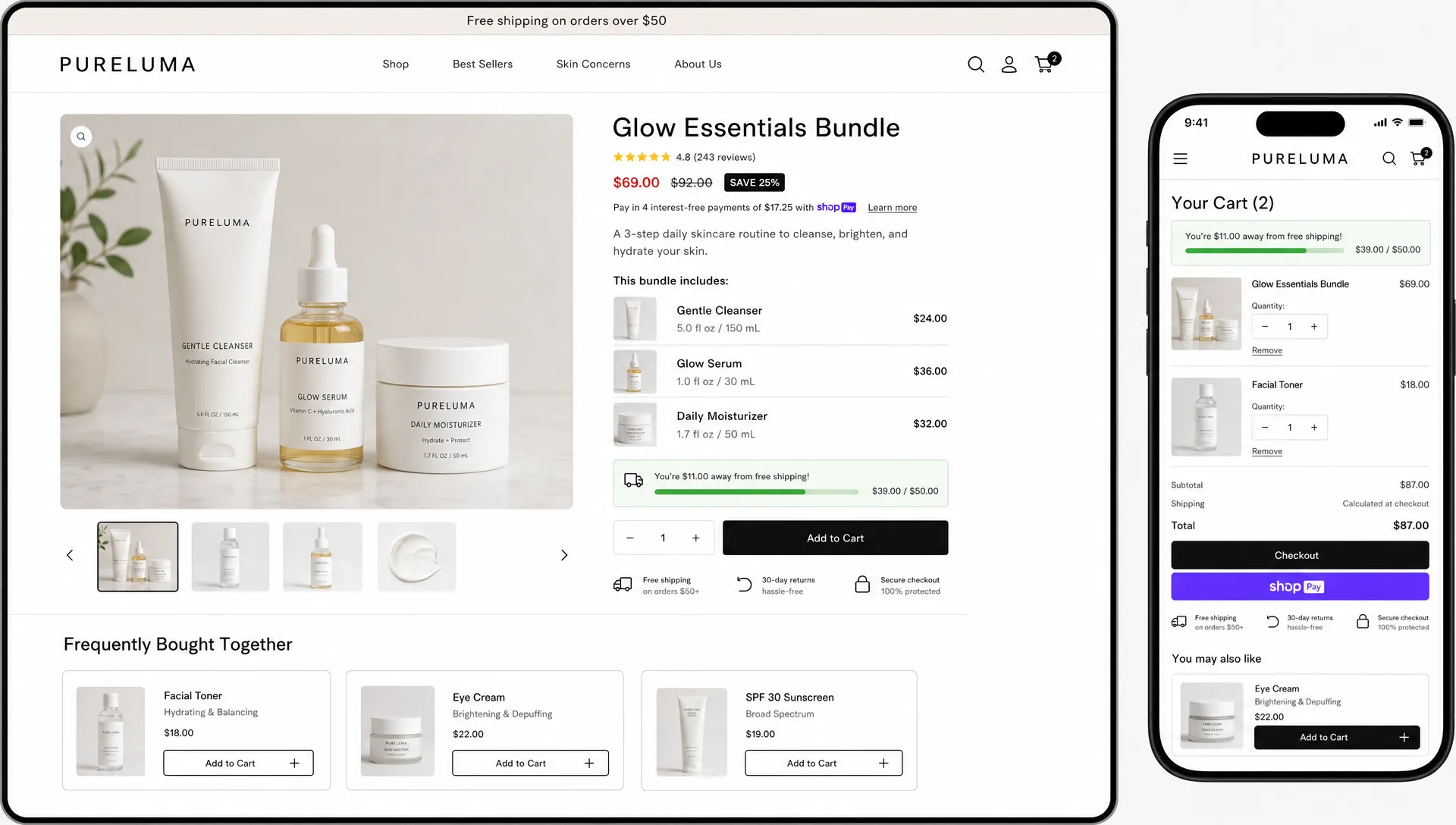
Turn the cart into a helpful sales associate
The cart is a powerful AOV moment because the shopper has already shown purchase intent. The mistake is treating it like a billboard.
Cart upsells should be limited, relevant and easy to accept. A cart drawer with five competing offers, a discount code field, a shipping message and a popup can create the feeling that checkout is getting farther away. Shoppers do not want to re-evaluate the entire purchase at this stage.
Use the cart to answer simple questions:
- Am I close to free shipping or another threshold?
- Is there a low-friction add-on that improves this order?
- Have I forgotten something needed to use the product?
- Can I increase value without delaying checkout?
A free-shipping progress bar can work well when the threshold is realistic. If your median order value is $62, a $75 threshold may encourage a reasonable add-on. A $120 threshold may feel out of reach and be ignored.
Low-priced complementary products often perform better in the cart than high-priced upsells. At this stage, shoppers are close to purchase. They may add socks, refills, batteries, gift wrap, samples, travel sizes or care products. They are less likely to reconsider an expensive alternative unless the value is extremely clear.
Design offers around margin, not just order size
Higher AOV is not always higher profit. A “buy more, save more” offer can increase order value while weakening gross margin. That may still be acceptable if it improves inventory turnover, customer acquisition efficiency or lifetime value. But the tradeoff should be intentional.
A good Shopify AOV strategy uses different offer types for different jobs:
| Offer type | Best use | Margin consideration |
|---|---|---|
| Free shipping threshold | Encouraging one more item | Shipping cost must be modeled by region and basket size |
| Gift with purchase | Moving specific inventory or increasing perceived value | Gift cost should be low relative to margin lift |
| Tiered discount | Increasing order size during campaigns | Can compress margin if thresholds are too easy |
| Product bundle | Simplifying a larger purchase | Works best when the bundle protects contribution margin |
| Subscription incentive | Replenishment and repeat purchase | Should be evaluated against retention and fulfillment costs |
The smartest offer is not always the largest discount. Many brands can raise AOV with better product grouping, clearer value messaging or more relevant recommendations before they need heavier promotions.
Keep Shopify performance from becoming the hidden AOV killer
AOV optimization often adds complexity. Recommendation widgets, review tools, bundle builders, personalization scripts and checkout extensions can all help revenue. They can also slow down key templates if they are poorly implemented.
That matters because shoppers experience these tools through page speed, responsiveness and visual stability. If a bundle widget loads late, shifts the product page or blocks the add-to-cart button, the AOV tactic can reduce conversion.
Prioritize performance on the revenue-critical templates:
- Product listing pages
- Product detail pages
- Cart drawer or cart page
- Checkout entry points
- Search results pages
Do not judge performance only from the homepage. Many Shopify stores have polished homepages but slower PDPs because product media, review scripts and recommendation tools stack up where buyers make decisions.
For a deeper breakdown of what to measure, read Space Dinosaurs’ guide to Core Web Vitals for ecommerce, especially if your AOV strategy depends on richer product experiences.
Personalize AOV tactics by shopper intent
The same offer should not appear to every shopper. New visitors, loyal customers, sale shoppers and email subscribers behave differently.
A new customer may need a starter bundle with reassurance, reviews and fit guidance. A returning customer may respond better to replenishment shortcuts, loyalty messaging or product recommendations based on prior purchases. A shopper arriving from a gift guide may need curated bundles and gift wrap. A shopper from paid search may need fast confirmation that the product solves the problem they searched for.
This is where merchandising and acquisition strategy need to talk to each other. If your campaigns attract bargain hunters, on-site AOV tactics may depend heavily on discounts. If campaigns bring shoppers with stronger purchase intent, you can often use bundles, premium variants and accessories more profitably. For brands that need outside support on demand generation, a managed digital marketing partner can help align campaign strategy with the on-site journey rather than treating traffic and conversion as separate problems.
Personalization does not have to be invasive. Start with practical segmentation:
- First-time vs returning shoppers
- Category viewed
- Product added to cart
- Traffic source
- Customer location when shipping costs vary
- Inventory availability
The goal is to make the next best action feel obvious.
Test AOV ideas with conversion guardrails
AOV tests can be misleading if you look at only one metric. A bundle test may lift AOV by 12 percent and reduce conversion by 15 percent. A free-shipping threshold may increase order value but reduce margin. A cart add-on may work on desktop but distract mobile shoppers.
Each test should have a clear hypothesis and a primary business outcome.
| Test idea | Hypothesis | Primary metric | Guardrail metric |
|---|---|---|---|
| Free-shipping threshold | Shoppers will add one more item to reach the threshold | AOV | Conversion rate and shipping margin |
| PDP bundle module | Relevant product combinations will increase units per transaction | Attach rate | Add-to-cart rate |
| Cart add-on | Low-priced accessories will increase cart value without delaying checkout | Cart AOV | Checkout start rate |
| Good-better-best pricing | Clear tier comparison will shift shoppers to premium options | Revenue per visitor | Return rate |
| Gift with purchase | Perceived value will increase completed orders above a threshold | Orders above threshold | Gross margin per order |
Avoid testing too many AOV changes at once. If you add a new bundle module, change the free-shipping threshold and install a cart upsell in the same week, you will not know what caused the result.
Use AI carefully for recommendations and merchandising
AI can improve Shopify AOV when it helps shoppers find relevant products faster. It can also create noise if it recommends products based only on popularity or superficial similarity.
Practical AI use cases include identifying product combinations, surfacing complementary accessories, adapting recommendations by shopper segment and spotting patterns in abandoned carts. For larger catalogs, AI can help merchandising teams see relationships that would be hard to manage manually.
Still, AI-driven retail experiences need human oversight. A recommendation model may not understand brand positioning, inventory priorities, fit issues or product compatibility without the right data and governance. The best results come from combining machine-driven pattern recognition with retail judgment.
A practical 30-day Shopify AOV plan
If you need momentum, start with a focused 30-day plan rather than a full site overhaul.
| Week | Focus | Output |
|---|---|---|
| 1 | Baseline analysis | AOV by segment, median order value, attach rate and margin view |
| 2 | Product and cart audit | List of PDP, bundle, cart and offer opportunities |
| 3 | First test build | One controlled AOV test with conversion and margin guardrails |
| 4 | Readout and iteration | Decision to scale, revise or stop the test |
This structure keeps teams from chasing random tactics. It also creates a repeatable optimization cycle: diagnose, prioritize, test, learn and improve.
Frequently Asked Questions
What is a good AOV for a Shopify store? A good AOV depends on your category, price points, gross margin and acquisition costs. Compare AOV against your own historical performance, median order value, customer segments and profit per order rather than relying on a universal benchmark.
Can Shopify conversion optimization increase AOV without hurting conversion rate? Yes, but only when offers are relevant and easy to act on. Bundles, cart add-ons, free-shipping thresholds and premium options should be tested with conversion rate, margin and return-rate guardrails.
What is the fastest way to increase Shopify AOV? The fastest low-risk starting point is usually a relevant cart add-on or a realistic free-shipping threshold. For longer-term gains, improve product page merchandising, bundle strategy and personalized recommendations.
Are Shopify upsell apps worth using? They can be useful, but they should not be treated as a strategy by themselves. Evaluate any upsell app by its impact on speed, mobile UX, conversion rate, AOV, margin and analytics quality.
Should discounts be part of an AOV strategy? Discounts can help when they are tied to clear thresholds, inventory goals or customer segments. They become risky when they train shoppers to wait, reduce margin or hide deeper merchandising problems.
Ready to raise Shopify AOV without adding friction?
Higher AOV comes from better retail systems, not louder upsells. Space Dinosaurs helps retail brands modernize Shopify experiences through AI-enabled engineering, UX design, analytics, performance optimization and ongoing conversion improvement.
If your team wants to grow order value while protecting speed, usability and margin, talk to Space Dinosaurs about building a smarter Shopify optimization roadmap.