


Retailers often reach for discounts because they are visible, easy to launch and simple to explain. But if you want to improve conversion rate in a way that protects margin, brand equity and customer expectations, the better move is to remove the doubts and friction that stop shoppers from buying at full price.
Discounting can be useful in specific commercial moments, such as clearance, seasonal campaigns or loyalty rewards. The problem starts when every conversion issue gets treated as a pricing issue. Many ecommerce stores do not need a bigger coupon. They need clearer product value, faster pages, stronger trust signals and a checkout that does not make customers work too hard.
How to improve conversion rate without cutting price
The practical path to improve conversion rate starts with a different question: why are ready-to-buy shoppers hesitating? Price may be one answer, but it is rarely the only one. Customers also hesitate when sizing feels risky, delivery details are vague, product imagery is weak, the mobile experience is slow or the checkout introduces surprise costs.
A non-discount CRO strategy focuses on reducing perceived risk. It gives shoppers more confidence before they add to cart, then removes friction after they decide to buy. For retail brands, that means treating conversion as an operating system across merchandising, UX, performance, analytics and fulfillment communication.
This is especially important in 2026, when paid traffic remains expensive and customers compare multiple options before committing. A store that converts more of its existing traffic without lowering price can grow revenue and preserve contribution margin at the same time.
Find the real conversion blocker before changing the offer
To improve conversion rate without promotions, start by locating where intent is leaking. A blanket homepage refresh or random A/B test may feel productive, but it often misses the specific point where shoppers lose confidence.
Look at the funnel by device, channel, product category and customer type. A mobile paid social visitor browsing a new collection behaves differently from a returning customer searching for a replenishment item. If those journeys are mixed into one average conversion rate, the signal becomes muddy.
Use evidence from three places
Analytics tells you where the drop happens. Session recordings and on-site search logs show what shoppers struggled to do. Customer service tickets, reviews and post-purchase surveys explain the objections in the customer’s own words.
A useful audit usually combines:
- Funnel analytics by device, traffic source and product category
- Product detail page engagement, including image interaction, size guide usage and review clicks
- Cart and checkout abandonment patterns, especially shipping, payment and account creation steps
- Site search queries with no results, low click-through or high exit rates
- Customer questions about fit, compatibility, delivery, returns or product use
Space Dinosaurs has written more about finding hidden revenue sitting in your existing traffic, which is the right mindset here. Before lowering price, identify the revenue already trying to happen.
Strengthen the value proposition at the moment of decision
If your team wants to improve conversion rate without discounting, the product page is usually the first place to work. Shoppers do not just ask whether the item is affordable. They ask whether it is right for them, whether it will arrive on time, whether the quality matches the claim and whether returning it will be a hassle.
A strong product detail page answers those questions before the shopper has to search for them. It connects the product to the customer’s intended outcome, not only to its features.
For example, a furniture retailer selling a sofa should not stop at fabric, dimensions and color options. The page should explain seat firmness, delivery access requirements, care instructions, room fit, assembly expectations and what makes the construction durable. A beauty brand should clarify skin type, application routine, ingredient purpose, shade matching and realistic results.
Turn features into buying confidence
A helpful value proposition is specific. Generic claims like premium quality, best-selling or must-have rarely move a cautious buyer. Better content ties each proof point to a shopper concern.
| Shopper concern | Weak page content | Stronger full-price conversion support |
|---|---|---|
| Will it fit me or my space? | Basic size dropdown | Size guidance, model measurements, fit notes, room dimensions or compatibility tools |
| Is it worth the price? | Generic quality claim | Materials, construction details, warranty, durability cues and comparison context |
| Can I trust the result? | One lifestyle image | Multiple angles, close-ups, use cases, reviews and customer photos |
| What happens if it is wrong? | Returns link in footer | Clear returns, exchanges and support details near the buy area |
This type of clarity does not cheapen the product. It helps the customer justify buying it.
Improve product discovery so shoppers find the right item faster
A retailer can improve conversion rate by helping visitors get to the most relevant product with fewer dead ends. Product discovery is not only a search bar. It includes navigation, filters, sorting, recommendations, collection pages and the logic that connects shopper intent to inventory.
Poor discovery quietly creates discount dependency. If customers cannot find the right variant, compare similar items or understand which product solves their need, they may only buy when a markdown compensates for uncertainty.
Make collection pages work like sales assistants
Collection pages should do more than display a grid. They should guide shoppers through the assortment. That means useful filters, clear category copy, merchandising rules that reflect demand and product cards that show the information people need before clicking.
For fashion, that might include color, fit, size availability and material. For home goods, it might include dimensions, delivery type and finish. For consumer electronics, it may include compatibility, key specs and use case.
Product cards also deserve attention. If every card looks identical, customers must open too many tabs to compare. Showing the right few details on the card can reduce pogo-sticking and move qualified shoppers deeper into the funnel.
Use on-site search as demand research
Search logs are one of the most underused CRO assets in retail. Queries with no results can reveal missing synonyms, merchandising gaps or navigation language that does not match customer language. Queries with high exits can reveal result pages that technically return products but fail to satisfy intent.
For a deeper view of funnel improvements that go beyond isolated tests, Space Dinosaurs covers practical ecommerce conversion rate optimization that actually works across discovery, product pages and checkout.
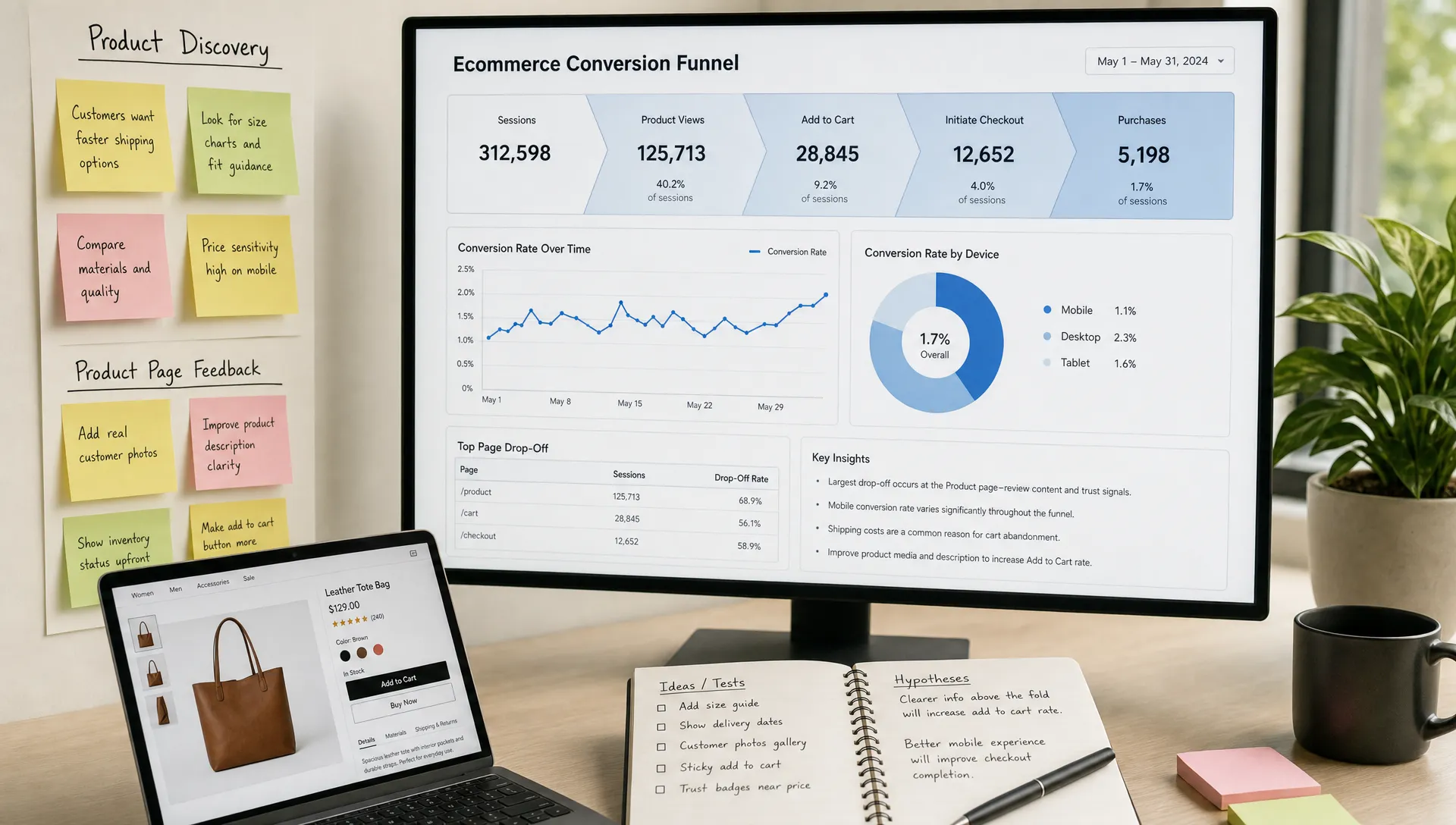
Build trust where shoppers feel risk
You can improve conversion rate by placing trust signals close to the decision they support. Many stores have useful trust content, but it sits in the footer, a help center or an About page that few shoppers visit during purchase consideration.
Trust signals should answer the doubts that appear at each stage. On a product page, reviews and customer photos help validate the item. Near the price, financing, warranty or durability details may matter. In cart, delivery timing, return policy and support access become more important.
Make social proof more useful
A star rating alone is not enough. Shoppers want to know whether people like them had a good experience. Review filters, fit feedback, verified buyer labels, images, use case tags and answerable Q&A sections make social proof more actionable.
For brands with limited review volume, the answer is not to fake abundance. Use founder notes, expert guidance, production transparency, press mentions or detailed product education. Trust can come from specificity as much as scale.
Reduce risk with clear policies
Policy clarity is a conversion lever. Shipping thresholds, delivery windows, return conditions and exchange options should be written in plain language. If a customer has to leave checkout to understand a policy, the journey has already weakened.
Do not hide constraints. If final sale items cannot be returned, say so before cart. If oversized items require special delivery, surface it early. Clear expectations may reduce some low-quality orders, but they increase customer confidence and reduce support costs.
Improve speed and mobile UX before spending more on traffic
Performance is one of the cleanest ways to improve conversion rate without changing the commercial offer. Slow pages make every other marketing investment less efficient. They also create a trust problem because a laggy experience can make even a strong brand feel less reliable.
Core Web Vitals, image weight, third-party scripts, app bloat and checkout load times all affect the buying journey. Retail teams should pay special attention to mobile because many shoppers discover products on mobile even if they complete the purchase later.
Prioritize the pages closest to revenue
Not every page speed issue has the same commercial impact. Start with high-traffic collection pages, top product detail pages, cart and checkout. These are the pages where milliseconds and layout instability can directly affect purchase completion.
A practical performance review should include:
- Largest Contentful Paint on mobile product and collection pages
- Interaction responsiveness around filters, add-to-cart buttons and checkout steps
- Layout shifts caused by banners, images, reviews widgets or promotional bars
- Third-party scripts that slow key templates without adding enough value
- Image sizing, lazy loading and video behavior on mobile networks
Speed work can be technical, but the business case is simple. If shoppers wait less, fight the interface less and trust the experience more, more of them complete the purchase.
Fix checkout friction without bribing the customer
The fastest way to improve conversion rate near the bottom of the funnel is often to remove checkout friction. At that stage, the customer has already chosen a product. Losing them there is especially expensive because acquisition, browsing and consideration have already happened.
Common checkout issues include forced account creation, too many form fields, unclear delivery options, limited payment methods, surprise shipping costs and weak error handling. Each one adds a small reason to postpone the purchase.
Make checkout feel predictable
Predictability matters more than decoration. Customers should understand how many steps remain, what they will pay, when the order will arrive and how to correct mistakes. Guest checkout, address autocomplete, clear payment options and persistent cart summaries are basic, but they still get overlooked.
Cart is also where retailers can increase order value without defaulting to discounts. Relevant bundles, replenishment prompts, threshold messaging and complementary products can work when they genuinely help the customer. The key is restraint. If upsells feel pushy or unrelated, they add noise at the worst possible moment.
Space Dinosaurs also covers Shopify conversion optimization tips for higher AOV, including ways to raise order value without damaging the buying experience.
Personalize the journey without overcomplicating it
Personalization does not need to start with a massive AI program. The goal is to improve conversion rate by making the experience more relevant to the shopper’s context. That can begin with simple segmentation by category interest, location, purchase history, traffic source or lifecycle stage.
A returning customer may need quick replenishment, loyalty recognition or new arrivals in a familiar category. A first-time visitor may need brand proof, education and reassurance. A shopper arriving from a specific ad should land on a page that continues the same promise, not a generic category page.
Retail can borrow a useful principle from adaptive learning environments. For instance, personalized and adaptive learning changes the experience based on the learner’s needs and context. Ecommerce personalization works best when it follows the same logic: respond to intent rather than showing everyone the same path.
Keep personalization measurable
Personalization becomes risky when teams add complexity without clear measurement. Every personalized element should have a hypothesis, an audience, a success metric and a fallback experience. Otherwise, the site becomes harder to maintain without proving revenue impact.
Useful first moves include recently viewed items, category-aware recommendations, location-relevant delivery messaging, returning-customer shortcuts and post-purchase flows based on what someone bought.
Test changes against margin, not just orders
The goal is to improve conversion rate profitably. A test that lifts orders by pushing low-margin products, increasing returns or training customers to wait for incentives may look successful in a narrow dashboard and still hurt the business.
Measure conversion alongside average order value, gross margin, return rate, support contacts, delivery cost and customer lifetime value when possible. A cleaner product page that increases full-price orders and reduces return-related tickets may be more valuable than a promotion that creates a temporary spike.
Build a non-discount experimentation roadmap
Your roadmap should rank tests by expected revenue impact, implementation effort and confidence. Start with issues supported by data, not opinions. If search exit rates are high, fix search relevance before testing button colors. If mobile checkout abandonment is the main leak, do not start with a homepage hero experiment.
A balanced roadmap might include:
- Product page clarity tests for sizing, compatibility, materials or use cases
- Review and Q&A placement tests near the add-to-cart area
- Collection page merchandising tests based on intent and margin
- Checkout simplification tests, including guest checkout and payment visibility
- Performance improvements on templates with high revenue exposure
Testing is not only about winning variants. It builds a shared understanding of what customers need to buy confidently at full price.
FAQ
Can you improve conversion rate without lowering prices? Yes. Many conversion gains come from reducing uncertainty, improving speed, clarifying product value, strengthening trust and simplifying checkout. Price cuts may lift short-term demand, but they are not the only lever.
What should retailers fix before offering a discount? Start with product detail pages, mobile performance, site search, collection navigation, shipping clarity and checkout friction. These areas often block ready-to-buy shoppers who would otherwise purchase at full price.
How long does non-discount CRO take to show results? Some fixes, such as clarifying delivery details or removing checkout friction, can show results quickly. Larger improvements, such as site performance, personalization or merchandising logic, usually require a roadmap and ongoing measurement.
Which metric matters most besides conversion rate? Gross margin is critical. A higher conversion rate is less useful if it depends on heavy markdowns, increases return volume or pushes unprofitable orders. Track conversion with margin, AOV, returns and customer value.
Grow conversion without shrinking margin
Discounts can create urgency, but they should not be the default answer to every funnel problem. Retail brands that invest in better UX, faster performance, clearer merchandising and smarter analytics can convert more shoppers while protecting price integrity.
If your ecommerce team is ready to turn existing traffic into more full-price revenue, Space Dinosaurs can help you modernize the retail experience with AI-enabled engineering, UX design, performance optimization and KPI-focused iteration.