


Choosing among ecommerce digital marketing agencies is not just a procurement exercise. For retail brands, the right partner can improve acquisition efficiency, protect margin, tighten the customer journey and turn marketing data into better decisions across the site, media channels and retention programs.
The wrong partner can do the opposite. They may bring more traffic that does not convert, spend budget without knowing contribution margin, separate marketing from site performance or report channel wins that do not show up in revenue quality. In 2026, ecommerce growth is too expensive for that kind of fragmentation.
A strong ecommerce digital marketing agency should help you answer a practical question: what has to change in the growth system so the business can sell more profitably? That includes media, SEO, lifecycle marketing, UX, analytics, technical performance, merchandising and increasingly, useful AI.
What ecommerce digital marketing agencies should actually own
The best agencies are not just channel operators. They connect demand generation with the experience a shopper lands on after the click. That distinction matters because a paid search campaign, category page, product detail page, promotion, checkout flow and post-purchase email all influence the same commercial result.
An agency does not need to run every discipline in-house, but it should understand the dependencies between them. If paid media performance drops because the site is slow, creative is misaligned or product availability changed, the agency should be able to diagnose the issue instead of blaming the algorithm.
Outcomes before outputs
Deliverables still matter. You need campaigns launched, feeds maintained, landing pages improved and reports delivered. But outputs are not the same as progress.
The strongest ecommerce digital marketing agencies frame work around measurable business outcomes such as profitable revenue, conversion rate, average order value, repeat purchase rate, organic revenue growth, customer acquisition cost and customer lifetime value. They can explain which metrics are leading indicators and which ones only look good after the fact.
Channel accountability without channel tunnel vision
A pure channel mindset often creates local optimization. Paid search wants more budget. SEO wants more content. Email wants more sends. CRO wants more tests. Each recommendation can be valid in isolation and still fail commercially if it ignores margin, inventory, seasonality or brand position.
Your agency should be able to say no to a tactic that looks efficient but damages the wider business. For example, acquiring low-margin customers through discount-heavy campaigns may raise revenue while lowering contribution profit. A better partner will model that tradeoff clearly.
Start with your commercial model, not their service menu
Before you compare retainers, case studies or pitch decks, map the business model the agency will need to support. Ecommerce brands do not all grow the same way. A marketplace-heavy beauty brand, a DTC apparel company, a specialty B2B supplier and an omnichannel retailer with stores all have different constraints.
If you want a deeper framework for marketing decisions tied to margin, contribution economics and demand capture, Space Dinosaurs has written about digital marketing for ecommerce that improves profitability. That profitability lens should be part of the agency selection process, not something added after campaigns go live.
Use a simple diagnostic table before outreach:
| Business factor | Why it matters when choosing an agency | What to ask |
|---|---|---|
| Margin structure | Determines how aggressive acquisition can be | How do you optimize toward contribution profit, not just ROAS? |
| Product catalog size | Affects feeds, SEO architecture and merchandising | How do you manage category, variant and inventory complexity? |
| Purchase frequency | Changes retention and LTV strategy | How would lifecycle marketing support repeat purchase? |
| Channel mix | Reveals dependency risk | Which channels are over relied on, and why? |
| Site performance | Influences conversion and media efficiency | How do you diagnose speed, UX and checkout friction? |
At this stage, ecommerce digital marketing agencies should be able to respond with business thinking, not a generic list of services. If every prospect receives the same channel plan, the agency is selling capacity rather than judgment.
Evaluate strategy, creative, media and technical depth together
Ecommerce marketing performance is rarely limited by one variable. A campaign can have sound targeting and still underperform because the landing experience is weak. A technically sound website can still struggle if product positioning is unclear. A polished creative concept can fail if feed data is messy or measurement is unreliable.
Paid media should be connected to merchandise reality
Ask how the agency handles product feeds, campaign structure, creative testing, landing page selection and budget allocation by margin or inventory position. A retail-aware agency will care about what is actually available to sell, what can be fulfilled profitably and which products create valuable customers.
Be cautious of partners that evaluate paid media only by platform-reported ROAS. Platform metrics are useful, but they can overstate impact when channels overlap or when branded demand is mixed with incremental acquisition.
SEO should support buying paths, not just rankings
For ecommerce, SEO is not only keyword research. It includes category architecture, faceted navigation, product page quality, internal linking, crawl efficiency, content usefulness and the way organic search supports shoppers at different stages of consideration.
If SEO is a major part of your brief, compare the agency’s approach with a more specialized evaluation model for choosing ecommerce SEO companies that drive sales. A strong digital marketing partner should know when SEO requires technical, UX and merchandising collaboration.
Vertical context changes the playbook
The agency should understand how buyers evaluate trust in your category. A consumer fashion brand may need speed, visual merchandising and creator-led storytelling. A complex B2B seller may need specification detail, quote flows and proof of operational reliability.
That principle applies outside ecommerce too. An industrial manufacturer such as specialist shafts and rollers producer Jakom earns trust through engineering capability, quality control and custom production expertise. The lesson for retail leaders is simple: marketing only works when it reflects how real buyers judge risk, quality and fit in that market.
How ecommerce digital marketing agencies should use AI
AI can improve ecommerce marketing, but only when it is attached to clear workflows and governance. Treat AI claims as prompts for deeper questions, not proof of capability.
A useful agency can show where AI helps with speed, pattern recognition or personalization without handing your brand voice, measurement or customer experience to unchecked automation. Examples might include creative variation workflows, smarter merchandising support, conversational commerce concepts, anomaly detection or faster insight generation from analytics data.
The key is accountability. Who reviews AI-assisted outputs? How is customer data handled? What is tested before changes reach shoppers? How are results measured against a human baseline or previous process?
Some agencies use AI as a label for generic tools. Better partners use it as part of a system that includes engineering, UX, analytics and commercial prioritization. That matters because automation at the wrong point in the journey can scale mistakes faster than manual work ever could.
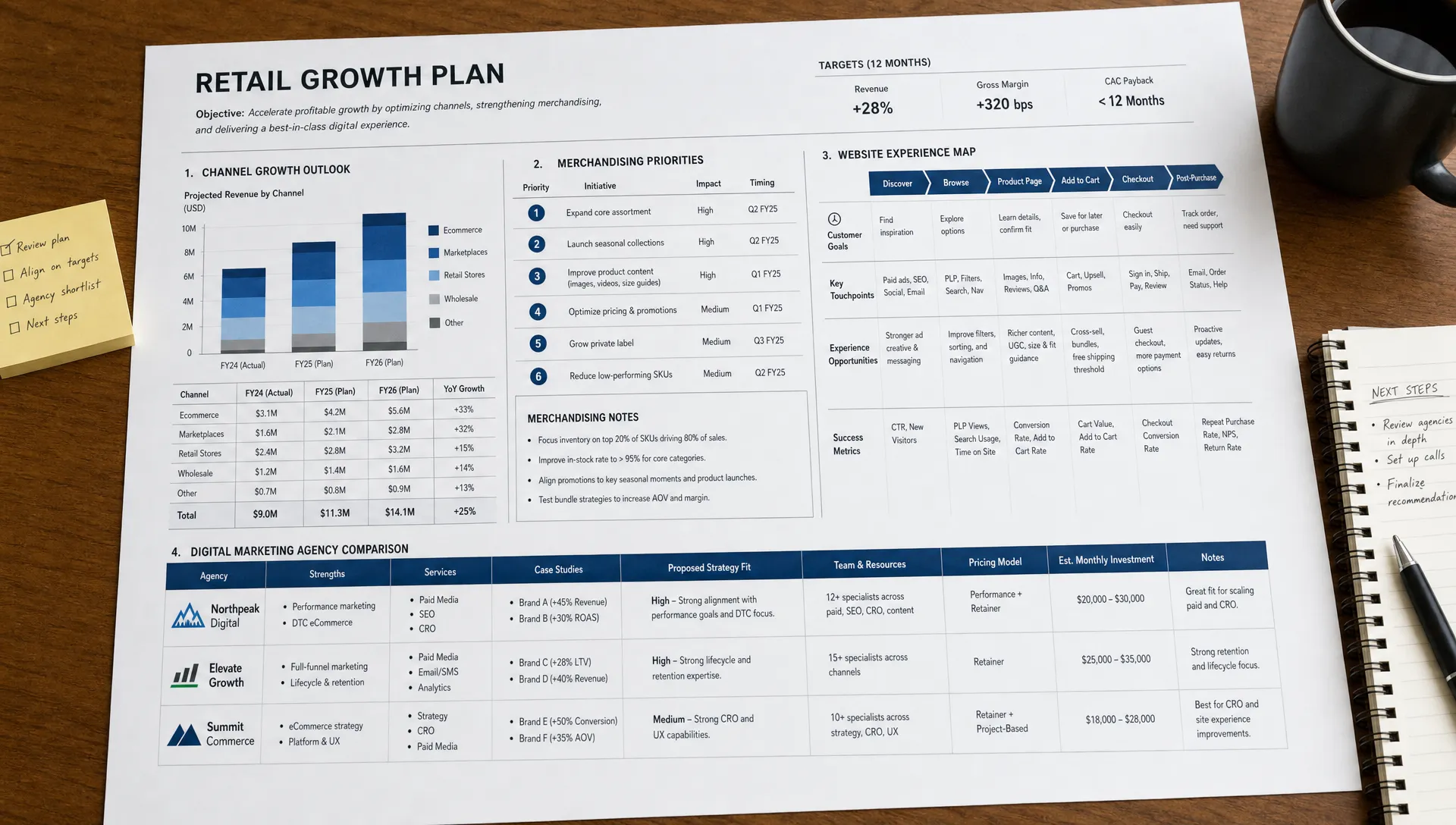
Ecommerce digital marketing agencies selection scorecard
A scorecard keeps the decision grounded. It also makes it easier to compare a performance marketing agency, a full-service ecommerce partner and a specialist consultancy without being distracted by presentation style.
Use a 1 to 5 score for each area, then weight the categories based on your business problem. A brand with declining conversion may weight UX and performance higher. A brand with high traffic but weak repeat purchase may weight retention and analytics higher.
| Evaluation area | What strong looks like | Warning sign |
|---|---|---|
| Commercial strategy | Connects growth to margin, LTV and operational constraints | Talks mostly about traffic and spend |
| Media capability | Explains incrementality, feed quality and budget tradeoffs | Relies only on platform ROAS |
| Ecommerce UX | Understands product discovery, PDP quality and checkout friction | Treats the site as someone else’s problem |
| Analytics | Defines KPIs, attribution limits and reporting cadence | Sends dashboards without interpretation |
| Technical awareness | Understands speed, tracking, platform limits and integrations | Cannot discuss implementation risk |
| AI maturity | Uses AI for defined workflows with review and measurement | Leads with vague AI promises |
| Operating model | Shows how strategy becomes weekly action | Offers a plan but no cadence |
When ecommerce digital marketing agencies present their capabilities, ask for examples that show cause and effect. You are not looking for a beautiful case study alone. You are looking for evidence that the team can diagnose problems, prioritize work and prove what changed.
Questions to ask before signing
The pitch process should reveal how the agency thinks under realistic conditions. Give them a real business scenario, not just a request for credentials. For example, describe a period where spend rose but profit did not, or where organic traffic grew while conversion declined.
Ask questions that force tradeoff thinking:
- Which metrics would you review first if revenue grew but contribution profit fell?
- How would you decide whether to invest in paid media, SEO, CRO or retention first?
- What site performance issues most often damage media efficiency?
- How do you separate branded demand capture from new customer acquisition?
- How do you validate whether a campaign is incremental?
- What work should happen in the first 30 days before major budget changes?
- How do your strategists, designers, analysts and engineers collaborate?
Shortlist ecommerce digital marketing agencies that answer with a method. The best responses will include what they need to inspect, what assumptions they would test and which decisions they would avoid making too early.
Red flags retail brands should avoid
Some warning signs show up before the contract is signed. If an agency promises fast growth without access to analytics, margin data or your ecommerce platform context, the recommendation is probably not grounded enough.
Another red flag is channel absolutism. No serious partner should claim that one channel solves every ecommerce problem. Paid media, SEO, email, SMS, affiliate, retail media and conversion optimization all have roles, but the right mix depends on economics and timing.
Vague AI claims deserve scrutiny too. If the agency cannot explain where AI enters the workflow, who governs outputs and how performance improves, the claim is branding rather than capability.
For a broader hiring checklist, Space Dinosaurs has outlined ecommerce agency red flags retail brands should avoid. Use those signals alongside your digital marketing evaluation so you do not choose a partner that can pitch well but operate poorly.
What a strong first 90 days should look like
A capable agency should not spend the first quarter only learning. Some discovery is necessary, but the early operating model should create momentum and clarity.
In the first 30 days, expect an audit of analytics, channel performance, site experience, tracking quality, commercial goals and operational constraints. The agency should identify what can be fixed quickly and what requires deeper planning.
By days 31 to 60, the team should be running focused improvements. That might include feed cleanup, campaign restructuring, landing page tests, lifecycle segmentation, SEO priority fixes or Core Web Vitals work. The point is not to do everything. The point is to prioritize work that can change the growth curve.
By days 61 to 90, the agency should be able to show what has been learned, which assumptions were wrong, which tests should scale and what roadmap comes next. Strong ecommerce digital marketing agencies create a rhythm where strategy, execution and measurement reinforce each other.
FAQ
What is the difference between an ecommerce agency and an ecommerce digital marketing agency? An ecommerce agency may focus on site builds, platform implementation, UX or technical maintenance. An ecommerce digital marketing agency focuses more directly on acquisition, retention, analytics and growth. The best fit for many retailers combines both perspectives because marketing performance depends heavily on the quality of the ecommerce experience.
How much technical expertise should a digital marketing agency have? It should have enough technical depth to understand tracking, site speed, product feeds, platform constraints, checkout issues and implementation risk. The agency may not be your development team, but it should know when technical problems are limiting marketing performance.
Should ecommerce digital marketing agencies manage every channel? Not always. A focused specialist can be the right choice when your problem is narrow. For complex retail growth, however, you need either one integrated partner or a clear operating model that connects media, SEO, retention, analytics, UX and engineering.
How do I know if an agency understands profitability? Ask how they use margin, return rates, discounts, fulfillment costs, customer lifetime value and incrementality in decision-making. If their main answer is ROAS, they may be optimizing for a partial view of performance.
What should I prepare before contacting agencies? Bring your business goals, current channel mix, analytics access, margin assumptions, platform context, customer segments and known pain points. The better the input, the easier it is to evaluate whether the agency can think commercially.
Build a more accountable ecommerce growth system
Choosing an ecommerce digital marketing agency is really about choosing how your retail growth system will operate. Look for a partner that can connect commercial strategy with execution, measurement, UX, performance optimization and practical AI.
Space Dinosaurs helps retail brands modernize ecommerce experiences, improve performance and build more effective digital growth systems through AI-enabled engineering, human-centered UX, analytics and ongoing optimization. If you want a partner built for the realities of modern retail, start with Space Dinosaurs.