

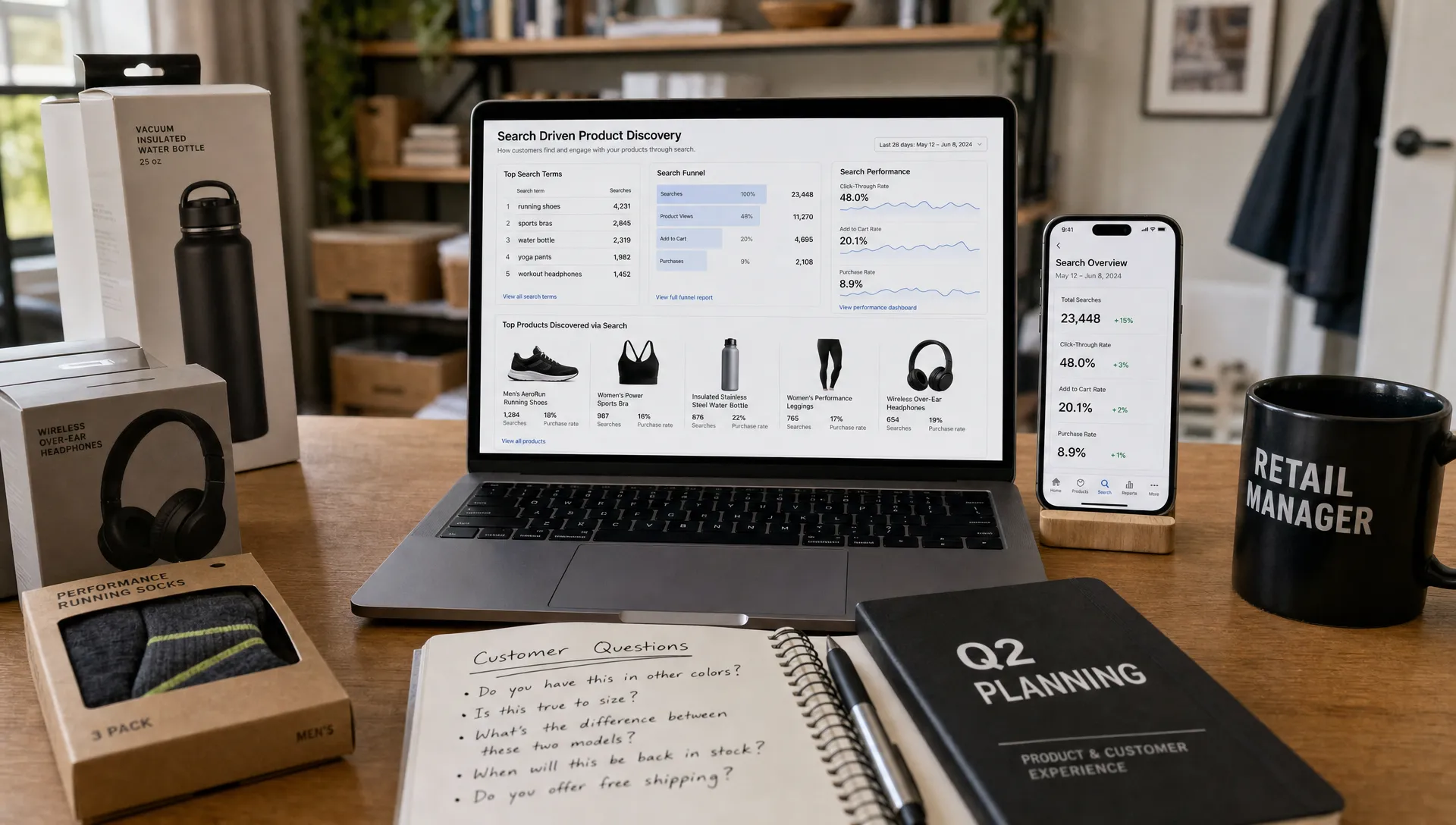
Enterprise ecommerce search is one of the fastest ways to improve product discovery because it meets shoppers at the moment they reveal intent. A customer who types wide leg black trousers, fragrance gift set or replacement filter is giving the retailer a valuable signal. The search experience decides whether that signal becomes a product view, a cart addition or a bounce.
For large retailers, search is not a small site feature. It is a discovery layer that connects catalog data, merchandising strategy, personalization, SEO learning, inventory logic and UX. When it works well, shoppers do not need to understand your taxonomy before they can buy from it.
What Enterprise Ecommerce Search Really Solves
Large catalogs create a simple problem: shoppers rarely think in the same structure that merchandising teams use. A retailer might organize products by category, subcategory, brand, season, collection, material and margin tier. A shopper may search by need, symptom, occasion, fit, color, compatibility or a half-remembered product name.
At its best, enterprise ecommerce search translates shopper intent into the most relevant path forward. It does not merely match keywords. It interprets incomplete phrases, spelling mistakes, synonyms, attributes and behavioral signals so customers can move from idea to item with less friction.
That matters because product discovery is often nonlinear. Some shoppers start with a generic term and narrow from there. Others paste a model number, compare similar products or search for an outcome such as travel backpack under seat. Search must support all of these behaviors without making the shopper feel like they are doing data entry.
Why Search Is Product Discovery, Not Just a Box
It captures demand that navigation misses
Navigation is built for structure. Search is built for intent. A well-planned menu helps shoppers browse, but it cannot anticipate every use case, synonym or long-tail product need. That is why enterprise ecommerce search should be treated as a primary product discovery channel rather than a fallback for people who failed to use the menu.
Search also captures demand that does not fit neatly into one category. A customer searching for wedding guest dress may care about color, length, season, price and delivery date all at once. Strong search can combine these signals and present useful products faster than category browsing alone.
This is where search overlaps with the broader work of reducing buying friction. If discovery, filtering, product comparison and checkout are disconnected, shoppers still struggle even when results are relevant. Space Dinosaurs covers that wider journey in its perspective on electronic commerce solutions that remove buying friction.
It reduces catalog complexity
Enterprise retailers often carry thousands or millions of SKUs across brands, markets, languages, sizes and availability states. Search has to simplify this complexity without hiding important differences. That means relevance logic needs to understand attributes such as fit, pack size, finish, compatibility, gender, age range or material.
The same information architecture challenge appears outside retail. A site for comprehensive psychiatric services in NYC has to help visitors distinguish evaluations, therapy, medication management and testing without making them read every page first. Retail search faces a similar clarity problem at larger catalog scale, where the right label, grouping and next step can change whether someone continues.
Modern enterprise ecommerce search improves product discovery by turning complexity into guided choice. The shopper still has control, but the system removes irrelevant paths before they create fatigue.
It supports exploration and decision-making
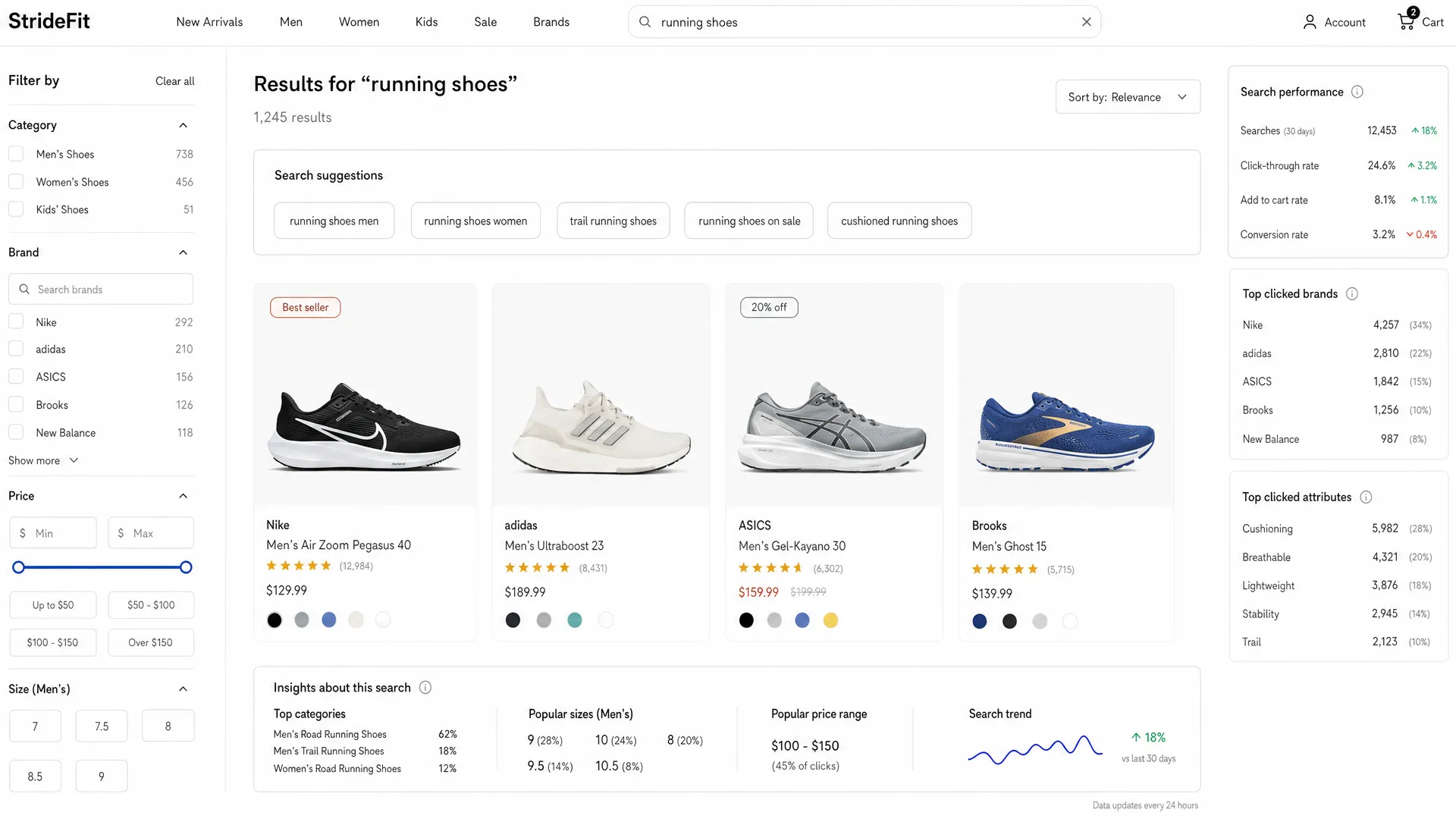
Not every query has one correct product. Search for running shoes, office chair or clean moisturizer may require education, comparison and filtering. Good search results pages should help shoppers refine the decision, not simply dump a list of items.
That can include faceted filters, sorting options, editorial content, product badges, reviews, compatibility prompts and alternative suggestions. For brands on Shopify, the same principles apply to collection pages, product cards and navigation, which Space Dinosaurs explores in its article on Shopify website design services that improve product discovery.
The Core Capabilities That Make Search Work
A useful enterprise ecommerce search roadmap starts with the capabilities that most directly influence relevance, usability and commercial performance. The goal is not to add every possible feature. It is to support the patterns that your shoppers actually use.
| Capability | What it improves | Example retail impact |
|---|---|---|
| Synonym management | Query matching | Trainers, sneakers and running shoes can lead to relevant footwear |
| Typo tolerance | Error recovery | A misspelled brand or product type still returns useful results |
| Faceted filtering | Decision support | Shoppers narrow by size, price, material, rating or availability |
| Ranking rules | Merchandising control | Bestsellers, new arrivals or high-margin products can be prioritized when relevant |
| Zero-results handling | Recovery | The page suggests alternatives instead of ending the journey |
| Behavioral learning | Relevance tuning | Results improve based on clicks, conversions and add-to-cart behavior |
Semantic relevance and natural language
Keyword matching alone breaks down when shoppers use descriptive language. A query such as breathable summer work pants may not match a product title exactly, but it can match attributes, reviews, descriptions and merchandising tags. Semantic search helps connect these expressions to products that satisfy the underlying need.
This is especially important for long-tail queries. Enterprise catalogs often contain niche products that are valuable precisely because customers search with specificity. If the search engine cannot interpret intent beyond literal terms, those products stay buried.
Merchandising controls and business logic
Enterprise ecommerce search also gives merchandising teams a way to balance relevance with business goals. A purely algorithmic ranking might not account for inventory depth, seasonal campaigns, private-label strategy, regional availability or profitability. A purely manual ranking becomes impossible to maintain at scale.
The right model blends algorithmic relevance with human controls. Teams should be able to boost products for commercial reasons, suppress unavailable items, pin strategic products for specific queries and adapt rules by market or season. The guardrail is relevance. If a boost makes results worse for the shopper, it can harm trust even if it helps a short-term campaign.
AI assistance and conversational commerce
AI-driven discovery can make search more helpful when shoppers are unsure how to describe what they need. Instead of forcing a perfect query, the experience can ask a clarifying question, suggest filters or recommend a product set based on stated preferences.
For example, a beauty retailer might help a shopper narrow by skin type, finish and coverage. A home improvement retailer might connect a project need to tools, parts and accessories. In both cases, AI works best when it is grounded in accurate product data, availability and business rules.
How Search Changes the Shopper Journey
From vague intent to useful results
When enterprise ecommerce search is designed around the full journey, it can support both uncertain browsers and decisive buyers. Someone searching gifts for new parents needs inspiration. Someone searching a specific appliance filter needs precision. The same search system should recognize the difference.
For vague searches, discovery modules, curated collections and guided filters help the customer decide what matters. For exact searches, speed, stock status, compatibility and clear product titles become more important. The results page should adapt to the query type instead of treating all searches the same.
From results to comparison
Product discovery does not end when results appear. Shoppers still need to evaluate options. This is why result cards matter. A product card that only shows an image and price may be enough for simple categories, but considered purchases often need ratings, color count, size availability, key specs, delivery promise or promotion information.
Comparison also depends on consistent product data. If one item includes material and another does not, filters become less useful and shoppers lose confidence. Strong search projects often reveal upstream catalog issues because missing attributes become visible in the shopping experience.
From search to assisted buying
Search can also feed guided selling. If a shopper repeatedly searches for waterproof hiking jacket, the site can surface care instructions, fit guidance, layering recommendations or accessories. For replenishment categories, search can prioritize previously purchased products or compatible refills when the customer is logged in.
This is where AI-powered retail experiences can be practical rather than flashy. The value is not novelty. It is helping the shopper choose faster, with fewer dead ends and fewer irrelevant results.
Implementation Priorities for Retail Teams
Start with catalog and query data
Successful enterprise ecommerce search projects usually start with data quality. Before tuning relevance, teams need to understand what shoppers search for, which queries convert, which queries return no results and where customers refine, abandon or click irrelevant products.
Catalog data deserves the same attention. Product titles, attributes, variants, images, availability and taxonomy all affect search quality. If sizes, colors or compatibility fields are inconsistent, search and filters cannot reliably help the shopper. This is often where engineering, merchandising and UX teams need a shared operating model.
For retailers reconsidering platform architecture, search should also be part of the platform conversation. Space Dinosaurs compares key tradeoffs in enterprise ecommerce platforms including SFCC, Shopify Plus and SCAYLE, which can help teams think about how search fits into the broader commerce stack.
Design for speed and resilience
A modern enterprise ecommerce search experience must be fast, stable and usable on mobile. Slow result pages hurt discovery because they interrupt the shopper at the exact moment of intent. Core Web Vitals, caching strategy, image performance and third-party scripts all influence how search feels.
Resilience matters too. Retailers need search experiences that can handle traffic spikes, campaign launches, seasonal events and inventory changes without breaking the buying path. If search results lag behind stock status or fail under load, the customer experience and paid media efficiency both suffer.
Treat search as an ongoing optimization program
Search is never finished because customer language changes, catalogs change and commercial priorities change. Teams should review top queries, failed queries, low-conversion queries and high-exit results pages on a recurring basis.
This work belongs across functions. Merchandising understands product priorities. UX understands decision friction. Analytics reveals behavior. Engineering protects performance and integrations. When these teams work from the same search data, optimization becomes much more practical.
Metrics That Show Product Discovery Is Improving
The business case for enterprise ecommerce search becomes clearer when teams connect search quality to revenue and customer behavior. Ranking relevance is useful, but retail leaders need metrics that show whether shoppers are finding and buying products more efficiently.
| Metric | What it indicates | How to use it |
|---|---|---|
| Search usage rate | How often shoppers rely on search | Segment by device, category and traffic source |
| Search conversion rate | Whether searchers buy at a higher or lower rate | Compare search users with non-search users carefully |
| Zero-results rate | Where the system fails to match intent | Add synonyms, redirects, content or assortment insights |
| Query refinement rate | Whether first results are too broad or irrelevant | Improve ranking, filters or query suggestions |
| Click position | Whether top results are useful | Tune ranking models and product data |
| Revenue per search | Commercial value of search sessions | Prioritize high-impact queries and categories |
| Exit rate after search | Friction or disappointment | Review page speed, relevance and result design |
These metrics should be interpreted together. A high search usage rate can be positive if search converts well, but it can also signal weak navigation if shoppers use the search box because browsing is confusing. A zero-results query might reveal a synonym issue, a content gap or an opportunity to stock a product customers clearly want.
Common Mistakes That Limit Search Performance
The strongest enterprise ecommerce search programs avoid treating search as a plug-in that can be installed once and ignored. Technology matters, but governance and data discipline matter just as much.
Common mistakes include launching search without a synonym strategy, letting product attributes drift across teams, hiding filters on mobile, overusing manual boosts, ignoring zero-results queries and measuring only total search revenue rather than incremental discovery quality. Another frequent issue is separating SEO, onsite search and merchandising data even though all three reveal how customers describe demand.
Retailers should also be careful with AI features that are not grounded in product reality. A conversational interface that recommends unavailable or incompatible products creates a worse experience than a simple but accurate results page. AI should improve relevance, guidance and efficiency, not add a layer of uncertainty.
Frequently Asked Questions
What makes enterprise ecommerce search different from basic site search? It has to handle larger catalogs, more complex product data, market-specific rules, merchandising controls, personalization signals, performance requirements and analytics needs. Basic search may match terms, but enterprise retail search must support discovery, ranking, filtering and commercial strategy at scale.
How does better search improve conversion rate? Better search reduces the work required to find relevant products. When shoppers see useful results, clear filters, accurate availability and helpful product information, they are more likely to click, compare and add to cart.
Should retailers prioritize AI search first? AI can help, but it should not come before the fundamentals. Clean product data, strong taxonomy, synonym coverage, fast pages and reliable analytics are the foundation. AI performs better when those inputs are already in good shape.
How often should search performance be reviewed? High-volume retailers should review critical search metrics weekly and run deeper analysis monthly or around major seasonal periods. The right cadence depends on catalog change, traffic volume and campaign activity.
Make Search a Growth System, Not a Utility
If your enterprise ecommerce search experience is treated as a simple query box, it will miss much of its commercial potential. Search should be a living discovery system that connects shopper intent with relevant products, useful guidance and measurable revenue outcomes.
Space Dinosaurs helps retail brands modernize ecommerce experiences with AI-enabled engineering, human-centered UX, analytics, performance optimization and ongoing improvement. For enterprise teams, the opportunity is not just to make search smarter. It is to make the entire discovery journey faster, clearer and easier to buy from.