

Searching for “seo agency ecommerce” gives you plenty of firms promising better rankings. Catalog consolidation requires a narrower skill set: deciding which product and category URLs should survive, preserving valuable search intent and coordinating changes across inventory, storefronts and measurement.
The business goal might be to combine acquired brands, retire duplicate listings or move several stores onto one platform. In each case, fewer pages and lower operating costs can come at the expense of organic revenue if the agency treats consolidation as a bulk redirect exercise.
Choose the agency that can defend its URL decisions, demonstrate comparable delivery and explain how it will detect revenue loss after launch. Use the framework below to test those capabilities before signing.
Define the consolidation before comparing agencies
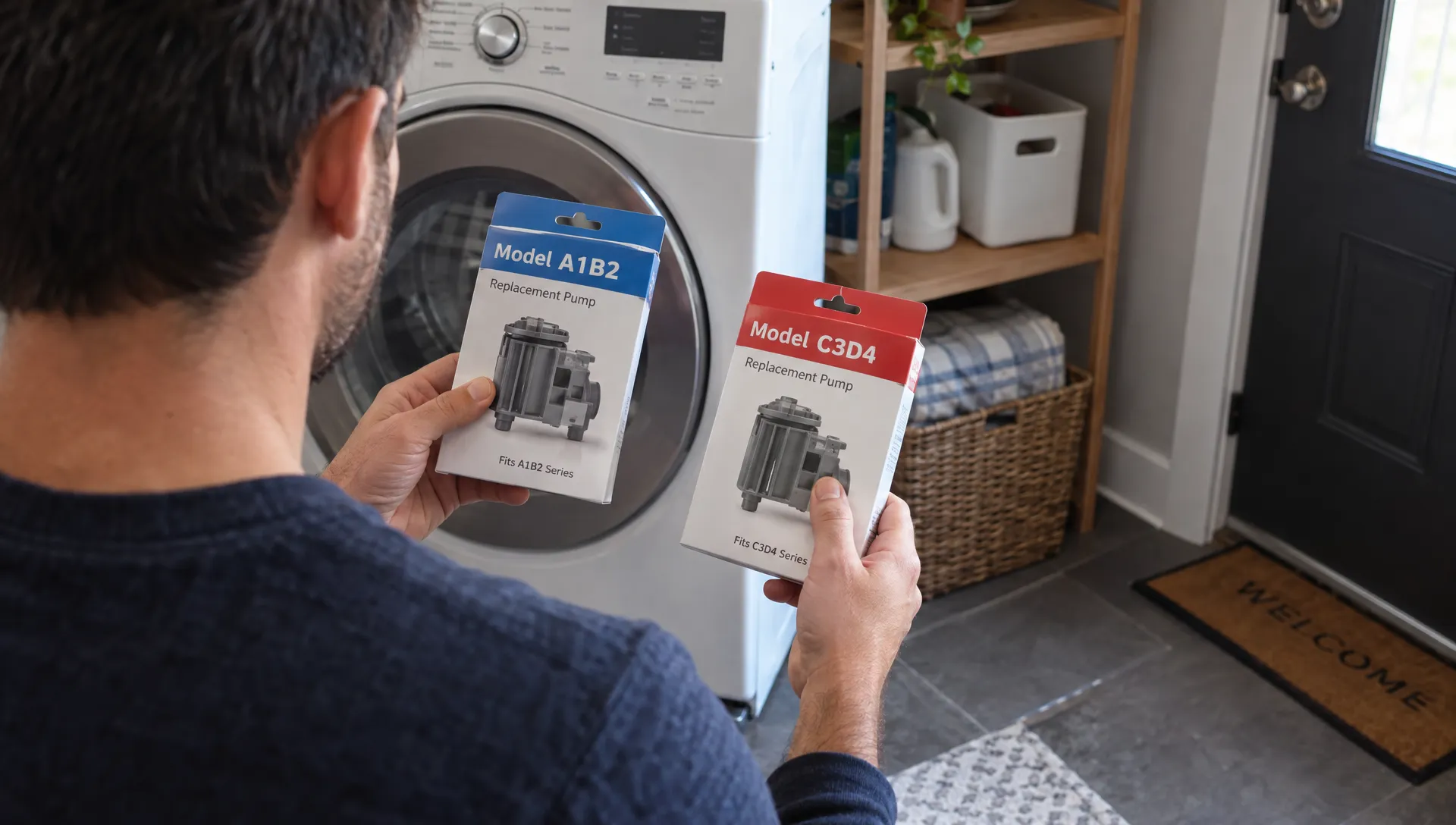
“Consolidate the catalog” can describe several different projects. Combining duplicate product records is not the same as merging domains, collapsing regional stores or replacing separate variant pages with one product detail page.
Write a short scope statement covering the source stores, destination platform, affected markets and business reason for the change. Specify whether product identifiers, category structures, domains and fulfillment rules will change. Include the teams responsible for the product information management system (PIM), inventory and historical order records.
An ecommerce SEO agency should then distinguish catalog identity from search-page identity. Two records can represent the same sellable item while serving different regional or customer needs. Conversely, different tracking URLs may expose the same page and need consolidation without any product-data changes.
For example, merging duplicate color listings may make sense when one product page supports every color. Combining two products with different compatibility requirements may erase information shoppers need to buy correctly.
The agency’s first deliverable should therefore be a dependency map, not a deletion list. It should identify which systems control product records, URLs, redirects, navigation and search visibility, with an accountable owner for each.
Test your “seo agency ecommerce” shortlist with real URL decisions
Give each finalist the same representative sample of URLs and data. Include high-revenue pages, duplicate products, discontinued items, filtered categories and products with variants. A proposed sample of 30 to 50 URLs is enough for an initial judgment test, not a substitute for the full audit.
Ask candidates to recommend a treatment for each URL and explain the evidence behind it. A capable SEO agency for ecommerce should recognize that different cases require different outcomes.
| Catalog situation | Potential treatment | Evidence the agency should examine |
|---|---|---|
| Exact duplicate product pages | Select a surviving page and redirect retired equivalents | Product identity, search demand, links and customer experience |
| Duplicate URLs that must remain accessible | Use consistent canonical signals where appropriate | Content equivalence, internal links and platform constraints |
| Variant pages with distinct buying needs | Retain useful pages or build a complete variant experience | Variant-specific queries, compatibility and selection behavior |
| Temporarily unavailable products | Usually preserve useful product pages | Restocking plans, demand and availability messaging |
| Permanently discontinued products | Redirect only to a meaningful replacement, otherwise consider removal | Replacement relevance, backlinks and remaining customer value |
| Overlapping categories | Merge only when the destination satisfies the same need | Query intent, assortment coverage and navigation |
Google’s guidance on duplicate URL consolidation explains the available canonicalization methods. Canonical annotations are signals, not a guarantee that Google will select the nominated URL.
Reject proposals that send every retired product to the homepage or use one category as a catch-all destination. A technically valid redirect can still be a poor answer for the shopper.
Verify comparable results, not just impressive charts
A successful content campaign does not prove migration competence. Ask for a case involving comparable catalog complexity, platform constraints and implementation responsibility.
The ecommerce SEO agency should distinguish its recommendations from changes it actually implemented. Request dated migration milestones, anonymized performance exports where permitted and a client reference who supervised the work. Confirm whether paid campaigns, promotions, acquisitions or a platform redesign happened during the reporting period.
Evidence should connect the starting condition to the decisions made and the subsequent outcome. A traffic chart without dates, affected page groups or commercial context is insufficient.
For independently checkable details, compare the agency’s account with the client reference and public evidence of URL changes. Archived pages can help corroborate a migration, but they cannot establish revenue impact. Confidentiality may limit what a client shares; it should not prevent the agency from explaining its method clearly.
Ask the reference what broke, how quickly the agency found it and who fixed it. Those answers reveal more about delivery quality than a claim that the project went smoothly.
Match the agency to your platform and internal resources
Platform experience matters when it translates into knowledge of implementation constraints. Ask candidates to explain how your actual setup handles redirects, canonical tags, product variants, filtered navigation and XML sitemaps.
On a hosted platform, some URL structures or routing behaviors may be constrained. In a composable setup, the storefront, commerce engine and content system may each influence the rendered page. Experience with the commerce backend alone does not prove the agency understands the storefront.
If your project involves custom rendering or routing, the questions used to evaluate a headless ecommerce agency also belong in the SEO selection process.
A suitable SEO agency for ecommerce should explain what it needs from your engineers, merchandisers and analytics team. With limited internal engineering capacity, you may need an implementation partner rather than an advisory-only engagement.
Catalog size changes the required approach too. Large inventories need repeatable mapping rules, automated checks and exception handling. A smaller catalog may justify more manual review. Ask how the agency will validate its rules against unusual products rather than applying them blindly across the store.
Require a migration runbook before approving launch
The proposal should describe the runbook the agency will produce and who will execute it. This is where strategy becomes an operational commitment.
Before launch: establish the baseline and mapping rules
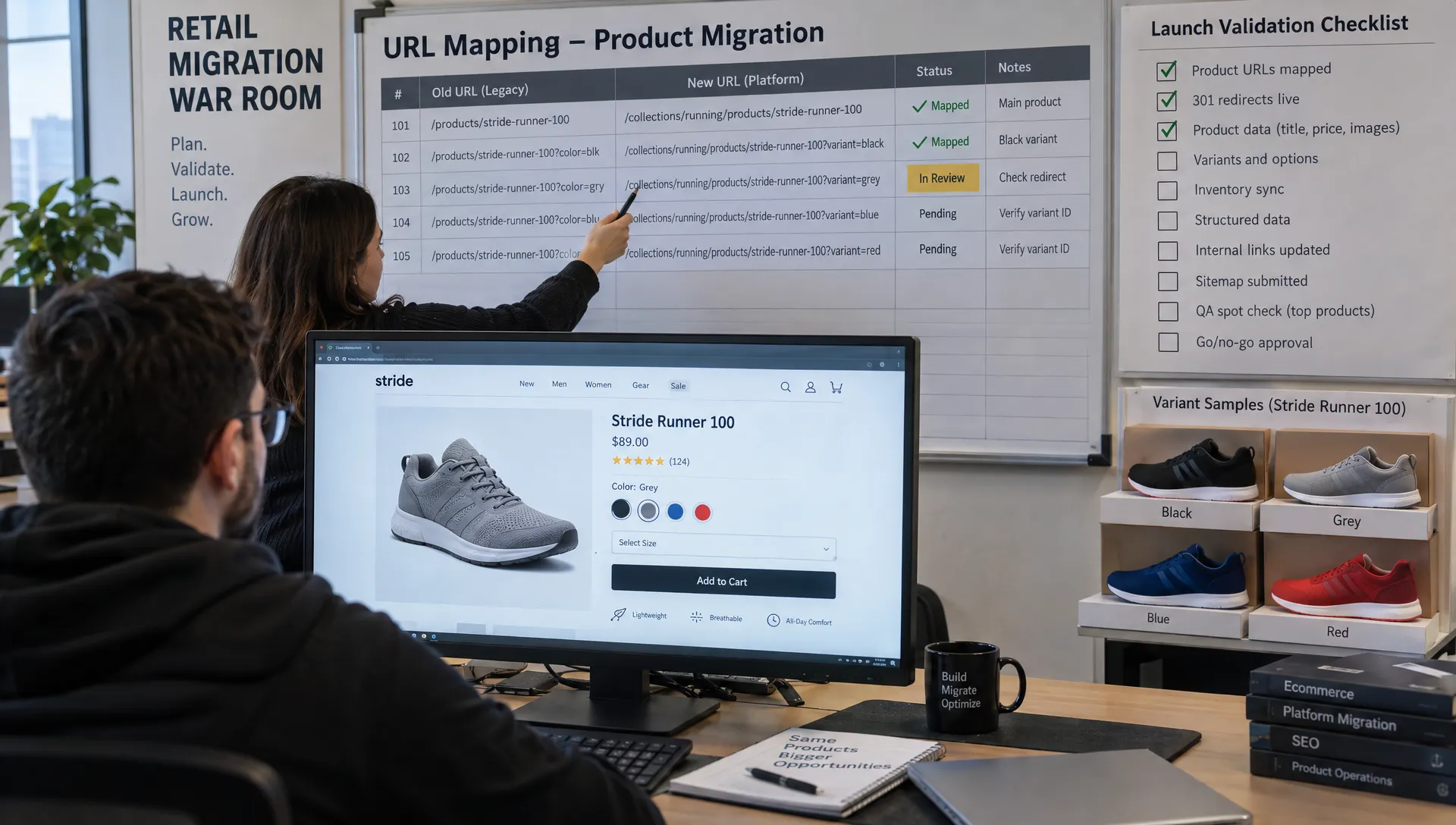
Require a URL inventory assembled from multiple sources, such as crawls, XML sitemaps, Search Console, analytics and available server logs. A crawl alone can miss orphaned pages that still receive search visits or backlinks.
Each affected URL should have a proposed destination or explicit retirement decision, a reason and a validation status. Automated rules need exceptions for valuable pages and ambiguous product matches.
The ecommerce SEO agency should also document baseline performance by page group, device, market and brand versus nonbrand demand where the data allows. Capture category membership and landing-page relationships before they change.
Staging checks should cover rendered content, canonical tags, product structured data, internal links and mobile purchasing flows. Define launch-blocking defects in advance, including accidental indexing restrictions and invalid redirects on commercially important pages.
At launch: validate the complete customer path
Require one accountable launch owner and a shared escalation process across SEO, engineering, merchandising and analytics.
Validation should test old URLs through to their final destinations, not merely confirm that redirect rules exist. Check for loops, unnecessary chains, missing variants and destinations that return errors or cannot be indexed.
Navigation, product feeds, advertising destinations, canonical annotations and sitemaps should point consistently to the intended URLs. Redirects should not become a permanent substitute for updating internal links.
Google’s site-move guidance recommends keeping redirects for at least one year. Longer retention may still make sense for URLs that customers or external sites continue to use.
An SEO agency for ecommerce should also verify that analytics and purchase events survive the change. A broken transaction event can resemble a revenue collapse even when orders continue.
After launch: define stabilization and recovery work
Ask for a monitoring schedule, named owners and escalation thresholds tied to your baseline. The right thresholds depend on traffic volume, seasonality and rollout size, so a universal percentage is not enough.
Monitor old and new URL groups together. Review destination errors, redirect behavior, indexing signals, search impressions, clicks, landing-page conversion and order data. Investigate missing high-value products separately from aggregate trends.
Specify recovery actions for different failures. Reversing a bad mapping may be straightforward; reversing product-data changes after new orders have been placed may not be. A credible recovery plan acknowledges those dependencies.
Where the architecture permits it, staged deployment can reduce exposure and improve diagnosis. It does not eliminate risk, especially when shared templates or navigation affect the entire store.
Measure preserved demand before claiming growth
Consolidation can make reporting look better without creating new business. When three stores become one, the destination site may gain traffic simply because existing visits moved there.
Require the ecommerce SEO agency to compare the combined pre-consolidation business with the combined post-consolidation business. Evaluate source and destination URLs together so transferred traffic is not presented as incremental growth.
Separate technical recovery from commercial performance. Redirect coverage and indexability show whether implementation is functioning. Search visibility, qualified visits, conversion and contribution margin show whether the business is benefiting. These are related measures, not interchangeable ones.
Seasonality, stock availability, promotions and paid media can all influence results. Compare affected page groups with suitable unaffected groups where available, while acknowledging that such comparisons do not automatically prove causation. A full measurement plan should apply the same discipline used to measure ecommerce SEO services against business outcomes.
Revenue attribution also needs a consistent definition. Agree on the analytics attribution model, reporting window, treatment of refunds and cross-domain tracking before launch. Otherwise, a measurement change may be mistaken for an SEO improvement.
Preserving existing organic contribution is a legitimate success metric. Any claim of incremental growth should be supported separately.
Compare total project cost, not just the agency fee
There is no useful universal price for catalog consolidation. Cost depends on URL volume, mapping complexity, platform access, engineering responsibilities, markets and the length of post-launch support.
Ask every finalist to quote against the same scope. Separate discovery, mapping, implementation, quality assurance and stabilization. Clarify whether development, analytics repair, content updates and feed changes are included or assigned to your team.
An SEO agency for ecommerce can appear inexpensive while leaving substantial work outside its proposal. Compare total delivery cost, including internal staff time, temporary platform overlap and remediation capacity. A retainer may support ongoing optimization, but it should not obscure migration-specific deliverables.
Your finance team should review the business case independently of the agency’s traffic forecast. For Australian retailers that need support with project bookkeeping or tax questions, an Australian accounting and tax adviser can address those financial matters separately from the technical assessment.
Model a downside scenario as well as the expected outcome. Include delayed launch, longer stabilization and temporary organic losses. Savings from fewer systems should be weighed against implementation cost and the contribution margin at risk, not just projected revenue.
Put ownership, acceptance and exit conditions in the contract
The contract should make the work usable if the relationship ends. Require delivery of the URL inventory, mapping rules, exception register, redirect files, test results and implementation documentation in accessible formats.
Your business should control its analytics, Search Console and relevant platform accounts. Agency access should be granted through appropriate permissions rather than making the agency the sole account owner.
Define acceptance criteria for each milestone. “Migration complete” is too vague. A stronger definition specifies agreed coverage, validation methods, documentation and resolution of launch-blocking defects. Avoid treating rankings as a guaranteed acceptance condition because neither party controls search results.
The ecommerce SEO agency’s agreement should also identify who fixes mapping errors, what constitutes a scope change and how quickly urgent incidents receive a response. Distinguish defects in agreed work from new requests.
Finally, document termination notice, handover support and any dependencies on proprietary tooling. You should understand whether redirect management or monitoring will stop when the engagement ends. A lower monthly fee is not good value if leaving the agency creates another migration project.
Frequently asked questions
Should we consolidate every duplicate-looking product page? No. Similar pages may address different specifications, markets or purchasing needs. Establish whether they represent the same item and satisfy the same search intent before choosing redirects, canonicalization or separate pages.
How long does SEO recovery take after catalog consolidation? There is no dependable universal timeline. It varies with the scale of the change, crawl activity, implementation quality and changes to content or architecture. Require monitoring checkpoints and recovery actions rather than a guaranteed recovery date.
Can our existing agency manage the consolidation? Possibly. Ask it to complete the same URL decision exercise and runbook review as other candidates. Existing access and brand knowledge are useful, but they do not replace migration experience or engineering capacity.
Can AI automate the URL mapping? AI can help suggest matches and surface exceptions, but plausible-looking matches can still be commercially wrong. An SEO agency for ecommerce should validate mappings using product identifiers, destination relevance and technical checks, with human review for ambiguous or high-value cases.
Is a smaller catalog automatically better for SEO? No. Removing redundant pages can simplify management and crawling, but deleting useful pages can remove relevant landing experiences. The goal is a coherent catalog that serves customer demand, not the lowest possible URL count.
Bring engineering and commercial decisions together
Before awarding the work, ask the finalist to walk through one valuable category, one complicated product family and one failure scenario. Its answers should connect search intent, implementation constraints and financial consequences.
Space Dinosaurs combines retail-focused engineering, human-centered UX, performance optimization and analytics. If catalog consolidation is part of a broader storefront modernization, start with a shared assessment of the systems changing, the customer journeys to preserve and the evidence needed to approve launch.