

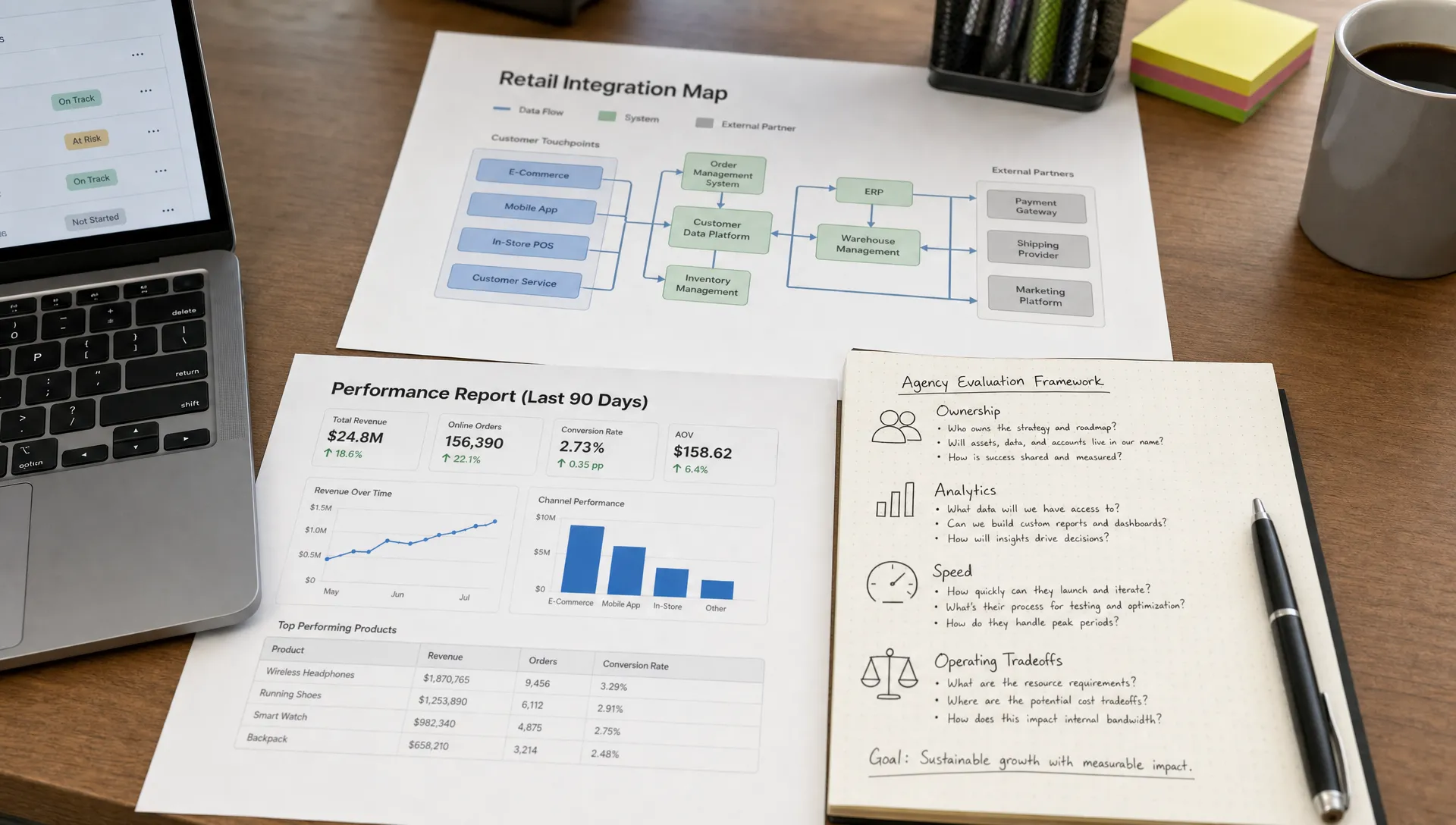
Choosing a headless ecommerce agency is not just a platform decision. It is a bet on how your retail business will ship digital experiences, manage cost, protect site speed and connect merchandising, content, data and operations over time. The right partner should help you decide whether headless is worth the complexity, then design a path that improves customer experience without making your team dependent on fragile custom work.
For retail leaders, the hard part is not finding agencies that can talk about composable architecture. The hard part is separating teams that understand the commercial realities of ecommerce from teams that mainly sell rebuilds. A good selection process should test strategy, technical judgment, UX discipline, analytics ownership and the agency's ability to support the site after launch.
What a headless ecommerce agency should actually own
A headless build separates the customer-facing experience from the commerce back end. That can give a retailer more flexibility, faster front-end experimentation and cleaner integrations across search, CMS, personalization, loyalty, product data and checkout. It can also create more moving parts than a traditional monolithic platform.
That is why the agency's role should go beyond implementation. The partner you choose should help answer three questions before anyone commits to architecture: what business problem are we solving, what operational tradeoffs are we accepting and how will we measure whether the move worked?
The best agencies are comfortable saying no to headless when the business case is weak. They should also be able to explain what remains standard, what becomes custom and which parts of the stack your internal team will need to own. If you are still shaping the bigger picture, Space Dinosaurs' guide to a future-proof headless commerce solution is a useful companion to this agency selection process.
Start with the business case, not the architecture
Clarify the value headless needs to create
Before you evaluate proposals, define why your current ecommerce setup is holding the business back. A capable headless ecommerce agency can translate goals like faster launches, improved site speed, better content control or international flexibility into a practical roadmap. Without that clarity, headless becomes a costly way to recreate the same customer experience with a more complex stack.
Common reasons retailers consider headless include slow page performance, limited design flexibility, difficult content workflows, poor integration between merchandising systems and the need to support multiple storefronts from shared services. Each reason points to different technical choices.
| Business goal | What the agency should clarify | Evidence to request |
|---|---|---|
| Improve speed | Which templates, scripts and data calls are slowing the experience | Performance audit and Core Web Vitals plan |
| Launch content faster | How marketers will create, preview and publish pages | CMS workflow demonstration |
| Support complex retail operations | How product data, inventory, promotions and fulfillment connect | Integration map and risk register |
| Reduce long-term cost | What can remain standard and what needs custom engineering | Total cost of ownership view |
| Improve conversion | Which customer journeys need redesign, testing or simplification | UX findings and measurement plan |
A headless ecommerce agency that cannot explain the connection between architecture and revenue outcomes is asking you to take on risk without a clear return.
Evaluate technical depth without getting buried in jargon
Look for composable architecture judgment
Headless commerce is not one product. It is usually a combination of commerce platform, front end, CMS, search, analytics, hosting, APIs and third-party services. The right headless ecommerce agency should know how to evaluate these components as a system rather than recommending whichever stack it prefers.
Ask how the team decides between buying, configuring and building. Custom code may be justified for a competitive advantage, but it should not become the default answer for routine commerce needs. A strong agency will explain tradeoffs in plain language, including the impact on release velocity, hiring, maintenance, security and future platform changes.
Test performance and reliability thinking
Performance is one of the strongest arguments for headless, but it is not automatic. A beautiful front end can still be slow if data fetching, image delivery, tagging, scripts and personalization logic are poorly handled. A headless ecommerce agency should be able to show how it protects speed from discovery through launch and beyond.
Look for a practical approach to Core Web Vitals, storefront caching, image optimization, third-party script governance, monitoring and incident response. Retail sites also need stability during high-traffic periods, product drops, promotions and seasonal peaks. If an agency treats performance as a final QA task, rather than a design and engineering principle, expect problems later.

Assess retail UX and conversion judgment
The agency should understand how shoppers behave
A headless site gives you more freedom over the experience, but freedom alone does not improve conversion. When a headless ecommerce agency reviews your site, it should examine customer journeys across discovery, product detail pages, cart, checkout, account flows, returns and post-purchase touchpoints.
Pay attention to whether the agency talks about shoppers in concrete terms. For example, a fashion brand may need stronger size guidance and editorial merchandising, while a home goods retailer may need better filtering, bundles and delivery clarity. A B2B or hybrid retailer may need account-specific pricing, saved lists and approval workflows.
Good UX work connects qualitative insight with data. The agency should use analytics, heatmaps where appropriate, search behavior, customer service feedback and merchandising input to find friction. It should also know when not to over-design. Retail customers reward clarity, speed and confidence more than novelty.
Review the discovery process before you review the proposal
Discovery reveals how the partnership will work
The way an agency runs discovery often predicts the quality of the project. Ask each headless ecommerce agency how it will learn your business, audit your stack, identify risks and prioritize work before writing a detailed scope. If discovery is mostly a sales workshop, the proposal may be built on assumptions.
A useful discovery process should cover business goals, customer journeys, technical architecture, data flows, content operations, analytics, SEO requirements, accessibility, team responsibilities and launch constraints. It should also produce decisions, not just documentation. You need to know what will be built now, what can wait and what should not be built at all.
AI may be part of discovery and delivery, especially for research synthesis, QA support, personalization concepts, content operations or workflow automation. The important question is governance. For a useful parallel, Founder Engine's article on how an agentic marketing agency should work with your team explains why AI-enabled workflows need clear ownership, bounded use cases and human approval for higher-risk decisions.
Ask questions that expose real capability
You do not need to become a solutions architect to evaluate the agency. You do need questions that force clarity.
- Which parts of our current stack would you keep, replace or simplify?
- What are the biggest risks in our catalog, checkout, integrations or content model?
- How will you protect SEO during a migration?
- What performance targets will you commit to influencing?
- What will our internal team need to learn or own after launch?
- How do you handle bugs, monitoring and optimization after the first release?
- Where would you recommend against headless for our business?
The answers should be specific to your business. Reused decks and generic architecture diagrams are not enough.
Check delivery model, governance and post-launch support
A launch is not the finish line
A dependable headless ecommerce agency should have a delivery model that fits how your retail team actually works. Some brands need a full project squad. Others need a partner that can integrate with internal product owners, engineers, marketers and merchandising teams. In either case, responsibilities must be clear.
Ask who owns product strategy, UX decisions, solution architecture, sprint planning, QA, release management, analytics validation and post-launch optimization. If several vendors are involved, the agency should explain how it will collaborate rather than create handoff gaps.
You should also understand the agency's maintenance approach. Headless systems need ongoing care across dependencies, APIs, front-end frameworks, integrations, analytics tags and platform updates. Cost optimization matters too. A technically elegant stack that is expensive to operate can become a burden within a year.
Measurement should connect to commercial decisions
Analytics cannot be an afterthought. Your partner should define measurement before launch, including events, funnels, dashboards, QA processes and KPI ownership. Traffic, conversion rate, average order value, revenue per session, search usage, add-to-cart rate and checkout completion may all matter, but the right mix depends on your model.
The agency should also explain how data will be used after launch. A measurement plan only has value if it supports decisions about UX, merchandising, content, performance and roadmap priorities.
Watch for red flags in proposals and sales calls
Beware of platform-first recommendations
If a headless ecommerce agency promises transformation before understanding your operations, catalog complexity or internal capacity, slow down. Headless is not automatically more modern, cheaper or faster. It can be the right move for retailers that need flexibility and performance, but it must fit the team that will operate it.
Other warning signs include vague ownership, no migration plan, no SEO safeguards, little interest in analytics, weak QA process, overreliance on custom code, avoidance of cost discussions and case studies that only show visual design. If you want a broader evaluation lens, Space Dinosaurs has a separate guide to ecommerce agency red flags retail brands should avoid.
Do not confuse headless experience with retail expertise
An agency can know the technology and still miss the retail realities. Promotions, product feeds, variant logic, stock visibility, returns, gift cards, loyalty, customer accounts and marketplace integrations can all affect the customer experience. The stronger partner will ask detailed questions about these operational layers because they shape the storefront.
You also want a team that can communicate with non-technical stakeholders. Merchandising, ecommerce, marketing, finance and customer service teams all live with the consequences of architecture decisions.
Use a simple scorecard to compare agencies
Make the decision visible
Once you have two or three serious options, compare them against the same criteria. This prevents the loudest sales pitch or most polished mockup from winning by default.
| Evaluation area | What strong looks like | Warning sign |
|---|---|---|
| Strategy | Clear business case and tradeoff discussion | Starts with technology preferences |
| Retail UX | Journey-specific recommendations tied to data | Focuses mainly on visuals |
| Architecture | Explains integrations, dependencies and ownership | Uses vague composable language |
| Performance | Builds speed into design, engineering and monitoring | Treats speed as post-launch cleanup |
| Analytics | Defines events, KPIs and decision process | Mentions dashboards without governance |
| Delivery | Clear roles, cadence, QA and release process | Unclear handoffs between teams |
| Support | Practical optimization and maintenance plan | Disappears after launch |
The best choice is rarely the cheapest proposal or the most ambitious build. It is the partner with the clearest path from current constraints to measurable retail improvement.
Frequently Asked Questions
What should a headless ecommerce agency do? It should help define the business case, design the technical architecture, build or integrate the storefront, protect performance, support UX decisions, plan analytics and maintain the experience after launch.
Is headless ecommerce always better than a traditional platform? No. Headless is useful when flexibility, performance, content control or integration complexity justify the added operational responsibility. Some retailers are better served by improving their existing platform first.
How long does it take to choose the right agency? Many retailers can create a shortlist within a few weeks, but a serious selection process should include discovery conversations, technical review, commercial comparison and stakeholder alignment before signing.
What is the biggest risk when choosing a headless partner? The biggest risk is choosing for technical excitement rather than operational fit. The stack must match your team's capacity, commercial goals, budget and post-launch roadmap.
Build a headless path that your retail team can operate
Choosing the right partner means looking past front-end polish and asking how the agency will help your business grow, adapt and run the experience every day. The decision should leave you with a clearer architecture, faster customer journeys, better data and fewer operational surprises.
If you are evaluating a headless build, Space Dinosaurs helps retail brands modernize ecommerce experiences with AI-enabled engineering, human-centered UX, performance optimization, analytics and ongoing improvement. Bring the business problem first, then choose the architecture that serves it.