

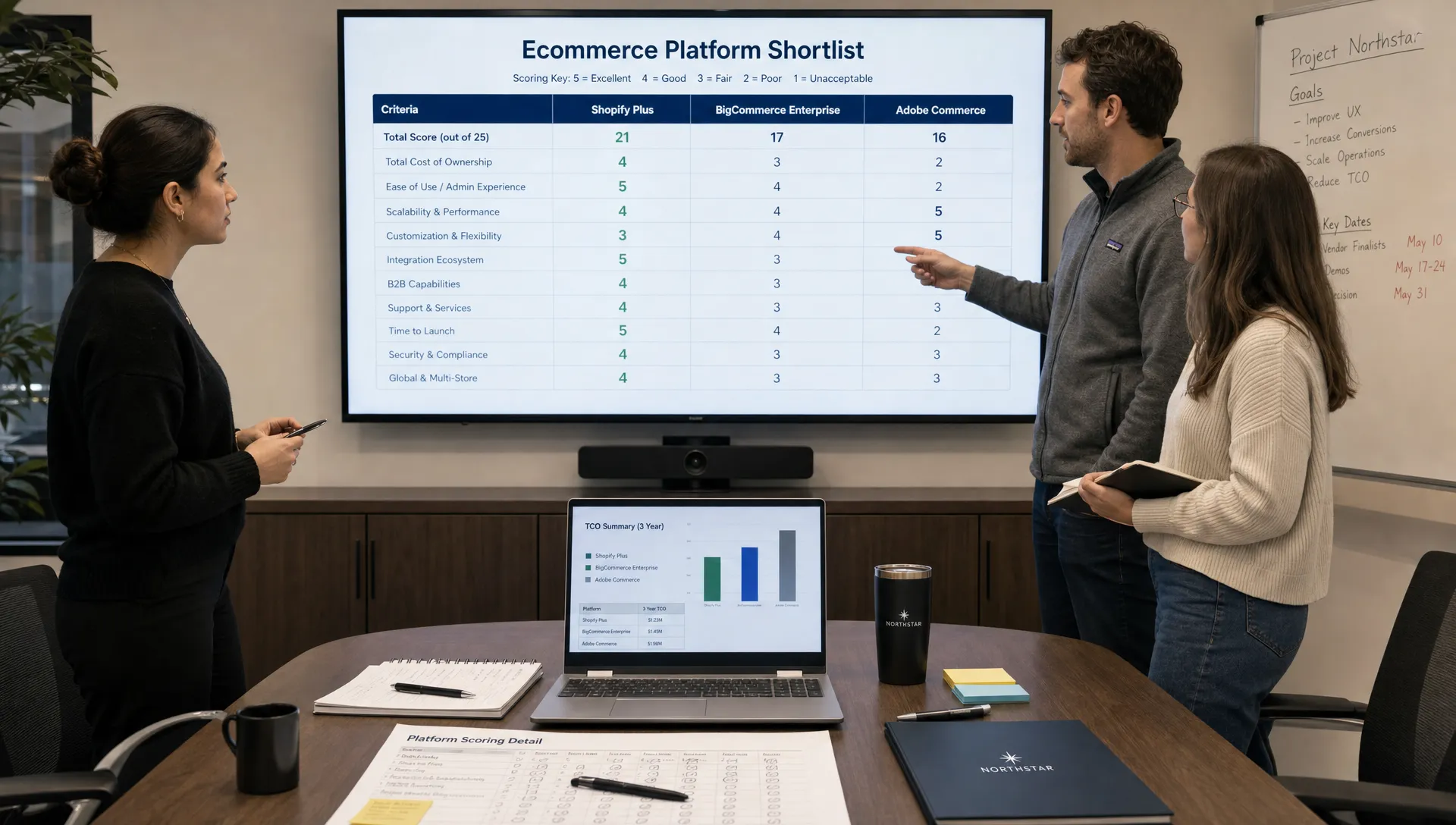
For enterprise retail, choosing a digital commerce platform is not just a technology decision. It affects merchandising speed, site performance, checkout conversion, international expansion, AI readiness, operational cost and the daily work of teams across ecommerce, stores, marketing, finance and customer service.
The wrong choice often looks fine during vendor demos, then becomes expensive when real retail complexity appears. The right choice does not simply have the longest feature list. It fits the retailer’s growth model, integrates cleanly with the operating environment and gives teams enough flexibility to improve the customer experience without creating constant engineering debt.
What a digital commerce platform must prove in enterprise retail
An enterprise platform has to handle more than online transactions. It needs to support the way a retailer sells, fulfills, promotes, analyzes and adapts. A luxury brand with curated drops, a multi-brand marketplace, a grocery chain, a B2B distributor and a fashion retailer with thousands of SKUs do not need the same commerce architecture.
A digital commerce platform should be evaluated against the business model before it is evaluated against a vendor checklist. If the platform cannot support how the company earns margin, manages assortment and serves customers across channels, technical elegance will not save it.
Enterprise retailers should begin by documenting where revenue growth is expected to come from. That might include faster international launches, improved mobile conversion, lower cost to serve, better personalization, store-assisted selling, subscriptions, marketplace expansion or stronger loyalty economics.
Start with the operating model
Before comparing platforms, map the decisions that will shape daily operations. This prevents the selection process from being dominated by surface-level features that may not matter after launch.
| Business question | Why it matters for platform choice |
|---|---|
| How fast do teams need to launch campaigns, markets and categories? | Determines CMS, localization, catalog and deployment requirements |
| How complex are promotions, pricing and inventory rules? | Shapes the need for native capabilities, custom logic or specialized services |
| Which systems own product, customer, order and stock data? | Defines integration depth and data governance |
| How important are speed, SEO and mobile experience to revenue? | Raises the importance of front-end architecture and performance engineering |
| How much control do internal teams need? | Influences admin usability, workflow design and dependency on developers |
For a broader view of how retail transformation should start with business outcomes rather than technology alone, Space Dinosaurs’ roadmap for digital transformation in retail is a useful companion framework.
Core criteria for enterprise platform evaluation
Enterprise buyers often compare platforms using RFP spreadsheets with hundreds of rows. That can be useful, but only if the scoring reflects commercial priorities. A digital commerce platform should be assessed across architecture, performance, integrations, experience management, AI readiness, operational cost and long-term stability.
The goal is not to find a system that does everything out of the box. The goal is to understand where the platform should be standard, where the business needs differentiation and where customization would create avoidable cost.
Architecture and composability
Architecture determines how easily a retailer can change. Traditional suite platforms offer many capabilities in one ecosystem, which can reduce vendor sprawl and simplify procurement. Composable architectures allow teams to combine best-fit services through APIs, which can improve flexibility but requires stronger governance.
Neither approach is universally better. A retailer with limited internal engineering capacity may benefit from a more integrated suite. A retailer with several brands, markets or differentiated customer journeys may need composable services for search, CMS, personalization, checkout or promotions.
The practical question is how much independence each layer needs. If front-end teams cannot improve product discovery without waiting on back-end release cycles, growth slows. If every capability is assembled from separate services without clear ownership, operating cost climbs.
Performance and Core Web Vitals
Retail platforms must be fast under real traffic conditions, not just in controlled demos. Product listing pages, search results, cart, checkout and account pages should be tested with the scripts, tags, personalization rules and media assets the site will actually run.
A digital commerce platform should support performance engineering across the full stack. That includes front-end rendering strategy, image optimization, caching, API response times, third-party tag management and stable checkout behavior during peak demand.
Core Web Vitals matter because they reflect real user experience signals: loading speed, interactivity and visual stability. More important, poor performance creates measurable friction. Enterprise retailers should ask vendors and implementation partners how performance budgets are enforced after launch, not just how the site will be optimized before go-live.
Customer experience requirements come before feature lists
Retail platform selection should be grounded in the buying journey. Customers do not care whether a feature is native, customized or integrated. They care whether they can find the right product, understand it, trust availability, pay without friction and receive support when something changes.
This is where enterprise evaluation often becomes too technical too soon. A digital commerce platform may look strong on architecture but still fail if merchandising teams cannot build landing pages quickly, if product data is inconsistent or if checkout introduces avoidable steps on mobile.
Product discovery and merchandising control
Search, navigation, filters, recommendations and merchandising rules have a direct effect on conversion. Retailers should test how easily teams can promote seasonal categories, pin products, handle out-of-stock items, personalize search results and create landing pages without engineering work.
The same applies to content. Product education, editorial storytelling, fit guidance, comparison content and service information all influence buying confidence. A platform that separates commerce from content too rigidly can make it harder to build high-converting experiences.
Service-led retail is a useful reminder that commerce journeys are not always simple SKU-to-cart flows. A salon brand such as Kingdom Cute Hair Salon combines services, appointment intent, styling information and product presentation, which shows why platform teams should account for hybrid journeys when product sales, booking and content all influence conversion.
Checkout and post-purchase experience
Checkout must match the retailer’s customer, risk profile and fulfillment model. Enterprise requirements may include saved payment methods, multiple shipping options, split shipments, buy online pick up in store, gift cards, loyalty redemption, fraud checks, tax handling and regional payment methods.
Post-purchase capability matters just as much. Customers expect accurate order updates, easy returns, clear inventory communication and support that reflects the same order data they see online. Weak post-purchase integrations create support volume, refund delays and customer frustration.
For a focused look at removing friction across the purchase path, Space Dinosaurs covers practical examples in its guide to electronic commerce solutions that improve buying journeys.

Integration depth is where enterprise complexity appears
Most platform failures are not caused by missing buttons in the admin interface. They are caused by underestimated integrations. ERP, PIM, OMS, CRM, CDP, loyalty, tax, payment, fraud, warehouse, store systems and analytics tools all shape the real customer experience.
A digital commerce platform should be evaluated by how cleanly it exchanges data with these systems and how resilient those flows are when something fails. Retail is full of exceptions: partial inventory, delayed fulfillment, regional tax rules, customer service adjustments and promotional edge cases.
Data ownership and governance
Enterprise retailers need clear answers to basic data questions. Which system owns product attributes? Where does customer consent live? What is the source of truth for inventory availability? How are prices synchronized across regions and channels?
If these ownership rules are unclear, the platform becomes a place where teams patch data problems manually. That creates slow launches, inconsistent reporting and customer-facing errors.
Strong governance does not require every data source to live in one system. It requires clear ownership, reliable synchronization, monitoring and fallback rules. The platform should make data usable for commerce teams without forcing every change through engineering.
Analytics and KPI tracking
Analytics should not be treated as a post-launch tagging task. Enterprise retailers need measurement built into the platform roadmap from the beginning. That includes conversion rate, revenue per session, search performance, promotion impact, margin, return rate, fulfillment performance, page speed and customer lifetime value.
Retail leaders should also define how success will be measured by team. Merchandising, acquisition, retention, UX, engineering and operations do not optimize the same metric. A platform program is healthier when every team understands which KPIs the new system is meant to improve.
AI readiness should be practical, not decorative
AI is becoming part of retail operations, but platform selection should avoid vague promises. The useful question is not whether a vendor “has AI.” It is whether the data, workflows and architecture can support AI-enabled use cases that improve customer experience or operational efficiency.
A digital commerce platform should make it possible to test practical applications such as conversational commerce, product recommendations, automated content assistance, customer service support, merchandising insights and anomaly detection. These depend on clean product data, customer context, consent management and integration with the systems that execute decisions.
Conversational commerce and guided selling
Conversational commerce is most useful when it helps customers make decisions, not when it adds a chat window to a broken journey. For enterprise retailers, this may mean guided product discovery, size and fit support, compatibility checks, post-purchase service or store associate assistance.
The platform does not need to own every AI capability natively. It does need APIs, event data, catalog access and governance strong enough to support AI services safely. Retailers should ask how AI tools will access product availability, pricing, promotions and customer context without creating compliance or accuracy risks.
Content and merchandising automation
AI can also support internal productivity. Product descriptions, SEO metadata, campaign variations and merchandising insights can be accelerated when teams have good workflows and review controls. The risk is publishing low-quality or inaccurate content at scale.
Enterprise teams should define where automation is allowed, where human approval is required and how brand standards are enforced. AI works best when it reduces repetitive work while leaving judgment, taste and commercial decisions with the people responsible for outcomes.
Total cost of ownership is bigger than license fees
License cost is only one part of platform economics. Implementation, integrations, hosting, third-party services, agency support, internal staffing, performance maintenance, upgrade paths and incident response all affect the full cost over time.
A digital commerce platform may appear cheaper in procurement but become expensive if every promotion needs custom development or if teams require workarounds for daily tasks. Another platform may carry a higher subscription cost but reduce maintenance and operational drag.
Build the cost model around change
Enterprise retailers should model the cost of common business changes, not just the cost of launch. How expensive is it to open a new market? Add a payment method? Launch a new brand? Rework checkout? Integrate a loyalty provider? Improve performance after adding new marketing tags?
The cost of change is often the clearest indicator of platform fit. If the business strategy depends on fast experimentation, the architecture and operating model must support frequent iteration. If the strategy depends on stability at scale, operational resilience may matter more than maximum flexibility.
Compare platform types honestly
The table below is not a substitute for due diligence, but it can help enterprise teams frame the tradeoffs before building a shortlist.
| Platform direction | Often fits best when | Watch carefully for |
|---|---|---|
| Integrated enterprise suite | The business wants broad native capability and centralized vendor management | Customization limits, release complexity and front-end flexibility |
| SaaS enterprise platform | Speed to market, operational simplicity and lower maintenance are priorities | Deep B2B, multi-region or highly custom workflow requirements |
| Composable stack | The retailer needs best-fit services and differentiated journeys across brands or markets | Governance, integration ownership and total operating cost |
| Headless front end with existing back end | Experience speed and UX flexibility are the main constraints | API limits, legacy bottlenecks and split responsibility |
Space Dinosaurs has also published a practical comparison of enterprise ecommerce platforms including SFCC, Shopify Plus and SCAYLE for teams that need a more vendor-specific view.
Migration planning is part of platform selection
A platform decision is not complete until the migration path is credible. Enterprise retailers must protect revenue while moving catalogs, customers, orders, integrations, SEO signals, analytics and operational workflows into a new environment.
A digital commerce platform should be chosen with implementation risk in mind. The best platform on paper can still fail if the migration requires a “big bang” cutover the organization cannot support.
Phase the rollout around risk
Retailers should identify which parts of the business can move first with manageable impact. That may be one brand, one region, one category, a new front end or a specific journey such as content pages before checkout.
Phasing is not about moving slowly. It is about reducing avoidable risk and learning before the most revenue-critical parts of the business are affected. A phased rollout also gives teams time to validate analytics, operational workflows and performance under real customer behavior.
Protect SEO and measurement continuity
Platform migrations can damage organic traffic if URLs, redirects, metadata, internal linking, structured data and page speed are not handled carefully. Measurement can also break if analytics events change without clear mapping.
SEO and analytics teams should be involved early in the platform program. They need time to audit current performance, define migration requirements and test the new environment before launch. Treating these areas as final QA tasks is a common and costly mistake.
Questions to ask before signing a platform contract
The final shortlist should be tested against real operating scenarios. Vendor demonstrations are useful, but enterprise retailers should ask for proof using their own requirements, data samples and edge cases.
A digital commerce platform should be able to demonstrate how the retailer’s teams will work after launch. That means showing the admin experience, release process, integration monitoring, merchandising workflows, reporting and support model, not only the customer-facing storefront.
Use these questions to keep the decision grounded:
- Can the platform support our next three years of growth without major replatforming?
- Which capabilities should remain native and which should be handled by specialist tools?
- How will the platform maintain speed as content, scripts and personalization increase?
- What work will business teams be able to do without developers?
- Where are customizations likely and how will they be governed?
- What happens when an integration fails during peak trading?
- How will analytics, experimentation and KPI ownership work after launch?
- What skills will our internal team need to operate the platform well?
These questions expose the difference between a system that demos well and one that can run a complex retail business reliably.
A practical decision framework for enterprise retailers
A strong selection process moves from strategy to operating model, then to platform architecture and implementation planning. It does not start with vendor preference.
The simplest way to choose a digital commerce platform is to score each option against four realities: how the business grows, how teams work, how systems connect and how fast the customer experience must improve. If a platform is weak in one of those areas, the risk should be visible before contracts are signed.
Enterprise retailers should also involve the right stakeholders early. Ecommerce, stores, IT, merchandising, marketing, finance, customer service, legal and operations all experience the platform differently. Their input prevents the decision from being optimized for one team while creating hidden costs for another.
The final decision should produce more than a vendor name. It should produce a roadmap: what launches first, what changes later, which KPIs will be improved, who owns each capability and how the platform will be optimized after go-live.
Frequently Asked Questions
What is a digital commerce platform for enterprise retail? A digital commerce platform is the technology foundation that supports online selling, product discovery, checkout, customer experience, integrations, analytics and operational workflows across retail channels.
How long does enterprise platform selection usually take? The timeline depends on stakeholder complexity, procurement rules, integration depth and migration risk. Many enterprise retailers need several months to define requirements, compare vendors, validate architecture and plan implementation responsibly.
Should enterprise retailers choose composable commerce? Composable commerce is a good fit when a retailer needs flexibility across brands, markets or differentiated customer journeys. It is less suitable when the organization lacks the governance, integration ownership or technical capacity to manage multiple services well.
What is the biggest mistake in platform selection? The biggest mistake is choosing based on feature checklists without mapping the platform to business goals, operating workflows, integration needs and total cost of ownership.
How should retailers evaluate AI capabilities in a platform? Retailers should focus on practical AI readiness: data quality, API access, consent controls, merchandising workflows, conversational commerce use cases and human review processes. Generic AI claims are not enough.
Make the platform decision easier to execute
Choosing the right platform is only the start. Enterprise retailers also need a realistic roadmap, strong UX decisions, performance engineering, analytics discipline and an operating model that keeps improving after launch.
Space Dinosaurs helps retail brands modernize ecommerce experiences, improve performance, support composable stacks and apply AI where it creates practical value. If your team is evaluating a platform decision or preparing for a migration, Space Dinosaurs can help turn the strategy into a buildable plan.