

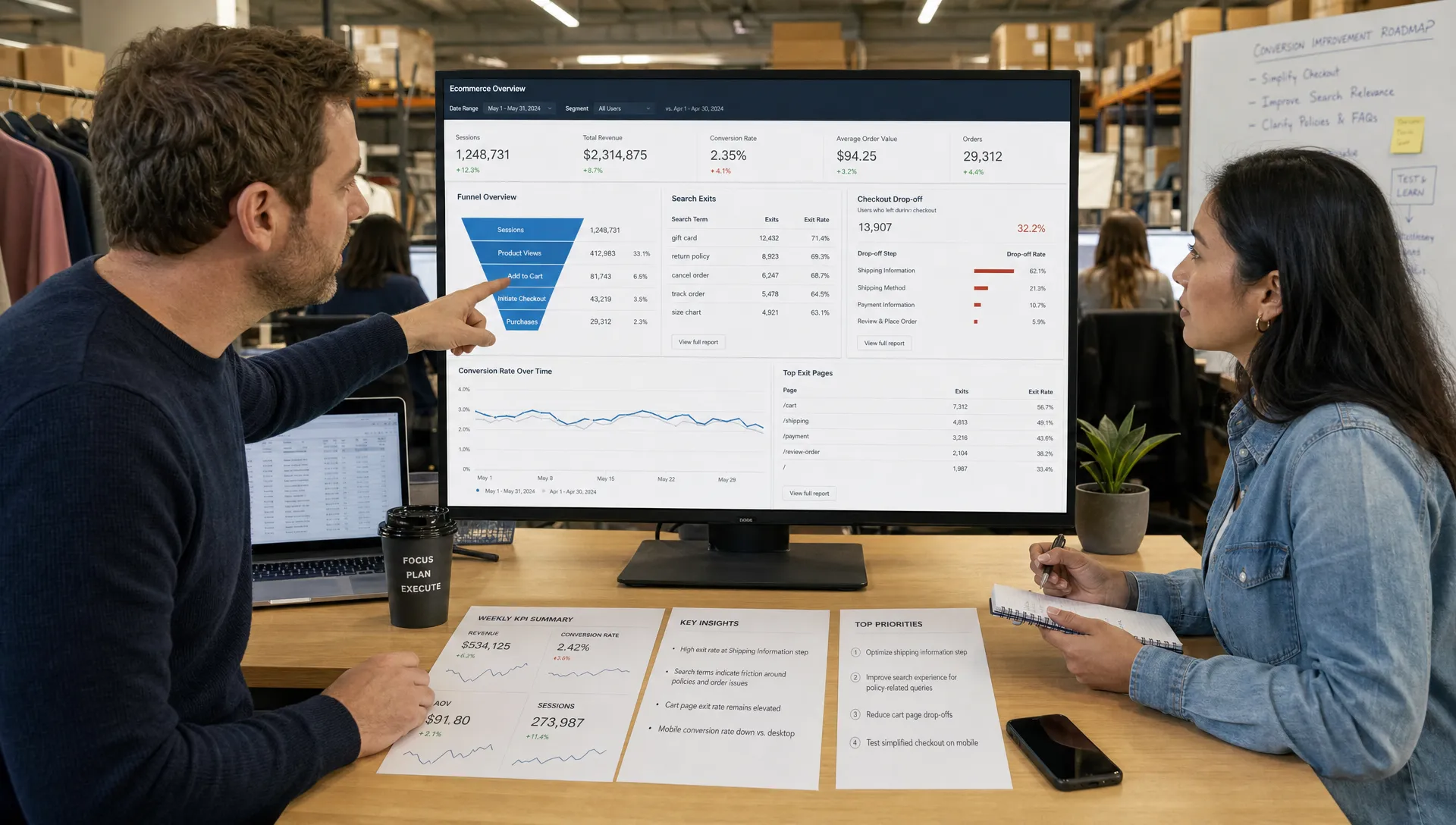
High-traffic stores do not usually have a traffic problem. They have a precision problem: too many customer paths, too many competing priorities and too much revenue at stake to rely on scattered A/B tests. A strong conversion optimization strategy gives retail teams a repeatable way to diagnose where shoppers hesitate, rank fixes by commercial impact and improve the experience without destabilizing the store.
For a smaller ecommerce site, a single product page tweak may take weeks to prove. For a high-traffic retailer, the same change can generate data quickly, but speed cuts both ways. A bad experiment can burn margin, confuse loyal customers or add technical debt across thousands of sessions per hour. The goal is not to test more. The goal is to make better decisions with the traffic you already have, especially where small lifts compound into meaningful revenue.
Build a conversion optimization strategy around revenue leaks
High-traffic stores should start with leaks, not ideas. A leak is any point where shoppers who show intent fail to move forward for a reason the business can influence. That could be weak product discovery, slow collection pages, unclear delivery messaging, missing payment options, stock visibility issues or promotions that create doubt instead of urgency.
This is why conversion work should sit close to analytics, merchandising, UX, engineering and trading teams. A conversion issue is rarely only a design issue. It may involve data quality, search rules, inventory logic, frontend performance, pricing, creative content or checkout configuration.
A useful starting point is to compare business-critical journeys by revenue exposure. Which categories get the most sessions? Which product detail pages have high views but low add-to-cart rates? Which checkout steps create the most abandonment? Space Dinosaurs has written separately about finding hidden revenue in existing traffic, and the same principle applies here: prioritize the places where intent is already present.
Diagnose behavior before choosing tactics
The first diagnostic layer is measurement. Every major action should be tracked consistently across devices, channels and templates. High-traffic teams often have plenty of dashboards, but the data is not always shaped for conversion decisions.
A practical event model should cover product list impressions, search usage, filter engagement, product detail views, size or variant selection, add-to-cart actions, cart edits, checkout starts, payment errors and completed purchases. It should also capture the context around those actions, such as device type, traffic source, customer status, product category and stock state.
Without this data layer, a conversion optimization strategy becomes a sequence of opinions. With it, the team can separate symptoms from causes. A low checkout completion rate after a marketing campaign may look like a checkout issue, but segmentation might reveal that the real problem is low-intent traffic from a discount-heavy acquisition source.
Segment by intent, not just demographics
High-traffic stores can afford to segment more deeply because sample sizes are usually large enough to reveal meaningful differences. The most useful segments are often behavioral rather than demographic.
Returning customers may respond differently than first-time visitors. Paid social traffic may need stronger reassurance than organic search traffic. Mobile shoppers may abandon because of speed or input friction, while desktop shoppers may leave because comparison information is weak. Category-level behavior matters too, especially when considered purchases and impulse purchases share the same storefront.
The key is to avoid averaging away the problem. A storewide conversion rate can look stable while a high-margin category, VIP customer segment or mobile checkout flow quietly underperforms.
| Revenue leak | Questions to answer | Typical intervention |
|---|---|---|
| High search exits | Are shoppers finding relevant results? | Improve search synonyms, ranking rules and zero-result pages |
| PDP views without add-to-cart | Is the value proposition clear enough? | Strengthen imagery, sizing, delivery, reviews and product content |
| Cart abandonment | Are costs or delivery dates surprising? | Clarify shipping, returns, promotions and payment options earlier |
| Checkout errors | Are failures technical or behavioral? | Fix validation, payment reliability and form usability |
| Low repeat purchase | Are post-purchase journeys connected? | Improve replenishment reminders, loyalty prompts and lifecycle messaging |
Prioritize by revenue impact and risk
High-traffic stores usually have more ideas than release capacity. Prioritization protects the roadmap from loud opinions and shiny tools. A clear scoring model keeps the team focused on fixes that are large enough to matter, fast enough to validate and safe enough to ship.
A simple model can score each opportunity against impact, confidence, effort and risk. Impact estimates the size of the upside. Confidence reflects the strength of evidence from analytics, research or customer feedback. Effort covers design, engineering, QA and operational complexity. Risk considers margin pressure, brand impact, technical stability and downstream effects.
A mature conversion optimization strategy does not automatically favor the easiest ideas. It favors the best tradeoffs. For example, simplifying promo messaging on high-traffic PDPs may beat a full checkout redesign if it reaches more shoppers, ships faster and has clearer evidence behind it.
For retail teams that want a broader tactical view, Space Dinosaurs covers practical levers in its guide to ecommerce conversion rate optimization that actually works. The strategic layer is deciding which of those levers deserves attention now.

Run experiments like a product system
High traffic gives teams the ability to test quickly, but it also increases the cost of sloppy experimentation. Each test should have a clear hypothesis, a defined audience, a primary metric, guardrail metrics and a decision rule before it goes live.
The primary metric should match the problem. A product discovery test may use product view rate, search refinement rate or revenue per session. A checkout test may focus on completion rate, payment success or drop-off by step. Guardrails protect the business from false wins, such as a conversion lift that lowers average order value, increases returns or hurts margin.
A reliable conversion optimization strategy also needs testing hygiene. Avoid overlapping experiments on the same audience unless the interaction is intentional. Keep a shared experiment log so future teams know what was tested, what changed, who was exposed and what decision was made. Losing institutional memory is one of the most expensive forms of CRO waste.
Combine quantitative and qualitative evidence
Analytics can show where shoppers leave, but it rarely explains the full reason. Session recordings, onsite surveys, usability testing, customer service transcripts and product reviews can clarify the friction behind the numbers.
This matters for high-traffic stores because small misunderstandings scale quickly. If thousands of shoppers misread a promo, miss a size guide or fail to notice delivery cutoffs, the revenue impact can be material. Qualitative research helps teams write better hypotheses and avoid tests that only rearrange surface elements.
Fix speed and stability before polishing the interface
Performance is not a cosmetic issue for high-traffic retail. It affects discoverability, customer trust, paid media efficiency and checkout completion. Google’s Core Web Vitals framework focuses on loading performance, responsiveness and visual stability through metrics such as Largest Contentful Paint, Interaction to Next Paint and Cumulative Layout Shift.
The best conversion optimization strategy treats speed as a revenue lever, not an engineering cleanup project. Teams should prioritize high-value templates first, such as home, collection, search, PDP, cart and checkout entry pages. Improvements to these surfaces affect more sessions and usually create clearer commercial returns.
Common fixes include reducing unused JavaScript, compressing media, improving image loading, limiting third-party scripts, stabilizing layout shifts and monitoring performance by device. Space Dinosaurs explains these priorities in more detail in its guide to website speed optimization fixes that improve conversions.
Stability matters just as much as raw speed. A fast page that breaks variant selection, cart updates or payment interactions will still leak revenue. For high-traffic stores, QA should cover real customer journeys, major devices, browser combinations, payment methods and peak trading conditions.
Improve the journeys closest to purchase
Once measurement, prioritization and performance are in place, focus on the highest-intent journeys. These are the paths where shoppers have already shown commercial interest, such as internal search, collection filtering, PDP comparison, cart review and checkout.
Product discovery should help shoppers narrow choice without feeling trapped. Search results should tolerate common wording, misspellings and category language. Filters should match the way customers shop, not only the way the catalog is structured. Sorting rules should balance relevance, availability, margin and merchandising goals.
Product pages should reduce uncertainty. High-traffic retailers should pay close attention to product imagery, variant selection, stock messaging, delivery dates, return clarity, reviews, fit guidance and promotion logic. The goal is not to add every possible module. The goal is to answer the questions that block purchase.
Checkout should be boring in the best way. Shoppers need clear costs, trusted payment options, minimal form friction and recoverable errors. Any surprise introduced late in the journey is more damaging because the customer has already invested time.
Use AI where it reduces decision effort
AI can support conversion work, but it should not be treated as a shortcut around strategy. The strongest use cases reduce customer effort or operator effort in ways that can be measured. Examples include smarter product recommendations, guided selling, onsite search improvements, customer service triage, review summarization, automated merchandising support and anomaly detection.
An effective conversion optimization strategy evaluates AI by the same standards as any other initiative: impact, confidence, effort and risk. A guided product finder may be valuable if shoppers struggle to choose between complex products. Automated service triage may be more valuable if pre-purchase questions regularly block checkout. AI-generated content may help at scale, but only if quality controls protect accuracy and brand trust.
For Shopify teams assessing automation opportunities, this guide to choosing a consultant IA pour e-commerce Shopify provides a useful lens on sales, service and logistics use cases in 2026.
AI should also support internal decision-making. High-traffic stores generate enough behavioral data to detect unusual conversion drops, search failures, checkout errors and category-level performance shifts quickly. The advantage is not replacing human judgment. It is giving teams better signals sooner.
Turn optimization into an operating rhythm
The biggest conversion gains usually come from continuity. One successful test helps, but a repeatable operating rhythm compounds learning across seasons, campaigns and platform changes.
A mature conversion optimization strategy should define who owns the roadmap, how opportunities are submitted, how tests are approved, how results are interpreted and how winning changes are rolled into the product backlog. It should also clarify what happens when a test is inconclusive, because inconclusive tests still teach teams about measurement, audience behavior or hypothesis quality.
A useful 90-day operating plan can look like this:
| Timeframe | Focus | Output |
|---|---|---|
| Days 1 to 30 | Audit analytics, funnel performance, speed and customer friction | Ranked opportunity map |
| Days 31 to 60 | Launch tests on high-intent journeys and fix clear technical blockers | Experiment results and shipped fixes |
| Days 61 to 90 | Scale winners, document learnings and refine the roadmap | Operating cadence and next test backlog |
This rhythm also prevents CRO from becoming a campaign-only activity. Retail traffic changes with seasonality, promotions, assortment, acquisition mix and customer expectations. The optimization system has to keep learning as the store changes.
Common mistakes to avoid
High-traffic retailers often underperform because they optimize the visible parts of the site while ignoring the operational causes behind friction. A PDP redesign will not fix inaccurate inventory. A new cart upsell will not help if promotions conflict with payment logic. A faster homepage will not offset slow collection pages during sale periods.
Another common mistake is celebrating conversion rate without context. A higher conversion rate can still be a bad outcome if it comes from heavy discounting, lower AOV, reduced margin or weaker customer quality. Revenue per visitor, contribution margin, repeat purchase behavior and return rates often provide a more complete picture.
Finally, avoid testing only what is easy to change in the CMS. The most valuable opportunities may require engineering, data cleanup, merchandising changes or cross-functional coordination. CRO should be a business system, not a button-color calendar.
Frequently Asked Questions
What makes high-traffic store optimization different? High-traffic stores can validate changes faster, but they also face higher risk. A small mistake can affect thousands of shoppers, so testing governance, segmentation and technical QA matter more.
How often should a high-traffic store run tests? The right cadence depends on traffic volume, engineering capacity and risk tolerance. It is better to run fewer well-designed tests with clean measurement than many overlapping tests that produce unclear results.
Which metric should guide a conversion optimization strategy? Conversion rate is useful, but it should not stand alone. High-traffic retailers should also track revenue per visitor, AOV, margin, checkout completion, payment success, returns and repeat purchase behavior.
Should AI be part of CRO? Yes, when it solves a measurable problem. AI is most useful when it improves product discovery, service response, personalization, merchandising workflows or anomaly detection without adding confusion or operational risk.
Ready to make your traffic work harder?
High-traffic stores do not need guesswork. They need a disciplined system for finding friction, proving what matters and shipping improvements safely. Space Dinosaurs helps retail brands modernize ecommerce experiences through AI-enabled engineering, UX design, analytics, performance optimization and ongoing improvement.
If your store already has meaningful traffic but revenue is not scaling the way it should, the next step is not another random test. It is a focused conversion optimization strategy built around your customer journeys, your technical stack and your commercial goals.