

The strongest ecommerce consulting firms leave behind more than a redesigned storefront or a platform recommendation. They help retailers make better investment decisions, remove operational constraints and build capabilities that continue producing value after the engagement ends.
An ecommerce consultant advises businesses on how to improve digital commerce, from strategy and technology to customer experience and operations. Some firms provide independent advice. Others also design, build and maintain the systems they recommend. Either model can work, but the deliverables alone do not establish whether the investment was worthwhile.
For retail leaders, the useful question is not simply which firm has the most recognizable clients. It is whether outside expertise can solve a meaningful business problem, whether the organization can implement the solution and whether the improvement will survive handover. That is the difference between buying a project and creating lasting value.
When ecommerce consulting firms create durable value
Consulting is most useful when a retailer faces a consequential decision or constraint that its current team cannot resolve efficiently. That might be an unreliable checkout, expensive maintenance, disconnected inventory data or uncertainty about whether to replace a platform.
Three conditions make an engagement more likely to succeed: a measurable problem, an accountable business owner and enough organizational capacity to act on the findings. Without these, even sound recommendations can remain in a presentation.
Start with a value thesis that connects a proposed change to a business outcome. For example: simplifying product discovery should help qualified shoppers find suitable products, increasing contribution profit without increasing acquisition spending. That statement gives the team something to investigate rather than treating a redesign as the objective.
A useful recommendation explains what should change, why it should work and what evidence would prove it wrong. It also identifies what the business should not do. Avoiding an unnecessary migration can be more valuable than delivering one successfully.
Match the expertise to the operating model
The right advice depends on how the business earns money and fulfills customer promises. Ecommerce consulting firms with relevant operating experience should recognize these differences before recommending technology.
| Retail situation | Constraint worth investigating | Useful consulting output |
|---|---|---|
| Growing direct-to-consumer brand | Acquisition costs rise faster than order profitability | Customer economics analysis and a prioritized retention or conversion plan |
| Omnichannel retailer | Online availability does not reflect store inventory reliably | Integration assessment and inventory ownership rules |
| B2B distributor | Account pricing and purchasing approvals create friction | Buyer workflow design and platform requirements |
| Multi-brand retail group | Separate systems duplicate costs and slow releases | Shared capability assessment and migration options |
Business size matters too. A small team may need fewer tools and simpler maintenance, while a larger retailer may need stronger governance across markets, brands and fulfillment partners. A sophisticated architecture is not automatically the appropriate one.
Even the definition of conversion changes by industry. A booking-led business such as Geelong Dental Centre directs visitors toward appointments for dental services, rather than merchandise orders. Appointment volume and retail contribution profit require different measurement models. A consultant should not transfer a generic conversion playbook without understanding those differences.
Require evidence before accepting the business case
Case studies are useful starting points, not sufficient proof. When ecommerce consulting firms claim revenue growth or cost savings, ask how the outcome was measured and what else changed during the same period.
A credible case study should explain the starting conditions, the work performed, the measurement window and the firm's actual responsibility. A percentage increase without a baseline can obscure a small absolute improvement. Revenue growth during a promotional period may not represent a durable gain.
Ask whether results were adjusted for traffic mix, discounting, stock availability and returns. Where controlled testing was impractical, the firm should acknowledge the limits of attributing the result to its work.
References can reveal what a polished case study leaves out. Ask a former client whether the proposed team stayed involved, how unexpected problems were handled and whether the client's employees could maintain the solution afterward.
Verify platform expertise with evidence from comparable work, not just certification badges. Useful proof includes an explanation of architectural trade-offs, experience with the relevant integrations and a practical account of migration risks. You do not need access to another client's confidential systems to assess whether the reasoning is sound.
Make commercial incentives visible
Independent advisors and implementation agencies bring different strengths. Ecommerce consulting firms that also deliver the build can connect recommendations to engineering reality, but they may also benefit financially from a larger scope.
That does not make their advice unreliable. It does mean incentives should be explicit. Ask whether the firm receives referral fees, resale revenue or other compensation from recommended vendors. Request an option that improves the current system alongside any replacement proposal.
For platform decisions, compare total cost of ownership rather than license prices alone. Include implementation, integrations, hosting, maintenance, staff training and the cost of operating old and new systems during transition. Composable architecture can offer flexibility, but it also introduces components the business must operate and govern.
A bounded discovery engagement can help separate diagnosis from commitment. Its output should be a usable decision package: options, assumptions, risks, estimated costs and a recommendation. The retailer should retain the ability to take that package to another delivery partner.
Turn the strategy into work the business can execute
A roadmap creates little value if nobody can deliver it. Each recommendation needs an owner, dependencies, an acceptance test and a clear relationship to the intended business outcome.
A practical implementation plan should distinguish among:
- Immediate repairs: Defects or reliability issues with a clear remedy and limited uncertainty.
- Experiments: Changes that require testing because customer behavior or financial impact is uncertain.
- Foundational work: Data, integration or architecture improvements that enable later benefits.
- Deferred decisions: Ideas that lack enough evidence or organizational capacity to justify action now.
The most useful ecommerce consulting firms prioritize these categories together with the client's product, engineering, merchandising and operations teams. A checkout change may look straightforward until payment rules, customer support processes or warehouse dependencies come into view.
Acceptance criteria should cover more than visual approval. Depending on the work, they may include accessibility, analytics accuracy, integration behavior and performance. Google's Core Web Vitals guidance provides a shared reference for loading performance, responsiveness and visual stability. Those measures are useful technical guardrails, not substitutes for commercial outcomes.
Test the economics with a transparent example
Consider a hypothetical retailer with 100,000 monthly sessions, a 2% conversion rate and a $100 average order value. It receives 2,000 orders and generates $200,000 in monthly revenue.
If conversion increased to 2.1% with traffic and order value unchanged, the retailer would receive 100 additional orders. At a 40% contribution margin before project costs, those orders would contribute $4,000 per month.
Suppose the project cost $30,000 upfront and added $1,000 in monthly operating costs. The modeled net benefit would be $3,000 per month, giving a simple payback period of 10 months once the improvement was fully realized.
This is an illustration, not a forecast. It excludes the implementation period and assumes the gain persists. Returns, discounts and fulfillment costs must be reflected in the margin calculation. Time saved by employees should be tracked separately unless it reduces spending or demonstrably creates additional output.

Build reporting that can challenge the recommendation
Reporting should help the retailer decide what to continue, change or stop. It should not exist primarily to justify the engagement.
Use a small set of connected measures. Contribution profit captures commercial impact. Conversion rate, order value and repeat purchase behavior can help explain it. Error rates, support contacts and performance measures can reveal whether the experience became less reliable or more expensive to operate.
Agree on definitions before implementation. Specify how returns are handled, which costs are included and how reporting distinguishes new customers from returning ones. Check that analytics events represent completed transactions rather than duplicated or incomplete actions.
Ecommerce consulting firms should also establish a measurement approach that fits traffic volume and business risk. High-volume stores may support controlled experiments. Smaller stores may need longer observation periods, phased releases and qualitative evidence, with more cautious conclusions.
The principles behind sustainable conversion improvements matter here: reliable baselines, useful segmentation and profitability guardrails make apparent gains easier to evaluate.
Assign a metric owner on the retail team. A dashboard without someone responsible for interpreting it rarely changes decisions.
Protect ownership and maintainability in the contract
Lasting value depends partly on what happens when the relationship changes. Contracts should make that transition manageable rather than leaving essential knowledge or access with the supplier.
Confirm ownership and permitted use of custom code, designs, documentation and data. Identify any pre-existing agency tools or third-party licenses that remain subject to separate terms. Have appropriate legal counsel review the provisions that matter to the engagement.
Whenever practical, the retailer should control production accounts, repositories, analytics properties and vendor relationships. Access should be role-based, with a documented process for removing it when people leave.
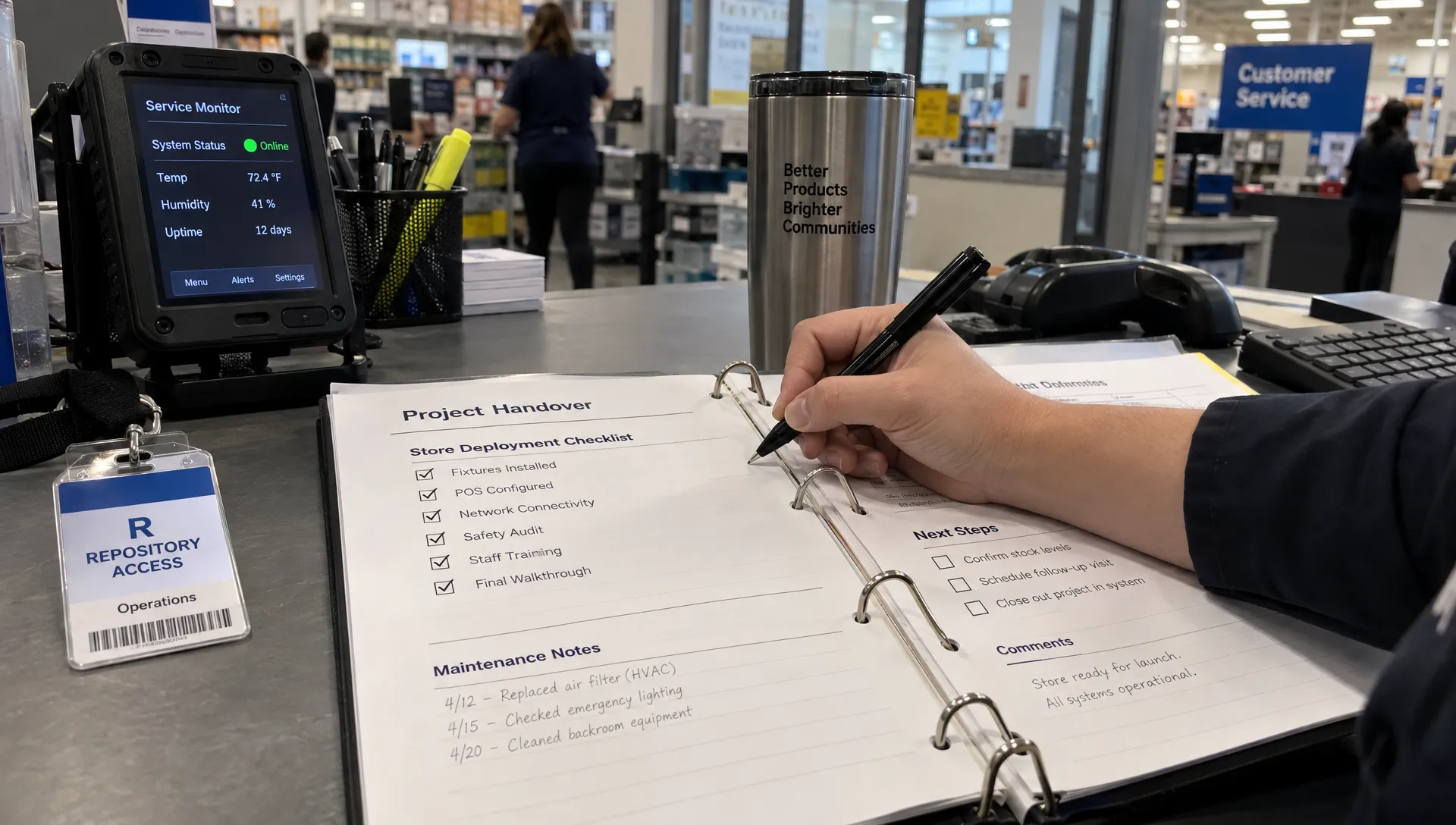
Ask ecommerce consulting firms to include knowledge transfer in the delivery plan, not as an optional activity at the end. Useful handover materials include architecture decisions, deployment instructions, integration responsibilities, support procedures and known limitations.
Commercial terms should also explain scope changes, acceptance, defect remediation and exit support. A fixed fee does not eliminate uncertainty, and a retainer does not establish accountability by itself. Define what work is included, how priorities are agreed and what evidence demonstrates completion.
Apply the same value test to AI
AI deserves the same scrutiny as a platform migration or checkout redesign. Begin with a specific task, its current cost and the consequences of a wrong answer.
Retail use cases might include product discovery, conversational assistance or reducing repetitive operational work. Each requires different safeguards. Product recommendations must respect catalog and availability data. Customer-facing assistance needs clear escalation paths. Generated content requires review appropriate to its risk.
When ecommerce consulting firms propose AI, ask for the evaluation method before the demonstration. The business should know how accuracy, task completion, operating costs and failure rates will be assessed. Include model and integration costs, not just the apparent speed of producing an answer.
A limited pilot can establish whether the capability is useful before it becomes embedded in customer journeys. Set conditions for expanding, revising or stopping it.
For a broader evaluation framework, Space Dinosaurs' guide to assessing an AI-powered ecommerce agency explains why implementation discipline matters more than the label.
Review the value after handover
A launch marks the start of operational evidence, not the end of evaluation. Set review points based on the project's scope and the time required for meaningful results.
| Review point | Questions to answer |
|---|---|
| Around 30 days | Is the change stable? Is tracking accurate? Can the internal team operate it? |
| Around 90 days | Are expected behaviors changing? Have support needs or operating costs increased? |
| Around 180 days | Has the financial benefit persisted? Can the team maintain and improve the solution? |
These are illustrative checkpoints, not guaranteed timelines for returns. Seasonal businesses or low-volume stores may need a different schedule.
Record what was learned, including recommendations that did not work. Update the roadmap using that evidence rather than automatically extending the original plan. A valuable engagement leaves the retailer better able to judge its next investment, including when not to make one.
Frequently asked questions
What services do ecommerce consulting firms provide? Common services include digital commerce strategy, platform assessment, customer experience analysis, conversion optimization, integration planning and analytics. Some firms also handle implementation and ongoing optimization. Confirm which responsibilities belong to the advisor and which remain with your team.
When is consulting preferable to hiring internally? Consulting can suit a time-limited decision, a specialist problem or a capability gap that needs resolving quickly. An internal hire may be more appropriate when the work requires continuous ownership. Many retailers need both, with explicit responsibilities.
Does a retailer need to replatform to improve performance? Not necessarily. Problems may come from configuration, third-party scripts, content, integrations or operating processes. A sound assessment compares targeted improvements with replacement before recommending a migration.
What should remain after an engagement ends? The retailer should retain the agreed deliverables, appropriate access, usable documentation and the ability to operate the solution. It should also understand how to measure results and prioritize further improvements without depending on undocumented supplier knowledge.
Start with the constraint, not the solution
Before commissioning a project, define the business problem, the evidence available and the capability your team needs to retain. That brief creates a stronger basis for both recommendations and accountability.
Space Dinosaurs combines retail-focused strategy, engineering, UX, analytics and ongoing optimization. If your next investment needs to improve commerce performance without creating unnecessary complexity, start the conversation with the constraint you need to remove and how success should be measured.