

A brief that says “increase conversion rate ecommerce” sets a direction, not a durable plan. Retail teams need to know whether more shoppers are buying because the experience improved, whether those orders remain profitable and whether the gain survives the next release.
Sustainable conversion improvement is an operating discipline, not a collection of website tweaks. It connects measurement, customer evidence, controlled releases and ongoing ownership. The goal is to improve the shopping experience without creating maintenance work, margin pressure or fulfillment problems that erase the benefit later.
1. Agree on what counts as a conversion
For a retail website, start with a clear purchase conversion metric:
Purchase conversion rate = sessions with at least one completed purchase ÷ eligible sessions × 100.
If 40 of 2,000 sessions include a purchase, the purchase conversion rate is 2%. Counting orders instead of purchasing sessions can produce a different result when shoppers place multiple orders during one session.
Document the denominator, reporting timezone and treatment of internal traffic, test orders and bots. Keep those rules consistent across reporting periods.
Then check implementation. Google’s GA4 ecommerce documentation explains purchase-event collection, including transaction identifiers. Reconcile analytics against your order system to understand missing events, duplicate events and consent-related gaps. The systems may not match perfectly, but unexplained changes need investigation.
Assign an owner to this measurement definition. Otherwise, a tracking update can look like a commercial improvement when customer behavior has not changed.
2. Give your “increase conversion rate ecommerce” plan a stable baseline
An overall rate can rise without any improvement to the website. Changes in device mix, acquisition channels or returning-customer share can explain the movement.
Consider this hypothetical example:
| Period | Mobile share of sessions | Mobile purchase rate | Desktop share of sessions | Desktop purchase rate | Overall purchase rate |
|---|---|---|---|---|---|
| Baseline | 80% | 2% | 20% | 4% | 2.4% |
| Following period | 50% | 2% | 50% | 4% | 3.0% |
The overall rate increased by 25% relative to baseline, but neither device group converted better. This may still represent a useful acquisition shift, but it does not demonstrate an on-site improvement.
Before claiming a win, compare results within meaningful segments: device, channel, new versus returning shoppers and major product categories. For longitudinal reporting, a fixed reference mix can help separate experience changes from audience changes.
Annotate promotions, stock shortages, tracking changes and unusual demand. These events belong beside the results, not in someone’s memory.
The practical deliverable is a baseline report that another team member can reproduce without asking which filters were used.
3. Define commercial guardrails before setting a target
To increase conversion rate sustainably, ecommerce teams need a definition of success that extends beyond completed checkouts.
A higher purchase rate can coexist with lower commercial value. Shoppers might buy smaller baskets, select products with weaker margins or return more of what they purchase. An expensive shipping incentive can also improve conversion while reducing contribution.
Choose one primary outcome and a small set of guardrails. Purchase conversion might be the primary metric, with contribution margin per session, return rate and payment failure rate acting as constraints. Define contribution consistently with finance, including the variable costs relevant to your business.
Revenue per session is useful, but it is not a substitute for profitability. It can reveal whether basket value offsets a conversion change, yet it does not account for the cost of generating and fulfilling those orders.
Some consequences arrive late. Returns, cancellations and support contacts may develop after an experiment ends. Establish an early decision window and a later review using sufficiently mature order cohorts.
A test can therefore be promising at launch without being declared a permanent commercial win.
4. Give each improvement a hypothesis and an owner
A sustainable backlog should explain the customer problem, not just name the component someone wants redesigned.
For example: “Mobile shoppers cannot find delivery timing before adding an item to their cart. Showing an accurate delivery estimate near the purchase action may reduce uncertainty and increase completed purchases.”
That hypothesis connects evidence to a proposed change and a measurable outcome. It also exposes dependencies: the estimate needs reliable inventory and fulfillment information. A persuasive message that operations cannot honor is not a durable improvement.
Ecommerce teams trying to increase conversion rate should assign one accountable owner to each hypothesis, even when delivery involves several functions. That owner coordinates analytics, UX, engineering and operations rather than completing every task personally.
Keep a short decision record containing the evidence, affected audience, expected mechanism, measurement plan and rollback conditions. Customer support themes, usability sessions and behavioral data can contribute, subject to appropriate privacy and consent practices.
Fix verified defects directly when appropriate. A broken payment button needs repair and validation, not an experiment to determine whether functioning buttons help customers.
5. Test changes with rules you will still respect later
Before launching an experiment, decide what evidence would justify shipping, extending or rejecting the change.
Specify the primary metric, eligible audience, randomization unit, minimum detectable effect and planned analysis method. Estimate the required sample using your baseline and statistical assumptions. There is no universal rule that every retail experiment becomes reliable after two weeks.
Keep assignment stable and check that shoppers remain in the intended experience across relevant visits. Investigate unexpected differences in traffic allocation or event collection before interpreting outcomes.
To increase conversion rate responsibly, ecommerce teams also need to resist stopping a conventional fixed-horizon test the first time a favorable result appears. Use either the planned analysis window or a valid sequential method designed for repeated evaluation.
For low-traffic stores, smaller ambitions may be more useful than a crowded testing calendar. Combine usability research, verified defect fixes and carefully scoped changes. Before-and-after comparisons can inform decisions, but seasonality and traffic changes limit causal certainty.
Finally, record inconclusive and negative results. A searchable decision log prevents another team from repeating the same idea six months later because the original learning disappeared into a presentation.
6. Protect released improvements from regressions
A successful experiment is not finished when the winning version goes live. It becomes part of the production experience, where later releases, third-party scripts and operational changes can undo the benefit.
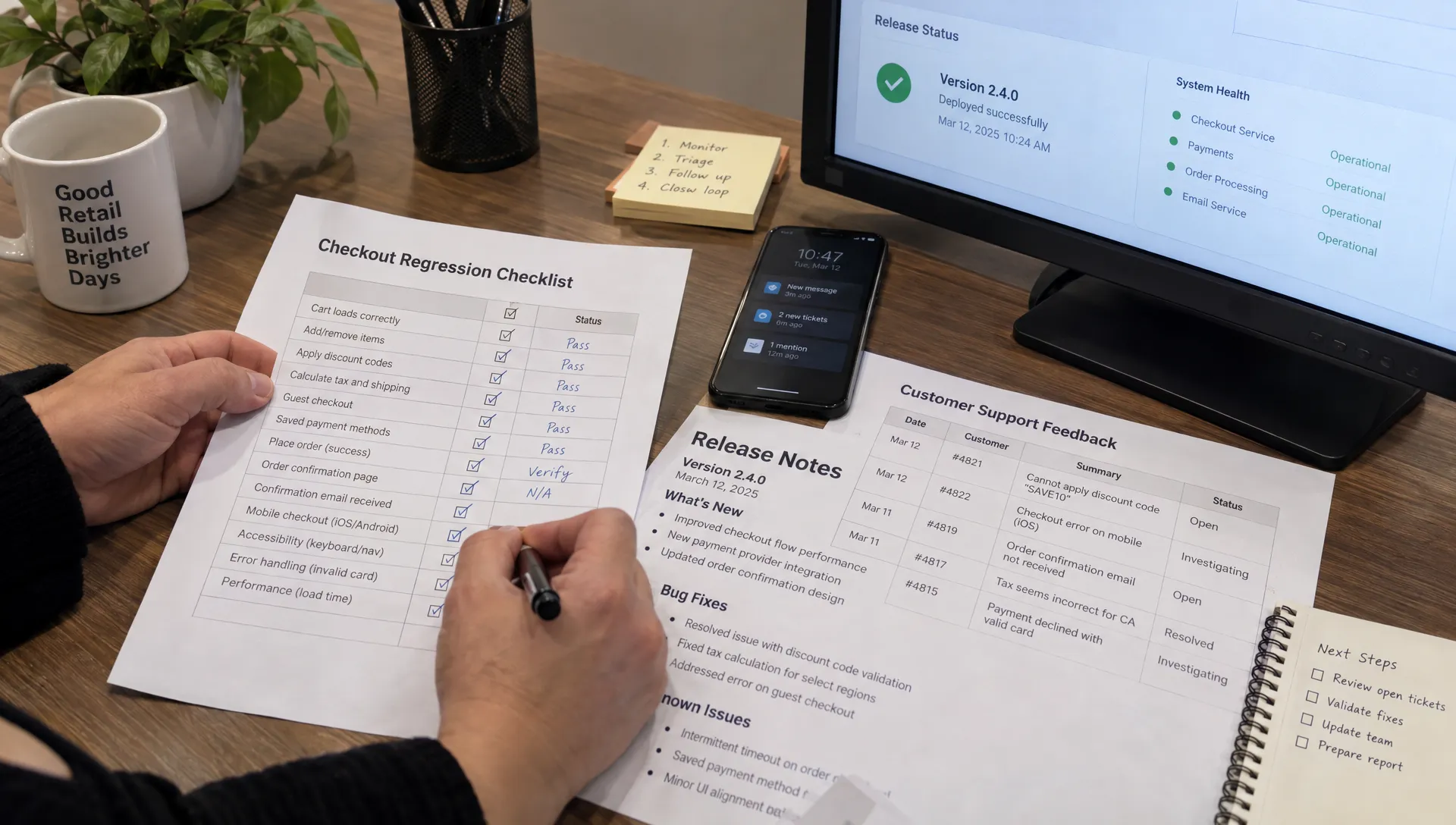
Give the change an implementation owner and a lightweight protection plan. For a checkout improvement, that might include automated checks for guest checkout, address validation, payment failure recovery and order confirmation. Use supported payment-testing flows and keep synthetic traffic out of commercial reporting.
Monitor technical and operational signals together. JavaScript errors, payment failures and inventory mismatches can damage conversion even when the page appears visually unchanged.
Performance also needs an ongoing budget. Largest Contentful Paint, Interaction to Next Paint and Cumulative Layout Shift describe different aspects of the experience. Track field performance for important devices and templates, then investigate material deterioration after releases. Space Dinosaurs’ guide to connecting site speed with retail revenue explores that relationship in more detail.
Ecommerce teams can increase conversion rate through a better experience, then lose the gain through an unrelated integration. Include checks for delivery promises, stock availability and promotional rules, not just page rendering.
Set rollback conditions before deployment. A material increase in checkout failures deserves a faster response than a minor movement in an engagement metric.
7. Establish a review rhythm the team can maintain
Sustainability depends on a manageable workload. A process that requires daily bespoke analysis from five departments will struggle to survive peak trading periods.
Weekly reviews should focus on exceptions and decisions. Check measurement health, active experiments, release-related incidents and significant changes in customer complaints. Investigate unusual movements before adding more work to the backlog.
Monthly, review the commercial outcomes of shipped changes. Compare performance across stable segments and inspect guardrails using mature enough data. Confirm that promised follow-up work, such as removing obsolete code or updating support guidance, actually happened.
Quarterly, reassess which improvements still deserve maintenance. Retire experiments that became permanent without adequate evidence and remove overlapping tools or scripts that add cost without a clear purpose.
The aim is to increase conversion rate while keeping ecommerce operations simpler, not to create an endless testing program. Limit work in progress so the team can complete analysis, implementation and follow-up before starting another batch.
Maintain a shared change log linking releases, experiments and operational incidents to the reporting timeline. That record becomes especially valuable when agency partners or internal team members change.
A practical 90-day rollout
Use the first quarter to establish the operating routine, not to promise a predetermined uplift. The schedule below is a planning example, not a guarantee that an experiment will reach sufficient sample within a particular month.
| Period | Main work | Evidence of progress |
|---|---|---|
| Days 1-30 | Define metrics, validate purchase tracking and build segmented baselines | A reproducible report, documented discrepancies and named owners |
| Days 31-60 | Address verified defects and launch a focused, adequately planned experiment | A written hypothesis, guardrails and a release or rollback plan |
| Days 61-90 | Evaluate available evidence, follow up on shipped changes and establish recurring reviews | A decision log, regression checks and a maintained improvement backlog |
To increase conversion rate without overloading ecommerce teams, choose one journey problem for this initial cycle. Avoid changing discovery, product pages and checkout simultaneously unless you have a design that can distinguish their effects.
At the end of the quarter, assess both commercial progress and process reliability. Reliable tracking and fewer release-related failures are useful foundations even when an experiment remains inconclusive.
Frequently asked questions
What does a 2% conversion rate mean? For a session-based purchase metric, it means two out of every 100 eligible sessions included at least one purchase. It does not necessarily mean two unique customers, because one person can generate multiple sessions.
Is a 12% website conversion rate good? It may be strong, but the conversion definition and audience matter. A returning-customer campaign is not directly comparable with broad prospecting traffic. Neither is a retail checkout comparable with a consultation request for off-plan property investment in the UAE, where a qualified inquiry may be the relevant outcome. Compare equivalent commitments and denominators.
What is the average conversion rate for ecommerce? There is no single average that works as a universal target. Published benchmarks vary by category, device, geography, traffic source and measurement method. Use a relevant benchmark as context, then prioritize improvement against your own consistent, segmented baseline.
What is conversion rate optimization? Conversion rate optimization, or CRO, is the process of identifying barriers to a desired action, making evidence-informed changes and evaluating the results. For retail, the objective is usually to increase conversion rate while protecting ecommerce profitability and customer experience, not simply to generate more clicks or cart additions.
Build a conversion program your team can maintain
Start with a dependable purchase metric, one evidenced customer problem and a named owner. Add commercial guardrails and regression protection before expanding the backlog.
Space Dinosaurs combines retail-focused strategy, UX design, analytics, AI-enabled engineering and performance optimization. If your conversion gains keep disappearing after releases or operational changes, focus the next conversation on the measurement and maintenance behind those gains, not just another redesign.