

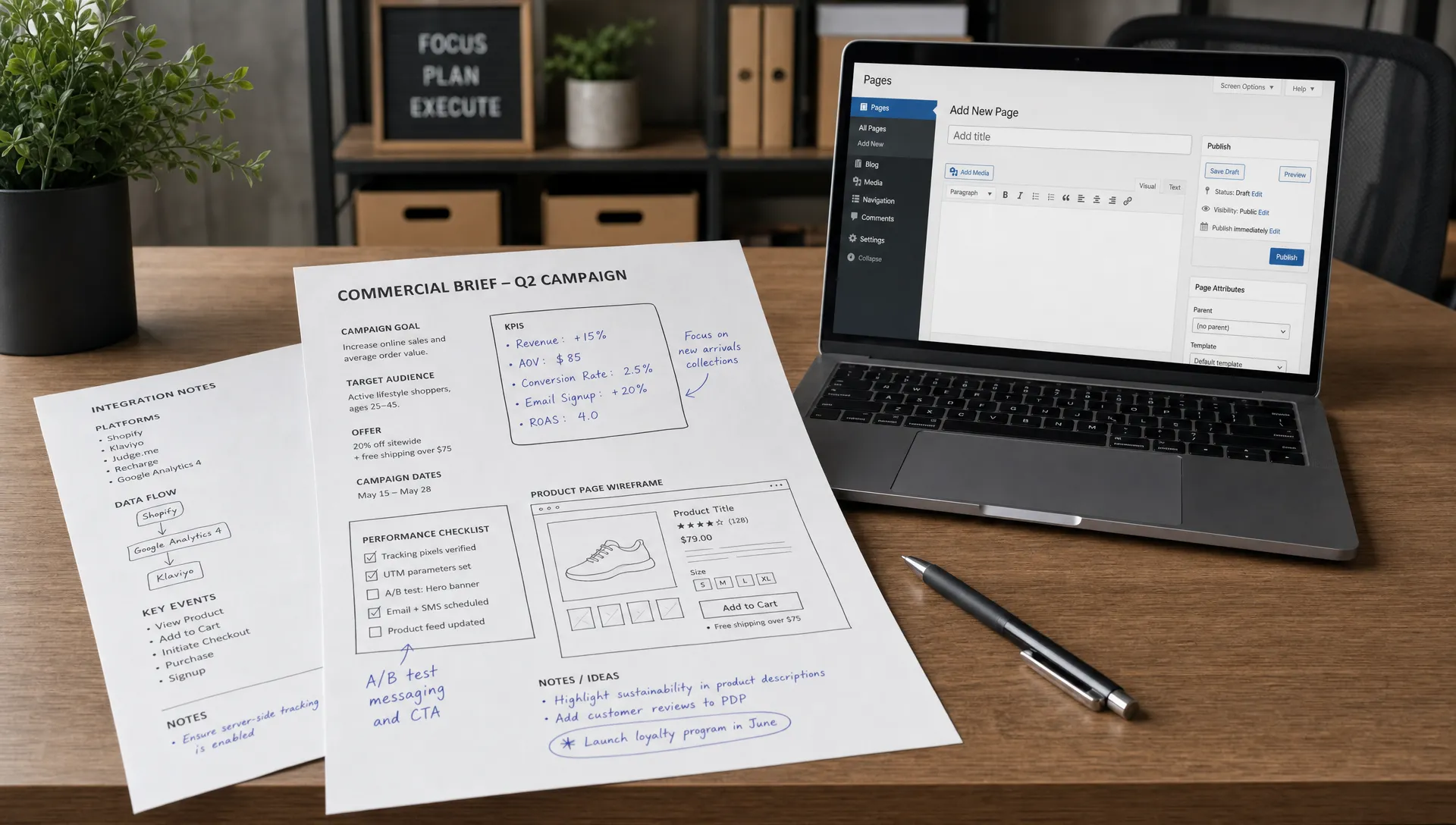
Choosing an ecommerce software development company is not just a procurement decision for a new storefront or backlog of tickets. For retail brands, the right partner affects conversion rate, page speed, merchandising agility, operational cost, customer data quality and the stability of every promotion you run. A good company should deliver software, but it should also deliver the commercial thinking that makes that software worth building.
If you are evaluating vendors, the useful question is not only whether they can code. It is whether they can translate retail goals into a reliable digital operating system: a storefront shoppers enjoy, integrations your team can trust and a roadmap that keeps improving after launch.
What an ecommerce software development company should deliver first
The first deliverable should be clarity. Before designs, sprints or platform recommendations, your partner should help define the business problem in measurable terms. That might mean improving mobile checkout completion, reducing maintenance cost, modernizing an aging stack, increasing organic category traffic or making content updates less dependent on developers.
A discovery phase should produce a concise commercial brief, not a long deck that disappears after kickoff. It should identify the customer segments, current funnel leaks, technical constraints, operational pain points and KPIs that will guide tradeoffs. If you want a broader view of the engagement lifecycle, Space Dinosaurs has a related guide on what to expect from an ecommerce development company.
Clear outcomes and decision rules
The right ecommerce software development company can explain how every major choice supports revenue, efficiency or risk reduction. For example, a new product detail page template should have a conversion rationale. A search integration should have merchandising and analytics requirements. A headless architecture decision should be justified by team capability, content needs and total cost, not by trend language.
Good decision rules protect the project when pressure rises. If launch speed matters more than custom experimentation, the roadmap should reflect that. If international expansion is the next growth lever, localization, payments, tax handling and content governance need to be considered early.
Platform architecture that fits the retail business
A strong partner should not force every client into the same platform, framework or composable stack. They should assess catalog complexity, inventory logic, promotions, traffic patterns, content needs, internal technical skills and planned channels before recommending a direction.
The architecture should also be understandable to non-engineers. Retail leadership needs to know what the platform will make easier, what it will make harder and which costs are likely to grow as the business scales. Custom software is not always better. SaaS defaults are not always safer. The right answer depends on the operating model.
A capable ecommerce software development company should document the major parts of the stack, including the storefront, CMS, commerce platform, search, personalization, analytics, tag management, payments, order management and customer service tools. Just as important, it should define ownership: who maintains each system, who monitors failures and who approves changes.
UX, merchandising and conversion should be built together
Retail UX is not decoration. It is the structure that helps shoppers find products, trust information, compare options and complete a purchase without unnecessary effort. Product listing pages, product detail pages, cart, checkout, search and navigation need to be designed as a connected shopping journey.
A retail-aware ecommerce software development company will connect UX decisions to merchandising workflows. A pretty interface that makes seasonal campaigns hard to manage is not a retail solution. A flexible component library that supports landing pages, category storytelling and product education is more valuable than one-off page designs that break after the first campaign.
Baymard Institute has documented thousands of ecommerce usability issues across checkout, search, product pages and mobile UX, and its research is a useful reminder that small interface decisions can create real revenue friction. Your software partner should be comfortable discussing those details with designers, merchandisers and developers in the same room.
Performance, Core Web Vitals and resilience
Speed is a commercial requirement. Shoppers may tolerate rich content, personalization and third-party tools, but they do not reward slow pages. Google's Core Web Vitals guidance gives teams a shared language for loading performance, interactivity and visual stability, but the work goes beyond passing a report once.
A serious ecommerce software development company should set performance budgets for page templates, key user journeys and major third-party scripts before code reaches production. Retail sites are especially vulnerable because marketing tags, reviews, personalization tools, A/B testing scripts and payment integrations tend to accumulate over time.
Performance delivery should include front end architecture, image strategy, script governance, caching, API response times, monitoring and release discipline. When performance becomes a standing practice rather than a launch task, teams can protect conversion and SEO while still shipping new features.
Integrations, data quality and operational reliability
The customer sees the storefront, but the business depends on what happens behind it. Product information, pricing, inventory, promotions, tax, shipping, returns, loyalty, customer service and order status all need clean connections. Weak integrations create manual work, inaccurate promises and customer support issues.
By this stage, an ecommerce software development company should be able to map data flows in plain language. Where does product data originate? How often does inventory update? Which system owns customer records? What happens when a payment succeeds but an order fails to reach the OMS? These questions are not edge cases in retail. They are daily operational realities.
Strong delivery also includes logging, alerting and recovery processes. Your team should not learn about broken feeds from angry customers or a failed campaign. Good software anticipates failure, surfaces it quickly and gives people a practical path to resolution.
AI should solve specific retail problems, not decorate the roadmap
AI can improve ecommerce experiences, but only when it is connected to a clear use case. Retailers should ask where AI can reduce friction, increase relevance or lower operating cost. Examples include guided product discovery, smarter search, support automation, content generation, product recommendations, demand insights and conversational commerce.
A modern ecommerce software development company should help distinguish useful AI from novelty. That means defining the data required, the customer experience, human review steps, measurement criteria and risks such as incorrect recommendations or off-brand content. AI should also be designed around the retailer's category. Beauty, apparel, furniture, grocery and electronics all have different trust signals and decision patterns.
The same principle applies outside retail. In real estate, for example, AI-powered real estate video creation can turn listings into marketing videos because the workflow has a specific input, output and publishing need. Ecommerce AI should be just as grounded: one job, a measurable benefit and a workflow your team can manage.
QA, security and launch readiness
A retail launch is not complete because the homepage loads. The release needs to survive real customer behavior, real promotions and real operational dependencies. Quality assurance should cover functional testing, cross-browser checks, mobile behavior, accessibility basics, analytics events, SEO requirements, payment flows, tax logic, shipping rules and failure states.
The ecommerce software development company you choose should also treat security and privacy as part of delivery. That includes secure handling of credentials, least-privilege access, dependency management, data protection expectations and coordination with platforms or payment providers. Retail teams do not need every engineer to become a compliance lawyer, but they do need disciplined processes.
Launch readiness should end with a clear go-live plan. Who approves the release? What is the rollback path? What monitoring is active? Who is on call? What issues are acceptable to defer and what blocks launch? These decisions should be made before the pressure of launch day.
Maintenance, optimization and cost control after launch
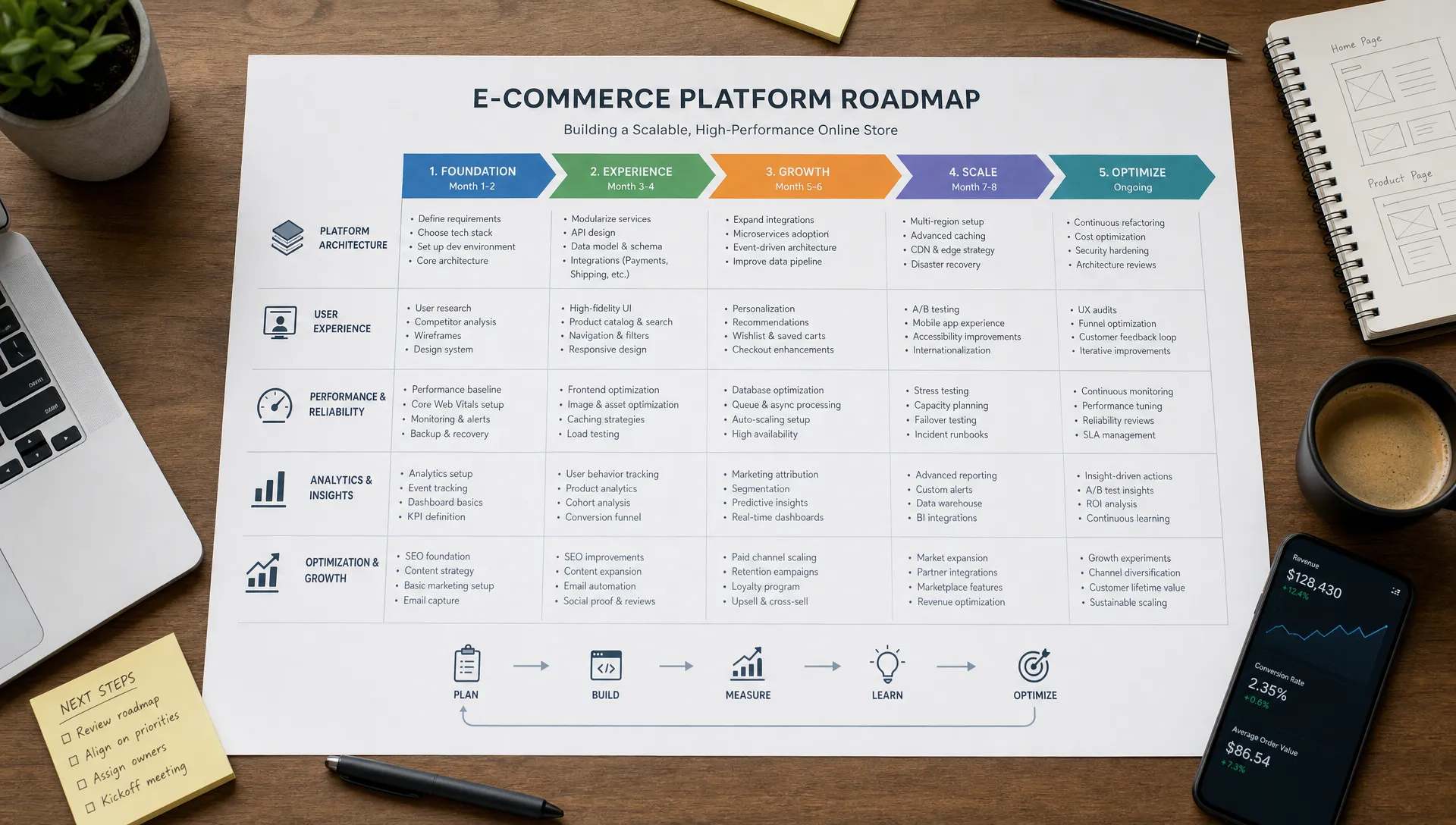
The best partners do not disappear after the site goes live. Ecommerce software is never finished because customer expectations, platform capabilities, search behavior, traffic sources and merchandising needs keep changing. Post-launch work should include bug fixes, dependency updates, performance monitoring, feature iteration, analytics review and experimentation.
An ecommerce software development company should also help control technical debt. Not all debt is bad, especially when speed to market matters, but it must be visible. Teams should know which shortcuts were taken, why they were taken and when they need to be revisited. Hidden debt becomes expensive during peak season, replatforming or international expansion.
A practical optimization program connects work to KPIs. If category pages have traffic but low engagement, the team might test filters, content hierarchy or product card information. If checkout abandonment rises after a payment update, the team should be able to investigate events, errors and session behavior quickly.
A practical delivery scorecard for retail brands
A scorecard helps procurement teams move beyond polished sales calls. Use it to compare vendors on the things that affect day-to-day retail performance, not just portfolio style.
| Delivery area | What good looks like | Warning sign |
|---|---|---|
| Strategy | KPIs, constraints and tradeoffs are defined before solutioning | Vendor jumps straight to platform or design preferences |
| Architecture | Stack choices match catalog, operations, content and team capability | Same recommendation for every retailer |
| UX and conversion | Shopping journeys are tested against customer needs and merchandising workflows | Visual design is separated from commercial performance |
| Performance | Core Web Vitals, scripts, APIs and monitoring are managed continuously | Speed is discussed only at launch |
| Integrations | Data ownership, failure handling and alerts are documented | Back-office complexity is treated as out of scope |
| Optimization | Roadmap uses analytics, experiment learnings and maintenance needs | Post-launch support is only a ticket queue |
A strong ecommerce software development company should be able to show how it prioritizes work, measures success and manages risk. If a vendor cannot explain those basics, the issue is not just communication. It may be a delivery problem. Space Dinosaurs has a separate guide to ecommerce agency red flags retail brands should avoid if you are narrowing a shortlist.
What to ask before signing
Before you commit, ask for evidence of how the team works. Case studies are useful, but delivery artifacts often reveal more. Ask to see anonymized examples of discovery outputs, technical documentation, QA plans, analytics specifications or post-launch roadmaps.
You should also meet the people who will run the work, not only the sales team. Delivery quality depends on strategists, designers, engineers, QA specialists, analysts and project leads understanding retail constraints together. The best vendor conversations feel specific: they ask about your catalog, promotions, fulfillment, customer segments, margin pressure and internal workflows.
If the answers stay generic, keep digging. A strong partner should be able to describe what they would investigate first, what they would avoid changing too soon and how they would create momentum without putting stability at risk.
Frequently Asked Questions
What should the development partner deliver beyond code? It should deliver strategy, platform architecture, UX, integrations, analytics, QA, launch planning and ongoing optimization tied to business goals.
How do I know if a development partner understands retail? Look for questions about catalog structure, merchandising workflows, promotions, inventory, fulfillment, returns, peak traffic and customer behavior. Generic technical questions are not enough.
Should every retailer choose a composable ecommerce stack? No. Composable architecture can offer flexibility, but it also increases integration and governance demands. The right choice depends on your team, roadmap, budget, content needs and operational complexity.
How soon should performance optimization start? It should start during planning and continue after launch. Site speed, script management, API performance and Core Web Vitals are easier to protect when they are designed into the operating model.
Build what your retail business actually needs
The right ecommerce partner should make your digital operation faster, clearer and more profitable, not just ship a new interface. Space Dinosaurs helps retail brands modernize ecommerce experiences through AI-enabled engineering, UX design, analytics and ongoing optimization.
If you need a partner that can connect strategy, performance and execution, start with Space Dinosaurs and build a roadmap your team can operate with confidence.