


A full service ecommerce agency contract should turn a broad promise of support into specific, enforceable obligations. It needs to explain what the agency will deliver, what your retail team must provide, how work gets approved and what happens when priorities change. Just as importantly, it should protect your access to the store, customer data and assets the relationship produces.
“Full service” is a commercial description, not a defined package. One agency may cover engineering, UX and analytics while another includes paid media but subcontracts development. The contract must resolve those differences before work begins.
For retail leaders, the most useful structure separates durable legal terms from project-specific commitments. This guide explains how to build that structure and where to negotiate. It is a commercial planning resource, not legal advice. Have qualified counsel review the final agreement for the applicable jurisdiction.
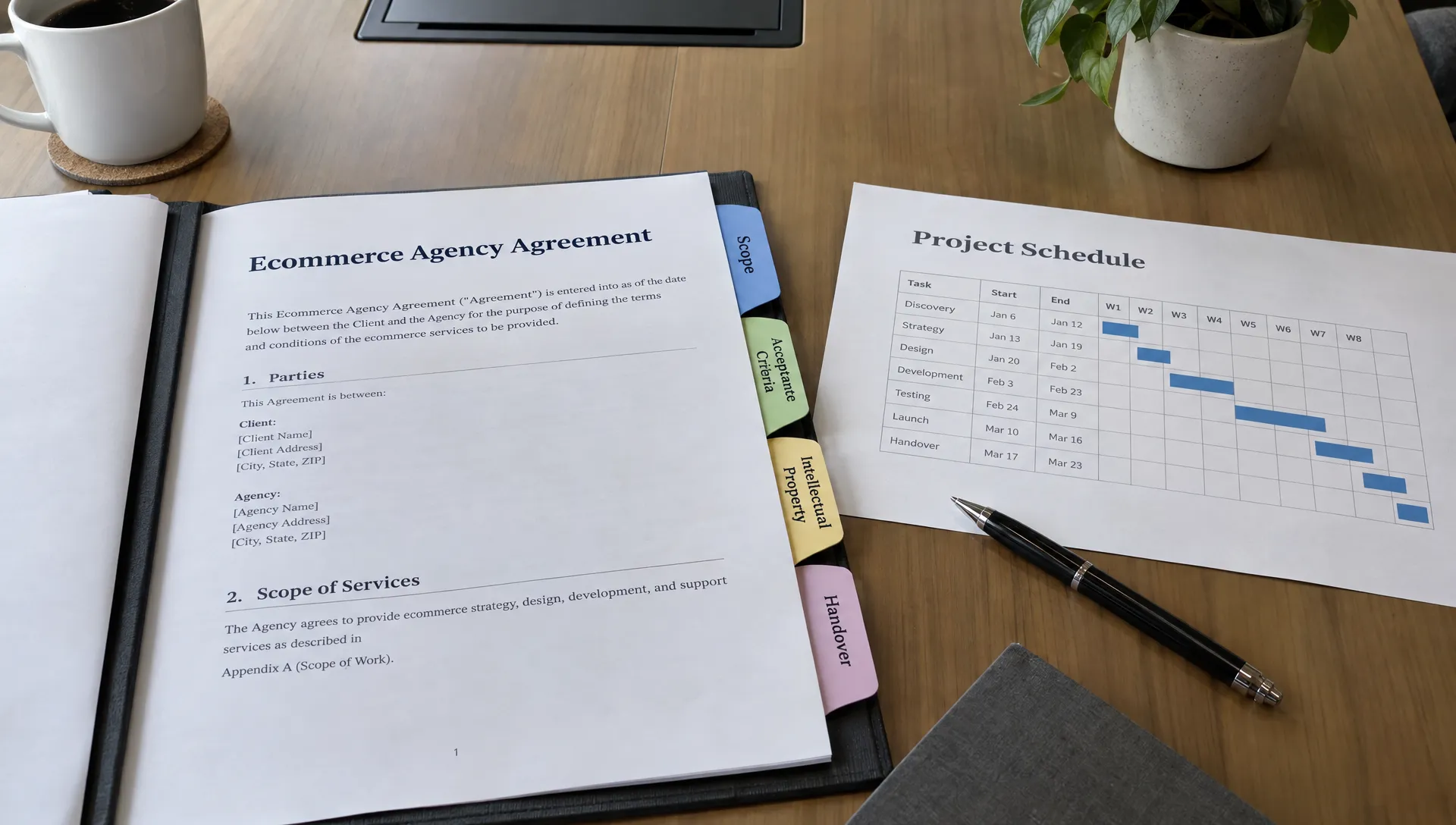
Structure the full service ecommerce agency contract in layers
Avoid putting every obligation into a proposal followed by a signature page. A document structure makes it easier to add projects without renegotiating the entire relationship.
| Document | What it should establish |
|---|---|
| Master services agreement (MSA) | General payment rules, confidentiality, intellectual property, liability, dispute resolution and termination |
| Statement of work (SOW) | Deliverables, exclusions, milestones, staffing assumptions, fees and acceptance criteria for a particular engagement |
| Service-level agreement (SLA) | Support coverage, incident severity, response commitments and escalation procedures |
| Data processing agreement (DPA) | Relevant privacy roles, processing instructions, security obligations and subprocessor arrangements |
Not every engagement needs four standalone documents. Support commitments or data-processing provisions can be schedules, provided they are clearly incorporated.
Specify which document controls when terms conflict. For example, an SOW might override an MSA provision only when it identifies that provision and expressly states the intended change. Privacy obligations should have an appropriate, counsel-reviewed precedence rule.
Also identify authorized signatories. A backlog comment, design approval or informal email should not silently rewrite liability terms or authorize substantial new spending.
Define services through deliverables and exclusions
The scope of a full service ecommerce agency engagement should describe work products rather than rely on labels such as “growth,” “optimization” or “end-to-end support.”
For each service, record what is included, what is excluded and what the merchant must supply. This illustrative scope matrix shows the level of specificity to seek:
| Workstream | Example of a defined commitment | Boundary to resolve |
|---|---|---|
| Store development | Build the approved product-page templates and named integrations | Whether product-data cleanup and content entry are included |
| UX design | Produce agreed customer journeys, designs and review rounds | Whether customer research and participant incentives are included |
| Performance | Implement an agreed set of improvements on specified templates | How third-party scripts and platform constraints are handled |
| Analytics | Configure named events and validate agreed reports | Whether historical data repair is included |
| Marketing | Deliver the specified campaigns or acquisition services | Whether media spend, creative production and channel management are included |
Separate launch deliverables from recurring services. “Maintenance included” does not establish whether the agency will handle dependency updates, broken integrations or new feature requests.
Require disclosure of subcontracted work and the agency’s responsibility for it. If a specialist delivers search, accessibility testing or an ERP integration, the contract should still identify who coordinates delivery and remedies defects. Otherwise, the merchant can become the unpaid project manager between suppliers.
Name decision-makers and merchant dependencies
Governance provisions should connect promises to people. Name the agency delivery lead, the merchant sponsor and the individuals authorized to approve scope, spending and releases.
Require relevant platform experience for critical roles and define how replacements will be handled. For B2B work, account hierarchies, negotiated pricing and purchasing approvals may require different expertise from a B2C merchandising project.
A full service ecommerce agency should also document the merchant dependencies behind its schedule. These may include access credentials, product data, brand assets, legal reviews or decisions from an ERP vendor.
Give each dependency an owner and due date. If the merchant misses a deadline, require prompt notice of the impact and a revised plan rather than an unrestricted right to extend every milestone or add fees.
For delivery oversight, specify the meeting cadence, status-report contents and escalation route. A useful status report shows accepted work, upcoming decisions, budget consumption and risks. Meeting attendance alone is not evidence of progress.
Make acceptance objective and separate it from launch
Acceptance determines when a deliverable meets the contractual standard. Launch authorizes deployment. Payment may depend on either, but the agreement should not treat them as interchangeable.
For each substantial deliverable, define the test environment, acceptance criteria, review period and defect-reporting process. Establish what happens when testing fails and how corrected work is resubmitted.
When contracting with a full service ecommerce agency, avoid acceptance language based only on “industry standards” or the agency’s judgment. Use observable requirements, such as an agreed checkout journey completing successfully under specified test conditions.
If deemed acceptance applies after a review deadline, negotiate notice and a reasonable opportunity to respond. Production use during a pilot should not automatically waive documented defects.
Distinguish defects from new requests. A defect fails an agreed requirement; a change adds or alters one. Define how disagreements will be escalated so every bug does not become a billable enhancement.
For launch, assign responsibility for deployment approval, backups, rollback decisions and post-release validation. Include blackout periods around major retail events where appropriate. A design approval should not count as approval to deploy production code.
Connect fees to scope and formal change control
Choose the pricing model after defining the work. Fixed fees suit sufficiently defined deliverables, time-and-materials arrangements suit evolving work and retainers can reserve ongoing capacity. A blended agreement can use different models for different phases.
Every full service ecommerce agency contract should explain what fees buy, when invoices become payable and which expenses require advance approval. Separate agency fees from software subscriptions, advertising spend, hosting, travel and specialist vendors.
For time-based work, specify rates, billing increments, reporting and any spending ceiling. For milestone billing, tie invoices to clearly identified events rather than ambiguous labels such as “phase substantially complete.”
No material change should proceed without an approved impact assessment. A change request should identify the added or removed scope, fee adjustment, schedule effect and acceptance implications. Establish who can authorize emergency work and any spending limit.
Avoid automatic charges for merchant delays without a defined trigger, notice process and explanation of the actual resource impact. Address disputed invoices separately from undisputed amounts.
When evaluating total cost, use a broader digital agency budgeting framework to account for implementation, internal staffing and recurring technology expenses. A lower agency fee can still produce a more expensive operating model.
Define performance measures without promising uncontrollable results
Separate delivery obligations from business outcomes. An agency can commit to implementing an approved experiment or fixing an instrumentation defect. Revenue also depends on inventory, pricing, promotions, acquisition quality and market conditions.
The measurement schedule in a full service ecommerce agency contract should identify each KPI’s definition, baseline, reporting source, owner and evaluation period. Agree how returns, cancellations, taxes and shipping affect revenue calculations.
For conversion reporting, specify the denominator and treatment of bots, consent-related gaps and cross-device behavior. For acquisition reporting, name the attribution model and window. Conflicting platform reports should not become competing versions of contractual truth.
Technical targets need similar precision. If Core Web Vitals are included, define the relevant templates, devices and measurement method. Google’s Core Web Vitals guidance distinguishes real-user experience metrics from the broader collection of performance diagnostics.
Use agreed lab tests for release checks and a suitable field-data period for post-launch evaluation. Do not make launch acceptance depend on collecting weeks of future traffic.
Where an outcome misses its target, specify the response: investigation, a remediation plan or a revised experiment backlog. Avoid blanket guarantees that ignore third-party systems or merchant-controlled changes.
Protect intellectual property and merchant-controlled accounts
Keep the merchant’s store, domain, payment accounts, analytics properties and core repositories under merchant-controlled ownership or administration wherever feasible. Give the agency role-based access rather than making it the sole gatekeeper.
Intellectual property terms in a full service ecommerce agency agreement should distinguish custom deliverables from pre-existing agency tools, third-party materials and open-source components.
For custom work, specify what transfers, when it transfers and which payment conditions apply. Ensure the agency obtains the necessary rights from employees and subcontractors. For retained tools embedded in deliverables, define the merchant’s continuing license, including whether a replacement provider may maintain or modify the implementation.
Do not assume that paying an invoice automatically transfers copyright. In the United States, commissioned work is not automatically “work made for hire”; the U.S. Copyright Office explains the applicable requirements. Counsel should draft an appropriate assignment where necessary.
Include editable design files, source code, configuration, documentation and deployment instructions in the deliverable inventory. Record third-party license restrictions and renewal responsibilities.
For customer data, address control, permitted use, export and deletion while respecting applicable privacy rights. A broad claim of “data ownership” alone does not establish lawful processing permissions.
Add privacy, security and AI-specific obligations
Identify the data the agency can access and why. Where applicable, the DPA should establish controller and processor roles, documented instructions, approved subprocessors, international-transfer arrangements and assistance with relevant privacy requests.
Specify access controls, credential handling, security-incident notification and offboarding requirements. Notification language should define the trigger and timing rather than simply promise “prompt” communication.
Security obligations for a full service ecommerce agency should reflect the actual architecture and access involved. If the agency touches payment systems, assign responsibility for relevant PCI DSS obligations without assuming a generic compliance promise covers the merchant’s entire environment.
Set rules for production data in development environments. Redacted or synthetic test data can reduce unnecessary exposure, but the contract should establish the required approach and any approved exceptions.
Create a separate schedule for AI-enabled work
Define which AI tools may receive merchant information, what information is prohibited and how retention or training use will be controlled. Require human review and testing of generated code or customer-facing content before release.
For conversational commerce or shopping-agent integrations, specify authorized actions, purchase-approval boundaries, logging and failure handling. Distinguish an assistant recommending a product from an agent authorized to place an order.
As a concrete example, KayWoot’s shopping-agent instructions address buyer authorization, agent identification and rate limits. A similar specification can help turn “agent-ready commerce” into defined deliverables rather than a vague promise. Do not assume another store supports the same integrations.
Assign ownership of integration credentials and responsibility for monitoring usage costs. Material changes to model providers or autonomous capabilities should follow the agreed approval process.
Allocate support duties and legal risk explicitly
Operational support needs its own boundaries: coverage hours, time zone, severity definitions, contact channels and escalation ownership. Define response, restoration and resolution separately. Acknowledging an outage is not the same as restoring checkout.
A full service ecommerce agency should state which systems it supports directly and which require coordination with a platform or infrastructure vendor. If service credits apply, explain their calculation, exclusions and whether they are the sole remedy for the relevant failure.
Clarify the defect-warranty period and how it relates to paid support. Correcting nonconforming project work should not quietly consume the merchant’s entire improvement budget. For recurring arrangements, align these provisions with what an ecommerce agency retainer should include.
Legal risk allocation deserves a separate review. Negotiate liability caps, exclusions and any different treatment for confidentiality breaches, data incidents or intellectual property claims. Broad indemnities can undo an apparently balanced liability clause.
Match insurance requirements to the exposure and confirm any evidence the agency must provide. Also establish governing law, dispute escalation and the forum for unresolved claims. These terms should reflect the parties and transaction, not remain unnoticed boilerplate.
Plan termination and handover before signing
The exit provisions should cover termination for cause, any cure period, termination for convenience and the treatment of renewal. State notice deadlines clearly and identify who must receive notices.
An exit-ready full service ecommerce agency contract also explains the financial consequences: payment for completed work, approved commitments, prepaid amounts and any negotiated early-termination fee. Avoid undefined obligations to pay for all remaining work regardless of whether it will be performed.
Define transition assistance as a deliverable with a timeframe, fee basis and owner. Handover should cover current source code, editable assets, deployment documentation, outstanding issues, vendor contacts and access records.
Address what happens to partially completed work and which rights accompany it. The merchant should not discover at termination that essential operational documentation was never included.
Finally, require access revocation and appropriate data return or deletion, subject to documented retention obligations. Keep merchant-controlled accounts accessible during an invoice dispute, with counsel drafting the relevant protections. A transition plan has limited value if the retailer cannot access its own operating environment.
Frequently asked questions
Does a full service ecommerce agency contract need a separate SOW? Not necessarily as a standalone file, but project-specific commitments should be identifiable. An SOW makes it easier to define deliverables, dependencies, fees and acceptance criteria without rewriting the general legal agreement for every assignment.
Should the agency guarantee ecommerce revenue growth? Revenue guarantees need careful scrutiny because agencies do not control every input. Prefer measurable delivery obligations, transparent reporting and defined responses to missed targets. If performance-based compensation applies, specify attribution, exclusions, data access and how disputed calculations are resolved.
Who should own the store code and analytics accounts? The agreement should expressly address custom-code rights and any exceptions for pre-existing or third-party components. Merchant-controlled administration of store and analytics accounts reduces continuity risk. Do not rely on a general ownership sentence to establish access, licensing and handover rights.
Is an annual commitment necessary? There is no universal requirement. The term should reflect onboarding effort, reserved capacity and the time needed to evaluate the work. Review renewal, notice, cancellation charges and transition assistance together rather than judging the initial term in isolation.
Bring a defined scope to the contracting discussion
Before signing, check that each major commitment has an owner, a measurable completion standard, a price basis and an exit path. Any missing element is a negotiation item, not a detail to settle after kickoff.
Space Dinosaurs combines retail-focused strategy, UX, AI-enabled engineering and performance optimization. Bring your proposed scope and operating constraints to the discussion so responsibilities can be defined before delivery begins.