

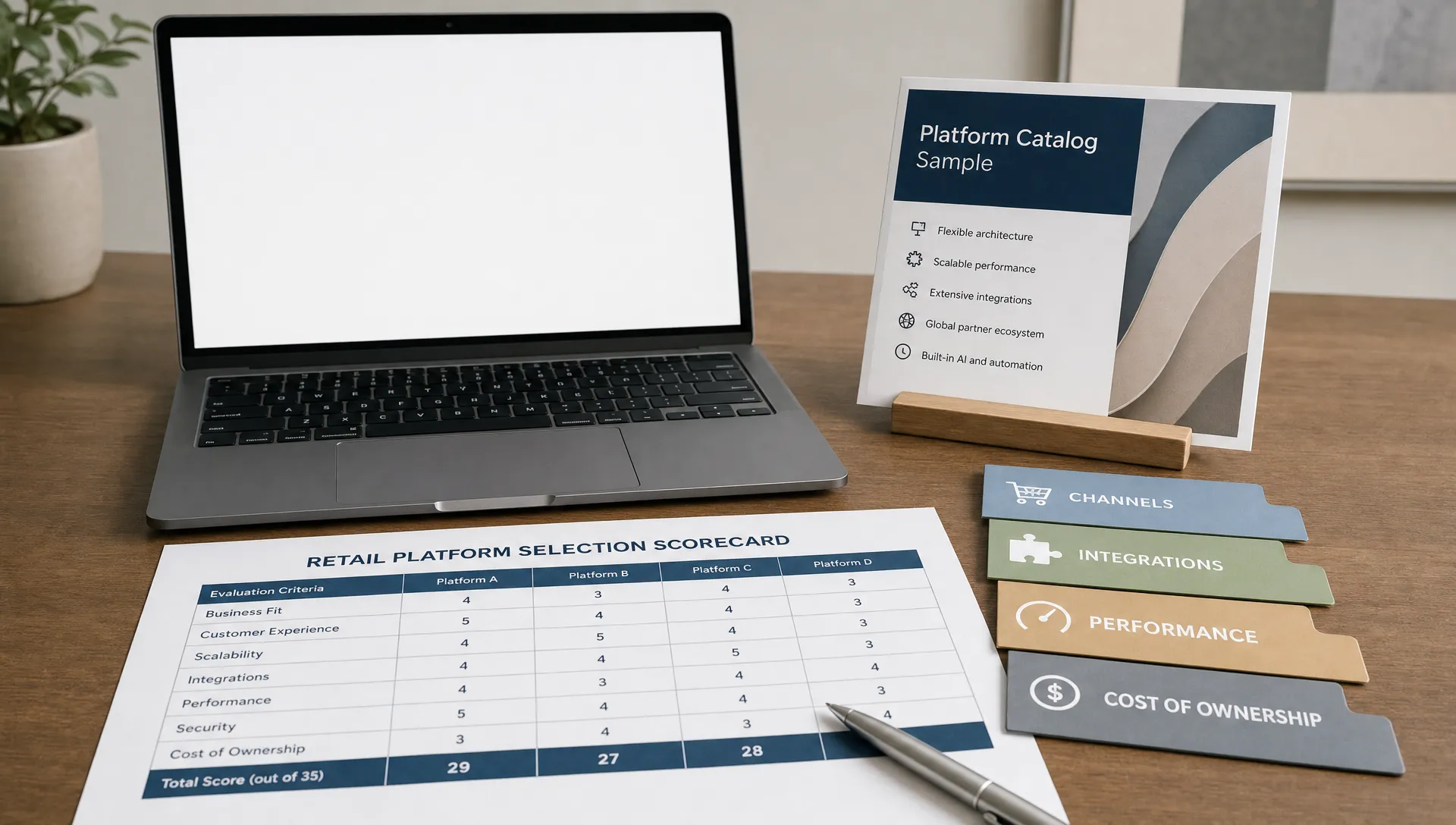
Choosing a commerce platform is one of the highest leverage decisions a retail team can make. The right choice can speed up launches, reduce operational drag and give merchandising, marketing, analytics and engineering teams the room to grow. The wrong choice can do the opposite, turning every campaign, integration and customer experience improvement into a workaround.
A strong platform decision is not about finding the longest feature list. Retail growth depends on how well the platform supports your business model, customer journey, team structure and next three years of change. That means evaluating technology and operating fit together.
This guide walks through a practical framework retail leaders can use to choose a commerce platform with confidence.
Start with the growth model, not the vendor demo
Many platform selections begin with demos, pricing decks and side-by-side feature grids. Those inputs matter, but they come too late if the team has not defined what growth actually requires.
Before looking at vendors, write a one-page commerce growth brief. It should describe how the business expects to grow, what currently blocks that growth and which capabilities must improve first. This turns the platform conversation from preference to fit.
Your brief should answer questions like these:
- Which channels matter most, including direct-to-consumer, marketplaces, retail stores, social commerce, wholesale or B2B?
- How complex is the catalog, including variants, bundles, subscriptions, made-to-order products or localized assortments?
- What customer experiences drive conversion, such as guided discovery, personalization, loyalty, conversational commerce or rich editorial content?
- Which systems must connect cleanly, including ERP, OMS, PIM, CRM, CDP, warehouse systems, payment providers and tax tools?
- How often do merchandising, marketing and content teams need to launch new campaigns without engineering support?
- What markets, currencies, languages, brands and fulfillment models will the platform need to support in the next three years?
This brief also keeps the team honest. A focused specialty retailer does not need the same architecture as a multinational brand operating dozens of storefronts. A product-led store, for example a space-saving closet organizer brand like MORALVE, may prioritize product education, mobile speed, bundles and frictionless checkout. A global fashion retailer may need complex promotions, localized catalogs, omnichannel returns, store inventory visibility and advanced release governance.
The right commerce platform is the one that fits the business you are building, not the one that wins the most generic checklist items.
Understand the main platform approaches
Retail teams typically compare four broad platform models. The boundaries are not perfect because many vendors now offer hybrid capabilities, but the categories help frame tradeoffs.
| Platform approach | Best fit | Strengths | Watchouts |
|---|---|---|---|
| SaaS commerce platform | Growing brands that need speed, managed infrastructure and a strong app ecosystem | Faster implementation, lower infrastructure burden, frequent product updates | App sprawl, limited control in some advanced workflows and potential constraints for unusual business logic |
| Enterprise commerce suite | Larger retailers with complex operations, governance and global requirements | Mature commerce features, enterprise controls, deep partner ecosystems | Higher implementation cost, longer delivery cycles and risk of heavy customization |
| Headless or composable commerce | Retailers that need differentiated front ends, multiple channels or flexible architecture | More control over customer experience, modular vendor selection and stronger front end flexibility | More integration responsibility, higher architecture discipline and greater need for technical ownership |
| Custom commerce architecture | Businesses with highly unique models that cannot be supported by standard platforms | Maximum control and tailored workflows | High maintenance burden, talent dependency and slower access to platform innovation |
If your team is weighing enterprise-grade options, a more detailed comparison of Salesforce Commerce Cloud, Shopify Plus and SCAYLE can help clarify how different platforms approach scale, flexibility and operating complexity.
Composable commerce deserves special attention because it is often discussed as if it were automatically more modern. It can be the right move when a retailer needs faster front end experimentation, multiple touchpoints, specialized services or a cleaner way to replace parts of a legacy stack. It can also be overkill if the team does not have the operating maturity to govern vendors, APIs, data flows and releases. Space Dinosaurs has covered the signs that indicate when online merchants should consider composable commerce if your team is debating that shift.
Evaluate platform fit across the retail customer journey
A commerce platform should be assessed through the shopper journey and the operational workflows behind it. Looking only at checkout, product pages or admin screens gives an incomplete view.
Start with discovery. Can the platform support the way customers find products, filter collections, compare options and move from content to purchase? For retailers with broad assortments, search, merchandising rules and product data quality are critical. For brands with considered purchases, product education and content flexibility may matter more.
Then look at conversion. The platform should support fast mobile browsing, clear product detail pages, reliable cart behavior, payment flexibility and checkout experiences that match customer expectations. Baymard Institute has tracked cart abandonment for years and places the average online shopping cart abandonment rate near 70 percent. Not all abandonment is caused by platform limitations, but slow pages, confusing checkout, missing payment methods and unexpected errors are preventable sources of revenue leakage.
Post-purchase matters too. Order status, returns, exchanges, customer service workflows, loyalty and retention campaigns all rely on clean data and dependable integrations. If the platform makes these experiences difficult, growth will become more expensive because teams must compensate with manual work or disconnected tools.
Put performance near the top of the selection criteria
Performance should not be treated as a technical afterthought. Retail storefront speed affects conversion, SEO, paid media efficiency and brand perception.
Google's mobile page speed research reported that the probability of bounce increases by 32 percent as page load time goes from 1 second to 3 seconds. Core Web Vitals also give retailers a clear framework for evaluating loading, interactivity and visual stability. When a platform or implementation approach makes those metrics hard to improve, the marketing team pays for it through weaker landing page performance and lower return on acquisition spend.
When evaluating a commerce platform, ask for evidence of real storefront performance under retail conditions. Demo stores are not enough. You need to understand how the platform behaves with your product imagery, scripts, third-party tools, personalization, promotions, reviews, analytics tags and traffic peaks.
Strong performance evaluation includes these areas:
- Front end rendering approach and its impact on page speed
- Image optimization, caching and CDN behavior
- Script governance for apps, tags and personalization tools
- Checkout reliability during promotions and seasonal peaks
- Ability to monitor Core Web Vitals and diagnose regressions after launch
A fast site is rarely the result of platform choice alone. It comes from disciplined implementation, measurement and ongoing optimization. Still, some platforms make that discipline easier than others.
Pressure test integrations and data ownership
Retail growth creates integration pressure. New channels, fulfillment options, loyalty programs, personalization tools and analytics requirements all depend on data moving between systems at the right time and in the right format.
A platform that looks simple in isolation can become fragile when connected to ERP, OMS, PIM, CRM, warehouse, tax, payments and customer data systems. This is where retailers often underestimate cost. The question is not whether an integration exists, but whether it supports the level of reliability, latency and business logic your operation needs.
For example, a retailer with store pickup, ship-from-store and online returns needs accurate inventory and order data across channels. A brand running frequent product drops needs catalog updates, checkout capacity and fraud controls to work together. A business expanding internationally needs localization, tax, payment and fulfillment integrations that do not require reinventing the store for every market.
Data ownership is just as important. Your commerce platform should not trap customer, product and order data in ways that limit analytics or future flexibility. Clean event tracking, accessible APIs and consistent data models make it easier to improve personalization, forecasting, reporting and AI-enabled experiences.

Assess merchandising and content agility
Retail growth often depends on the speed of commercial execution. If the merchandising team needs engineering support for every landing page, bundle, promotion or campaign change, the platform will slow revenue teams down.
Look closely at how the platform supports non-technical users. Can teams create content-rich product pages, campaign pages and collection experiences without compromising performance? Can they schedule promotions, adjust merchandising rules and localize content confidently? Can they preview changes before publishing?
The best platform for retail growth gives commercial teams freedom within guardrails. That means reusable components, role-based permissions, approval workflows and design systems that protect brand consistency without forcing every change through a developer queue.
This is also where content and commerce need to work together. Product education, editorial storytelling, fit guides, buying guides, comparison content and user-generated content can all support conversion. If your business relies on content to sell, the platform's CMS capabilities, integration options and front end flexibility should be evaluated early.
Separate AI readiness from AI theater
Many commerce vendors now present AI features as a major reason to choose their platform. Some of those capabilities are valuable. Others are surface-level add-ons that will not move revenue unless the underlying data, workflows and customer experience are ready.
A retail platform is AI-ready when it can support clean data, structured content, reliable event tracking and safe integration with decisioning tools. Product recommendations, AI-assisted search, conversational commerce, automated merchandising and personalized content all depend on data quality and governance.
When assessing AI capabilities, ask practical questions:
- What data does the platform need to power the AI feature?
- Can the retailer control rules, exclusions, tone and brand guardrails?
- How are recommendations, search results or generated content measured?
- Can the platform connect AI outputs to analytics, experimentation and merchandising workflows?
- What happens when the model is wrong, incomplete or biased toward the wrong commercial outcome?
AI should help teams make better decisions or create better customer experiences. It should not become another black box in the stack.
Calculate total cost of ownership, not only license cost
Platform pricing can be misleading when viewed in isolation. A lower subscription fee may come with higher app costs, more integration work, performance remediation, ongoing development or manual operations. A higher license fee may be justified if it reduces operational complexity and supports revenue growth more effectively.
Total cost of ownership should include software, implementation, maintenance and the cost of change. Retailers should model at least three years, not just launch.
| Cost category | What to include | Why it matters |
|---|---|---|
| Platform fees | Subscription, transaction fees, revenue share and add-on modules | Determines baseline cost as revenue scales |
| Implementation | UX, design systems, development, integrations, QA, migration and launch support | Often the largest upfront investment |
| Extensions and apps | Search, reviews, loyalty, subscriptions, personalization, fraud, tax and analytics tools | Can grow quickly if governance is weak |
| Operations | Release management, monitoring, support, content workflows and training | Affects team efficiency after launch |
| Optimization | Performance work, experimentation, analytics improvements and roadmap delivery | Determines whether the platform keeps improving |
| Risk and downtime | Peak traffic resilience, security, compliance and recovery planning | Protects revenue and brand trust |
Do not evaluate cost without evaluating capability. The cheapest option is rarely cheap if it slows the roadmap, creates brittle integrations or forces teams into manual work.
Look for stability and governance before scale demands it
A platform that works for normal trading days may fail under promotion pressure, seasonal peaks or rapid expansion. Retailers need to evaluate stability before the business is depending on it.
Governance includes release processes, testing environments, rollback plans, access controls, documentation and monitoring. It also includes how the platform handles spikes in traffic, checkout load, API limits and third-party service failures.
Ask vendors and implementation partners how they manage peak events. What happens during Black Friday, product drops, influencer campaigns or paid media surges? How are incidents detected? Who owns the response? What parts of the stack are most likely to degrade first?
These questions may feel operational, but they are growth questions. Revenue growth increases pressure on the stack. If the platform cannot handle that pressure, the business will eventually trade speed for stability or accept avoidable risk.
Choose the platform and the implementation model together
A commerce platform does not deliver growth by itself. Architecture, UX, engineering quality, analytics and post-launch optimization determine whether the platform's potential becomes business value.
This is why platform selection and partner selection should happen together. The same platform can produce very different outcomes depending on the team implementing it. A strong partner should understand retail operations, not just code. They should be able to challenge assumptions, reduce complexity, protect performance and build a roadmap that connects technical decisions to revenue outcomes.
If your team is also evaluating outside support, this guide to choosing an ecommerce agency for long-term growth outlines what to look for beyond launch capability.
Use a scorecard that reflects business priorities
A useful platform scorecard should weight criteria according to your business model. A global multi-brand retailer should not use the same weighting as a single-brand DTC company. A retailer with heavy content needs should not evaluate CMS flexibility as an afterthought.
Here is a simple starting point:
| Evaluation area | What good looks like | Suggested weight |
|---|---|---|
| Business model fit | Supports catalog, channel, market, fulfillment and promotion needs without excessive customization | High |
| Customer experience flexibility | Enables differentiated storefronts, content, merchandising and checkout improvements | High |
| Performance potential | Can support strong Core Web Vitals and peak traffic reliability with disciplined implementation | High |
| Integration readiness | Connects cleanly with core retail systems and supports reliable data flows | High |
| Team usability | Lets merchandising, marketing and operations teams move quickly within governance | Medium to high |
| AI and data readiness | Provides structured data, events, APIs and controls needed for AI-enabled experiences | Medium to high |
| Total cost of ownership | Balances platform fees, implementation cost, apps, maintenance and cost of change | High |
| Partner ecosystem | Has qualified implementation and support options aligned with your category and complexity | Medium |
| Future flexibility | Can adapt to new channels, markets, services and customer expectations | High |
The score is less important than the conversation it creates. A scorecard helps teams see tradeoffs clearly and prevents loud preferences from overpowering business requirements.
Watch for red flags during selection
Platform selection often reveals warning signs before contracts are signed. Take them seriously.
Be cautious if a vendor cannot explain how the platform performs under your real catalog, traffic and integration conditions. Be cautious if every gap is answered with custom development or another app. Be cautious if business users love the demo but technical teams cannot validate data flows, release processes or operational requirements.
Other red flags include vague migration plans, unclear ownership of performance, limited access to analytics data, weak documentation, high dependency on a single implementation partner or a roadmap that assumes your team can change faster than it realistically can.
A good selection process should make complexity visible. If complexity is being hidden until after the sale, the retailer is taking on risk without enough information.
Plan migration as a growth program
Replatforming is not only a technical migration. It is a commercial, operational and organizational change. Treating it as a simple site rebuild often leads to missed requirements, SEO losses, analytics gaps and launch instability.
A healthy migration plan covers discovery, architecture, UX, data migration, integrations, SEO, analytics, QA, training, launch readiness and post-launch optimization. It should also define what will not change during the first release. Trying to fix every customer experience, integration and operational problem at once can create unnecessary risk.
For many retailers, the best approach is phased. Stabilize the foundation first, then improve the experiences that drive growth. That may mean launching with a cleaner architecture, stronger performance and reliable data before layering in advanced personalization, new markets or more complex AI use cases.
The right platform is the one your team can grow with
Choosing the right commerce platform is not about finding a perfect system. Every option has tradeoffs. The goal is to choose the platform whose tradeoffs align with your growth strategy, operating model and capacity to execute.
Retail teams should prioritize fit, speed, stability, flexibility, data readiness and total cost of ownership. They should also evaluate the people and processes required to make the platform successful after launch.
A platform decision becomes a growth decision when it helps teams ship faster, learn faster and serve customers better without adding unnecessary operational weight.
Frequently Asked Questions
What is the most important factor when choosing a commerce platform? The most important factor is fit with your retail growth model. Features, pricing and vendor reputation matter, but the platform must support your catalog, channels, integrations, customer experience goals and operating capacity.
Should retailers choose SaaS or composable commerce? SaaS is often better for teams that value speed, managed infrastructure and a strong ecosystem. Composable commerce can be better for retailers that need flexible architecture, differentiated front ends and modular services. The right answer depends on complexity, team maturity and growth plans.
How much should performance influence platform selection? Performance should be a major selection criterion. Storefront speed affects conversion, SEO, paid media efficiency and customer satisfaction. Retailers should evaluate performance under realistic conditions, not only through demo environments.
How can retailers avoid overpaying for a commerce platform? Model total cost of ownership across at least three years. Include platform fees, implementation, integrations, apps, maintenance, performance work, analytics and operational support. A lower license cost can become expensive if the platform creates manual work or slows change.
When should a retailer replatform instead of optimizing the current stack? Replatforming makes sense when the current stack blocks growth in ways optimization cannot solve, such as severe performance constraints, brittle integrations, poor business user workflows, high maintenance costs or limited support for new markets and channels.
Build a commerce foundation for retail growth
Space Dinosaurs helps retail brands modernize e-commerce experiences with AI-enabled engineering, performance optimization, human-centered UX, analytics and ongoing platform improvement. If your team is evaluating a new commerce platform or trying to make an existing stack work harder, Space Dinosaurs can help connect the technical decisions to measurable retail growth.