


Choosing a Shopify Plus agency is not the same as choosing a team to redesign a storefront. For a complex retail brand, the agency becomes part architect, part performance engineer, part UX partner and part growth operator.
That matters because Shopify Plus sits at the center of decisions that affect revenue, margin, customer experience and team velocity. The wrong agency can still launch a polished site, then leave your merchandising team fighting rigid templates, your developers maintaining fragile integrations and your leadership team wondering why conversion is not moving.
The right Shopify Plus agency should help you answer a larger question: how should your retail business grow without creating more operational drag?
Why Shopify Plus agency selection is different for complex retail
A standard Shopify build often centers on theme setup, app configuration and a clean launch. Shopify Plus work usually has a wider surface area. Retailers may be managing large catalogs, multiple customer segments, complex promotions, international expansion, ERP connections, PIM workflows, OMS logic, loyalty programs, wholesale buyers or store operations.
In that environment, every design decision has operational consequences. A product detail page is not just a page. It may need to support variants, bundles, fit guidance, delivery promises, financing messages, subscriptions, store availability and post-purchase support. A checkout customization is not just a conversion tactic. It may affect tax, fraud, fulfillment, analytics and customer service.
Before you evaluate agencies, confirm that Shopify Plus is the right platform for the job. If your team is still comparing enterprise platforms, Space Dinosaurs has a detailed breakdown of Salesforce Commerce Cloud, Shopify Plus and SCAYLE for enterprise ecommerce. Once platform fit is clear, agency fit becomes much easier to judge.
Start with a growth complexity map, not a feature list
Many retailers begin agency conversations with a list of deliverables: new theme, subscriptions, loyalty, landing pages, checkout updates, analytics cleanup. That list is useful later, but it is not the best starting point.
A stronger brief maps the complexity behind your growth plan. An experienced Shopify Plus agency should want to understand the business model before recommending architecture or apps.
| Growth complexity | What it affects | What to ask an agency |
|---|---|---|
| Large or changing catalog | Product data, filters, search, templates and SEO | How would you structure product data so merchants can move quickly? |
| Multi-channel retail | Inventory, attribution, promotions and fulfillment | How do you connect ecommerce decisions to stores, marketplaces or wholesale? |
| International growth | Markets, pricing, localization, tax and content operations | How do you prevent regional complexity from slowing the core site? |
| High-consideration products | Education, comparison tools, lead capture and sales follow-up | How do you design for customers who need more than a simple add-to-cart path? |
| Frequent campaigns | Landing pages, performance, merchandising and QA | How do you help teams launch campaigns without developer bottlenecks? |
| Legacy systems | ERP, OMS, PIM, CRM and data quality | How do you decide what to integrate, replace or simplify? |
The high-consideration product point is often overlooked. Not every retail journey is a fast impulse purchase. A category such as manufactured homes in San Antonio may require model comparisons, financing education, local availability and lead nurturing before a buyer is ready to speak with sales. A Shopify Plus agency that understands complex retail should be able to design commerce journeys around the real buying process, not just the default product grid and checkout path.
Evaluate strategy before production capacity
A large development team is not enough. Complex retail growth depends on judgment: what to build, what to buy, what to simplify and what to avoid.
During discovery, listen for how the agency frames tradeoffs. A capable Shopify Plus agency will not say yes to every request. They should challenge app sprawl, unnecessary custom code and features that look good in a deck but add little commercial value.
Look for strategic fluency in five areas:
- Retail economics: margin, AOV, repeat purchase, CAC pressure and fulfillment costs
- Merchandising operations: how teams build collections, launch campaigns and manage product content
- Customer behavior: search, comparison, trust, checkout friction and post-purchase expectations
- Technical architecture: data models, integrations, performance budgets and release processes
- Measurement: event tracking, dashboards, test plans and KPI ownership
If an agency jumps straight into visual references or theme preferences, slow the conversation down. Design matters, but the best design system for Shopify Plus is one that helps retail teams sell, learn and adapt.
Check Shopify Plus technical depth
Shopify Plus gives retailers more room to support complex operations, but it does not remove the need for disciplined architecture. In fact, the flexibility can make poor decisions more expensive.
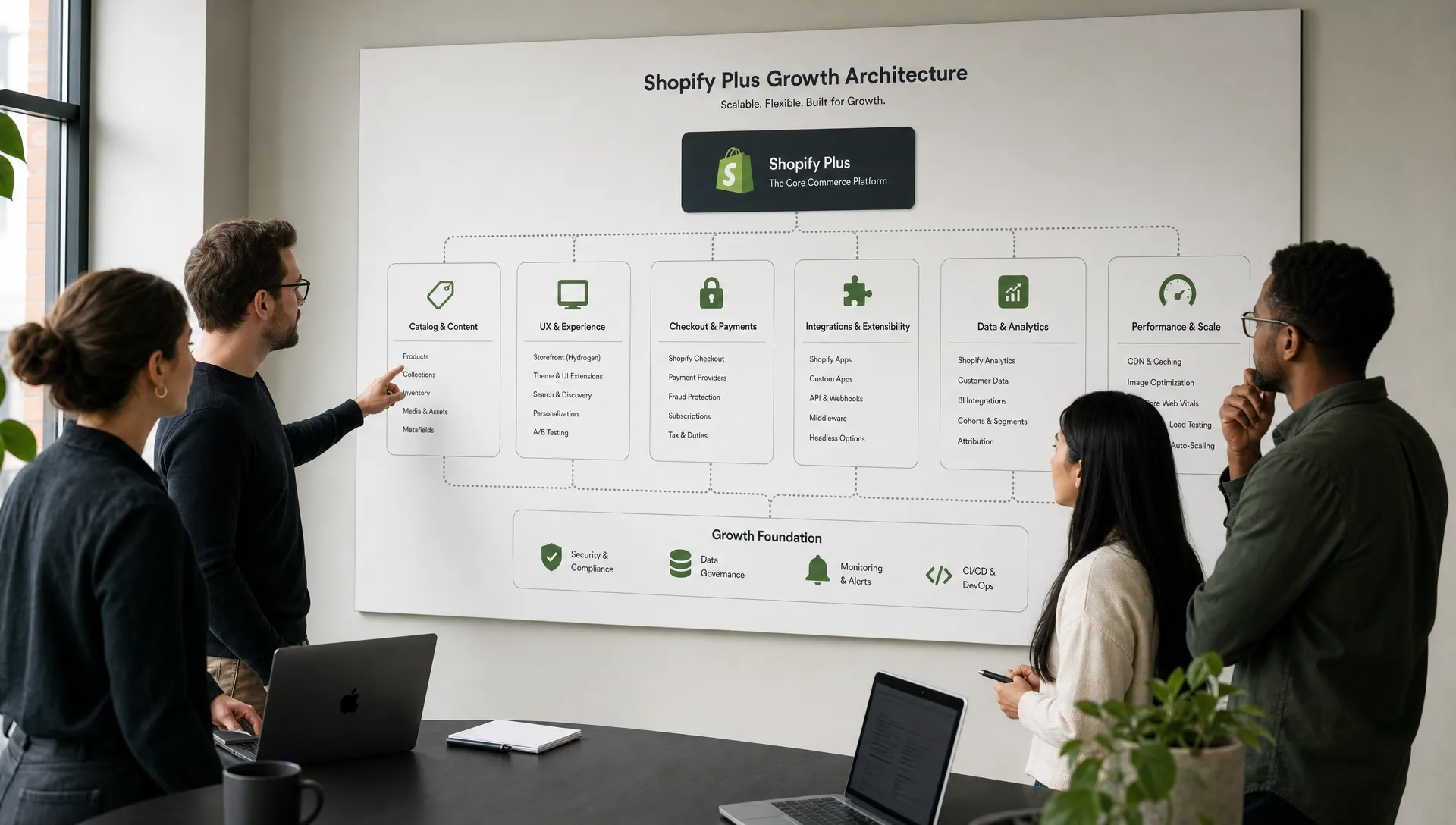
A qualified agency should be comfortable discussing Shopify theme architecture, Shopify Functions, checkout extensibility, Shopify APIs, app governance and integration patterns. They do not need to custom-build everything. They do need to explain where native Shopify capabilities are enough, where apps are appropriate and where custom development creates a durable advantage.
Ask how the agency handles:
- PIM, ERP, OMS and CRM integrations
- Product data normalization and metafield strategy
- Migration of customers, orders, redirects and content
- Theme customization without creating update risk
- QA across devices, markets, payment methods and customer types
- Release management for campaigns and ongoing improvements
For a deeper look at the broader evaluation process, Space Dinosaurs also covers how to choose a Shopify agency that can actually scale. For Shopify Plus specifically, place extra weight on architecture, governance and long-term maintainability.
Treat performance as a revenue system
Site speed is not a technical nice-to-have. For retail, performance affects discovery, browsing depth, conversion, paid media efficiency and customer trust. Google’s Core Web Vitals framework focuses on loading performance, interactivity and visual stability, which are directly relevant to ecommerce experience quality.
A strong Shopify Plus agency should be able to show how they manage performance before, during and after launch. That includes image strategy, app impact, JavaScript control, theme code quality, third-party scripts and performance monitoring.
Do not accept vague promises about a fast site. Ask for process. How do they set performance budgets? How do they audit apps? How do they balance rich merchandising experiences with speed? How do they prevent analytics, personalization and marketing scripts from quietly slowing the site over time?
Look for human-centered UX, not just polished UI
Complex retail UX is about reducing hesitation. Shoppers need to find the right product, understand the difference between options, trust availability and delivery information, then complete the purchase with minimal friction.
A Shopify Plus agency should connect UX decisions to customer jobs. That means understanding how shoppers compare products, what questions block purchase and where merchandising teams need control. Beautiful pages can still fail if the customer cannot understand sizing, compatibility, shipping timing, return rules or product differences.
For retail growth, evaluate whether the agency can improve:
- Navigation and product discovery
- Collection and search experiences
- Product detail page clarity
- Fit, compatibility or configuration guidance
- Trust signals, reviews and support content
- Cart, checkout and post-purchase communication
The best agencies also design for internal users. A modular content model can let marketers build landing pages faster. Better product data structures can help merchants manage launches without developer support. Clear design systems can reduce QA time across campaigns.
Demand analytics and KPI ownership
A Shopify Plus project without reliable analytics is a risky investment. You can launch a better-looking site and still lack the data needed to prove what changed.
Your agency should be able to define tracking requirements early, not at the end of the build. They should understand the difference between implementation data and decision data. Implementation data tells you an event fired. Decision data tells you whether customers are moving through the journey more effectively.
Ask what KPIs they recommend for your growth stage. A retention-led brand may prioritize repeat purchase rate, subscription performance and lifetime value signals. A marketplace-style catalog may focus on search usage, filter engagement, product comparison behavior and add-to-cart rate by category. A high-ticket retailer may care more about qualified lead completion, appointment requests or assisted selling metrics.
Analytics also protects your roadmap. Without clean measurement, prioritization becomes opinion-driven. With clean measurement, your team can see where performance, UX and merchandising improvements produce the strongest returns.
Understand their AI position without falling for AI theater
AI can help Shopify Plus teams move faster, but it should be tied to clear use cases. AI-generated copy alone is not a transformation strategy.
A serious agency should be able to explain how AI supports retail work in practical ways, such as product content workflows, on-site search improvement, merchandising insights, customer service enablement, testing velocity or development efficiency. They should also speak clearly about governance, brand control, data quality and measurement.
Be cautious with agencies that use AI as a vague label. Ask what AI changes in their process, what remains human-led and how outcomes are validated. Space Dinosaurs explores this distinction in more detail in its guide to choosing a next-gen ecommerce agency, not just an AI-powered one.
Ask better questions during agency selection
The questions you ask will shape the answers you get. Instead of asking only for cost, timeline and examples, test how the agency thinks under real retail constraints.
| Selection question | What a strong answer should reveal |
|---|---|
| How would you evaluate whether Shopify Plus is the right fit for us? | Platform judgment, not platform bias |
| What would you need to know before estimating scope? | Discovery maturity and respect for complexity |
| How do you prevent app sprawl? | Governance, cost control and performance awareness |
| How do you handle data and integration risk? | Technical planning, migration discipline and QA depth |
| How do you involve merchandising and marketing teams? | Human-centered process and operational empathy |
| What happens after launch? | Optimization model, analytics ownership and roadmap thinking |
| Which tradeoffs would you expect us to make? | Strategic honesty and practical experience |
Good agencies will ask questions that make you rethink the brief. That is a positive sign. If every conversation feels like a sales confirmation of what you already wrote, you may not be getting the strategic challenge that complex retail growth requires.
Review proof beyond portfolio screenshots
Portfolio design is useful, but screenshots do not show maintainability, analytics quality or operational impact. Ask for examples that reveal how the work performed in the real world.
A credible Shopify Plus agency should be able to discuss the problem, constraints, decisions and outcomes of relevant projects. They may not be able to share every metric due to confidentiality, but they should still explain the commercial logic behind the work.
Look for proof in areas such as:
- Replatforming without major SEO or operational disruption
- Improving Core Web Vitals on a complex retail site
- Reducing dependency on developers for campaign launches
- Simplifying app stacks or lowering technical debt
- Building product discovery for large catalogs
- Improving measurement quality for growth teams
References can be useful too, especially if you speak with a client who worked with the agency after launch. Ask what the agency was like when requirements changed, bugs appeared or priorities shifted. Retail growth is messy. You want a partner that handles reality well.
Compare engagement models, not just project fees
A low build estimate can become expensive if the result is rigid, slow or hard to maintain. A higher estimate can be wasteful if it includes unnecessary custom work. The right comparison is total value over time.
For complex Shopify Plus work, consider three phases: discovery, implementation and optimization. Discovery should clarify business goals, architecture, risks and measurement. Implementation should deliver the experience with strong QA and documentation. Optimization should use live data to improve conversion, speed, merchandising and operational workflows.
Ask how the agency staffs each phase. Senior strategy at the pitch stage means little if your project is handed off without continuity. You need to know who will own architecture, UX, engineering, analytics and delivery once the work begins.
Also ask how they manage change. Retail teams learn during a project. New requirements will appear. Campaign calendars will move. Integrations may behave differently than expected. A mature agency will have a process for prioritization and change control that protects both timeline and quality.
Watch for red flags
Some warning signs appear early. If an agency promises a full Shopify Plus transformation without asking about your systems, data quality, merchandising process or growth model, they are probably underestimating the work.
Be careful when you hear absolute claims such as every app is bad, every custom build is better or Shopify Plus can handle anything. Good agency partners are more precise. They know when native Shopify is enough, when an app is sensible and when custom logic is justified.
Other red flags include weak analytics planning, no performance process, little discussion of post-launch ownership and a discovery process that ignores internal teams. A visually impressive site can still fail if marketers cannot update it, merchants cannot manage the catalog or leadership cannot see what is working.
If you want a more complete checklist, Space Dinosaurs has a focused guide to ecommerce agency red flags retail brands should avoid.
A practical scorecard for choosing a Shopify Plus agency
A simple scorecard helps teams compare agencies without letting the best pitch win by default. Adjust the weightings based on your business model, but keep the categories tied to growth outcomes.
| Evaluation area | Suggested weight | What to look for |
|---|---|---|
| Retail strategy | 20% | Clear understanding of your growth model, customer journey and operational constraints |
| Shopify Plus technical depth | 20% | Strong architecture, integration planning, app governance and maintainability |
| UX and merchandising | 15% | Customer-centered design that also supports internal retail teams |
| Performance and stability | 15% | Defined process for speed, QA, monitoring and release quality |
| Analytics and optimization | 15% | KPI planning, tracking quality and post-launch learning loops |
| Team and communication | 10% | Senior involvement, clear ownership and transparent delivery rhythm |
| Commercial fit | 5% | Scope, budget and engagement model aligned with expected value |
The purpose is not to make selection purely mathematical. It is to force the conversation toward the capabilities that actually affect complex retail growth.
Frequently Asked Questions
What does a Shopify Plus agency do? A Shopify Plus agency helps enterprise or scaling retail brands plan, build, integrate and optimize Shopify Plus experiences. The work can include strategy, UX, development, migration, performance optimization, analytics, app governance and post-launch improvement.
How is a Shopify Plus agency different from a regular Shopify agency? A Shopify Plus agency should be equipped for higher operational complexity, larger catalogs, deeper integrations, more advanced checkout needs, international growth and stronger governance. The difference is less about visual design and more about architecture, scale and long-term retail performance.
When should a retailer hire a Shopify Plus agency? Hire one when your ecommerce growth depends on more than basic site updates. Common triggers include replatforming, poor site performance, messy integrations, limited merchandising flexibility, international expansion, frequent campaign needs or a growing app stack that has become hard to manage.
How long does a Shopify Plus project take? Timelines vary based on scope, integrations, data quality, design complexity and migration risk. A focused optimization project may move quickly, but a full replatform or complex rebuild needs proper discovery, technical planning, QA and launch support.
Should a Shopify Plus agency handle optimization after launch? For complex retail, yes. Launch is only the beginning. Post-launch optimization helps teams improve conversion, performance, analytics quality, merchandising workflows and customer experience using real behavior data.
Choose for the operating model you want, not only the site you need
A Shopify Plus agency should help your retail team move faster without adding hidden complexity. That means building a commerce foundation that supports merchandising, performance, analytics and growth long after launch day.
Space Dinosaurs works with retail brands on e-commerce builds, performance optimization, AI-enabled retail experiences, UX design, analytics and ongoing improvement. If your Shopify Plus decision is tied to complex growth, start a conversation with Space Dinosaurs about building a retail experience that can keep improving.