


Shopper trust is not earned only by a recognizable logo, a secure checkout badge or a generous return policy. It is built through every interaction a customer has with the storefront, from the first page load to the order confirmation. That is why ecommerce web design services matter so much for retail brands that want more than an attractive site. Strong design turns credibility into something shoppers can feel as they browse, compare and buy.
For many retailers, the trust problem is easy to underestimate. Teams may focus on traffic acquisition, promotions and product photography, then wonder why paid visitors hesitate. The issue is often not one dramatic failure. It is a chain of small doubts: unclear navigation, slow product pages, vague delivery details, inconsistent imagery, missing reviews or a checkout flow that feels riskier than it should.
Why shopper trust has become a design problem
Online shoppers make fast judgments. Before they read your full product description, they have already assessed whether the site feels current, stable and legitimate. A dated interface or confusing layout can make a quality product feel less reliable, especially for new visitors who have no previous relationship with the brand.
Trust is also more fragile in retail because shoppers are often comparing several stores at once. If one experience feels easier, faster and more transparent, the customer has little reason to tolerate uncertainty elsewhere. Good design does not manipulate that behavior. It respects it by making the buying journey clear enough that the shopper can focus on fit, value and preference.
How ecommerce web design services turn credibility into interface choices
Professional storefront design is not just a visual refresh. The best work connects brand strategy, user experience, performance, merchandising and analytics into one coherent shopping system. Ecommerce web design services help retailers decide what a shopper needs to trust at each stage, then translate those needs into concrete design patterns.
That might mean simplifying a category structure, rewriting microcopy around shipping, redesigning product cards or improving mobile page speed. It might also mean removing elements that create noise, such as competing banners, unclear discounts or popups that interrupt product evaluation too early.
First impressions depend on consistency and polish
The first trust cue is usually visual coherence. Shoppers expect typography, spacing, photography, color use and calls to action to feel intentional. When pages look assembled from mismatched components, visitors may assume the back-end experience is equally inconsistent.
Consistency matters because it reduces cognitive effort. If product cards behave predictably across collections, the shopper can compare items without relearning the interface. If size guides, delivery messages and return information appear in familiar places, the buying decision feels safer.
Speed and stability signal operational competence
A fast storefront does more than improve technical metrics. It tells shoppers that the brand is capable, prepared and respectful of their time. Laggy image loading, layout shifts and stalled add-to-cart actions can feel like warning signs, even when the product and fulfillment operation are solid.
Google’s Core Web Vitals give teams a shared language for performance, but the shopper experience is more direct: pages should load quickly, buttons should respond immediately and the layout should not jump while someone is trying to tap. Retailers that want to go deeper can explore why e-commerce teams need faster storefronts as part of both conversion and trust strategy.
Product discovery lowers uncertainty before the product page
Shoppers rarely start with perfect certainty. They may know the category, the occasion or the problem they want to solve, but not the exact product. When ecommerce web design services improve navigation, filters, search and merchandising logic, they help customers feel guided instead of left to hunt.
Product discovery builds trust when it makes the assortment understandable. Filters should match how customers actually shop, not only how internal teams organize inventory. Collection pages should explain meaningful differences between products. Search should handle common language, not punish a visitor for using the wrong term.
A trusted storefront also avoids hiding key differences until late in the journey. If materials, compatibility, sizing, bundles or delivery timing affect the purchase decision, those details should appear early enough to prevent disappointment.
Product pages must make claims believable
A product page is where marketing promise meets customer skepticism. Strong pages combine persuasive content with evidence: sharp imagery, clear specifications, authentic reviews, use cases, care guidance, availability and transparent policies. The goal is not to say more. It is to answer the doubts that stop a purchase.
Proof matters in every category, even outside retail. A specialty events business, for example, can make an ambitious promise feel credible by showing record-breaking achievements, visual evidence, partner brands and direct contact options, as seen in Luuk Broos Events’ world-record event experience. Retail product pages work the same way: bold claims need visible support.
For retailers, that support might include customer photos, certifications, fit notes, ingredient details, comparison charts or usage videos. The exact proof depends on the product, but the principle stays the same. Shoppers trust what they can inspect.
Checkout is where trust becomes revenue
Checkout design has to remove anxiety at the moment when perceived risk is highest. Effective ecommerce web design services treat checkout as a trust-critical flow, not a standard template to be accepted without thought.
A good checkout makes costs visible before the final step, offers familiar payment options, explains delivery timing and keeps error messages helpful. It avoids forcing account creation before purchase and it reassures shoppers that they can review order details without losing progress.
Many conversion leaks come from trust issues disguised as usability issues. A vague shipping estimate, a surprise fee or a promo code field that invites uncertainty can all make shoppers pause. Space Dinosaurs has covered related issues in its guide to ecommerce conversion optimization mistakes, including the kinds of friction that make buyers hesitate.
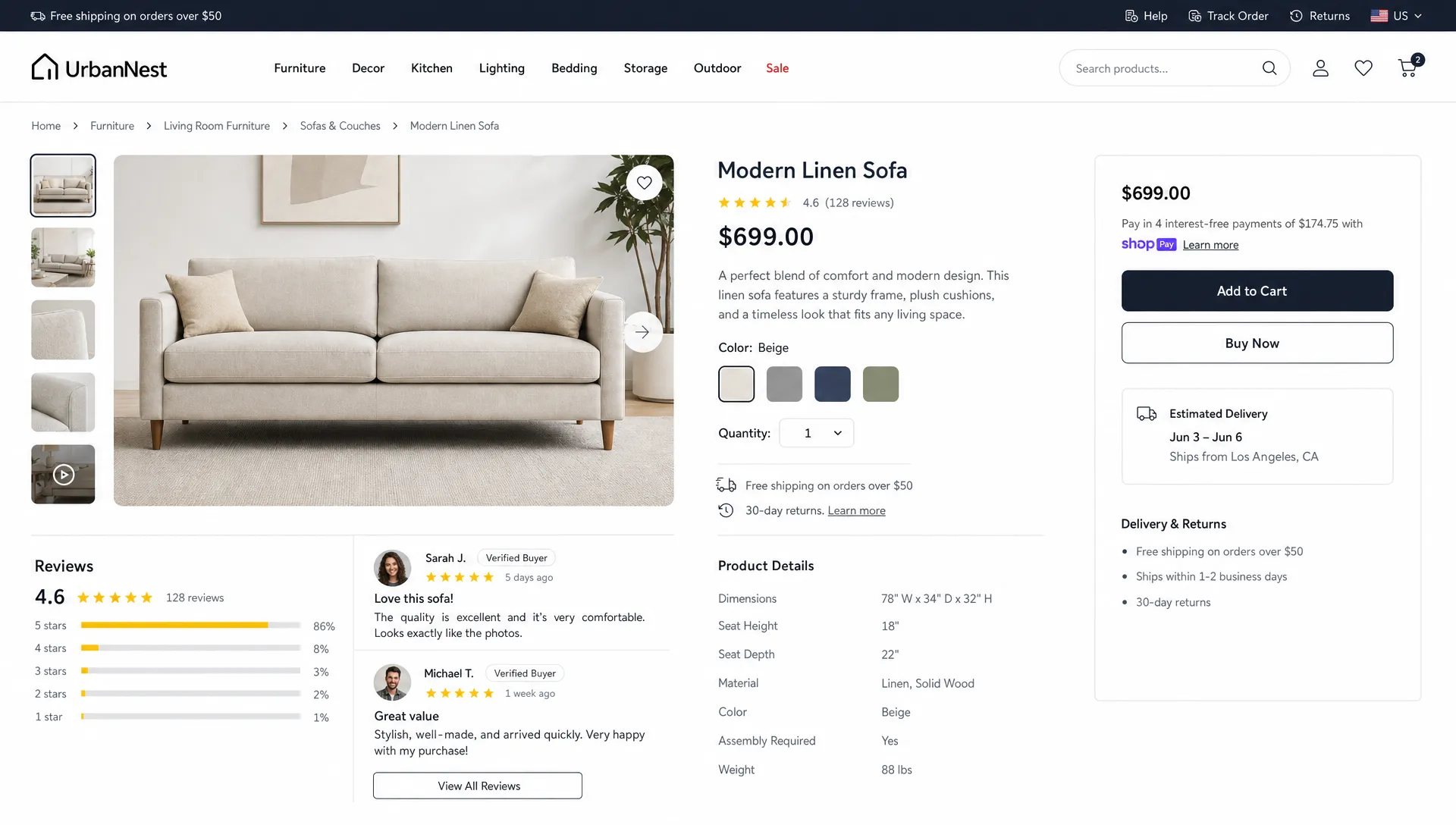
The trust signals shoppers notice across the journey
Some trust signals are explicit, such as reviews and payment icons. Others are felt through clarity, speed and coherence. Retail teams should map both types because shoppers do not separate brand perception from UX. They experience one storefront.
| Shopper concern | Design response that builds trust | Where it usually appears |
|---|---|---|
| Is this brand legitimate? | Consistent visual identity, clear contact details, polished content | Homepage, footer, about page |
| Is this the right product? | Strong filters, comparison cues, size or fit guidance | Navigation, collection pages, product pages |
| Will the item arrive on time? | Delivery estimates, stock status, shipping thresholds | Product page, cart, checkout |
| Can I return it if needed? | Plain-language return policy and visible support options | Product page, cart, footer |
| Is checkout safe and simple? | Familiar payment methods, clear totals, helpful form validation | Cart, checkout, order review |
This is where design decisions become commercial decisions. A retailer can invest heavily in acquisition and still lose customers if the storefront does not answer basic trust questions at the right time.
Mobile design determines whether trust survives
Mobile shoppers are less forgiving of clutter, slow interactions and unclear hierarchy. On a small screen, every design decision becomes more visible. A sticky add-to-cart button can help, but only if it does not cover product information. A menu can be compact, but not if it buries important categories. A promotional banner can drive urgency, but not if it pushes the product out of view.
On mobile, ecommerce web design services should prioritize thumb-friendly navigation, compressed decision paths and readable content. Product images need to zoom cleanly, accordions should use plain labels and checkout fields should be easy to complete without repeated corrections.
Trust also depends on continuity between channels. If a shopper clicks from an ad, email or social post, the landing page should match the promise that brought them there. Mismatch creates doubt. A customer who clicked for a specific collection, offer or product should not have to rebuild the context from scratch.
AI and personalization must feel useful, not intrusive
AI can support more relevant retail experiences, from product recommendations to conversational commerce. Yet personalization only builds trust when it feels helpful and understandable. If recommendations seem random, too aggressive or disconnected from current intent, they can make the site feel less reliable.
Modern ecommerce web design services should define where AI improves the shopping journey and where a simpler rule-based experience is better. A guided quiz, for instance, can reduce choice overload if the questions are short, the result is explainable and the shopper can still browse freely. A chat experience can help if it answers practical questions about product fit, delivery or returns without blocking the rest of the site.
Retailers should also be careful with data signals. Personalization should not make shoppers wonder how much the site knows about them or why a recommendation appeared. Labels such as recommended for your size, pairs well with this item or popular in your selected category can make relevance feel transparent.
Analytics proves whether trust is improving
Trust may sound qualitative, but it can be measured through behavior. Retail teams should track where shoppers move forward, hesitate or exit. Metrics like product detail page engagement, filter usage, add-to-cart rate, checkout completion, return visits and support inquiries can show whether the experience is reducing uncertainty.
The most useful analytics connect behavior to specific design decisions. If a redesigned product page increases size guide engagement and reduces return-related support questions, that is a trust win. If a faster checkout improves completion but increases post-purchase questions, the flow may be efficient but not clear enough.
Strong ecommerce web design services do not end at launch. They create a testing and measurement rhythm so the storefront keeps learning from real shopper behavior. That rhythm matters because customer expectations, device habits and competitive benchmarks keep changing.
Choosing a design partner that treats trust as a growth lever
A useful partner will not begin with moodboards alone. They will ask about customer objections, conversion gaps, technical constraints, merchandising priorities and post-purchase pain points. They will also understand that trust is shaped by the full retail system, including UX, performance, content, platform architecture and analytics.
When comparing agencies, look for teams that can explain how design choices support measurable outcomes. Ask how they validate assumptions, what they inspect before recommending a redesign and how they balance brand expression with usability. If you are evaluating options, Space Dinosaurs offers a practical guide on how to compare ecommerce website design companies without getting distracted by surface-level polish.
For retail brands, the right partner should make the site feel easier to trust because it is easier to use, faster to navigate and clearer to buy from. That combination is where design becomes revenue infrastructure.
Frequently Asked Questions
How do ecommerce web design services build shopper trust? They build trust by making the storefront clear, fast, consistent and easy to buy from. That includes better navigation, stronger product pages, visible policies, reliable checkout flows and design choices based on shopper behavior.
What are the most important trust elements on an ecommerce site? The most important elements are clear product information, transparent delivery and return policies, authentic reviews, secure and familiar payment options, fast page performance and accessible customer support details.
Does visual design affect conversion as much as technical performance? Yes, but the two work together. Visual design shapes first impressions and comprehension, while technical performance affects confidence during browsing and checkout. A beautiful site that feels slow or unstable still damages trust.
How often should retailers review trust signals on their site? Retailers should review trust signals after major campaigns, seasonal merchandising changes, checkout updates and platform releases. A quarterly review is a practical baseline for catching outdated policies, broken UX patterns and new shopper objections.
Build a storefront shoppers can believe in
Trust is built through details that compound: faster pages, clearer product information, smoother discovery, more transparent policies and checkout flows that respect the buyer’s confidence. Space Dinosaurs helps retail brands connect those details through AI-enabled engineering, UX design, analytics and ongoing optimization.
If your storefront looks good but shoppers still hesitate, it may be time to examine where trust is breaking down. Start with the moments of uncertainty, then design the experience around removing them.