
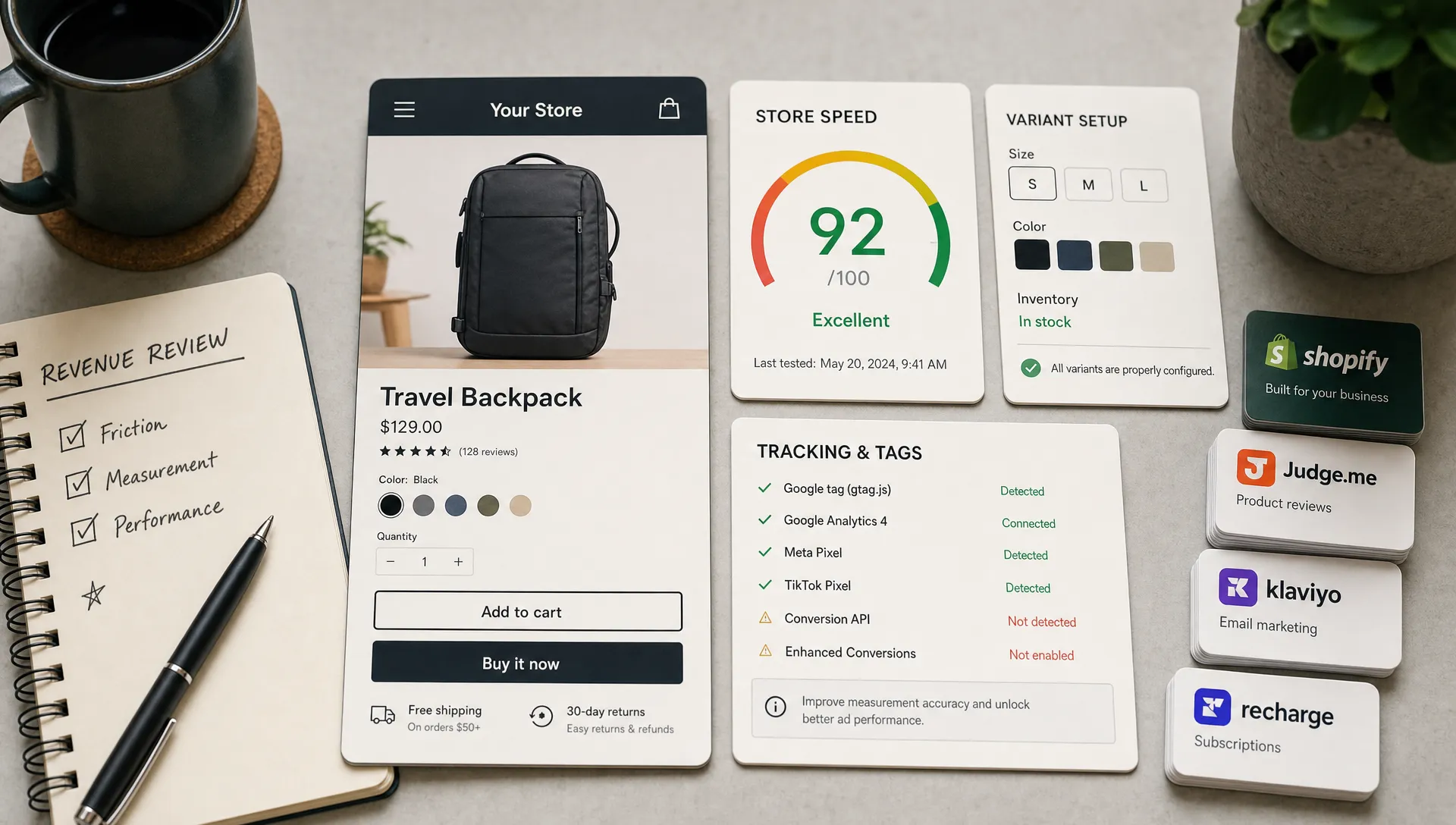
A Shopify store can look polished and still leave revenue on the table. The problem is rarely Shopify itself. More often, the gap sits in how the storefront has been architected, how fast it loads, how clearly it guides shoppers and how well it connects commercial priorities to technical execution.
That is why choosing a Shopify development company is a revenue decision, not just an engineering hire. The right partner does more than build templates or fix bugs. It helps a retail team turn traffic into orders, reduce friction across the buying journey, protect site stability and make future improvements easier to ship.
For growing retailers, the difference can be significant. Two brands can run on the same platform, sell comparable products and spend similar amounts on paid media, yet see very different outcomes because one site is faster, clearer, easier to manage and better measured.
Shopify is the platform, not the revenue strategy
Shopify gives retailers a strong commerce foundation: product management, checkout, content tools, apps, payments and integrations. That foundation matters, but it does not automatically create a high-performing revenue engine.
Revenue comes from the decisions layered on top of the platform. Those decisions include how collections are structured, how product data is modeled, how mobile shoppers move through the site, how promotions are presented, how many third-party scripts run on key pages and how accurately analytics reflect what customers are doing.
A Shopify development company affects revenue because it shapes those decisions in code, design systems, integrations and operating processes. Poor decisions create small leaks everywhere. A slow product page, a confusing variant selector, a broken tracking event or an app that adds unnecessary script weight may not look catastrophic on its own. Combined across thousands or millions of sessions, those leaks become real lost revenue.
Where revenue leaks usually appear in Shopify stores
Most Shopify revenue problems are not dramatic. They are practical points of friction that accumulate across the customer journey. A shopper arrives with intent, gets slowed down, fails to find the right item, lacks confidence in the product or abandons when the purchase path feels harder than expected.
Common revenue leaks include:
- Slow mobile pages that make shoppers bounce before the product story loads.
- Navigation that reflects internal merchandising categories rather than how customers actually shop.
- Product pages that hide sizing, delivery, returns or trust information below the fold.
- App-heavy themes that create fragile experiences and inconsistent performance.
- Checkout paths with avoidable surprises around shipping, tax, discounts or availability.
- Analytics setups that make it hard to identify which fixes changed conversion or average order value.
These are not cosmetic issues. They affect conversion rate, average order value, customer acquisition cost, retention and support burden. A good Shopify development company will look for these issues before suggesting a redesign, a migration or another app.
How a Shopify development company connects engineering to revenue
A revenue-focused Shopify partner treats the storefront as a commercial system. Engineering choices are evaluated by how they affect shopper behavior, operational efficiency and the brand's ability to test and improve.
Performance becomes a conversion lever
Fast sites reduce friction. For retail teams, performance is not just a technical score in a dashboard. It affects how quickly shoppers can see product imagery, interact with filters, change variants, add items to cart and complete checkout.
A Shopify development company can improve performance by auditing theme code, reducing unnecessary JavaScript, optimizing media, setting performance budgets and reviewing the impact of apps before they become permanent parts of the stack. Core Web Vitals such as Largest Contentful Paint, Interaction to Next Paint and Cumulative Layout Shift are useful because they connect technical behavior to the real experience of loading, interacting and staying oriented on the page.
Space Dinosaurs has covered this connection in more depth in its perspective on how e-commerce teams turn site speed into revenue, but the key point is simple: a faster Shopify store gives every traffic source a better chance to convert.
UX work becomes fewer abandoned sessions
Shoppers rarely abandon because one button is the wrong color. They abandon when the experience does not answer the questions they need answered quickly enough.
A Shopify development company with strong UX capability can improve the steps that matter most: collection filtering, product comparison, image galleries, reviews, size and fit guidance, delivery messaging, cart behavior and checkout preparation. These improvements are especially valuable because they increase revenue from traffic the brand is already paying to acquire.
That is the same commercial logic behind website conversion optimisation services that lift revenue: improving the path from visit to purchase often creates growth without increasing media spend.
Merchandising becomes easier to execute
Retail revenue depends on speed of execution. If the merchandising team needs engineering help every time it wants to launch a seasonal landing page, update a buying guide or create a new product storytelling module, the site becomes a bottleneck.
A strong Shopify build gives non-technical teams flexible, governed tools. That may include reusable sections, clean product data, well-structured metafields, scalable collection templates and content modules that maintain brand consistency without forcing every change through development.
Vertical nuance matters here. Fashion retailers need fit, variant and return confidence. Beauty brands often need education, routines and ingredient clarity. A business selling high-consideration experiences, such as expert-guided Uganda safari itineraries, needs trust content, itinerary structure, inquiry flows and mobile clarity more than a standard product grid. The development partner's job is to match the buying journey to the commercial model, not force every business into the same template.
The revenue levers a Shopify development company controls
A Shopify partner will not control brand demand, product-market fit or pricing strategy. It can, however, influence the digital mechanics that determine how much revenue a site captures from existing demand.
| Revenue lever | Development impact | KPI usually affected |
|---|---|---|
| Site performance | Leaner theme code, optimized assets, fewer blocking scripts and better app governance | Conversion rate, bounce rate, paid media efficiency |
| Product discovery | Clear navigation, smarter filtering, search improvements and collection logic | Product views, add-to-cart rate, revenue per session |
| Product page confidence | Better content hierarchy, variant UX, trust signals, delivery clarity and reviews placement | Add-to-cart rate, return rate, support inquiries |
| Cart and checkout readiness | Clear discount handling, shipping messaging, upsell logic and reduced surprises before checkout | Checkout conversion, average order value |
| Merchandising agility | Reusable components, editable sections and scalable product data models | Campaign speed, content output, trading responsiveness |
| Analytics quality | Clean event tracking, funnel visibility and KPI alignment | Decision speed, experiment accuracy, budget allocation |
| Stability and maintainability | QA processes, documentation, app reviews and release discipline | Downtime, bug volume, engineering cost |
Better development improves paid media efficiency
Paid acquisition exposes site weaknesses quickly. If a retailer spends more on ads but sends traffic to slow, confusing or poorly measured landing pages, cost per acquisition rises and campaign learning becomes noisy.
A Shopify development company can improve paid media efficiency by creating faster landing page templates, aligning product feeds with on-site product data, preserving UTM and analytics integrity, improving mobile page speed and reducing friction between ad promise and product page reality.
This matters because media teams are often judged by channel metrics, but the site controls a large part of what happens after the click. A paid social campaign may attract qualified shoppers, but if the mobile product page takes too long to become interactive or hides the offer details, the campaign absorbs blame for a site-side problem.
The same logic applies to organic traffic. Technical structure, page templates, internal linking and content performance all influence how much value a retailer captures from search. For teams evaluating this channel, Space Dinosaurs has also written about what actually moves revenue in e-commerce SEO.
Development quality lowers operating cost
Revenue impact is not limited to topline growth. A poorly built Shopify store can become expensive to operate. Teams spend more time fixing regressions, working around theme limitations, reconciling data problems and waiting for developers to make routine merchandising changes.
A good Shopify development company reduces that drag. It builds in a way that supports day-to-day retail operations, not just launch day. That means cleaner code, fewer unnecessary dependencies, documented workflows, controlled app usage and a release process that protects stability.
Cost optimization is often less visible than conversion improvement, but it still affects profitability. If the business can launch campaigns faster, reduce maintenance effort and avoid repeated rebuilds, the Shopify investment works harder over time.
The wrong Shopify implementation can cap growth
Shopify is a strong fit for many retail teams, but no platform should be treated as universally right. The wrong implementation can cap revenue if the brand needs capabilities the chosen architecture cannot support, or if the store becomes over-customized in ways that make every change slow and risky.
Warning signs include heavy reliance on apps that duplicate each other, custom code with no documentation, unclear ownership between agency and internal team, analytics that nobody trusts and a roadmap dominated by urgent fixes instead of growth work.
There are also cases where retailers should step back and question the platform choice itself. For a more detailed view of platform fit, Space Dinosaurs has a separate guide on when retailers should not use Shopify.
A capable Shopify development company should be honest about these tradeoffs. The goal is not to make Shopify do everything at any cost. The goal is to build the most effective commerce system for the brand's revenue model, operational needs and growth stage.
What to ask before hiring a Shopify development company
The best evaluation questions are commercial as much as technical. You are not only buying development hours. You are choosing a partner that will influence conversion, performance, stability and the pace of future improvement.
| Question | Why it matters |
|---|---|
| How do you connect development work to revenue KPIs? | A revenue-focused partner should talk about conversion, average order value, performance, retention and operating cost, not only deliverables. |
| What is your approach to site speed and Core Web Vitals? | Performance should be designed into the build, not treated as cleanup after launch. |
| How do you decide between custom code and Shopify apps? | Good app governance protects speed, stability and long-term maintainability. |
| How will our merchandising team manage content after launch? | The build should make trading and campaign execution easier for non-technical teams. |
| How do you QA analytics and events? | Bad data leads to bad investment decisions, even when the site looks good. |
| What happens after launch? | Revenue gains usually come from ongoing optimization, not a single release. |
A strong answer should be specific. If a company only talks about theme design, app setup or launch timelines, it may be a developer rather than a commercial partner. If it can explain how technical choices affect shopper behavior and business outcomes, the conversation is more likely to produce revenue impact.
A practical way to prioritize Shopify revenue work
Retail teams often have more ideas than engineering capacity. The answer is not to build everything faster. It is to prioritize the work most likely to improve revenue, reduce risk or create better learning.
A useful prioritization filter asks whether the proposed change removes a known customer friction, supports a measurable KPI, improves future team velocity or reduces technical risk. If the change does none of those things, it may still be nice to have, but it should not outrank work that directly improves the buying journey.
This is where an experienced Shopify development company earns its value. It can help leadership separate visible activity from meaningful progress. A redesign may be useful, but sometimes the higher-return move is fixing mobile performance, restructuring product data, improving collection templates or cleaning up analytics so the team can finally make decisions with confidence.
Frequently Asked Questions
How does a Shopify development company increase revenue? A Shopify development company can increase revenue by improving site speed, product discovery, product page clarity, checkout readiness, analytics quality and merchandising agility. These improvements help more shoppers complete purchases and help teams make better growth decisions.
Is hiring a Shopify development company only useful for large retailers? No. Smaller brands can also benefit, especially when paid media costs are rising or internal teams are spending too much time on manual site changes. The scope should match the business stage, but the revenue logic applies at most sizes.
What is the difference between a Shopify developer and a Shopify development company? A Shopify developer may focus on specific technical tasks. A Shopify development company usually brings a broader mix of engineering, UX, analytics, strategy, QA and ongoing optimization. For revenue-focused work, that broader view often matters.
Can too many Shopify apps hurt revenue? Yes. Apps can add useful functionality, but too many can slow the storefront, create conflicts, complicate maintenance and make the shopper experience less consistent. A good partner reviews app value against performance, stability and business need.
Should every retailer use Shopify? No. Shopify is a strong option for many commerce teams, but platform fit depends on operating model, catalog complexity, international requirements, customization needs and integration depth. Retailers should evaluate fit before committing to a build.
Turn your Shopify site into a stronger revenue system
A Shopify store is not just a digital storefront. It is a revenue system made up of performance, UX, data, merchandising tools, integrations and ongoing optimization. When those parts work together, every channel benefits. When they do not, traffic becomes more expensive and growth becomes harder to diagnose.
Space Dinosaurs helps retail brands modernize e-commerce experiences through AI-enabled engineering, human-centered UX, performance optimization, analytics and ongoing improvement. If your Shopify site is underperforming, the next step is not simply another redesign. It is a focused look at where revenue is leaking and which technical changes will create the clearest commercial impact.