


Custom BigCommerce design needs more than a theme when the obstacle sits in product data, business logic, app integrations or the journey from storefront to checkout. A theme can change presentation and interaction. It cannot, by itself, make an inventory feed accurate or turn an unsupported payment flow into a supported one.
The decision is not simply whether to buy a theme or build something unique. Retail teams need to identify which parts of the experience need changing, where those changes belong and who will maintain them after launch.
The practical options are to adapt an existing theme, commission a custom Stencil storefront or separate the frontend from BigCommerce with a headless architecture. None is automatically better. The right choice addresses a documented buying problem without creating unnecessary operating costs.
Where custom BigCommerce design outgrows a theme
A theme controls much of the shopper-facing experience: navigation, category layouts, product presentation, responsive behavior and reusable interface components. BigCommerce’s Stencil framework gives developers substantial control over these areas while retaining a platform-native storefront architecture.
That makes a theme a reasonable starting point for many substantial redesigns. A distinctive brand experience does not automatically require headless commerce.
However, three different problems can look like the same design request:
- Presentation problem: Shoppers cannot find size information because the product page gives it too little prominence.
- Data problem: Size information is missing, inconsistent or stored in a format the storefront cannot reliably use.
- Workflow problem: Availability depends on location or fulfillment rules that the current systems do not expose correctly.
Only the first is primarily a theme issue. The others may require catalog cleanup, integration work or changes to backend services before the interface can deliver the intended experience.
Ask a simple diagnostic question: if the team had complete freedom over the page layout tomorrow, would the shopper’s problem disappear? If not, the redesign brief needs to include more than visual requirements.
Choose between theme changes, a custom build and headless
For custom BigCommerce design, choose an architecture based on the constraints you can demonstrate, not on how modern a technology sounds.
| Approach | Best fit | Main responsibility to plan for |
|---|---|---|
| Adapt an existing Stencil theme | The buying journey works, but branding, hierarchy or selected interactions need improvement | Managing modifications and incorporating relevant theme updates |
| Build a custom Stencil theme | The storefront needs distinct templates, reusable components and substantial UX changes within BigCommerce’s native model | Maintaining custom theme code and testing platform and app interactions |
| Build a headless storefront | Documented frontend, content or cross-channel requirements are difficult to satisfy economically within Stencil | Owning frontend hosting, deployments, caching, integrations and ongoing maintenance |
Page Builder can support merchant-managed content and layout changes where the theme exposes appropriate settings and regions. Developers can also create custom widgets for reusable content needs. It is not unrestricted control over every storefront or checkout behavior.
A custom Stencil build can therefore provide both a differentiated experience and manageable editing tools. The implementation determines how much independence the merchandising team gets.
Headless changes the ownership model more substantially. BigCommerce provides Catalyst, a storefront framework built with Next.js and React, but a framework does not remove operational responsibilities. API coverage, authentication, checkout integration and app compatibility still need validation.
Ask whoever recommends headless to identify the requirement that makes it worthwhile, demonstrate that requirement and explain the ongoing support burden. A desire for a different homepage is not enough.
Prove the hardest buying task before approving the visuals
A homepage mockup rarely reveals the most expensive constraints. Start with a representative shopping task that crosses several parts of the system.
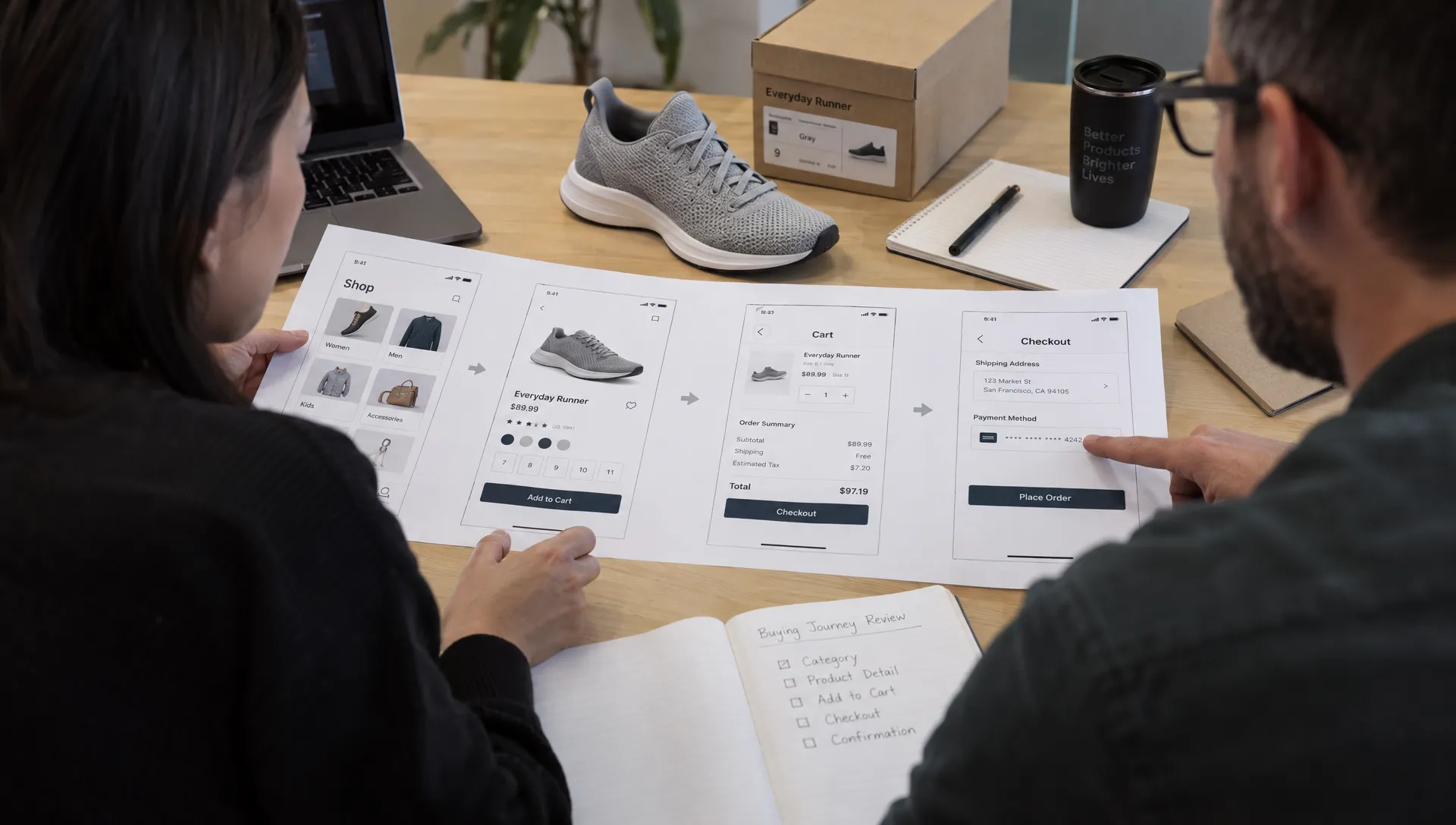
For a footwear retailer, that might mean finding a style, selecting a size, checking availability, applying an eligible promotion and completing a mobile purchase. For a B2B seller, it could involve signing in, seeing account-specific pricing and purchasing with an approved payment method.
Before investing in custom BigCommerce design, prototype the task that is most likely to expose a platform or integration limitation.
The prototype should answer practical questions. Does the required data exist? Can the storefront retrieve it under realistic conditions? Does the relevant app support the proposed frontend? Does the experience remain usable when a product has many variants or a service responds slowly?
This is also where design and engineering need to work together. A layout that looks simple may depend on several services, while an apparently unusual interaction may be straightforward in Stencil. Our discussion of when an ecommerce design agency needs technical depth explains why those dependencies belong in design decisions, not just development tickets.
The output should be evidence: a working interaction, a documented limitation or a revised requirement.
Build a scope that merchandising and engineering can share
A useful project scope describes what shoppers and internal teams must be able to do. “Premium look and feel” is a creative direction, not an acceptance criterion.
Bring merchandising, customer service, operations, marketing and engineering into discovery. Each sees different failure points, from repetitive content entry to confusing delivery messages.
Define templates, content ownership and data dependencies
List the page types and meaningful variations the storefront must support. A standard product, a configurable product and a subscription product may need different behaviors even if their layouts share components.
Custom BigCommerce design should also define the editing experience behind those pages. Specify which content merchants can change, which components they can reuse and which changes require a developer. Request a demonstration of those tasks before accepting the build.
Changing themes is not necessarily a catalog migration, but theme settings, widget placements, custom HTML and app-generated content still need an inventory. Do not assume they will transfer cleanly into a new implementation.
For every dynamic element, identify its source of truth. Delivery messages, product specifications and stock status should not become disconnected copies maintained in several places. Assign ownership for missing content and data cleanup before launch planning begins.
Make accessibility and performance testable
Use WCAG 2.2 Level AA as an accessibility target and translate it into acceptance checks. Test keyboard navigation, visible focus, form labels, validation messages and product-option controls. Automated scans help, but they do not replace manual testing of complete buying tasks.
Performance requirements should cover representative category and product pages, not just an uncluttered homepage. Include realistic imagery, product options, consent tooling and third-party scripts in testing.
For custom BigCommerce design, define performance budgets before approving interactions that introduce substantial JavaScript or large media assets.
Google’s Core Web Vitals guidance defines good thresholds as Largest Contentful Paint at or below 2.5 seconds, Interaction to Next Paint at or below 200 milliseconds and Cumulative Layout Shift at or below 0.1, assessed at the 75th percentile. These are experience metrics, not promises of higher sales. Use lab tests during development and field data after launch, with mobile results reviewed separately.
Treat compatibility and rollback as design requirements
A storefront can pass visual review and still fail at the moment a customer tries to buy. Build a compatibility matrix covering the apps and services that affect the purchase journey.
Check search, reviews, personalization, subscriptions, loyalty, consent management and analytics wherever they are present. Some integrations depend on specific theme markup or scripts. A headless implementation may need a different integration method, so an app’s availability in the marketplace is not sufficient proof of compatibility.
Checkout needs its own validation. Test relevant payment methods, shipping rules, tax behavior, promotions and guest or signed-in purchasing. A storefront theme is not the same as checkout, and customization options depend on the checkout approach and applicable platform constraints.
A safe release plan for custom BigCommerce design also distinguishes theme rollback from recovery of everything around it. Retain the known-good theme and document how to republish it, but separately record changes to scripts, app settings, redirects, catalog data and checkout configuration.
Use local development and unpublished-theme previews for appropriate checks, then validate end-to-end behavior in a suitable test environment. A preview alone does not establish that every payment or integration path works.
Set explicit launch-blocking conditions, such as failed purchasing paths or broken tracking, and name the person authorized to revert. Rehearse the recovery steps before launch day.
Measure the redesign against your own storefront
Define success before implementation begins. Generic conversion benchmarks cannot tell you whether a particular redesign helped your customers or protected your margins.
Choose measures that match the original problem. If shoppers struggle with product selection, track successful option selection and product-to-cart progression. If delivery uncertainty is the issue, review abandonment around shipping information alongside relevant customer-service contacts.
The measurement plan for custom BigCommerce design should connect customer behavior to commercial results without treating every post-launch change as a design effect.
| Original problem | Useful measures | Important comparison controls |
|---|---|---|
| Difficult product selection | Option-selection errors, product-to-cart progression, task-test completion | Product availability and catalog mix |
| Mobile interaction friction | Mobile funnel progression, interaction responsiveness, form errors | Device mix and acquisition source |
| Unclear fulfillment information | Checkout progression, delivery-related support contacts | Shipping policies and promotion changes |
| Slow merchandising updates | Time to publish a campaign, developer interventions, publishing errors | Comparable campaign complexity |
Record a baseline before launch and verify that analytics events retain consistent meanings afterward. A renamed event or missing consent integration can make an apparent improvement meaningless.
Where feasible, use controlled testing. Otherwise, compare equivalent periods and segments while documenting changes in pricing, stock, campaigns and traffic. Revenue per session can provide a commercial view, but review margin, refunds and order quality where relevant.
Include operational outcomes too. A storefront that performs well for shoppers but requires engineering support for every campaign may not meet the business case.
Frequently asked questions
Can I customize a BigCommerce theme without coding? Yes, within the options exposed by the theme and Page Builder. Merchants can adjust supported settings and manage content in available regions. New functionality, custom templates or changes outside those controls generally require development.
Do I need headless commerce for a completely different design? No. Stencil supports extensive storefront customization. Consider headless when specific frontend, content or cross-channel requirements justify its additional operating responsibilities, not simply because the proposed design looks different from a standard theme.
How should I test a new BigCommerce theme? Combine local development checks, unpublished-theme previews and end-to-end testing in an appropriate test environment. For custom BigCommerce design, include realistic catalog scenarios, mobile devices, accessibility checks, app interactions, checkout paths and analytics validation rather than relying on screenshots.
Will changing themes hurt SEO? It can if the change disrupts internal links, headings, canonical tags, structured data or crawlable content. Preserve valuable URLs where possible, map redirects where needed and compare representative pages before and after release. Monitor indexing and organic landing-page performance afterward.
Choose the smallest build that solves the whole problem
Ask for a proposal that ties each major requirement to its implementation layer, acceptance test and maintenance owner. If you are comparing partners, use these requirements to evaluate ecommerce website design companies on more than their portfolios.
Space Dinosaurs combines retail-focused UX design, engineering, analytics and performance optimization. Discuss the buying journey that needs fixing first, then determine whether the work belongs in a theme, an integration or a broader storefront rebuild.