

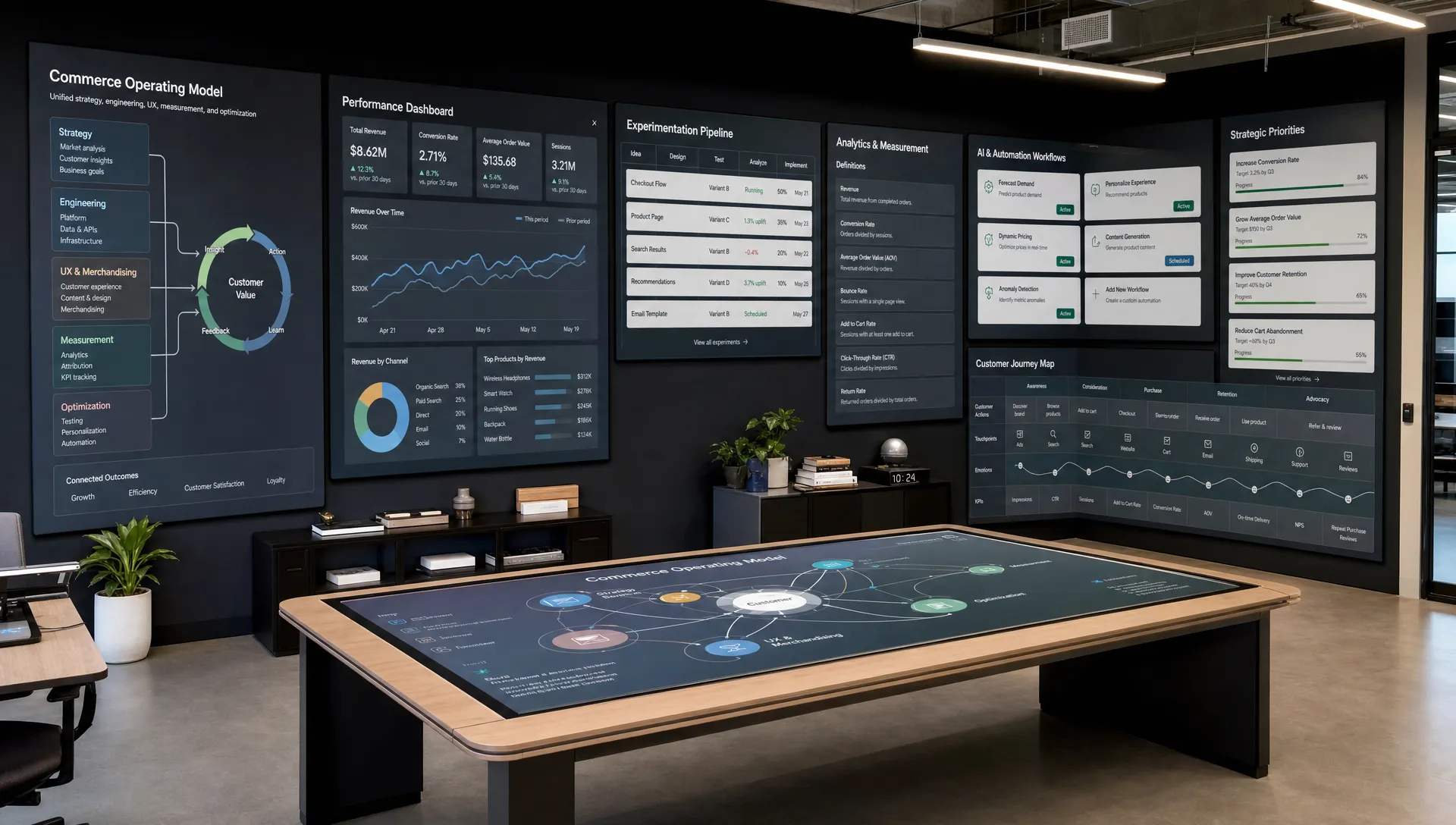
By 2027, retail commerce will not reward brands for having a modern-looking storefront. It will reward brands that can learn faster, personalize responsibly, operate efficiently, and turn every customer interaction into measurable business progress.
That raises the bar for what a digital commerce agency should deliver. A redesign, platform migration, or AI proof of concept is not enough. Retail teams need a partner that can connect strategy, engineering, UX, performance, analytics, and continuous optimization into one operating model.
If your team is still prioritizing what needs to be fixed before the next planning cycle, Space Dinosaurs has also outlined the core issues digital commerce leaders need to fix for 2027. This article takes the next step: what should the agency you hire actually deliver?
The 2027 standard: outcomes over outputs
The old agency model was built around deliverables: wireframes, sprints, launch dates, campaign assets, and post-launch support. Those still matter, but they are not the end goal.
In 2027, a strong digital commerce agency should be accountable for commercial outcomes such as faster page experiences, higher conversion quality, cleaner analytics, lower operating cost, better merchandising flexibility, stronger retention signals, and fewer technical blockers for growth.
That does not mean an agency can control every revenue variable. Pricing, inventory, brand demand, product-market fit, media efficiency, and macroeconomic conditions still matter. But the agency should be able to show how its work improves the parts of the system it can influence.
A useful test is simple: after 90 days, can the agency explain what changed, why it changed, what the data says, and what should happen next? If the answer is no, you are probably buying production capacity rather than a commerce partner.
A commercial roadmap, not just a redesign brief
A capable agency should start by translating business goals into a commerce roadmap. That roadmap should connect customer experience, technology, operations, and measurement.
For example, a retailer trying to improve conversion may not need a full visual redesign. The better roadmap might include faster product listing pages, clearer size and fit content, improved search relevance, checkout simplification, and better event tracking. Another retailer may need platform modernization because every promotional change requires expensive development work.
A 2027-ready roadmap should define:
- The business outcomes the work is meant to influence
- The customer journeys and revenue moments that matter most
- The technical constraints slowing growth
- The data required to measure improvement
- The sequence of work that balances impact, cost, and risk
This is where many agencies overpromise. A strong digital commerce agency will not recommend headless, composable, AI personalization, or a full replatform just because those ideas sound modern. It will diagnose the constraint first, then recommend the right level of change.
Performance engineering as revenue infrastructure
Retail teams already know speed matters. By 2027, the bigger issue is that performance cannot be treated as a one-time launch checklist.
A strong agency should deliver performance as an operating discipline. That includes Core Web Vitals improvements, image optimization, front-end architecture choices, third-party script governance, caching strategy, monitoring, and performance budgets that prevent slowdowns from creeping back in.
This is especially important as commerce experiences become more content-rich and AI-assisted. Product imagery, reviews, video, personalization engines, recommendation widgets, payment tools, loyalty scripts, and analytics tags can all add value. They can also slow the buying journey if nobody owns the tradeoff.
The agency should help your team answer practical questions. Which scripts are essential? Which ones hurt mobile speed? Which templates drive the most revenue and deserve optimization first? Where are latency issues coming from? What performance standards should be built into release workflows?
The deliverable is not a performance report. The deliverable is a faster, more resilient commerce experience that stays fast as the business changes.
AI that solves real retail problems
By 2027, every digital commerce agency will claim to use AI. The difference will be whether AI is used as a label or as a working layer across the commerce system.
Useful AI in retail should improve decisions, customer experiences, or operational efficiency. That might include smarter product discovery, conversational commerce, merchandising insights, customer service support, content workflow acceleration, anomaly detection, or personalization that adapts to intent.
But AI should also come with governance. Retailers need clarity on data sources, privacy, model behavior, human review, testing, and failure handling. A chatbot that gives the wrong answer, a recommendation model that amplifies poor inventory logic, or an automated content workflow that creates inaccurate product claims can all damage trust.
A serious agency should be able to explain where AI belongs, where it does not, and how performance will be measured. The goal is not to make the site feel futuristic. The goal is to make the shopping experience more relevant, efficient, and trustworthy.
UX that sells confidence
Human-centered UX will matter more, not less, as AI and automation become more common. Customers still need to understand what they are buying, why it fits their needs, how delivery and returns work, and whether they can trust the brand.
For retail, this means product pages need more than attractive layouts. They need useful comparison points, persuasive merchandising, strong content hierarchy, clear pricing, accessible design, and frictionless paths to purchase. Checkout needs to feel secure and simple. Account, loyalty, returns, and support experiences need to feel connected rather than bolted on.
The same principle applies outside traditional retail categories. A premium travel brand such as Lumina’s luxury vacation rentals is not just selling a booking. It is selling confidence in the property, the stay, the service, and the overall experience before a guest ever arrives. Retail brands should think the same way: the digital journey has to reduce uncertainty at every step.
In 2027, a digital commerce agency should deliver UX that is beautiful, measurable, accessible, and commercially grounded. If a design decision cannot be connected to customer understanding or business impact, it is decoration.

Analytics and experimentation that teams can actually use
Many commerce teams have plenty of data but not enough clarity. Events fire inconsistently. Dashboards disagree. Marketing, merchandising, product, and engineering teams use different definitions for the same metric. Experiments run, but learnings disappear after the next sprint.
A 2027-ready agency should help create a measurement system that supports decisions. That means clean event taxonomy, reliable funnel tracking, KPI definitions, analytics QA, and dashboards that distinguish between leading indicators and business outcomes.
The agency should also support experimentation. Not every change needs a formal A/B test, but important changes should have hypotheses, success metrics, and a readout. Over time, this creates institutional knowledge about what actually moves the business.
The best agencies make analytics part of delivery, not something added after launch. They instrument features properly, check data quality, and help teams interpret results. That is how a retailer moves from opinion-driven change to evidence-led optimization.
Architecture decisions that reduce complexity
Platform choices are strategic decisions, not technical fashion statements. In 2027, some retailers will need composable or headless architectures to support scale, speed, localization, omnichannel content, or complex integrations. Others will get better returns by improving their current platform and reducing unnecessary customization.
A strong digital commerce agency should deliver an architecture recommendation that considers business maturity, team capability, budget, operational complexity, and long-term flexibility. If headless commerce is on the table, the agency should be clear about both the upside and the responsibilities it creates.
For teams evaluating that path, Space Dinosaurs has a deeper guide to building a future-proof headless commerce solution. The key point is that architecture should make the business more adaptable, not simply more complex.
The right agency will also care about maintenance. Can internal teams manage content without developer dependency? Are integrations observable? Are release processes safe? Is the stack documented? Can the business launch campaigns quickly without creating technical debt each time?
SEO, content, and merchandising built into the system
A commerce site can look great and still fail if search engines, internal site search, category pages, and product content are treated as separate workstreams.
By 2027, a digital commerce agency should understand how technical SEO, UX, merchandising, and performance interact. Category architecture affects crawlability and conversion. Faceted navigation affects indexation and product discovery. Product content affects organic visibility, paid landing page quality, returns, and customer confidence.
The agency should help teams build content systems, not just pages. That includes scalable templates, structured data where appropriate, metadata logic, internal linking patterns, search-friendly category experiences, and content workflows that merchandising teams can maintain.
This does not mean every agency must replace a specialist SEO partner. But it does mean commerce decisions should not break organic visibility. SEO needs to be considered during platform changes, redesigns, migrations, and performance work, not cleaned up after revenue drops.
Cost optimization and stability
Growth is not only about adding features. Many retail organizations are carrying high operating costs from bloated stacks, fragile integrations, slow development workflows, excessive third-party tools, and platform decisions that no longer fit the business.
A 2027-ready agency should identify where complexity is costing money or slowing execution. That might mean reducing redundant tools, improving deployment stability, simplifying templates, refactoring high-risk code, improving monitoring, or creating a clearer maintenance model.
Stability is also part of customer experience. If promotions break, checkout fails, inventory data lags, or pages slow down during peak traffic, customers do not care that the roadmap looked innovative. They leave.
The agency should therefore support both innovation and reliability. Retail needs experimentation, but it also needs operational discipline. The best partners know how to ship improvements without turning the site into a permanent beta test.
The digital commerce agency scorecard for 2027
When evaluating agencies, use a scorecard that focuses on proof. The strongest partners will be comfortable discussing tradeoffs, measurement, and accountability.
| What to evaluate | Weak agency answer | Strong 2027 agency answer |
|---|---|---|
| Strategy | We will redesign the site | We will map revenue goals to customer journeys, technical constraints, and measurable priorities |
| Performance | We will optimize before launch | We will set performance budgets, monitor regressions, and govern third-party impact |
| AI | We have AI capabilities | We will identify practical AI use cases, define governance, and measure customer or operational value |
| UX | We create modern interfaces | We design around trust, accessibility, conversion friction, and customer decision-making |
| Analytics | We provide reports | We create reliable tracking, shared KPI definitions, and experiment readouts |
| Architecture | We recommend the newest stack | We recommend the right stack for your business model, team, and growth constraints |
| Optimization | We support after launch | We run a continuous improvement cycle tied to commercial outcomes |
If an agency cannot explain how it will measure success, it is not ready for 2027 commerce expectations. If it cannot explain what not to build, it may not be ready to protect your budget.
What Space Dinosaurs believes agencies should deliver
For retail brands, digital transformation is not a single project. It is an ongoing capability. That is why the best agency relationship should feel like a combined strategy, engineering, UX, analytics, and optimization function focused on making the commerce business faster and more effective.
At Space Dinosaurs, the standard is practical: modern e-commerce builds, performance optimization, AI-enabled retail experiences, cost-aware engineering, human-centered UX, analytics, composable stack support, and continuous improvement. The point is not technology for its own sake. The point is better retail outcomes.
If you are comparing agencies, look past the pitch deck. Ask what they will improve, how they will measure it, what risks they see, and how they will help your team operate better after launch.
Frequently Asked Questions
What does a digital commerce agency do? A digital commerce agency helps brands improve the systems that support online revenue, including e-commerce platforms, UX, performance, analytics, integrations, SEO foundations, experimentation, and ongoing optimization.
What should retailers expect from a digital commerce agency in 2027? Retailers should expect measurable outcomes, AI readiness, fast and stable experiences, customer-centered UX, clean analytics, cost-conscious engineering, and a roadmap that connects technology work to business goals.
Is AI now required in digital commerce? AI is becoming a core part of modern commerce, but it should be used selectively. The best use cases improve discovery, service, personalization, operations, or decision-making with clear governance and measurement.
Should every retailer move to headless or composable commerce by 2027? No. Headless and composable approaches can be powerful, but they are not automatically the right answer. The decision should depend on scale, complexity, team maturity, budget, and the business need for flexibility.
How do you know if an agency is outcome-focused? Ask how it defines success, what KPIs it will track, how it handles post-launch optimization, and how it connects design and engineering decisions to revenue, cost, stability, or customer experience.
Ready to raise the standard for your commerce roadmap?
If your retail team needs a partner that can connect AI-enabled engineering, performance, UX, analytics, and ongoing optimization, Space Dinosaurs can help you build a more resilient digital commerce foundation for 2027 and beyond.