


Before hiring an ecommerce PPC company, confirm that your business can access and operate its advertising accounts without the agency’s cooperation. A contract saying “the client owns the account” is not enough if the agency controls the administrator login, recovery email, billing relationship or tracking infrastructure.
The practical test is simple: if the relationship ended tomorrow, could your team appoint another partner without rebuilding campaigns or losing access to historical results? This guide explains which terms to inspect, what evidence to request and how to test account control before signing. The contract examples are negotiation starting points, not legal advice.
Separate account control from contractual ownership
“Ownership” can describe several different things. Your agreement needs to distinguish them rather than treating the word as a complete safeguard.
Platform control means the permissions your employees hold inside advertising, analytics and commerce systems. Contractual rights determine what the agency must provide, preserve or license. Intellectual property rights cover deliverables such as creative files, scripts and feed rules. Privacy obligations govern how personal data can be collected, used and shared.
These rights do not automatically travel together. Your business might have contractual rights to campaign deliverables while lacking permission to edit the account. Conversely, an administrator login does not give you unrestricted rights to licensed photography or customer information.
Ask an ecommerce PPC company to explain all four categories in writing. Its answer should name the assets and identify any exceptions, not simply promise that “everything is yours.”
Platform terms also matter. An agency cannot promise an account transfer, audience export or data use that the platform prohibits. Contract language should require cooperation within those limits and disclose material restrictions before work begins.
Build an asset ownership schedule
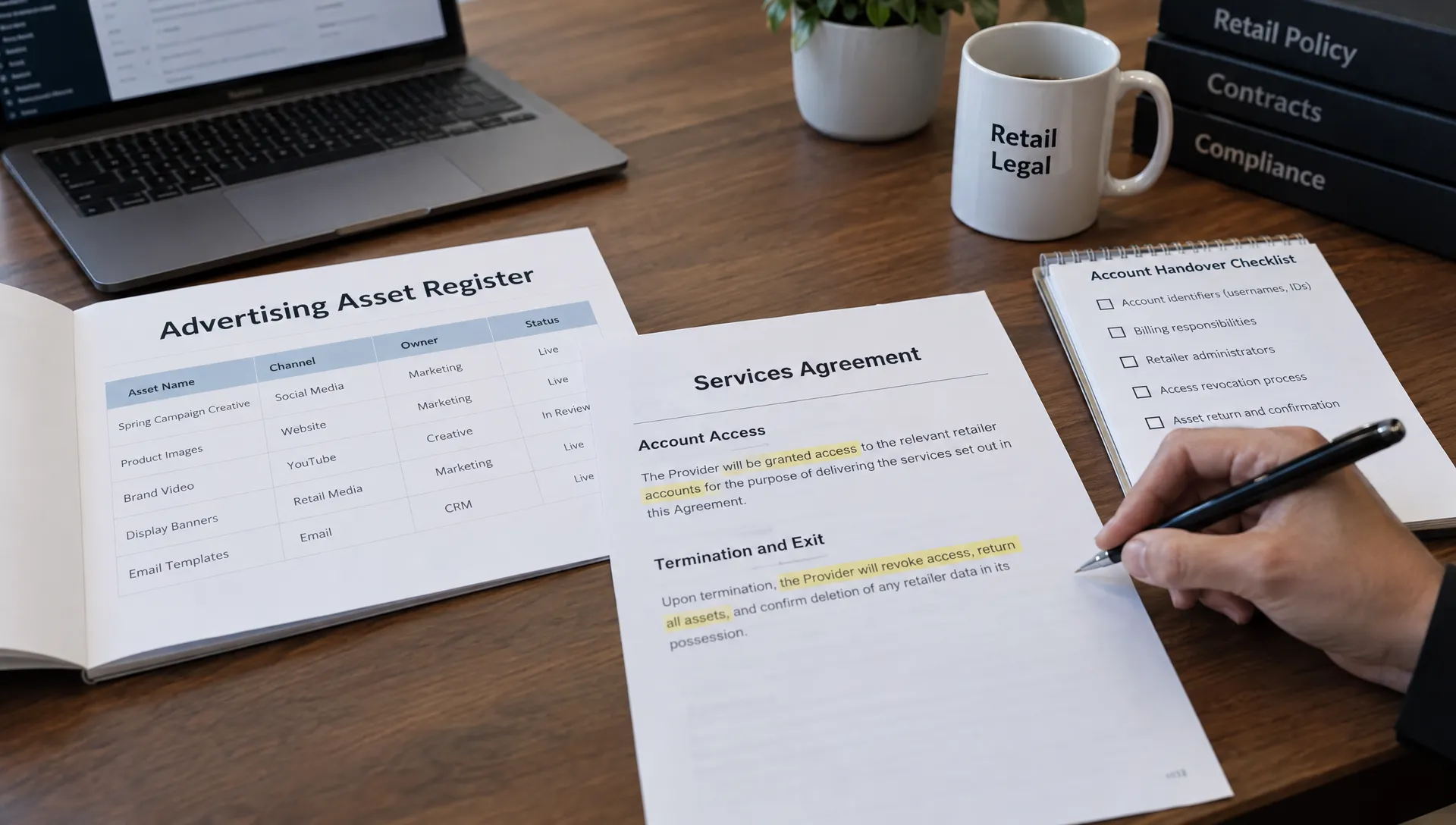
Attach an asset register to the agreement or statement of work. Record the account identifier, controlling business, retailer administrators, agency permissions and exit treatment for each asset.
Use this as a starting framework, adjusting it to the channels and technology you actually use:
| Asset | Control to verify | Exit treatment to document |
|---|---|---|
| Advertising accounts | Retailer employee access and linked agency relationships | Continued access to existing accounts and campaign history |
| Product catalogs and merchant accounts | Business association, administrators and store connections | Continued catalog access and management rights |
| Analytics properties | Retailer-controlled administration | Continued historical reporting and configuration access |
| Tag management | Account, container and publishing permissions | Access to configurations and permitted exports |
| Pixels and server-side tracking | Asset access, hosting and credential control | Continued operation or a documented replacement plan |
| Product-feed services | Subscription holder, feed rules and source access | Transfer, export or replacement arrangements |
| Campaign deliverables | Rights to copy, creative, scripts and documentation | Editable files or specified licenses |
| Reporting tools | Subscription holder and underlying data access | Defined exports and treatment of historical reports |
The schedule should expose dependencies. An agency-owned feed subscription, for example, might support a retailer-controlled merchant account. Losing the subscription could still interrupt product advertising.
Have the ecommerce PPC company identify exceptions directly in this register. For deliverables that include licensed or third-party material, apply the same distinction between ownership and usage permission explained in our guide to agency content rights.
Check advertising-platform control directly
Google Ads: inspect the client account and manager relationship
A Google Ads manager account lets an agency manage client accounts. That relationship is not, by itself, a problem. The issue is whether your business retains appropriate direct access to the advertiser account and understands the manager’s permissions.
Request the client account’s customer ID, then sign in using a retailer-controlled identity. Inspect user permissions, linked managers and any applicable manager ownership designation. A platform’s technical use of “owner” is not a substitute for the contractual rights discussed above.
If an ecommerce PPC company proposes creating a new account, ask who will create it, which business identities will receive administrator access and how the agency manager will be connected. An agency-created account is not automatically unusable, but the access arrangement must be deliberate.
Where supported, maintain at least two authorized retailer administrators using company-managed identities and multifactor authentication. Keep recovery arrangements under company control. Agency personnel should use separately assigned access rather than a shared retailer password.
Also ask why a new account is needed if you already have one. There may be a legitimate reason, but convenience alone should not justify abandoning accessible history, established configurations or existing integrations.
Meta and other platforms: trace each connected asset
On Meta, an ad account, business portfolio, Page, Instagram account, catalog and pixel or dataset are distinct assets. Access to one does not establish control over the others.
Inspect where each asset sits, which business controls it and how the agency receives access. A working campaign can conceal a fragile arrangement in which the retailer controls its Page but depends on an agency-controlled ad account or catalog.
Ask the ecommerce PPC company to show these relationships in the live platform. Do not accept “we can transfer it later” without checking whether that asset and arrangement are transferable under current platform rules.
Apply the same method to Microsoft Advertising, TikTok or marketplace advertising where relevant. Platform structures differ, so a generic contract promise needs an asset-specific implementation plan.
Prefer appropriately scoped partner access where the platform supports it. If direct administrator access is necessary for a task, document why, who receives it and when it will be reviewed.
For an existing agency-controlled asset that cannot be transferred, negotiate a realistic transition plan before signing. Identify what can be preserved, what must be rebuilt and which reporting, review or learning continuity cannot be guaranteed.
Inspect measurement and billing dependencies
Tracking must survive a change of partner
Campaign access is only part of continuity. Advertising can keep spending while conversion measurement breaks because an agency-owned service or credential has been disconnected.
Trace the path from the store event to the advertising platform. Check analytics properties, tag containers, consent settings, server-side endpoints, commerce integrations and any product-margin or offline-conversion imports used for bidding.
Your ecommerce PPC company should identify who controls each component and who pays for it. If a server-side implementation runs in agency-owned cloud infrastructure, establish whether the environment can transfer, whether configuration can be exported and how replacement would work.
Google’s Tag Manager permissions documentation distinguishes account and container permissions. Check both levels rather than assuming that container editing access provides complete administrative control.
The agreement should also address customer-list uploads and other personal-data processing. Define authorized purposes, applicable privacy roles, subprocessors and retention or deletion duties based on the actual arrangement. Hashing identifiers does not automatically remove privacy obligations.
Request documentation sufficient for a qualified replacement to understand event definitions, deduplication and key integrations. That does not require disclosure of every agency trade secret, but it does require an explicit boundary between reusable agency technology and client-specific configuration.
Billing access is a separate check
Before appointing an ecommerce PPC company, establish who pays each platform and which billing arrangements depend on the agency.
Direct platform billing can make spend easier to reconcile, but agency-funded arrangements also exist. If the agency pays media costs and invoices your business, document how charges, fees, credits, refunds and outstanding balances will be reported and settled.
Inspect billing separately from campaign permissions. An advertising administrator may still lack the billing access or payment authority needed for an independent transition.
For Google Ads, Google’s third-party policy includes transparency requirements concerning advertising costs and management fees. Those requirements do not replace your contract’s account-control and exit provisions.
Ask what happens when agency-linked invoicing or credit arrangements end. Changing billing may require platform procedures, approvals or a replacement payment method. The exit plan should identify responsibility for those steps before access is removed.
Finally, distinguish legitimate payment obligations from account-access restrictions. Have counsel review any clause allowing the agency to suspend services, revoke permissions or withhold deliverables during a dispute. Those actions can have very different operational consequences.
Contract safeguards to request from an ecommerce PPC company
Translate the live account arrangement into enforceable obligations. Check the master agreement, statement of work, incorporated online terms and any platform-specific addendum. Establish which document prevails when they conflict.
The following are illustrative starting points for legal review, not complete clauses.
Account control: “Client will retain direct administrative access to the client accounts identified in Schedule A, subject to applicable platform rules. Agency personnel will receive separately assigned permissions appropriate to their work.” Specify how newly created assets are added to the schedule.
Restrictions on changes: Require written authorization before the agency changes controlling business relationships, removes retailer administrators or introduces a dependency that materially affects portability. Preserve a defined emergency process for security incidents.
Work product and licenses: Identify client-specific deliverables, when rights transfer and any payment conditions. Separately list agency tools, third-party licenses and the rights needed to keep campaigns operating after termination. “Proprietary methodology” should not become an undefined exception covering every configuration.
Exit assistance: Define the required exports, documentation, access changes, assistance period and charges. For example, the parties could negotiate delivery of specified materials within five business days of an authorized request. That is a proposed contractual deadline, not a platform guarantee.
Access disputes: Ask counsel to address whether account control or existing client data can be withheld during a fee dispute. Payment remedies should be explicit rather than hidden inside a broad right to “suspend all access.”
Reject promises that depend entirely on goodwill at termination. The agreement should explain who must do what and by when.
Run a live ownership test before signing
A contract review establishes obligations. A live test shows whether the proposed arrangement can work.
Ask the ecommerce PPC company to join a screen-sharing session with your account administrator. If implementation has not started, use your existing assets where possible and make verification of new accounts an onboarding acceptance condition.
During the session, have your employee complete the following checks using their own login:
- Open the actual advertiser account and confirm its identifier against the asset register.
- Inspect user permissions, agency relationships and relevant business-control settings.
- Verify who can administer access and which identity controls recovery.
- Review billing access, connected catalogs and measurement dependencies.
- Produce an available export and locate the agreed configuration documentation.
Do not remove a working agency connection merely to prove that removal is possible. Where unlinking could affect billing, tracking or delivery, inspect the documented process and test changes only through an agreed plan.
Record the date, account identifiers, reviewer and unresolved exceptions. Screenshots can support the record, but direct verification is stronger than agency-provided images alone.
If permissions are insufficient, distinguish a correctable setup issue from a refusal to provide control. Give the agency a defined remediation deadline and make acceptance conditional on the corrected arrangement. A promise to fix access after substantial spend has begun leaves your business carrying the risk.
Price the exit as carefully as the monthly fee
A low management fee can conceal an expensive departure. Review notice periods, automatic renewal, minimum commitments, termination charges and transition support together.
Have the ecommerce PPC company price any chargeable exit work before engagement. Separate routine access administration and delivery of existing materials from genuinely additional work, such as rebuilding an integration on new infrastructure.
Define who is responsible for third-party cancellation fees, unused prepaid subscriptions and data exports. Identify any agency-bundled tool that will stop working, along with the replacement cost or licensing option where known.
The transition sequence matters as much as the document list. Preserve measurement and billing continuity, validate the incoming team’s access, then remove unnecessary agency permissions. Rotate credentials or secrets the outgoing team could access without disrupting unrelated systems.
Set a final checkpoint covering campaign status, scheduled changes, unresolved platform issues and the location of agreed materials. Require confirmation when agency access has been removed and when data has been deleted or retained under an applicable obligation.
Our guide to assessing ecommerce handover plans covers the broader operational transition. For paid media, prioritize continuity of account access, payment and conversion signals.
Recognize exceptions that need negotiation
Some exceptions are reasonable. An agency may retain its reusable software, a third-party image license may prohibit assignment or a platform may restrict movement of an existing asset.
The risk is not the existence of an exception. It is discovering a critical dependency after signing.
Ask an ecommerce PPC company to replace vague language such as “accounts remain on our infrastructure” with named assets, practical consequences and an agreed exit treatment. Similarly, “full reporting access” should identify whether you receive platform access, dashboard access, exported reports or all three. These are not interchangeable.
Treat refusal to identify account IDs, administrator arrangements or billing dependencies as a serious concern. Another warning sign is a promise of universal transferability with no reference to platform limitations.
Classify unresolved issues by consequence. A licensed reporting template may be easy to replace. An inaccessible advertiser account or undocumented conversion pipeline can create a much larger disruption.
Make the decision on disclosed evidence. Accept manageable limitations in writing, negotiate material dependencies and avoid arrangements where business-critical control rests on an informal assurance.
Frequently asked questions
Does paying for ads mean my business owns the account? Not necessarily. Payment, platform permissions and contractual rights are separate. Verify the account’s controlling relationships, your employees’ access and the agreement’s provisions for continued use. A media invoice does not establish all three.
Should an ecommerce PPC company have administrator access? Sometimes, depending on its responsibilities and the platform. Use permissions appropriate to the work, retain retailer-controlled administration where supported and review access periodically. Agency access should use identifiable users or supported partner relationships, not shared passwords.
Can I transfer campaign history and audiences to a new account? Do not assume so. Some settings and reports may be exportable, but exports do not recreate all historical context, optimization signals or audience availability. Privacy rules and platform restrictions also apply. Keeping an accessible existing account may preserve more continuity than rebuilding.
What if the agency says its setup is proprietary? Request a written boundary between reusable agency technology and client-specific assets. The agreement should state what you receive, what you may continue using and what must be replaced. Proprietary tools can be legitimate, but their removal should not be a surprise.
Resolve technical dependencies before committing
The strongest ownership terms are backed by working permissions, a complete asset register and a feasible exit plan.
If reviewing an ecommerce PPC company exposes fragile tracking, unclear store permissions or agency-dependent integrations, address those technical risks before increasing spend. Space Dinosaurs supports retail brands through e-commerce engineering, analytics, UX and performance optimization. Bring the asset register and unresolved dependencies to a technical review so your team can distinguish contract questions from infrastructure work that needs fixing.