

A magento ecommerce agency should be able to show how it protects your store, not just promise that security is included. The strongest evidence is operational: recent patch records, restricted production access, tested recovery procedures and clear ownership when something goes wrong.
For retail teams, the consequences extend beyond a compromised website. An incident can interrupt checkout, expose customer information, alter payment details or leave orders out of sync with fulfillment systems. This guide gives you a practical way to compare agencies through documents, demonstrations and contract commitments before granting production access.
Define what the agency is responsible for
Start with a responsibility map for your actual environment. Magento Open Source and Adobe Commerce deployments can involve different hosting arrangements, platform services and third-party responsibilities. A managed infrastructure service does not automatically secure custom modules, administrator accounts or checkout scripts.
Ask the agency to identify who owns application patches, infrastructure updates, extensions, payment integrations, monitoring and incident coordination. Include your internal team, hosting provider and other vendors. Every responsibility needs a named owner and an escalation route.
Also establish which systems are in scope. Your storefront may connect to an ERP, warehouse platform, customer service tools and marketing services, each with credentials that can create exposure.
A useful deliverable is a one-page responsibility matrix. If two providers both assume the other handles a control, treat that gap as unresolved rather than covered.
What a magento ecommerce agency should prove
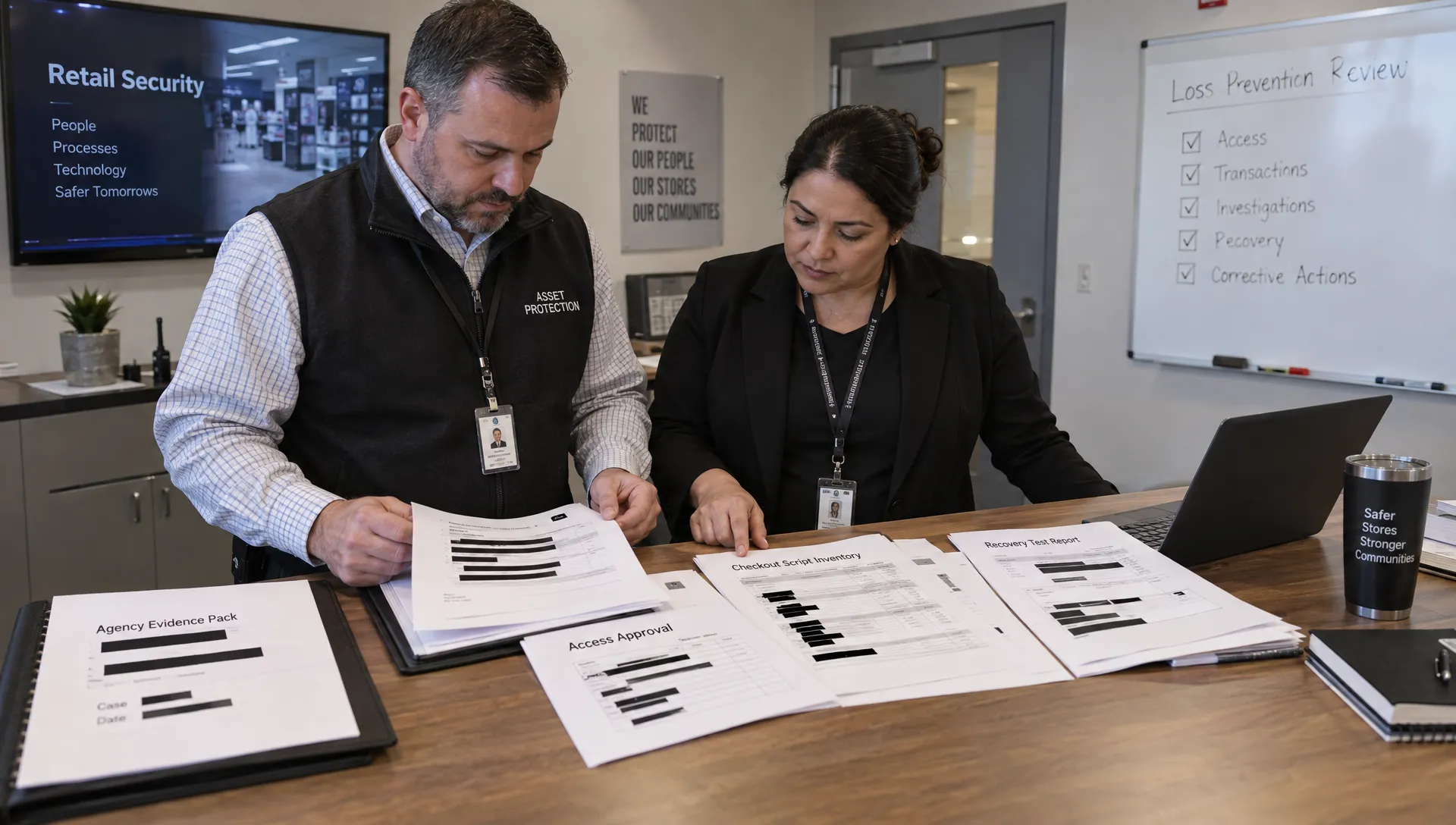
Request a small, redacted evidence pack before the sales presentation. You need enough detail to verify that controls operate in practice, without asking the agency to disclose another client's confidential information.
Useful evidence includes a completed security patch ticket, an access review, a restore-test record and an incident communication template. A remediation example should connect a finding to its assigned owner, corrective work and verification.
Then ask the proposed delivery lead to explain those records. Who approved the change? How was checkout tested? What happened when a deployment failed? This distinguishes an operating process from a policy document nobody follows.
Certifications and partner credentials can support your assessment, but they do not establish that your assigned team follows secure practices. If an agency presents an assurance report, check its date, organizational scope, exclusions and relevance to the services you are buying. Accept redacted evidence under an appropriate confidentiality agreement rather than demanding unrestricted reports.
Verify patching against actual exposure
Ask a magento ecommerce agency to walk through its most recent relevant security update, from advisory detection to production verification. A generic statement such as “we patch monthly” does not explain what happens when active exploitation makes waiting unsafe.
The agency should maintain an inventory of platform versions, extensions, Composer dependencies and relevant infrastructure components. Compare its process with Adobe's Magento security bulletins, rather than relying on an agency-maintained list alone.
Request separate commitments for assessing an advisory, applying temporary mitigation and deploying a tested fix. Urgency should reflect exploitation activity, exposure and business impact. A web application firewall rule may reduce immediate risk, but it is not automatically a permanent substitute for remediation.
Ask how emergency changes are tested and approved outside normal release windows. Evidence should include relevant checkout and integration checks, deployment monitoring and a rollback decision process. Rolling back must not silently restore the vulnerability.
If the platform or an extension is outside supported maintenance, require an explicit remediation plan. Our guide to evaluating a Magento upgrade partner helps distinguish an urgent security fix from the broader work needed to restore maintainability.
Test access controls and sensitive-data handling
A magento ecommerce agency should demonstrate how an individual receives, uses and loses access across the full delivery environment. Inspect Magento Admin, hosting, source control, deployment pipelines and integration credentials, not just the storefront login.
Look for named accounts, least-privilege roles and multifactor authentication wherever supported. Production privileges should be narrower than development access, with time-limited elevation where practical. Shared administrator accounts weaken accountability and make offboarding harder.
Ask for a sample access review and a walkthrough of developer offboarding. The process should address active sessions, keys, tokens and emergency accounts. Secrets belong in an appropriate secrets-management system, not repositories, tickets or chat histories.
Production customer data also needs boundaries. Ask how test environments are sanitized and what restrictions apply to subcontractors and AI coding tools.
Business permissions deserve scrutiny too. Refunds, inventory adjustments and payment-configuration changes can enable abuse without exploiting a software vulnerability. The control-testing approach described in how audit and accounting firms assess fraud risks is useful here: examine authorization, separation of duties and possible management override. Financial fraud assessment and technical security testing address different risks, so neither replaces the other.
Inspect custom code and extension governance
Before accepting “secure development” as an answer, ask the magento ecommerce agency to trace one recent code change through review, testing and deployment. The explanation should show who can approve changes and what prevents an unreviewed commit from reaching production.
For custom Magento work, review practices should address authorization, input handling, output escaping and safe database access. Automated dependency and code scanning can help, but findings need owners and deadlines. A clean scan is not proof that business logic is safe.
Extensions require their own governance. Ask who approves new modules, checks vendor maintenance and removes abandoned packages. A vulnerability inventory is less useful if nobody knows where a package is installed or whether its vulnerable functionality is reachable.
External testing should have a defined scope, remediation process and retesting step. Request a redacted example showing that significant findings were closed, not merely reported. For higher-risk changes, ask whether independent testing is warranted.
If AI-assisted development is used, require human review and approved data-handling rules. Generated code should pass the same checks as manually written code, and customer information or production secrets should not enter unapproved tools.
Examine checkout security and PCI responsibilities
A magento ecommerce agency should explain how your payment architecture affects security responsibilities. Hosted payment pages, embedded payment forms and other integrations can create different obligations. Outsourcing payment processing does not remove every merchant responsibility.
Ask your acquirer or a qualified assessor to confirm the applicable validation approach. The PCI Security Standards Council document library provides the authoritative PCI DSS materials; an agency's proposal is not a compliance determination.
For applicable payment-page controls, discuss script authorization, integrity assurance and tamper detection. Request an inventory of scripts that can affect checkout, including tag-manager additions, analytics and customer-service tools. Establish who can approve changes and how unauthorized changes are detected.
Security headers and a carefully managed Content Security Policy can contribute to protection, but should not be presented as a complete defense. Verify what is enforced in production, how exceptions are reviewed and who investigates alerts. Logs must also avoid collecting sensitive payment information unnecessarily.
Check monitoring and incident response ownership
Monitoring is only useful when someone investigates and acts. Ask which events are collected, where records are retained and how the agency detects suspicious administrator activity, unexpected code changes and relevant configuration changes.
Request an alert-to-resolution example. The evidence should show when the signal arrived, who assessed it and how the issue was contained. Distinguish an uptime alert from a security alert, since an apparently healthy storefront can still be compromised.
Run a short tabletop exercise: an unauthorized checkout script appears during a busy trading period. Ask who can disable it, preserve evidence, coordinate with the payment provider and update your team. Include a scenario in which agency access itself is compromised.
Before selection, have the magento ecommerce agency explain incident coverage outside business hours, notification triggers and escalation contacts. “Emergency support available” is too vague without an operating commitment and commercial terms.
Your organization should retain ownership of legal and regulatory decisions, with appropriate counsel and specialist support. The agency must supply timely facts and preserve relevant evidence, rather than promise a universal notification deadline that ignores jurisdiction and circumstances.
Require a demonstrated recovery process
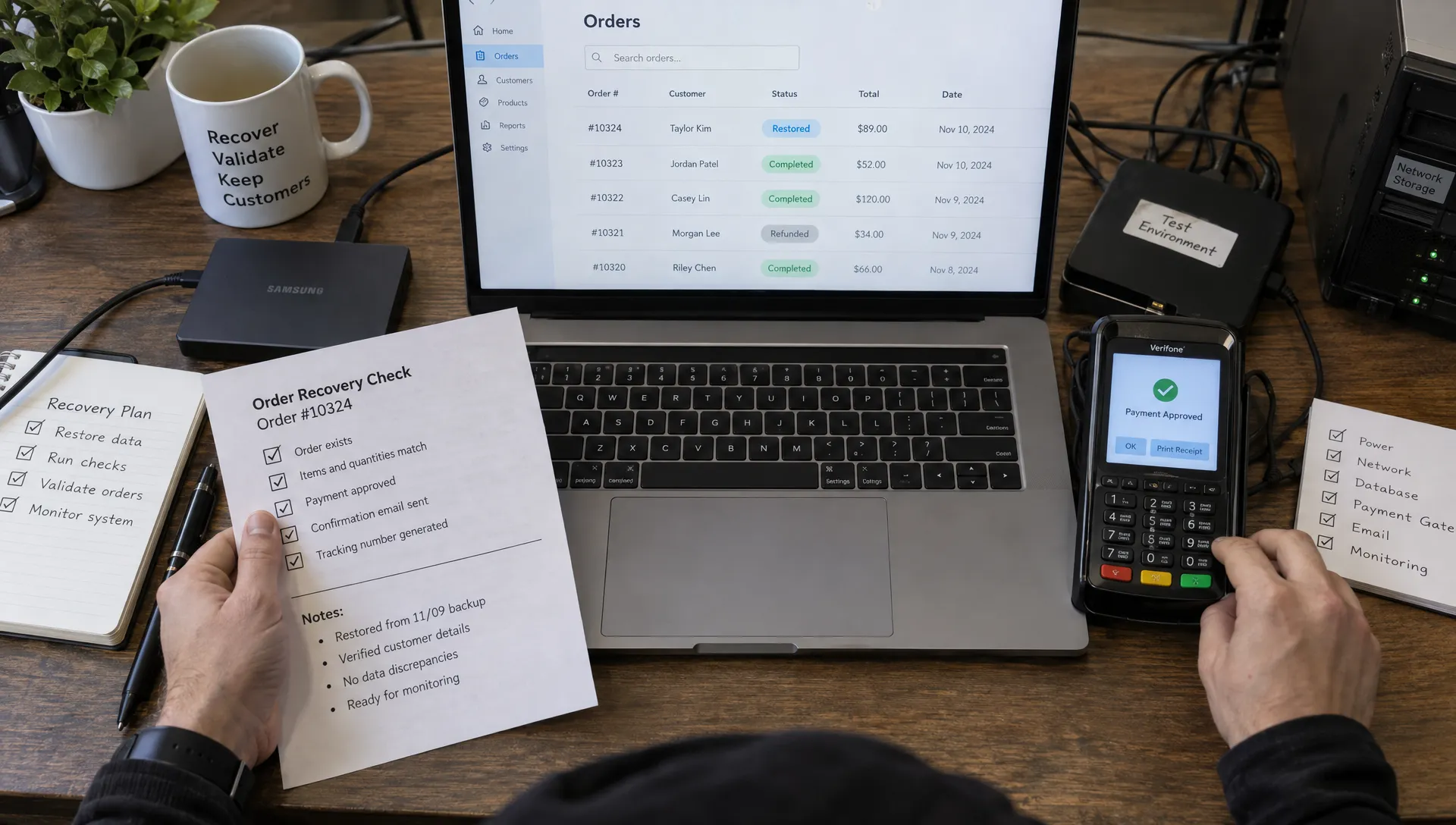
Backups should be assessed through restoration evidence, not dashboard screenshots. Ask when the last restore test occurred, what was restored and whether the recovered environment could support a safe purchase journey.
Define a recovery point objective, the acceptable amount of data loss, and a recovery time objective, the acceptable restoration duration. Those objectives should reflect business needs and demonstrated capability rather than an untested promise.
A database restore can remove orders created after the backup. Recovery therefore needs reconciliation with payment, ERP and fulfillment systems. Ask how the team avoids duplicate capture, shipment or customer notifications when replaying transactions.
Inspect backup access restrictions, encryption, retention and separation from production credentials. An attacker with production privileges should not automatically be able to destroy every recovery copy. A clean restore also needs checks that compromised code, accounts or secrets have not been reintroduced.
A magento ecommerce agency should distinguish restoring infrastructure from recovering a trustworthy retail operation. For the broader operational scope, our guide to what a Magento development company should support after launch explains how ongoing responsibilities fit together.
Compare agencies with an evidence-based scorecard
Use the same assessment method for every shortlisted provider. The following is a suggested purchasing tool, not a certification scheme.
Score each area from zero to three: zero for no credible answer, one for a documented policy, two for recent operating evidence and three for operating evidence supported by a relevant demonstration or test.
| Assessment area | Evidence to request | Warning sign |
|---|---|---|
| Patching | Inventory, completed patch ticket and emergency workflow | No owner for urgent advisories |
| Access and data | Access review, offboarding record and test-data rules | Shared privileged accounts |
| Development | Reviewed change, dependency findings and remediation example | Scans without follow-up |
| Checkout | Payment architecture and script-change controls | Assumption that a processor handles everything |
| Incident response | Escalation plan and tabletop walkthrough | Alerts without an accountable responder |
| Recovery | Restore-test record and reconciliation procedure | Backups that have never been restored |
Do not average away a critical gap. Uncontrolled production access or an unresolved unsupported component may require remediation before work begins, regardless of the total score.
Translate the findings into contract terms
The strongest proposal from a magento ecommerce agency connects its claims to deliverables, responsibilities and measurable service commitments. Record who assesses vulnerabilities, approves emergency changes, investigates alerts and coordinates recovery.
Separate response time from resolution time. An acknowledgment within an agreed window is not the same as containing an incident or deploying a fix. Define coverage hours, escalation paths and the circumstances that trigger emergency work.
Also document ownership and exit arrangements. Your business should retain appropriate control of repositories, hosting accounts, domains, logs and backups. Specify how access is revoked and records are transferred when the relationship ends.
Finally, clarify which security activities are included, separately priced or supplied by another specialist. Avoid contracts where essential controls exist only as undefined “best efforts.”
Frequently asked questions
Does an Adobe credential prove an agency is secure? No. Credentials can indicate relevant knowledge or a partner relationship, but you still need evidence of access controls, patching, incident handling and recovery for the proposed delivery team.
Is a penetration test enough to assess security? No. It examines a defined scope at a point in time. Combine testing with operational evidence, secure development controls and confirmation that significant findings were remediated and retested.
What should happen if an agency cannot share client evidence? Accept redacted records, anonymized walkthroughs or a demonstration in a nonproduction environment. Confidentiality is reasonable, but it should not prevent the agency from explaining how its controls work.
Should security be included in a maintenance agreement? Responsibilities should always be explicit. Confirm exactly which updates, monitoring activities, response services and recovery tests are included, along with exclusions and additional costs.
Make security part of the selection decision
Before choosing a magento ecommerce agency, ask it to demonstrate one patch, one access review, one incident exercise and one recovery test. Resolve the gaps before granting production access.
If you are planning a retail modernization project, discuss your engineering and ongoing optimization needs with Space Dinosaurs. Bring the responsibility map and evidence checklist into the conversation so security expectations become part of the scope, not an assumption.