

An e commerce cloud platform subscription buys access to software, but it rarely represents the full cost of running your store. Migration, integrations, payment rules, operational support and eventual exit costs can change the economics enough to reverse an apparently straightforward buying decision.
For retail leaders, the useful comparison is not simply monthly price. It is the cost of delivering the same business capabilities, at the same order volume, with a clearly assigned level of operational responsibility.
That means separating unavoidable commerce expenses from costs introduced by a particular platform. Payment processing, for example, exists regardless of architecture. A platform-specific transaction surcharge is different. Treating both as one undifferentiated expense makes competing proposals harder to evaluate.
The framework below turns subscription quotes into a practical three-year budget, with explicit assumptions rather than hidden allowances.
What an e commerce cloud platform subscription actually covers
Cloud commerce means the software runs on infrastructure accessed over a network rather than solely on servers you operate on premises. It does not tell you who maintains the application, fixes integrations or responds when checkout fails.
The deployment model helps establish that boundary:
| Model | What you are generally buying | Costs to verify separately |
|---|---|---|
| Software as a service (SaaS) | Access to a vendor-operated commerce application | Implementation, apps, integrations, premium support and usage limits |
| Platform as a service (PaaS) | A managed environment for deploying and running applications | Application engineering, testing, integrations and operational responsibilities retained by your team |
| Hosted open-source commerce | Hosting for an application whose source code is available | Patching, upgrades, extensions, security work and support, depending on the hosting agreement |
| Commerce deployed on public cloud | Infrastructure and managed services supporting a commerce stack | Engineering, consumption, observability, resilience and application maintenance |
These categories overlap. A SaaS provider may run on public-cloud infrastructure, while a managed host may offer extensive application support. The contract and responsibility matrix matter more than the label.
Compared with on-premises hosting, cloud deployment can shift spending away from hardware ownership toward subscriptions and consumption. It does not automatically eliminate maintenance or make the total bill lower.
Budget the implementation, not just the launch date
Moving to an e commerce cloud platform creates one-time costs that should be visible before contract signature. A storefront build estimate is incomplete if it excludes the work required to make that storefront operational.
Migration and integration work
Data migration includes more than copying products. Teams may need to reconcile product variants, customer records, historical orders, promotions and consent data. Password portability and payment-token migration depend on the systems and providers involved, so confirm feasibility early.
Integration estimates should specify actual business flows. “Connect the ERP” is not a sufficient scope. Inventory updates, order acknowledgments, tax calculations, refunds and fulfillment exceptions each require defined behavior and testing.
SEO migration also needs an owner. URL mapping, redirects, canonical rules and analytics validation are delivery tasks, not automatic outcomes of moving to the cloud.
Internal capacity and overlapping systems
Merchandising, finance, customer service and operations teams contribute time to requirements, testing and training. Record that effort using fully loaded labor costs, even when it does not create a new supplier invoice.
Also allow for parallel running. Your old platform, new environment and supporting services may all remain active during migration and stabilization.
If an agency handles delivery, distinguish implementation fees from post-launch maintenance. This guide to budgeting for an ecommerce agency helps separate those commitments without counting the same work twice.
Find the recurring charges that grow with the business
An e commerce cloud platform budget should show which charges are fixed, which scale with activity and which change when you cross a contractual threshold. Annual totals alone conceal those differences.
Transaction fees, apps and feature dependencies
Ask whether charges depend on orders, gross merchandise value, revenue, payment-provider choice, storefront count or another metric. Then establish exactly how that metric is defined. Refunds, cancellations, taxes and shipping can affect the calculation depending on the agreement.
Keep ordinary payment-processing costs separate from platform-specific surcharges. Include the incremental difference when comparing options, rather than attributing the entire processing bill to one platform.
Build a capability ledger for extensions. Search, subscriptions, loyalty, reviews, returns and B2B pricing may be native, paid add-ons or custom integrations. Record both the license and the effort needed to maintain each dependency.
Infrastructure, support and AI consumption
Headless storefronts can introduce separate hosting, content delivery, search, monitoring and preview-environment charges. These are not inherently wasteful, but they belong in the comparison.
AI-enabled experiences can add model usage, retrieval infrastructure, evaluation and human-review costs. Budget against a useful business unit, such as cost per resolved service interaction, rather than assuming every generated response creates value.
For B2B retailers, include the operational cost of account hierarchies, negotiated catalogs, approvals and payment terms. A low subscription price is less meaningful if employees must manually bridge missing workflows every day.
Build a three-year comparison with explicit assumptions
The most useful e commerce cloud platform comparison applies one workload and one capability checklist to every proposal. Otherwise, a basic subscription is being compared with a fully supported implementation.
Use this structure:
Three-year TCO = implementation and migration + recurring platform and service costs + usage charges + internal operating labor + transition and exit allowances.
The following figures are illustrative budgeting assumptions, not vendor prices or market benchmarks. They show how a lower subscription can coexist with a higher total cost.
| Cost category over 36 months | Option A | Option B |
|---|---|---|
| Platform subscription | $108,000 | $72,000 |
| Implementation and migration | $90,000 | $140,000 |
| Apps, integrations and separate infrastructure fees | $54,000 | $72,000 |
| Internal and external operating labor | $90,000 | $126,000 |
| Exit allowance | $12,000 | $18,000 |
| Illustrative total | $354,000 | $428,000 |
In this example, Option B saves $36,000 on subscriptions but costs $74,000 more overall. That does not automatically make it the wrong choice. It could support a required capability that Option A cannot deliver. The additional cost simply needs a measurable justification.
The table excludes payment processing, taxes, marketing spend and business-loss estimates. Any platform-specific transaction charges would need to be added. Operating labor excludes work already counted in implementation or supplier fees.
Stress-test the assumptions
Run at least a base case and a growth case. Change order volume, traffic, storefront count and integration usage independently rather than assuming they all rise at the same rate.
Small unit-price differences deserve attention. A hypothetical $0.25 difference per order at 10,000 monthly orders adds $90,000 over 36 months.
Model promotions separately from annual averages. Traffic may spike without an equivalent increase in completed orders, raising infrastructure or API consumption while revenue stays flat.
Finally, show both cash spend and internal capacity. Existing employees may absorb work without increasing this year's payroll, but their time still has an opportunity cost. Keeping those views separate helps finance distinguish affordability from staffing feasibility.
Price reliability and performance as operating requirements
A subscription can include infrastructure availability without covering every dependency in the buying journey. Checkout may also rely on payment services, tax engines, inventory feeds and custom code.
An e commerce cloud platform needs a named owner for failures across those boundaries. Confirm who receives alerts, investigates incidents, communicates with suppliers and validates recovery. Premium vendor support is not necessarily a substitute for someone operating your complete stack.
AWS's shared responsibility model illustrates how security duties are divided in cloud environments. The exact division changes with the services used. Translate that principle into a written responsibility matrix for your commerce application, customer data, access controls and integrations.
Ask for the contractual uptime definition, exclusions and service-credit process. A service credit is not compensation for all lost sales. For disaster recovery, establish the recovery time objective and recovery point objective: how quickly service should return and how much data loss is acceptable. Include backup restoration tests in the operating plan.
Performance also requires ongoing ownership. Google's Core Web Vitals cover loading, responsiveness and visual stability. Themes, third-party scripts and merchandising changes can affect those measures after launch.
Budget for monitoring, regression testing and remediation. Track potential revenue impact separately from supplier invoices so an estimated conversion loss is not presented as a guaranteed saving.
Account for contract friction and the cost of leaving
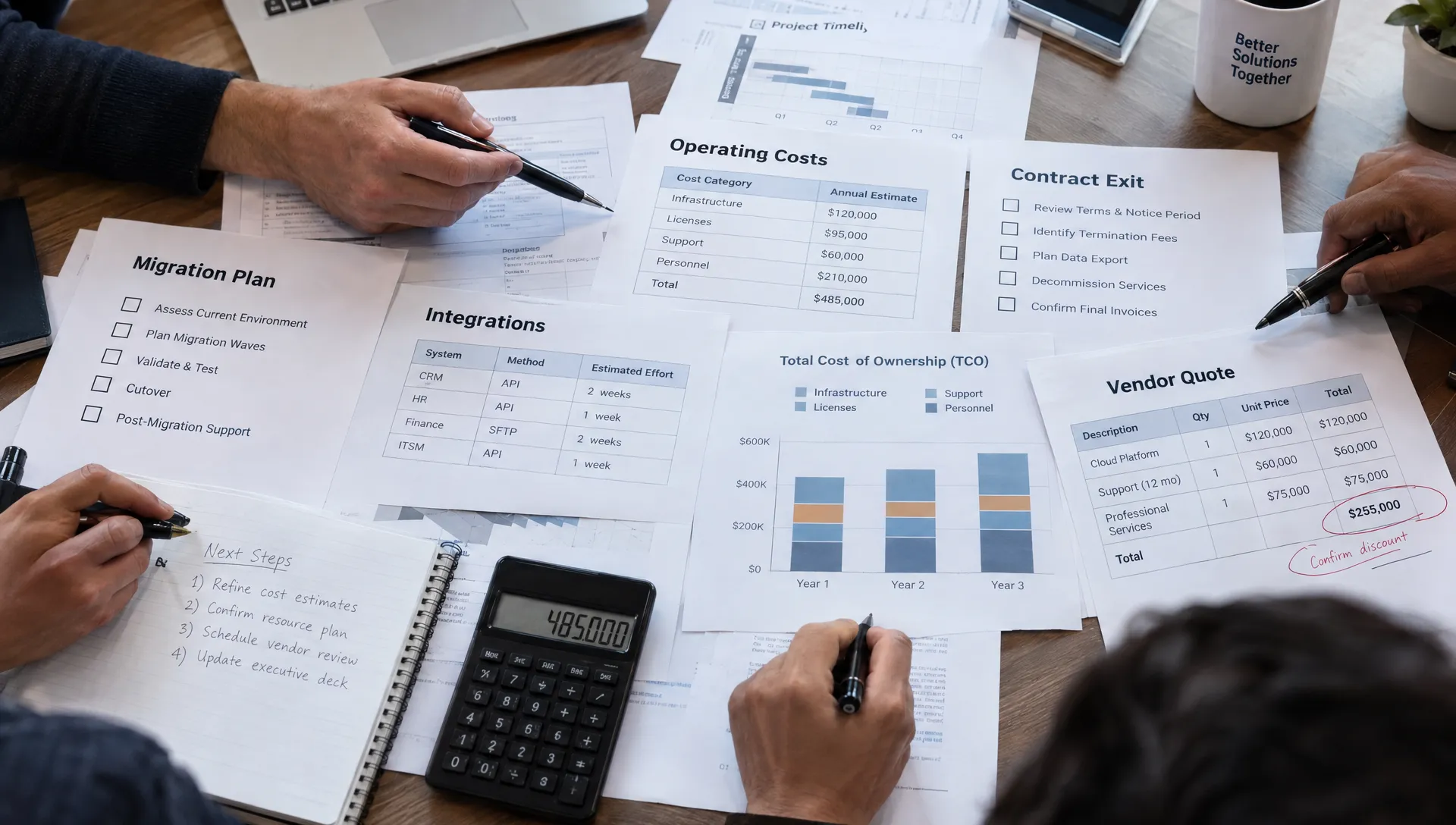
A platform can be economical to operate but expensive to leave. Before signing, confirm whether you can export products, customer records, orders, redirects and configuration in usable formats. An export button does not guarantee that another system can recreate the original behavior.
Custom extensions, proprietary workflows and tightly coupled integrations can increase migration effort. Composable architecture can make individual components replaceable, but it can also create more contracts and integration boundaries to manage. Modularity is not the same as a free exit.
Review renewal notice periods, price-adjustment mechanisms, minimum commitments, overage rates and termination assistance. Identify who owns custom code and what access remains available during a transition.
For an e commerce cloud platform contract, legal review should focus on the agreement's actual risks, including liability, data handling, service commitments and exit obligations. Budget appropriate counsel rather than assuming implementation support includes legal advice.
If the technology change forms part of a broader retail restructuring, separate those legal workstreams. A New York or Connecticut retailer consolidating stores may also need real estate or bankruptcy counsel for property or debt matters. Those costs are distinct from reviewing a software agreement and should not be buried in the platform implementation line.
Normalize the quote before choosing a vendor
Ask every shortlisted provider to respond to the same assumptions. A concise comparison pack should include:
- Workload: Monthly orders, peak traffic, catalog size, markets, currencies and storefronts.
- Capabilities: Required B2C or B2B workflows, integrations and any manual work that remains.
- Responsibilities: Named owners for upgrades, monitoring, security tasks and incident response.
- Commercial terms: Included allowances, overages, renewal provisions and support coverage.
- Transition requirements: Migration scope, stabilization period, data exports and exit assistance.
Request a priced exception list, not just a statement that the requirements are supported. “Available through an integration” should identify the supplier, recurring fee and implementation owner.
For architectural tradeoffs, this enterprise commerce platform comparison provides useful context. Keep your financial model tied to your own operating requirements rather than assuming one platform's typical buyer resembles your business.
Require finance, engineering and retail operations to approve the assumptions together. This makes missing responsibilities visible before they become change requests.
Frequently asked questions
What is included in an e commerce cloud platform subscription? It depends on the product and contract. A SaaS subscription generally covers access to the vendor-operated application, but implementation, extensions, payment processing, premium support and some usage may be separate. Obtain a written inclusion and exclusion schedule.
Is SaaS always cheaper than hosted open-source commerce? No. SaaS may reduce infrastructure and application-maintenance responsibilities, while hosted open-source can offer different customization options. Compare equivalent functionality, support coverage and internal labor over the same period rather than comparing license fees alone.
Does headless commerce reduce operating costs? Not automatically. It can support greater frontend flexibility, but separate hosting, deployment pipelines and integrations require ownership. Its business case should identify a constraint it removes and include the cost of maintaining the resulting architecture.
How should downtime be included in the budget? Include actual resilience expenses, such as monitoring, recovery testing and incident support, in operating costs. Model potential business losses separately using your own traffic, conversion and margin assumptions. Avoid treating all interrupted demand as permanently lost revenue.
Turn the subscription quote into an operating plan
Before approval, require a three-year model, a responsibility matrix and a credible exit plan. The best-value option is the one that meets your retail requirements at an acceptable total cost and risk level, not necessarily the one with the lowest monthly fee.
Bring your shortlist, order forecast and current stack to Space Dinosaurs to discuss retail-focused engineering, performance optimization and ongoing maintenance against that operating plan.