


Hiring a Shopify SEO services agency for a multilingual store means evaluating more than rankings and translation quality. Your partner needs to understand how Shopify publishes localized URLs, how search engines interpret language signals and how customers search within each market. A technically sound English storefront does not automatically become an effective French, German or Japanese shopping experience.
The strongest selection process tests those capabilities directly. Instead of comparing broad promises about international growth, ask candidates to explain specific decisions, demonstrate implementation quality and show how they will measure results without overstating attribution.
Define the multilingual assignment before requesting proposals
Start with a market-and-language brief. Language, country and currency are separate dimensions: French content for France may need different merchandising, delivery information and terminology from French content for Canada.
Document your current domains, Shopify Markets configuration, published languages and translation workflow. Add the collections that matter commercially, regional inventory restrictions and the people available to approve localized content.
Then separate two assignments that agencies often bundle together: improving existing language versions and launching new ones. The first requires diagnosis; the second also requires research, publishing rules and launch validation.
If market selection itself remains unresolved, address the broader international expansion decision before commissioning large-scale translation. Otherwise, a proposal can look comprehensive while optimizing languages your business cannot yet support profitably.
What a Shopify SEO services agency must prove technically
A capable candidate should explain your actual configuration, not present a generic international SEO checklist. Ask for a walkthrough using a small sample of your products and collections, ideally through a paid diagnostic rather than an extensive unpaid pitch.
URL architecture and Shopify Markets
Ask why your store should use language subfolders, regional domains or another supported arrangement. The answer should consider existing rankings, operational ownership and maintenance, not claim that one structure always ranks better.
Shopify’s international domains documentation explains supported approaches. Candidates should distinguish what Shopify handles from what requires theme work, app configuration or custom engineering.
They should also explain how visitors and crawlers reach each version. A language selector should provide crawlable links where appropriate, and market redirection should not make localized content inaccessible.
Indexability and canonical decisions
Have the Shopify SEO services agency inspect rendered pages, response codes and canonical targets. A translated page that points its canonical to an unrelated English equivalent creates conflicting signals.
Regional pages with substantially identical same-language content require a deliberate canonical policy, not a blanket rule. Ask how that policy changes when pricing, availability or merchandising differs.
The deliverable should identify affected templates and representative URLs, rather than simply reporting a count of “duplicate pages.”
Test hreflang on real page relationships
Hreflang helps Google understand relationships between language and regional alternatives. It does not translate a page, guarantee indexing or fix mismatched content.
Shopify can generate international SEO signals for supported configurations, but candidates should verify the output rather than assume every theme, app and customization preserves it correctly. Google’s localized-version guidance provides the relevant requirements, including valid language codes and reciprocal annotations.
Give candidates a collection, a product with regional availability differences and an item missing from one language version. Ask them to map the intended relationships and explain what happens when an equivalent page does not exist.
A Shopify SEO services agency should detect broken alternates, links to redirected URLs and regional codes such as en-UK used incorrectly instead of en-GB. It should also explain when an optional x-default annotation would help your configuration.
A useful acceptance test follows complete page clusters. Checking that a tag exists on one homepage is not enough. Require evidence that representative alternatives return the expected responses, reference appropriate equivalents and remain consistent after deployment.
Evaluate localization as merchandising, not word replacement
Ask who researches search demand in each language and who approves the resulting copy. “We use AI translation” describes a production method, not a quality standard. Machine-assisted drafts can be useful, but someone still needs responsibility for terminology, intent and commercial accuracy.
An effective Shopify SEO services agency should connect local search behavior to collection names, product attributes, size terminology and purchase questions. It should also identify pages that need genuinely different content rather than close translations.
For specialist catalogs, test whether the team distinguishes adjacent search intents. A drone retailer, for example, needs to separate searches for aircraft and accessories from searches for drone operations management and flight planning, which concern software and operational workflows. Translating a shared term without that distinction could attract the wrong audience.
Request a short sample covering a collection introduction, product specifications and metadata. Have a native-language reviewer familiar with the category assess whether the wording sounds natural and describes the offer accurately.
Also ask how approved terminology feeds back into the translation workflow. Without a maintained glossary and review process, later catalog updates can reintroduce errors that the launch team already corrected.
Compare proposals through a shared diagnostic brief
Give shortlisted candidates the same limited assignment. This makes their reasoning easier to compare and reduces the advantage of polished presentation over relevant expertise.
Ask the Shopify SEO services agency to prioritize a small sample of issues using commercial importance, technical risk and implementation effort. Include at least one collection template, one product template and a language-switching journey.
The assessment should produce decisions and testable outcomes:
| Area | Evidence to request | Useful acceptance condition |
|---|---|---|
| Localized URLs | Sample crawl and URL map | Intended pages are accessible and internally linked |
| Hreflang | Page-cluster validation | Alternates reference appropriate, functioning equivalents |
| Canonicals | Template-level findings | Targets match the agreed indexing strategy |
| Localization | Reviewed copy sample | Terminology and purchase intent receive named approval |
| Performance | Findings by localized template | Proposed changes have measurable validation criteria |
| Measurement | Reporting specification | Markets, channels and revenue definitions are documented |
Include performance in the exercise because longer translations, fonts and localization apps can affect the shopping experience. Ask candidates how they would investigate Core Web Vitals without assuming that every slow page needs a theme rebuild.
The best response is not necessarily the longest. Look for clear trade-offs, acknowledged uncertainties and a sequence your team can realistically execute. A candidate who requests missing evidence before recommending a major change may be demonstrating better judgment than one who immediately prescribes a rebuild.
Verify case studies and separate SEO from other growth
A multilingual case study should identify the starting problem, affected markets, work delivered and measurement period. “International revenue increased” is insufficient if the same period included paid media expansion, discounting or a new distribution agreement.
Ask the Shopify SEO services agency for an anonymized walkthrough of supporting evidence. Useful material includes Google Search Console trends by country and query, analytics acquisition reports and a timeline of major releases. Request client references where permission allows.
Keep the datasets’ limitations clear. Search Console reports search performance, not revenue. Analytics revenue depends on consent, tracking quality and attribution settings. A shopper’s country is not a reliable substitute for the language version they used, and organic revenue cannot always be cleanly split into branded and nonbranded searches.
Look for consistent evidence across sources rather than a perfect-looking attribution chart. Results should be interpreted alongside inventory, seasonality, promotions and market launches.
Finally, inspect the source of recommendations. An agency appearing first in its own “best agencies” article is making a promotional claim, not providing independent validation. Disclosed commercial relationships and client evidence deserve more weight than placement in a self-published ranking.
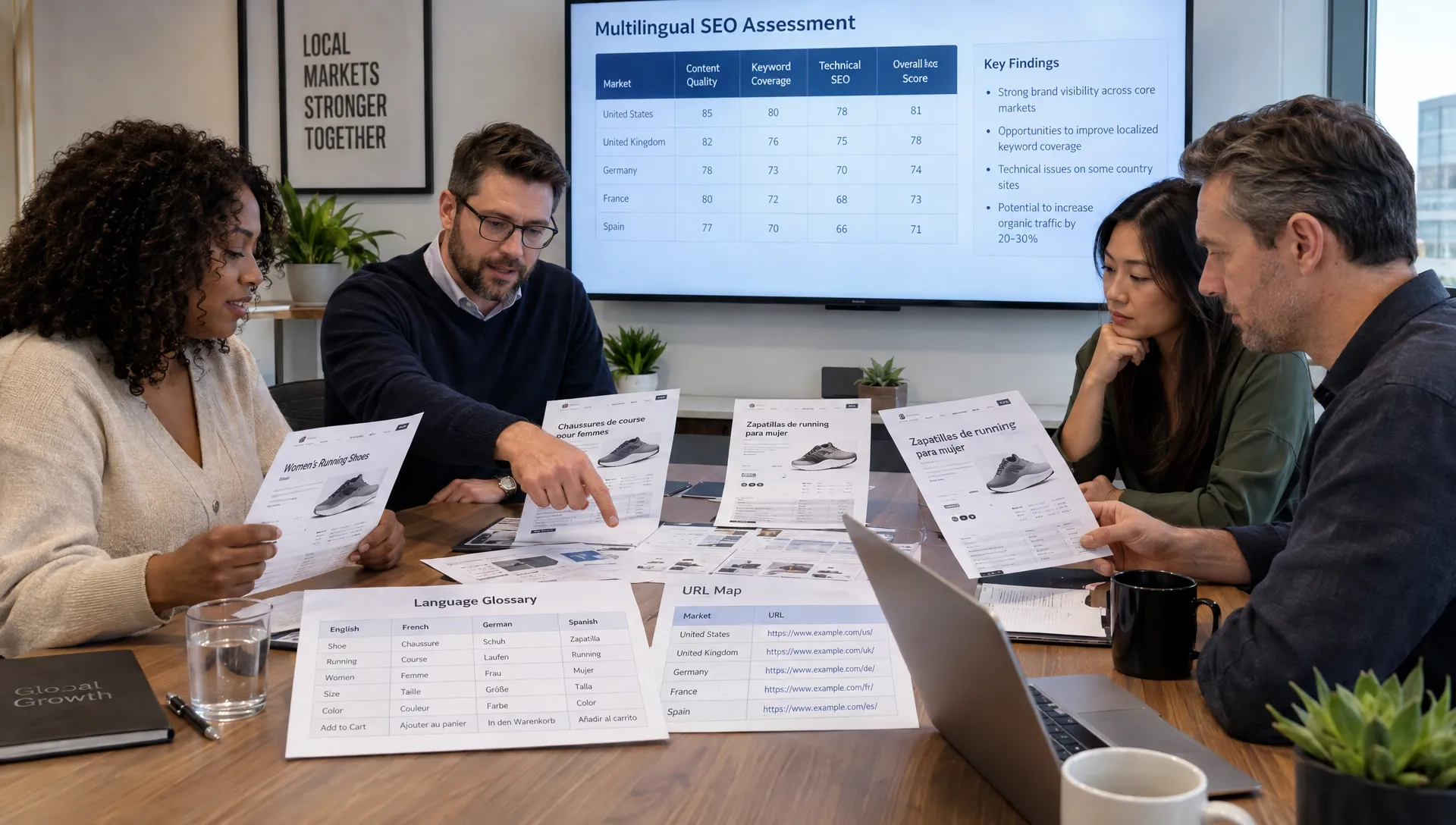
Assign implementation and approval ownership before signing
A common delivery gap sits between an audit recommendation and a production release. One supplier identifies a problem, another controls the theme and nobody has budgeted for the development work.
Your Shopify SEO services agency should state whether its fee covers diagnosis, implementation, quality assurance or only recommendations. Clarify who changes theme code, manages translation apps, updates content and approves deployments.
For work crossing several teams, evaluate the Shopify agency’s ability to support ongoing growth, not just its ability to launch a project. Multilingual SEO depends on release discipline after the initial fixes are complete.
Require each significant task to identify an owner, dependencies, acceptance criteria and rollback approach. Access should be proportionate to the job, with named accounts rather than shared credentials. Where practical, use preview environments and documented approval before production changes.
Ownership also extends to content. Specify who checks translated claims, regional delivery promises and product details. Legal or regulatory review, where needed, belongs with qualified reviewers rather than being treated as a keyword-editing task.
Agree on handover too. Your business should retain access to research, approved glossaries, reporting definitions and implementation records if the relationship ends. Those materials are operating assets, not just presentation files.
Compare commercial scope instead of headline retainers
Two proposals with similar monthly fees can cover very different amounts of work. One may include native-language review and engineering; another may provide recommendations that your team must execute separately.
Ask each Shopify SEO services agency to separate initial diagnosis, technical delivery, content localization, ongoing monitoring and third-party costs. Identify assumptions about the number of languages, templates and new products supported. A fixed language count does not describe the workload when one market contains a handful of pages and another contains thousands.
For recurring work, define what happens after the initial backlog shrinks. Ongoing value might include release checks, collection improvements, regional demand research and investigation of indexing changes. “Monthly optimization” is too vague to evaluate.
Be cautious about guaranteed rankings, large volumes of undifferentiated translated content and link packages sold without editorial relevance. Ask who approves link-building activity and how paid placements or other commercial relationships are disclosed.
An in-house approach may be more suitable when your architecture is stable, the catalog is manageable and you already have technical and native-language expertise. A specialist audit plus internal execution can be a sensible alternative to a broad retainer.
Choose the service model that closes a real capability gap. Do not pay an agency indefinitely to produce recommendations your organization cannot implement.
Frequently asked questions
Is Shopify suitable for multilingual SEO? Yes. Shopify supports multilingual storefronts and international domain configurations. Results still depend on implementation, localized content, crawlable navigation and consistent technical signals. Publishing translated pages alone does not establish local search demand or make those pages competitive.
How can I tell whether an agency has genuine multilingual Shopify experience? Ask it to explain a real configuration, show how it validated language alternatives and describe a problem it resolved after launch. A Shopify SEO services agency should distinguish platform-generated behavior from theme, app and custom-development responsibilities.
Should every product be translated before launch? Not necessarily. Prioritize products and collections your business can sell and support in that market. Agree on how unpublished or unavailable equivalents behave so that navigation, language switching and search annotations remain coherent.
What should multilingual SEO reporting include? Track search visibility, relevant landing-page traffic, conversion and revenue where measurement supports them. Segment by market and language version where possible, document attribution limitations and connect results to releases. A report should also show what was implemented, what remains blocked and who owns the next action.
How quickly should results appear? Discovery, crawling and ranking changes vary. Ask for delivery milestones and leading indicators instead of a guaranteed revenue date. Technical fixes can be validated before their commercial impact becomes clear.
Choose a partner you can hold accountable
Before signing, make sure the proposal answers four questions: which language-market problems matter first, who fixes them, how completion is verified and how commercial outcomes will be assessed.
Space Dinosaurs combines retail-focused engineering, UX, performance optimization and analytics. If multilingual growth is exposing gaps between those disciplines, discuss your retail storefront with Space Dinosaurs and establish the scope before committing to a larger program.