


More traffic is not always the fastest path to more revenue. For retail and ecommerce teams, the larger opportunity is often hiding inside the visitors they already paid to attract. Website conversion optimisation services, often spelled website conversion optimization services in the U.S., focus on turning more of that existing demand into add-to-carts, completed checkouts, larger baskets, and repeat purchases.
That matters because customer acquisition keeps getting more expensive. Paid media costs fluctuate, organic search takes time, and marketplaces compress margins. If your site leaks revenue after the click, every new campaign has to work harder just to break even.
The right conversion program does not guess at button colors or chase random A/B tests. It connects analytics, UX, performance engineering, merchandising, and experimentation into one revenue system. For retail brands, that system can lift revenue without requiring a proportional increase in traffic.
What website conversion optimisation services actually do
Conversion optimisation is the practice of improving the percentage of visitors who take valuable actions on your website. In ecommerce, that usually means purchase conversion, but it also includes micro-conversions such as product views, search usage, email signups, add-to-cart events, checkout starts, and account creation.
A professional service goes beyond analysis. It should identify friction, prioritize improvements, implement changes, measure results, and keep learning. The strongest programs combine commercial strategy with hands-on technical execution, because many conversion problems live at the intersection of design, content, speed, data, and platform architecture.
Typical conversion optimisation work includes:
- Analytics and KPI audits to verify what is actually happening in the funnel
- UX reviews across product listing pages, product detail pages, cart, and checkout
- Technical performance reviews, especially on mobile and revenue-critical templates
- Experiment planning, A/B testing, and test result interpretation
- Personalization and merchandising improvements based on customer intent
- Ongoing backlog prioritization so teams focus on changes likely to move revenue
For retail brands, this is especially important because the buying journey is rarely linear. Shoppers compare products, filter collections, search by need, read reviews, check delivery options, abandon carts, return later on another device, and expect the entire experience to feel fast and trustworthy.
The revenue math: why small conversion lifts become meaningful
Conversion rate gains can look modest in percentage terms but large in financial terms. The reason is simple: conversion improvements apply to every qualified visitor, not just to one campaign or one channel.
A basic ecommerce revenue model looks like this:
Sessions x conversion rate x average order value = revenue
That formula is not the whole business, since margin, returns, retention, and acquisition cost also matter. But it shows why the site experience has so much leverage.
| Scenario | Monthly sessions | Conversion rate | Average order value | Estimated monthly revenue |
|---|---|---|---|---|
| Current baseline | 500,000 | 2.0% | $80 | $800,000 |
| 10% relative lift | 500,000 | 2.2% | $80 | $880,000 |
| 25% relative lift | 500,000 | 2.5% | $80 | $1,000,000 |
This table is illustrative, not a forecast. Still, it captures why conversion optimisation services often pay attention to revenue per session rather than conversion rate alone. A change that slightly lowers conversion but increases average order value and margin may be a win. A change that improves checkout completion but attracts more returns may need refinement.
A mature CRO program asks a better question than whether the conversion rate went up. It asks whether the business generated more profitable revenue from the same demand.
Where conversion services find revenue
Most websites do not have one giant conversion problem. They have dozens of smaller leaks that compound. A slow mobile product page causes impatient shoppers to bounce. A confusing size guide leads to hesitation. Weak search relevance hides popular products. A checkout form asks for too much information too early. A promotional banner pushes visitors away from the product they came to buy.
The job of website conversion optimisation services is to uncover those leaks, rank them by business impact, and fix them in the right order.
Funnel leakage stops hiding in averages
Many ecommerce reports are too broad to guide action. A sitewide conversion rate might look stable while paid social traffic on mobile is collapsing on product pages, or while high-intent shoppers are dropping during shipping selection.
A conversion partner should segment performance by device, channel, page type, customer type, geography, product category, and funnel step. This reveals where the business is losing money and where improvements are most likely to compound.
For a deeper view of how existing visits can produce more revenue, Space Dinosaurs has written about the hidden revenue sitting in your existing traffic. The principle is the same: before buying more attention, make sure your site converts the attention you already have.
UX removes buying friction
Ecommerce UX is not just about making pages look better. It is about helping shoppers make confident decisions faster.
On product listing pages, that may mean better filters, clearer sort options, stronger product cards, and fewer dead-end category paths. On product detail pages, it may mean improved imagery, review visibility, sizing guidance, availability messaging, shipping clarity, and better answers to common objections. In checkout, it may mean fewer fields, clearer error handling, trusted payment options, and earlier transparency around delivery costs.
Checkout is a particularly rich area for improvement. Baymard Institute research consistently shows that cart abandonment is a major ecommerce challenge, with common causes including unexpected costs, forced account creation, slow delivery, and complicated checkout flows. Not every abandoned cart is recoverable, since some shoppers are only researching. But many abandonment triggers are preventable.
The best optimisation teams look for moments where the shopper has intent but not enough confidence. Then they remove the obstacle.
Performance converts impatience into revenue
Speed is one of the most measurable conversion levers. A shopper who waits for a product image to load, taps a filter that lags, or sees the layout shift during checkout is less likely to complete the purchase.
Performance is also more than a technical score. It affects perceived trust, mobile usability, SEO, paid landing page efficiency, and customer support demand. Deloitte’s Milliseconds Make Millions research found that even a 0.1-second improvement in mobile site speed could improve conversion outcomes for retail brands.
For ecommerce teams, the highest-impact performance work usually focuses on the templates where money changes hands: product listing pages, product detail pages, cart, and checkout. If you want to connect performance metrics to commercial outcomes, Space Dinosaurs’ guide to Core Web Vitals for ecommerce explains which metrics actually matter for conversions.
AI turns intent into relevance
AI can support conversion optimisation when it is used to reduce shopper effort, not when it adds complexity for its own sake. In retail, AI-driven improvements may include better onsite search, more relevant recommendations, smarter product discovery, conversational commerce, automated insight generation, and personalized content based on behavior or context.
The key is discipline. AI should be tied to a measurable customer problem, such as helping shoppers find the right product faster, answering pre-purchase questions, or surfacing products that match intent. When AI features are treated as conversion tools rather than novelty features, they can make the shopping experience feel more useful and less generic.
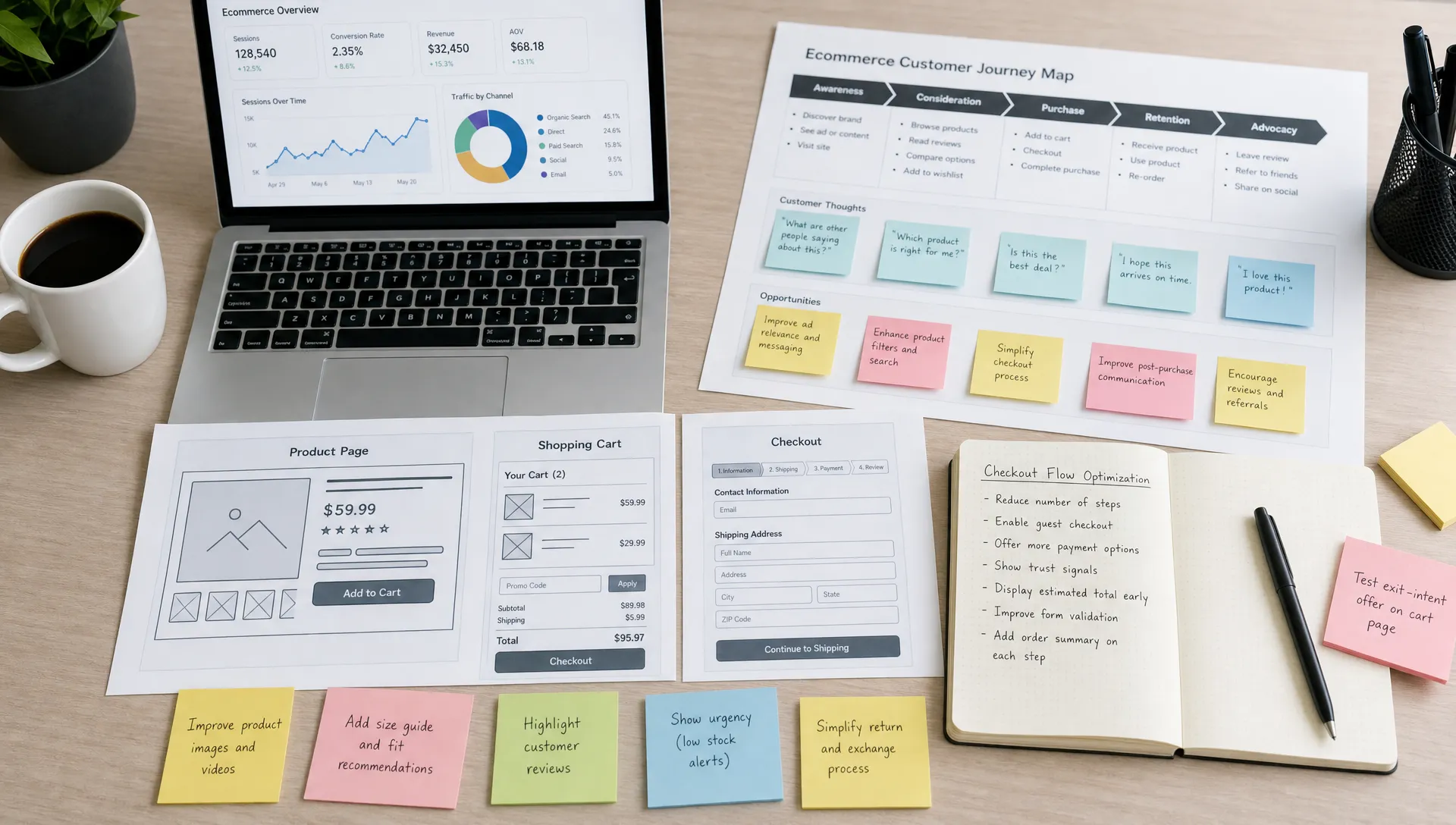
What a professional conversion engagement looks like
A strong conversion optimisation engagement usually starts with measurement. If analytics events are inconsistent, checkout steps are missing, or revenue attribution is unclear, teams can optimize the wrong thing with confidence. The first goal is to establish a reliable baseline.
From there, the work moves into diagnosis and prioritization. Not every issue deserves immediate attention. A confusing checkout error that affects thousands of shoppers is likely more valuable than a cosmetic homepage change. A mobile performance problem on high-traffic product pages may beat a creative test on a low-traffic landing page.
| Phase | Main goal | Typical output |
|---|---|---|
| Baseline | Confirm current funnel performance and data quality | KPI map, tracking review, revenue model |
| Diagnosis | Identify friction and technical blockers | UX audit, performance review, funnel analysis |
| Prioritization | Rank work by impact, effort, and confidence | Conversion roadmap and experiment backlog |
| Implementation | Ship fixes and tests | Design updates, engineering work, content changes |
| Measurement | Learn what changed and why | Test readouts, revenue impact, next actions |
| Continuous optimization | Keep improving as traffic, products, and customer behavior change | Ongoing backlog and performance reporting |
This is where service quality becomes obvious. A weak provider delivers a deck of recommendations and leaves the team to figure out implementation. A stronger partner can connect strategy, UX, analytics, engineering, and ongoing optimization so improvements actually reach production.
That is especially valuable for retailers working with composable stacks, legacy platforms, seasonal campaigns, and merchandising calendars. The conversion roadmap has to respect technical reality and commercial timing.
The metrics that show whether revenue is lifting
Conversion rate is important, but it should not be the only success metric. A website can increase conversion by over-discounting, pushing low-margin products, or simplifying purchase paths in ways that increase returns. Revenue lift is healthier when multiple indicators move in the right direction.
| Metric | What it reveals | Why it matters |
|---|---|---|
| Conversion rate | Percentage of visitors who purchase | Shows whether more visitors become customers |
| Revenue per session | Revenue generated per visit | Combines conversion rate and order value into one useful view |
| Average order value | Typical basket size | Helps determine whether changes improve purchase quality |
| Add-to-cart rate | Product page and merchandising effectiveness | Shows whether shoppers are moving from interest to intent |
| Checkout completion rate | Checkout clarity and trust | Reveals friction close to purchase |
| Core Web Vitals | Loading, responsiveness, and visual stability | Connects technical experience to shopper behavior |
| Return rate | Post-purchase quality of conversion | Helps avoid revenue that creates downstream cost |
A good conversion partner will also look at leading indicators. For example, if search usage increases and search exit rate falls, discovery is improving. If delivery information engagement rises and customer service questions fall, pre-purchase clarity may be improving. If mobile product page bounce rate drops after speed work, the site is capturing demand that previously disappeared.
The most useful measurement combines quantitative data with qualitative insight. Analytics can show where shoppers drop off. Session recordings, surveys, customer support themes, and user testing can help explain why.
Common fixes that lift ecommerce revenue
The highest-performing conversion fixes are rarely random. They usually align with a specific type of shopper uncertainty.
A product detail page might need clearer value communication. Shoppers want to know whether the product fits their needs, whether it is worth the price, when it will arrive, and what happens if it does not work out. Strong imagery, benefit-led copy, reviews, product comparisons, and transparent policies all help reduce hesitation.
A category or collection page might need better product discovery. If shoppers cannot narrow a large assortment quickly, they may abandon even if the right product exists. Better filters, sorting, product badges, availability indicators, and category-specific content can make the path to purchase feel easier.
A checkout might need fewer interruptions. Every unexpected cost, confusing field, slow payment step, or unclear error message creates risk at the most valuable moment in the funnel. Improving checkout often produces measurable gains because users at this stage already have purchase intent.
A mobile experience might need both UX and engineering attention. Mobile shoppers are less patient with slow interactions, cramped interfaces, popups, and difficult form entry. Since mobile traffic often represents a large share of ecommerce sessions, small mobile improvements can have outsized revenue impact.
How conversion optimisation improves paid media efficiency
Website conversion optimisation services do not only affect onsite metrics. They can also improve marketing efficiency.
If conversion rate rises, the same ad spend can generate more orders. If landing pages load faster and answer shopper questions more clearly, paid traffic becomes more productive. If revenue per session improves, teams may be able to bid more competitively while maintaining target return on ad spend.
This is why CRO should not be isolated from acquisition. Paid search, paid social, email, affiliate, organic search, and direct traffic all send visitors into the same site experience. When that experience improves, every channel can benefit.
The reverse is also true. If conversion problems persist, marketers often compensate by increasing discounts, expanding retargeting, or spending more on lower-efficiency traffic. That can create revenue, but it may erode margin.
How to choose the right website conversion optimisation services
Not all CRO providers are built for retail. Some specialize in analytics strategy but cannot implement. Others run experiments but lack performance engineering depth. Some focus on creative changes without understanding merchandising, platform constraints, or revenue quality.
When evaluating a partner, look for evidence that they can connect commercial outcomes with technical execution. The provider should be comfortable discussing conversion rate, revenue per session, page speed, experimentation, customer experience, and implementation tradeoffs in the same conversation.
Strong selection criteria include:
- Ecommerce and retail experience, not just general website design experience
- A clear process for diagnosing funnel friction before proposing solutions
- Ability to implement improvements across UX, engineering, analytics, and performance
- Prioritization based on revenue impact, effort, and confidence
- Measurement discipline that includes revenue quality, not vanity metrics only
- Ongoing optimization support rather than one-time recommendations
Space Dinosaurs was built around this kind of retail-focused digital transformation, combining AI-enabled engineering, human-centered UX, analytics, performance optimization, and ongoing improvement. For teams that want conversion gains to become a continuous operating rhythm, Momentum by Space Dinosaurs is designed around ongoing ecommerce website growth and optimization.
Why conversion optimisation is a continuous revenue lever
Customer behavior changes. Product assortments change. Traffic mix changes. Competitors change. Technology changes. A conversion win from last year may become the baseline this year.
That is why the best conversion programs are continuous. They build a habit of discovering opportunities, prioritizing work, shipping improvements, measuring results, and learning from the market. Over time, this creates a compounding advantage. The site becomes faster, clearer, more relevant, and more resilient.
For retail leaders, the strategic shift is simple: stop treating the website as a fixed asset and start treating it as a revenue system. Every template, interaction, content block, and performance improvement has the potential to influence commercial outcomes.
Website conversion optimisation services lift revenue by making that system work harder for the business and easier for the customer.
Frequently Asked Questions
What are website conversion optimisation services? Website conversion optimisation services help improve the percentage and quality of visitors who take valuable actions on a website, such as buying, adding products to cart, signing up, or requesting information. In ecommerce, they usually combine analytics, UX, testing, performance, and technical implementation.
How do conversion optimisation services increase revenue? They increase revenue by reducing friction across the shopping journey, improving page speed, clarifying product information, strengthening checkout, personalizing experiences, and measuring which changes produce profitable lift.
How long does it take to see results from conversion optimisation? Timing depends on traffic volume, site complexity, implementation speed, and the issues being fixed. Some technical and UX fixes can show impact quickly, while experimentation programs need enough traffic and time to reach reliable conclusions.
Is CRO only about A/B testing? No. A/B testing is one tool, but conversion optimisation also includes analytics audits, UX improvements, performance optimization, customer research, merchandising strategy, and engineering fixes. Testing is most valuable when it is part of a broader revenue program.
What metrics should ecommerce teams track during conversion optimisation? Useful metrics include conversion rate, revenue per session, average order value, add-to-cart rate, checkout completion rate, Core Web Vitals, return rate, and channel-level performance. The best metric mix depends on the business model and margin goals.
Turn more of your existing traffic into revenue
If your ecommerce site has traffic but revenue is not scaling the way it should, the next growth lever may be conversion rather than acquisition. Space Dinosaurs helps retail brands modernize ecommerce experiences, improve performance, and create ongoing optimization systems that connect site improvements to business outcomes.
Explore how Space Dinosaurs can help your team build a faster, smarter, higher-converting retail experience at spacedinosaurs.com.